Neither my father nor my wife’s father served in the military during World War II. The only person on my side of the family who was in the military was my brother, who served in the U.S. Army Reserves and never had any combat action. He told me that the worst thing that ever happened to him while in uniform was when the Army Jeep he was driving conked out on the Chesapeake Bay Bridge during summer camp duties and snarled traffic for hours.
But there is some military history in my wife’s side of the family — and it is a sad story.
Her mother’s first cousin was Hans J. Chorpenning, Cozad, NE, who as a lieutenant was assigned to the 100th Bomber Group, which flew B-17 bombers from England to targets in Germany.
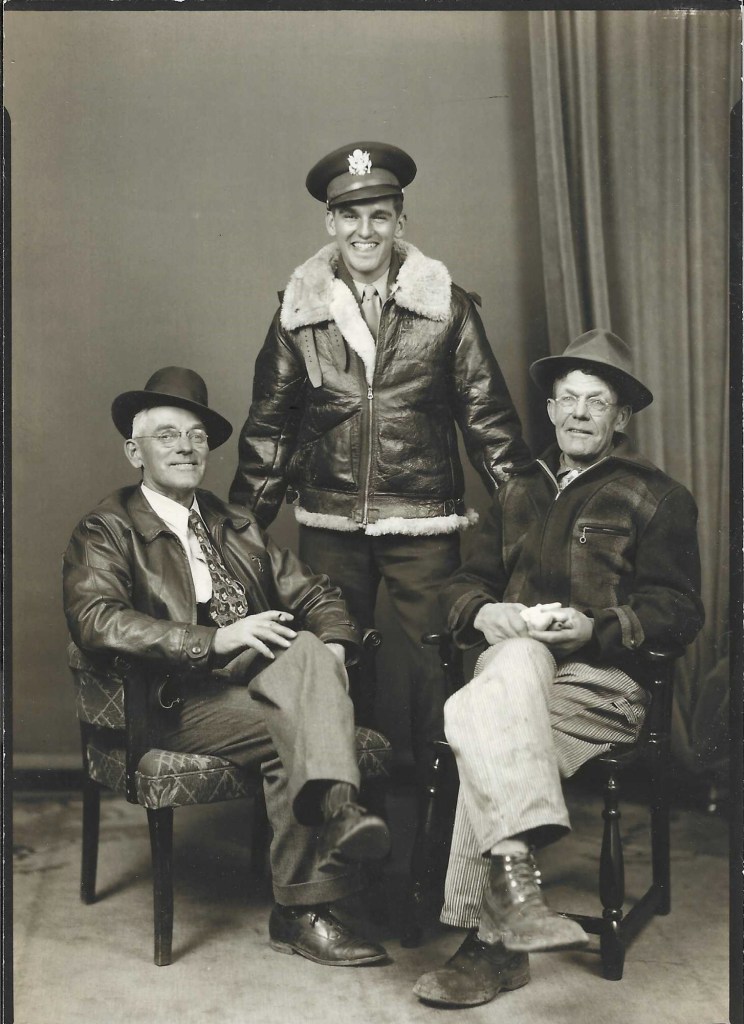
The photo above was taken on Chorpenning’s last visit home before returning to action in Europe. In this photo he was 20, very handsome, and is wearing a fleece bomber’s jacket that was issued to crew members on the unpressurized, unheated B-17 bomber in which he served as navigator.

Chorpenning was part of the massive D-Day invasion operation in June of 1944. It was his very first mission. His aircraft, called “Pack of Trouble” of the 349th Bomber Squadron, was assigned to bomb targets behind enemy lines. The lumbering bomber took off from an airbase in England on June 12, 1944, but as it reached the coast of Europe, it was attacked by German Luftwaffe fighters. A fire broke out between the two engines on the right side of the wing and it was clear that the plane would go down. One of the crew members was killed in the plane and the others tried to scramble and parachute out of the doomed aircraft. Chorpenning apparently tried to help one last person inside the plane escape but never made it out himself. The plane exploded and crashed into the English Channel near Dunkerque.

Only one person on the aircraft survived the incident when he was able to parachute onto an enemy a beach at Dunkerque, where the area had been mined. That survivor, George L. Sherback, said the German soldiers would not go into the area to capture him because of the mines. He was forced at gunpoint to walk towards them, was captured, and then spent much of the rest of the war in a prison camp.
Chorpenning posthumously received the Purple Heart and the Air Medal for his valor on that day. He is also a member of the Roll of Honor of the American Air Museum in Britain.
I know there are thousands of stories like this from those terrible days of World War II. I hope we all take a minute today to remember those like Hans Chorpenning who gave their all.
 aero-cordero.com