You’ve probably heard the old adage that “it’s hot enough to fry an egg on the street.”
Well, here’s a new twist. This week, I read online about a couple of staff members from an Albuquerque television station who wanted to determine if, during our current heat wave, there was enough heat to cook a steak on the dashboard of a parked car with all its windows rolled up.
They succeeded in cooking up a medium rare steak in 90 minues in their car, where the temperature reached 140 degrees. Their experiment was a warning to everyone not to leave children or pets in parked cars during the day.
After reading the story, my keen investigative journalist brain kicked into full throttle and I came up with an even more insightful probe.
If New Mexico is known worldwide for our chile, why not see if our favorite vegetable can be roasted in a hot car? I was called to action, just as I was when I investigated and wrote about Mexican bologna smuggling in Las Cruces. (I’m still awaiting my Pulitzer Prize award for that one.)
So bear with me as I unleash a large volume of data, expert analysis, detailed observation and pure guesswork to come to the startling conclusion (spoiler alert) that roasting chile in your car (or the sidewalk) doesn’t work that well.

Okay, for the four of you still left reading this blog — because you have nothing else to do on a hot afternoon — here goes:
I purchased green chile (just now starting to come in from the fields) from two different sources. All of it was said to be a mild variety.
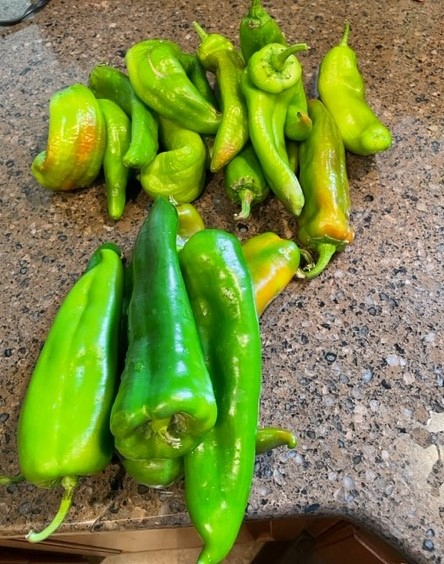
When I drove to get the chile, the outside temperature registered on my car was 104 degrees. The shaded back yard of our house had a temperature of 100 (which would rise to 101 by the time the research was completed). The exterior temperature sensor on our truck showed 109 (always a bit optimistic). The interior temperature of our pickup truck at the dashboard was 141, according to a kitchen digital thermometer. (I think it would have gone higher if I had waited another couple of minutes, but I was not willing to roast myself.)

I placed some of the two different varieties of in two aluminum foil pans on top of the dashboard and set the timer for 90 minutes.

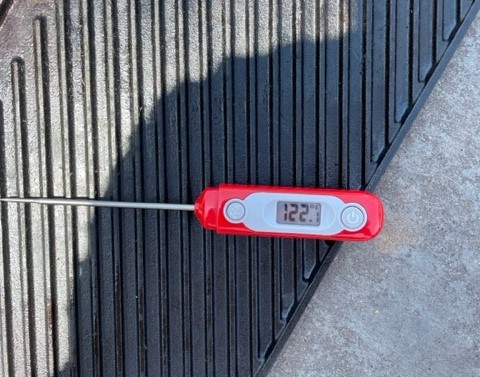
I had also placed a cast-iron griddle that I sometimes use for grilling on the driveway at the front of the house. Its temperature had reached 122 degrees when I placed additional chile on top of it.
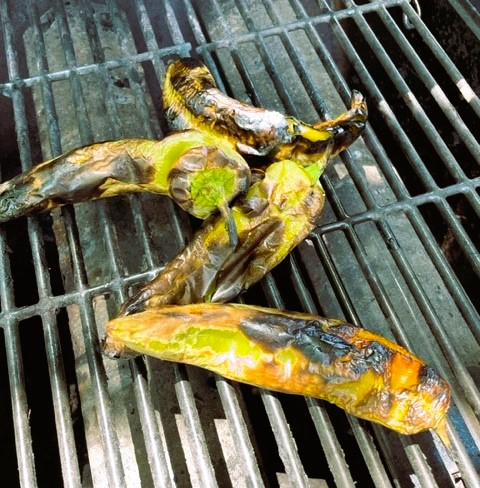
In true scientific method procedure, I also roasted the remaining pods the old fashioned way on the gas barbeque grill. Those took only a few minutes to roast and blister up.
Things were moving slowly inside the truck and on the griddle on the driveway. The interior of the truck was starting to smell like the Hatch Chile Festival. The chiles were turning a pale color in both locations and getting limp from the heat.
I remembered when I bought the chile from one vendor and proudly explained my planned experiment. He rolled his eyes and smirked, but offered a bit of advice that if the chiles begin to turn white, you’ve roasted the flavor and heat out of them.
As my timer marked 90 minutes, I noticed the experimental pods in both locations were turning white, looking extremely flaccid and appearing very unappetizing. My truck’s interior, however, had an even more pungent Hatch Chile Festival smell.
I pulled both varieties off the dash and the griddle and measured their internal temperatures. Both were at 140 degrees.
There was no blistering of the skin of any of the sun-roasted chiles, so in order to make them easier to peel, I decided to toss them on the grill for a few minutes. Once off the grill, I steamed them for a few minutes and began peeling and taking a small bite out of each one.
The taste was mostly beyond bland and slightly odd — not even as much flavor or heat as an overly ripe bell pepper. Of all the truck or driveway roasted chiles, I only kept two for use in an enchilada dish I made later that evening.

So the conclusion of my investigative reporting is this:
Don’t use the sun, even in our current extreme heat wave, to do the work of the old reliable gas grill or tumble roaster. That is unless you want the interior or your car or truck to smell like the Hatch Chile Festival for the rest of its life.
 aero-cordero.com