What follows is important journalism, loyal readers! It may take a while to read and digest it all.
As I think I’ve mentioned several times in my blogs, I grew up in the southern New Mexico mountain community of Ruidoso in the shadow of Sierra Blanca peak.
Sierra Blanca is the tallest mountain in the southernmost third (maybe southernmost half if you count the Florida keys) of the United States.
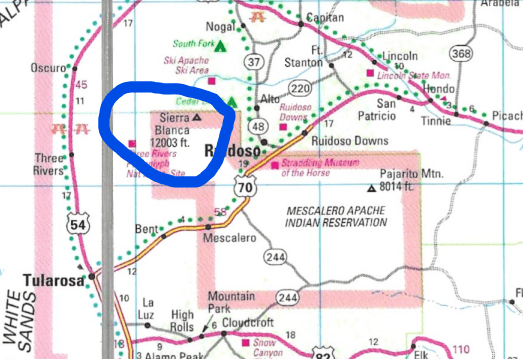
For as long as I could remember, road maps, charts, magazine and newspaper articles, travel brochures, signs and other points of information listed the altitude of the mountain as 12,003 feet.
But somehow, in the last 15 or so years, the “official” height of the mountain has been dumbed down to 11,981 feet — a full 22 feet shorter than what many people were led to believe for years.
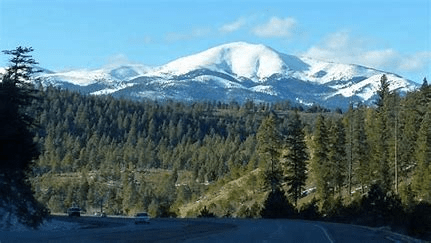
So what happened to those 22 feet? I can’t find the exact period of time when the maps started showing the lower altitude of the mountain top. Maps from the time when I lived in Ruidoso all showed the altitude at 12,003 feet. And I couldn’t find out who or what agency made the decision to officially downsize the altitude.
The newest New Mexico road map I have in my possession is a 1999 Rand McNally “Easy Finder” laminated quick fold edition, which shows the altitude of Sierra Blanca as 12,003 feet. If you can’t trust Rand McNally, who can you trust? (I have a lot more faith in them than Siri on my i-Phone for giving directions and accurate information.)
A book we have called “New Mexico Place Names” from 1965 lists Sierra Blanca as having an altitude of 12,003 feet. If I took the time, I’m sure could find many more documents with the 12,003 foot listing for the mountain’s elevation.
So who or what agency made the decision to make the altitude change. My logical thought was the U.S. Geological Survey. I found an 800 number of their website and called it, assuming I would get a mind-numbing and endlessly repeating list of menus with no live human ever answering.
To my surprise, after a number of rings, a real live guy answered the phone and was immediately engaged in my quest for information on this subject. He said he’d been with the agency for almost 40 years and loved weird quests such as mine. A true nerd like me, I suspected. He was very willing to help with my search for the truth.
He checked various sources at the USGS and found several current things showing that the mountain is listed in their current database as 11,981 feet. He scrolled over a digitized map from the 1950s and couldn’t find a pinpoint location for the top of the peak above the 11,950 foot line. He found another database from 1980 listing a height of 11,854. Then he found another document with an altitude of 11,974 listed for the top of Sierra Blanca.
But nothing anywhere in USGS documents he could find showed when the mountain was “downlisted” to its current sub 12,000 mark. (One theory he tossed out was that rising sea levels had reduced the elevation “above sea level.” That would have been a lot of rising of the sea that I think would have been noticed in Miami, New Orleans and a lot of small islands in the South Pacific.)
So what happened? After discussing it further with him, we both concluded that the 12,003 foot mark had been “Chamber of Commerced” way back when. I mean, what sounds better:
“A mountain more than 11,000 feet high”
or
“Soaring more than 12,000 feet above the New Mexico desert”
I think some local promoter from Ruidoso back when we had a sketchy system for determining elevations saw that Sierra Blanca was just shy of 12,000 feet and just fudged the elevation to be higher. Chamber of Commerce stuff, right? We’ll likely never know who that person was. If you have any information about this, I’d LOVE to hear from you. Otherwise, we’ll probably see the issue slide into the realm of conspiracy theories.
In Colorado, there are lots of mountains topping 14,000 feet. There are hikers who work to scale each of the state’s “14ers” in the state each year. (See website www.14ers.com).
At one point, there was dispute over which of Colorado’s two highest mountains was actually higher — Mount Elbert or Mount Massive. There was only 12 feet of difference between them, with Mount Elbert at 14,440 feet getting the nod as the tallest.
“This led to a dispute which came to a head with the Mount Massive supporters building large piles of stones on the summit to boost its height, only to have the Mount Elbert proponents demolish them,” according to an entry on Wikipedia.
In New Mexico, we only have two mountains that top 13,000 feet — Wheeler Peak in Taos County at 13,167 and Truchas Peak at 13,108. Sierra Blanca is the 8th tallest mountain in New Mexico. All the rest of the tall peaks are all in the Sangre de Cristo Range between Santa Fe and the Colorado border.
So far as I know, there has been no effort in New Mexico to place 59 feet of rocks on top of Truchas Peak to make it the tallest.
HOWEVER, maybe’s it’s time to return Sierra Blanca to its 12,000 foot plus glory.
There was a movie produced several years ago starring Hugh Grant entitled “The Englishman Who Went Up a Hill But Came Down a Mountain.” Based loosely on rural legends, residents in a town in Wales near a large hill were upset that the geological feature was just short of the elevation it needed to be categorized a “mountain.” The townspeople came together and organized an effort to pile enough rocks on top of the hill so it would become tall enough to be labeled a mountain. The joint effort succeeded and the hill became a mountain.

So New Mexico, are we up for the task to make Sierra Blanca a “12er?”
I’ve actually hiked to the top of Sierra Blanca (and also to the top of Truchas Peak — both many years ago). Neither hike was a difficult technical climb — just lots of short sprints with lots of breaks to pant and scoop up more oxygen before pressing on. The tops of both of these mountains are barren with a few large rocks strewn around. Maybe enough to cobble together for a 22-foot high mound.
It’s entirely possible that if each of the many hikers who hike to the top of Sierra Blanca each year carried a few small rocks (maybe no bigger six inches in diameter) near the summit and stacked them on top of eachother, there would be a mound that would push the peak’s summit past the 12,000 foot mark.
Yeah, I know, creating a rock pile 22 feet high is a bit of a challenge.
How about this as an alternative? We ask some wealthy person to hire one of those giant sky crane helicopters to carry a load of rocks and some bags of cement to dump on top of the mountain on some moonless night. We’d have to line up a crew team of concrete workers to be flow to the top of the mountain to put the rocks together in a permanent formation, but I’d volunteer for that.

So if you’re a wealthy person looking for something memorable to do, contact me. We’ll put a plaque on top of the 12,000 + mountain to commemorate your vision.
Otherwise, it’s entirely possible that someone else is going to seize this opportunity by lifting a fully functional McDonald’s fast food outlet up there and just dump it on top of the mountain. I think those stores are at least 22 feet high.
 aero-cordero.com