This morning, as I was finishing up my morning walk with our dog Chester, he made an abrupt stop just as we were entering our front door. He was peering upwards at something on the parapet wall of the house and was fixated on whatever it was.
Following his clue, I looked up and there was an adult roadrunner staring down at me and Chester. It wasn’t moving much, knowing that it was pretty safe and that neither Chester nor I could jump up and grab it. After a few moments, Chester began barking at it, but it did not seem to faze the bird.
We live in the valley area of Las Cruces/Mesilla, and roadrunners usually stick to the desert areas where they can munch on lizards and small mammals. You occasionally spot them in town, but it’s a bit unusual. I even had one wandering around a home we owned in the middle of Albuquerque, miles from where you’d expect to see one.
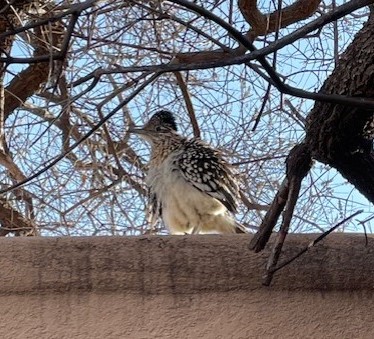
I had heard that sighting a roadrunner is a sign of good luck, so I’m happy this bird decided that the top of my house was a good place to perch.
I looked online for some information about roadrunner legends and found several interesting things.
I found this on the “Native Languages of the Americas” website:
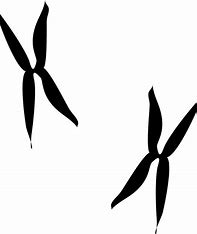
“The Hopi and other Pueblo tribes believed that roadrunners were medicine birds and could protect against evil spirits. Their unusual X-shaped footprints are used as sacred symbols to ward off evil in many Pueblo tribes– partially because they invoke the protective power of the roadrunners themselves, and partially because the X shape of the tracks conceals which direction the bird is headed (thus throwing malignant spirits off-track.) Stylized roadrunner tracks have been found in the rock art of ancestral Southwestern tribes like the Anasazi and Mogollon cultures, as well. Roadrunner feathers were traditionally used to decorate Pueblo cradleboards as spiritual protection for the baby. In Mexican Indian tribes, it was considered good luck to see a roadrunner. In some Mexican tribes, the bird was considered sacred and never killed, but most Mexican Indians used the meat of the roadrunner as a folk remedy to cure illness or to boost stamina and strength.”
I had previously heard the story about the unique X-shape of a roadrunner’s tracks and how it confused anything that was trying to track it. I learned that the bird’s walking appendages are “zygodactyl feet, with four toes. Two toes point forward and two toes point backward.” I don’t think, however, that I would be inclined to eat one to “boost (my) stamina and strength.”

Another site, Symbolicmystic.com, said the birds are known for “speed and agility,” “protection and fearlessness,” and “resourcefulness.”
“In conclusion, the spiritual significance of roadrunners is both diverse and profound. Whether they symbolize speed, protection, resourcefulness, or hope, these captivating birds inspire and guide those who encounter them. By understanding and appreciating their deeper meaning, people can find strength and wisdom from these incredible creatures.”
That may be a little too deep for me, but I’m always glad to see one because they are so interesting to observe, particularly how the feathers on the top of their heads raise up and down as they are contemplating running down a road to escape.
And I hope this week finds a roadrunner on your roof as well.
 aero-cordero.com