I believe the last time I saw (and briefly captured) a horny toad was about 20 or more years ago after I had landed my hot air balloon in the desert on the east side of the Mesilla Valley. I’m not sure why horny toads wandered into my brain this week, but somehow thoughts about the unique critter popped into my mind and I decided to see what I could find out about their current status.

Phrynosoma cornutum
As a kid growing up in Ruidoso, we had lots of horny toads around. We caught them all the time, played with them and released them back into the wild. It was especially fun to find a batch of just born horny toads, no more than an inch in length, observe them, play with them and then release them. And of course, when you found adults, it was fun to turn them on their back and then gently stroke their underbelly to mesmerize them temporarily. I don’t think I ever harmed any of them. I think anyone else who has captured one ever felt the urge to harm one of the critters.
They look so ferocious but are just very gentle creatures that somehow make you feel good and generate excitement when you find one. Native Americans legends say horny toads are a positive thing and that they represent “healing and renewal.” Seeing one is supposed to be good luck.
My most memorable experience with a horny toad was when I discovered one on a hike on the far west side of Sierra Blanca, the mountain on the Mescalero Apache reservation. I picked it up and suddenly my hands were covered in blood. Upon further inspection, I realized, as I had heard once, that it could shoot blood out of its eyes in a defensive technique. It’s actually true that they do this and you can read more about it on the link below.
https://www.discoverwildlife.com/animal-facts/reptiles/horned-lizard
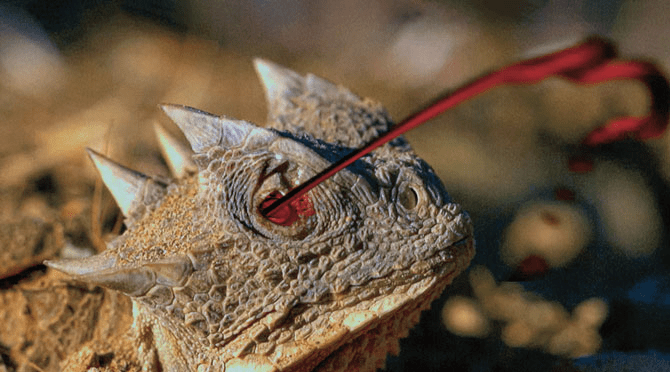
Anyway, I’ve known that horny toad populations seem to be on the decline in the Southwest and I decided to see what research I could discover about that trend. (First of all, it irks me that all the research seems to refer to them as “Texas horned lizards” instead of just the folksy “horny toad” moniker that we all used as kids growing up in New Mexico. After all, they’re not just in Texas. They are in all of the Southwest and northern Mexico.)
Some sites on the internet say that the horny toads are still out there, but that they have moved away from urban population areas. Another says that since horny toads only diet is red ants, the decline of the red ant population due to pesticides, climate change, etc. has led to the lizard’s decline.
A story from two years ago on Albuquerque TV station KRQE had this to say:
“… the communications director for the New Mexico Department of Game & Fish and says a main factor in the declining horned lizard population in the state’s major cities is (due to) population changes. “A lot of that is caused by like, people using poison on ants; which, if you poison the ants, that takes away one of the primary food sources for those horned lizards,” he said. He also notes that vehicle traffic is an issue for the horned lizard, along with being prey for feral cats and dogs.”
There are lots of internet sites about the horny toad, some very scientific, including one on why some horny toad “horns” are getting bigger because of certain predator activity. See if you can digest this:
“We quantified selection (3,4) on relative horn lengths of flat-tailed horned lizards by comparing skulls (n=29) of shrike-killed (a variety of predator bird) lizards with the heads of live lizards (n=155) . …The average parietel horn length of live horned lizards was 10.0% longer (x+-SE: 9.65 +- mm) than that of shrike killed lizards (8.77 +- 0.21 mm and the average squamosal horn length was…”
Well, you get the picture. If you want to read more and put yourself to sleep, here is the whole scientific study…
Some states, including Texas and Oklahoma, have declared the species as endangered. They not yet listed as endangered in New Mexico but are legally “protected,” but if you find one, you shouldn’t pick it up (or try to mesmerize it like I used to do when I was a kid).
And I hope you spot one on your next walk through our New Mexico landscapes. I’m sure it will bring you good luck.
 aero-cordero.com