Last week, we accompanied our grandkids on a tour of Lincoln County where I grew up in southern New Mexico. Our trip included stops at the Smokey Bear museum in Capitan, the Malpais lavabeds north of Carrizozo, old Lincoln, Fort Stanton, Ruidoso and other points in between. On the way, we stopped at the International Space Museum in Alamogordo, which the grandchildren thoroughly enjoyed, including a stop at the museum’s gift shop.
At the gift shop, pieces of “Trinitite” were on sale, starting at $80 for the tiny sample shown below and up to $450 for larger chunks of the “mineral.”

For those of you unfamiliar with Trinitite, it was created when the first atomic bomb was tested on July 16, 1945 at the Trinity site southeast of Socorro. The heat generated in the blast of the atomic bomb was so intense that scientists first concluded it had melted desert sand at ground zero into a strange greenish glass-like substance that was dubbed Trinitite.
The bomb was developed by scientists in the 1940s at the secret Los Alamos laboratory as part of the effort to end World War II. Los Alamos is about 200 miles north of the test site, a remote desert location on what was then the White Sands Bombing Range. Main components of the bomb were driven from Los Alamos to the test site, with final assembly done in an abandoned ranch house on the property. Code named as the “gadget,” the bomb created temperatures in excess of 14,000 degrees (8,430 Kelvin) when it exploded on that stormy morning about 5:30 a.m. Residents as far away as 150 miles felt and saw the explosion, which the U.S. Army explained away as an accidental munitions explosion on the bombing range.
After the explosion, the ground around ground zero was covered with the greenish glass-like material. Later research led scientists to conclude that the substance was created when sand was sucked up into the fireball of the explosion, then literally rained back down on the ground. Some of those pieces of melted sand formed tiny spheres which scientists now believe were “drops (like water) that cooled and hardened enough to keep their shape when they hit the ground.”

The site remained off limits to the public for many years, and in 1952, the Atomic Energy Commission scooped up much of the still radioactive contaminated dirt and trinitite and hauled it away. There were still enough pieces of the crusty green glass around that people found a way to acquire and collect it.
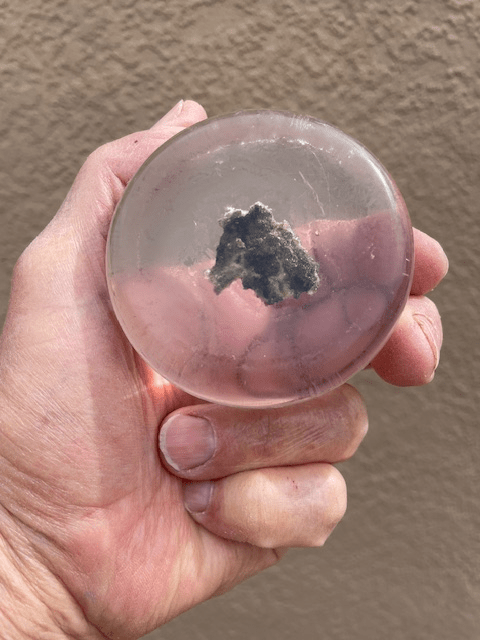
For some reason, my brother managed to get a piece of Trinitite when he lived in New Mexico in the late 1950s or early 1960s. I suspect he had arranged a tour of the site as a reporter for the Albuquerque Journal and picked up a sample of it of it then, but I never got a chance to ask him about it before his death in 2004. I inherited it after his death and have it displayed at our home. It is about an inch and one-half long and about an inch wide and is encased in a round piece of clear plastic, which I assume was done to limit any radiation danger. To be honest, it’s not very attractive — maybe looking like a ragged fossilized booger from an ancient dinosaur. A photo is below.
The U.S. Army now allows tours to the Trinity site twice a year. My wife and I took a tour a few years ago and enjoyed the visit. You can still see pieces of Trinitite on the ground nearby the blast site, but it is illegal to pick them up and take them away as a souvenir. However, I recall that when we came to the gate to get on the Missile Range to begin the tour, there was a guy sitting behind a roadside table with a canopy cover selling Trinitite samples he had acquired somewhere over the years. Of course, they might just have been fossilized dinosaur boogers.
 aero-cordero.com