The morning was eerily calm, but the sky had an unusual appearance. It wasn’t quite opaque like a high thin cloud cover, but thinner and with a faintly reddish hue. Shortly after about 1 p.m., the western horizon began to take a more menacing appearance, with the reddish color intensifying higher in the atmosphere and starting to reach over the top of our community. And within half an hour, the winds began and clouds of dust and sand whipped up from the ground as the sun began dimming from the higher overcast of red dust.
I’ve lived in Las Cruces more than 45 years. I’ve endured some ferocious winds here but I don’t recall a weather event like this where the visibility was so choked off by the dust in the air and the amount of sunlight that was able to filter through made it seem like dusk. The constant noise of the wind seemed to overpower any other sounds. It was difficult to make out homes at the north end of our block. — less than 200 yards away.
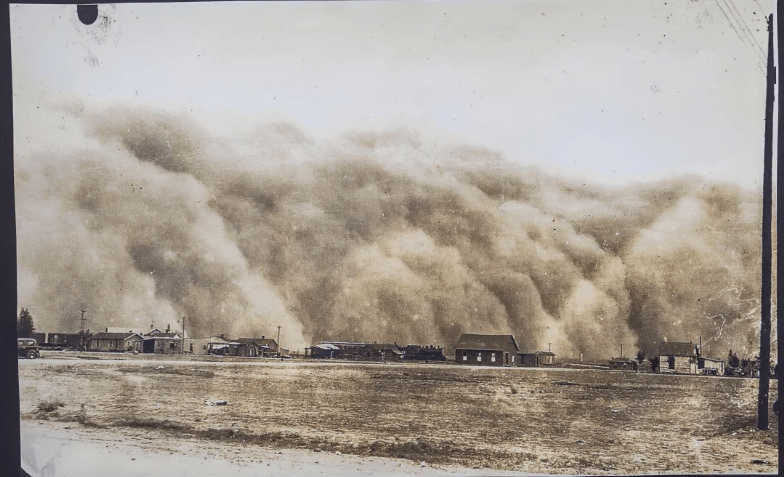
That storm occurred in Las Cruces on March 18, almost 90 years since the date of the “Black Sunday” storm that roared through the dustbowl states of Oklahoma, Texas, Kansas, southeastern Colorado and the northeast corner of New Mexico.
The Las Cruces wind event and the one on April 14, 1935 were termed a “haboob,” which usually occurs during the summer months when towering thunderstorms fall over dry desert landscapes and the intense wind generated by heavy rainfall scour the dry ground in an outflow from the storm.
However both the April 2 event and the “Black Sunday” event were of a march larger scale and did not feature much — if any — rainfall.
The Albuquerque Journal had an informative article about the event, which was published last Sunday, April 13. Here’s a link if you want to read more:
https://www.abqjournal.com/news/article_31cfd2c0-000b-11f0-94ed-bb6c05e5e8bb.html
I tried to find more about how the storm impacted Clayton on that day in 1935, but was not able to find much in searches on Newspapers.com. The town did have a newspaper in the early 1900s — The Clayton Citizen — but it had ceased publication by the time the great storm occurred. There were brief mentions of dust storms in the Albuquerque Journal and Santa Fe New Mexican in the days following the April 14 event, but nothing specific about Clayton.
I found one mention of a dust storm that day in the Carlsbad Current-Argus, which noted that a local man, described as the “Horace Mann” of the city, slept through the dust storm. It noted that he had left “all windows (in his home) and his lungs open” and “lost his usual loquacity.”
“He could not talk,” the newspaper article concluded.
The Santa Fe New Mexican reported that a local baseball game had been played during the “driving dust storm” and concluded with the El Rito Eagles beating the local gas company team.
Another “sporting” event that was disrupted by the April 12 storm was a “rabbit hunt” around Hooker, a small town in the Oklahoma panhandle not far from Clayton. An article said that the dust was so intense that hunters would occasionally be run into by a rabbit that they could not see. The article said there were “hundreds (of hunters) who were unable to reach their own cars and were marooned for yours in any car they could reach.”
Shortly after the April 12 storm, there was another intense weather system that produced dust but also included moisture. Denver reported almost 2.3 inches of precipitation in that storm, which spread so far south that Ruidoso, NM, received large hail.
Another article that I found interesting was a report in the Albuquerque Journal on April 25, 1935, that the U.S. Weather Bureau would soon be starting daily flights up to 17,000 feet over New Mexico to began gathering data to better predict the weather. I’m sure that kind of information would have made life much easier for the residents of the dust bowl.
The storms became so bad that at one point, dust from the dust bowl drifted over Washington, D.C. during a Congressional hearing about the need for better soil conservation techniques. An advisor to President Franklin D. Roosevelt who was lobbying for the cause pointed out a window of the capitol at the dust in the air and said: “This, gentlemen, is what I’ve been talking about.”
And finally, American folk music legend Woody Guthrie, who lived in the panhandle of Texas during the dust bowl days, wrote an entire collection of songs about the event. The lyrics from one are below:
“A dust storm hit, an’ it hit like thunder;
It dusted us over, an’ it covered us under;
Blocked out the traffic and blocked out the sun,
Strait for home all the people did run.”
 aero-cordero.com