In 1927, a 13-year-old orphan of Aleut-Russian descent, came up with the design for the Alaska state flag. The simple design featuring the big dipper and the north star in gold on a dark blue flag, was submitted by Benny Benson to the Alaska Department of the American Legion, which had conducted a design contest for the then territory’s flag.


Like New Mexico’s iconic red Zia on a yellow-gold background, the Alaska state flag has consistently been picked as one of America’s top ten state flag designs because of its elegant simplicity and meaning.
What made me think about this was the discovery of a dead “official state insect” on the grounds of our church earlier this week. The insect was the tarantula hawk wasp (Pepsis formosa), which became the state’s official insect because of a project by an elementary school class in Edgewood, NM.
The class had discovered that New Mexico was one of a few states that did not have a state insect, so students began researching for a candidate. After looking around for something that was unique and creepy at the same time, the students came up with three choices, then asked other students around the state to vote for their favorite insect. The tarantula hawk was the students’ choice. It is a giant wasp that laid its eggs in the living body of a tarantula spider — both common species in the high desert climate of New Mexico. And to make things even creepier, they discovered that a sting from the wasp is said to be the most painful sting of any flying insect. (Luckily, not many human stings are recorded because the insect does not sting unless provoked or it finds a suitable tarantula scuttling along the ground.)
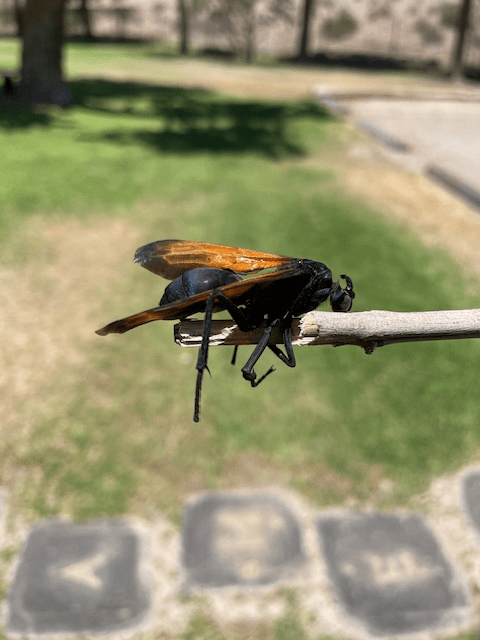
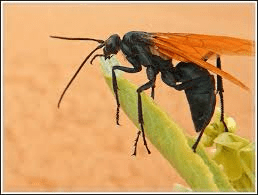
They are very large and have a rather imposing presence with orange colored wings and a black almost blue body. A predominant feature is the extremely long stinger at the end of its abdomen. The dead insect I found at our church did not appear to have a stinger still attached, so it may have delivered that weapon earlier.

American entomologist Justin Schmidt created the Pain Scale for Stinging Insects with the help of variably willing or unwitting test subjects. He once described the tarantula hawk’s sting as “instantaneous, electrifying and totally debilitating.” Schmidt has also in the past suggested that when stung, the only response is to “lay down and scream.”
Fortunately, the pain seems to go away in about five minutes, according to sources in my search.
One writer about this insect said its life cycle “sounds like the most gruesome horror story Hollywood could make up.”
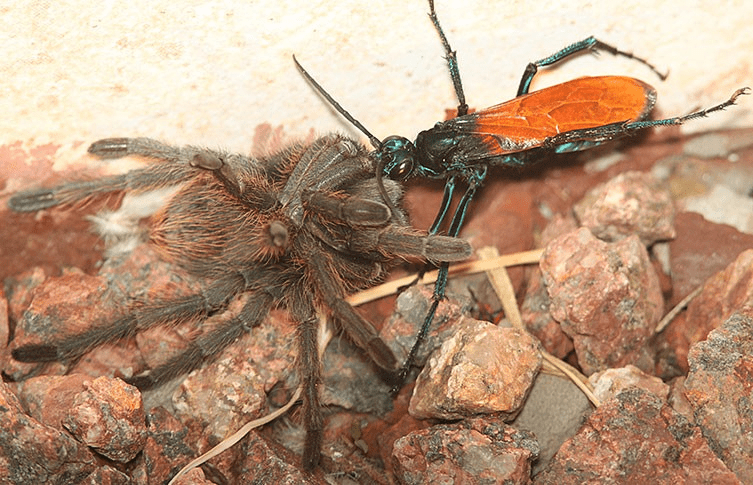
To begin the cycle, the tarantula hawk wasp looks for tarantulas, which often come out from their underground burrows after Southwest monsoon rains to look for mates. After spotting one, the wasp makes a quick attack on the otherwise gentle spider, paralyzes it, lays a single egg in the body of the spider and then drags it off to a nest where the baby wasp will then hatch inside the body of the victim. The body of the spider — still living but still immobilized — then feeds the baby wasp when it hatches.
So thanks to the kids at Edgewood Elementary School, we have a really creepy insect specimen that was adopted by the New Mexico Legislature in 1989. And ironically, a group of students from Alaska heard about the New Mexico school’s insect project and traveled all the way to New Mexico to watch the legislature vote on the official state insect.
I suspect they didn’t trade one of their state’s flag for a live tarantula wasp.
 aero-cordero.com