I’m finishing up a more than two-week stint as an election official for early voting in the Nov. 4 primary in Dona Ana County. My location, as it has been in the previous four elections, is the town hall of Mesilla.
Surrounding me are displays about the history of Mesilla, many focusing on the connections between legendary Western outlaw Billy the Kid and this town that was once an influential center and hub of southern New Mexico.
Specifically, William H. Bonney was convicted in a trial in Mesilla in 1881 for the murder of Lincoln County Sheriff William J. Brady during the years leading up to the famous Lincoln County War during the late 1870s. Following the trial, he was transported back to the town of Lincoln where he would be hanged on May 13, 1881. But before his date with the gallows, he staged a daring and lethal escape from the Lincoln County Jail on April 28, 1881, killing two more lawmen, Deputy U.S. Marshall Robert Olinger and Deputy Sheriff J.W. Bell. On July 14, 1881, he was shot and killed by Sheriff Pat Garrett in Fort Sumner, New Mexico.


There have been hundreds of thousands, if not millions, of words written about Billy the Kid and the Lincoln County War. On top of that, 52 movies (not including TV shows and documentaries) have been made about the outlaw’s escapades and the Lincoln County War. Needless to say, I’m not going to try to add anything new about Billy the Kid or the Lincoln County War because the subject has been worked to death.

However, while here at the polls during lots of slow periods, I thought it might be fun to read more about the subject while I was surrounded by Billy the Kid lore. I had previously read parts of a book by good friend, John P. “Jack” Wilson, entitled Merchants, Guns & Money, The Story of Lincoln County and Its Wars. This seemed like an opportune time to delve further into the subject by thoroughly reading his work.
The book was published by the University of New Mexico Press in 1987 and, in my opinion, is the most thoroughly researched publication on the subject of the Lincoln County War. To that point, the book has 50 pages of additional documentation, notes and references. Wilson, a Harvard graduate and long-time resident of Las Cruces, has had a distinguished career in archaeological and historic research. He’s written several books, one of which I’ve reviewed in previous posts on my blog. Wilson clearly knows how to do thorough research.
I highly recommend his book, which you can still find on Amazon and I suspect in local bookstores, like COAS.
Be prepared for lots of detail in the book, especially regarding financial matters, government records and population statistics. But as Wilson said, to find the real truth about the cause of the Lincoln County War, you have to “follow the money.”
As he wrote, the Lincoln County War “was not a cattle or a range war, nor even a feud. Essentially it grew out of a struggle for economic power in a land where hard cash was scarce and federal contracts…. were the grand prizes. The competition for these contracts became bitter and frequently ruthless.”
What struck me most when reading his book about the war was the number of people who were killed, many of them senselessly.
One sentence in Wilson’s book sums it up succinctly:
“Of the 30 funerals the Reverend (Taylor) Ealy conducted during his five months in Lincoln (during 1877-78), only one resulted from natural causes.”
You probably have seen Westerns where opposing sides are blasting away hundreds of shots with their pistols, rifles or shotguns. I always thought that was Hollywood going over the top in portraying the Old West. Not so in Lincoln during the war.
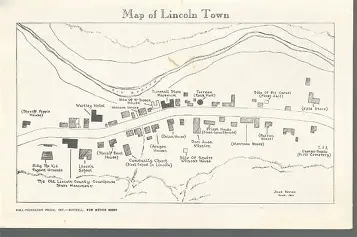
The peak of the War was “The Five-Day Battle” in Lincoln July 15-19, 1878. Wilson told me that “as many as 50” men participated in that shootout between the rival Murphy-Dolan group and the Tunstall-McSween group during those five days. Lt. Col. N.A.M. Dudley, commanding officer at Fort Stanton, estimated that 2,000 shots were fired on one night alone. At one point, troops at Fort Stanton brought a Gatling gun and a 12-pound howitzer to position in the middle of Lincoln’s main street in hopes of subduing the fighting. Wilson’s books contains many descriptions of individuals being wounded or shot dead during that and other skirmishes between the two groups.
The mayhem went on outside of Lincoln. A retreating party of Murphy-Dolan supporters later shot and killed three men harvesting hay further down the Rio Bonito “without the least provocation,” then on the same day randomly killed the young son of a rancher and raped two women at another ranch.
One of the principals in the war, Alexander McSween, said he had heard reports that “there were 200 armed men in the field” during the height of the war. The post surgeon at Fort Stanton commented that there was “depredation and murder by a band of miscreants” throughout the county.
An interesting statistic from the 1880 census showed that 20 percent of the 167 households in Lincoln were headed by women. Digging further into this statistic, Wilson discovered at 33 of those 39 women said they were widowed — likely many because their husband was a casualty of the Lincoln County War.
I asked Wilson how many people had likely been killed in the events leading up to the war, during the peak of the war and its aftermath. He said although the number isn’t certain, he suspects it is around 60. He noted that many of the deaths of Hispanics (Identified by locals as “Mexicans” at the time — even though they were born in the United States territory) and Indians were not counted.
To show why you shouldn’t believe everything on the Internet, I asked Google how many people were killed during the Lincoln County War. The number it gave was 19. If you read Wilson’s thoroughly researched book, you’d agree that number is far too low and that Lincoln was a frightening and lawless place to be in the 1870s and 1880s.
 aero-cordero.com