New Mexico hasn’t had the best record on public executions for bad guys over the years.
I previously wrote about the botched hanging of notorious outlaw Tom “Black Jack” Ketchum during which his head snapped off when he plunged through the gallows at Clayton, NM, April 16, 1901.
Ketchum, who had made a career of robbing trains with the “Hole in the Wall” gang and other desperados, had been convicted of attempting to hold up a train by himself on Aug. 16, 1899, at Twin Forks in northeastern New Mexico. During the robbery attempt, an agent on the train shot Ketchum in the arm, making his subsequent capture relatively easy. While in prison awaiting his trial, his arm was amputated and he gained significant weight. Both of those things appeared to be factors in his unfortunate ending at the gallows.
According to a Wikipedia entry about him:
“Ketchum was executed by hanging… but no one in the town had any experience with the procedure. The combination of too long a rope, Ketchum’s significant weight gain while in jail, and the mass imbalance due to the amputation of his arm caused him to be decapitated when he fell through the trapdoor. His last words were “Good-bye. Please dig my grave very deep. All right; hurry up.”

I recently finished reading John P. Wilson’s excellent book on the Lincoln County War, during which one man had to be hung twice before the executioner could complete his job. In that incident, William Wilson (no relation to author John Wilson) was convicted and sentenced to hang on Dec. 10, 1875, for a fatal shooting in the turmoil leading up to the Lincoln County War.
Author John P. Wilson said William Wilson had apparently made disparaging remarks earlier about Maj. L.G. Murphy, one of the principals in the Lincoln County War and now probate judge and the person in charge of the execution. While standing on the gallows, Wilson was given a chance to make his last remarks. He began by telling Murphy “You know you are the cause of this. You promised to save me but…” At that point, apparently not wanting to hear anything more negative said against him, Murphy cut the rope to the trap door and silenced Wilson.
According to John Wilson’s book, the convicted Wilson hung for six and one-half minutes, then was cut down and placed in a casket. But one observer at the hanging noticed that Wilson appeared to still be breathing while in the casket. Another rope was placed around his neck and this time he swayed from the gallows for 20 minutes to make sure the deed was done.
At least Wilson didn’t suffer the consequences of being hung three times like Texas outlaw Wild Bill Longley. The story goes that Longley was hung the first time by a lynching party for being involved in a horse or cattle theft. But while swinging from a tree branch, an errant bullet fired in celebration by the retreating posse severed the rope attached to the noose and freed Longley. He was later convicted of murder in another case and sentenced to hang on Oct. 11, 1888, in Giddings, TX.
When he gave his last remarks, he told the crowd of about 4,000:
“I deserved this fate. It is a debt I have owed for a wild and reckless life. So long, everybody!”
This time, the hanging party used a rope that was too long. When Longley fell through the trap, he landed upright on his feet. No longer trusting their skills with the gallows, the sheriff and deputy sheriff simply pulled up hard on the rope themselves until Longley expired.
New Mexico outlawed capital punishment in a bill signed by then Gov. Bill Richardson in 2009. Prior to that, the last execution occurred in 2001 by means of lethal injection.
Before lethal injection was used, New Mexico executions used “Old Sparky,” the somewhat gruesomely named electric chair in the infamous old state prison outside of Santa Fe. The last time it was used was in 1956 in what also turned out to be a less than textbook execution.
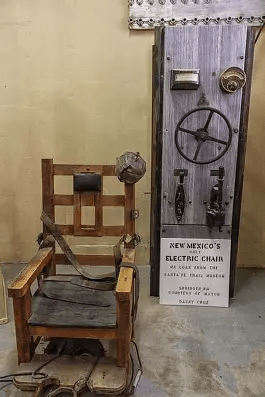
The prisoner, James Larry Upton, was convicted for the 1954 murder of a Kirtland Air Force base airman in Albuquerque. His execution date was set for Feb. 24, 1956.
When that date came, it was found that the standard cap used for the electric chair did not fit Upton. Prison officials decided to make it fit by using a cap from a parka that had fur around the edges. As the electric current surged through the chair and Upton’s body, the fur of the parka ignited and smoke billowed from the improvised cap. This incident provided further impetus for the state to discontinue using the electric chair for future executions.
Needless to say, we’ve had some less than stellar attempts at public executions in New Mexico. But at least we can say there are no records in the Land of Enchantment of public stonings or burnings at the stake.
 aero-cordero.com