When I write, I always try to find some connection to New Mexico, since that’s the stated purpose of my website.
However, a recent book that I read and really enjoyed left me grasping for connections to the Land of Enchantment. However, I’ll tell you about the book and then try to make some lame New Mexico connection.
On Nov. 11, 1975, a huge ore carrier with 29 crew aboard was sunk during a “storm of the century” on Lake Superior as it neared the eastern shore of that body of water. The shipwreck was made famous in a ballad by Canadian singer Gordon Lightfoot called “The Wreck of the Edmund Fitzgerald.”
I can’t recall hearing the news about the shipwreck but I distinctly remember Lightfoot’s song, which fascinated me. You may have read some articles last fall in various publications or on-line posts about the 50th anniversary of the event.
Two summers ago, when my wife and I hosted our children and grandchildren for a delayed 50th anniversary get-together, I had put together a “mix tape” on my iPhone of songs that were relevant to my wife and I during the earlier years of our marriage. One of the songs on that collection was Lightfoot’s “Wreck of the Edmund Fitzgerald.”
Our youngest grandson Hayes, who would have been five at the time, became fascinated by the story about the shipwreck and asked endless questions about it. We found a children’s book about it, gave him a toy ship that sort of looked like the doomed freighter and have continued to have conservations about it.
He somehow learned (probably from his mother) about the recently published book “The Gales of November”, written by John U. Bacon and convinced her to give it to me for Christmas last year.
I found the book fascinating in its detail and in the relentless pursuit of information about the ship, shipping in the Great Lakes, weather patterns and family recollections about the incident.

In my general conclusion, the ship went down for several reasons, although no one knows for certain. The ship was overweight, weather forecasts were not nearly as reliable as they are today, the captain was pushing the limits of the vessel in a “race” with another ship, navigational aids were not as accurate as they are today and possible structural problems with the ship seem to have contributed to the loss of the Edmund Fitzgerald (known on the Great Lakes as “The Fritz”). From my experience and training as a balloon pilot, I’ve learned that accidents in the air (or on the water) are likely caused not by just one single event, but a series of things that sneak up on pilots or captains before they realize they are in trouble. By then, it’s usually too late. The best advice I have is to seriously analyze the first setback of any flight or sail and then try to think clearly about the implications of what might happen if two or three other things go wrong. I suspect more seasoned pilots who read this blog would agree.
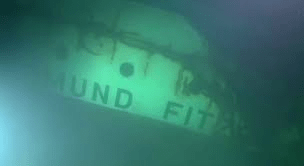
I’d recommend reading the book, which is broken down in short chapters and runs logically through the history of Great Lakes shipping, regional weather phenomena, the building of the ship, personal profiles of key individuals and post analysis of the shipwreck.
So my only connection to Great Lakes shipping and New Mexico is contained in an earlier post I wrote in March of 2022 about a really hairbrained scheme in the early 1900s to channel the Rio Grande between the Gulf of Mexico to El Paso to allow ocean going ships to reach the westernmost city in the state of Texas. The scheme included constructing a damn just north of El Paso, which would have flooded the fertile Mesilla Valley and, most importantly for the businessmen in El Paso, prevented any ship traffic into New Mexico.
Consider the dredging operation that would have been required for an operation like that. And consider the little amount of water that now flows in the river.

And even if the proponents of the Rio Grande ship channel had agreed to dredge the river even further upstream from El Paso, what if Elephant Butte Dam still had been constructed? It would have required locks to lift sea going vessels into what is now Elephant Butte Reservoir.
Once on Elephant Butte Reservoir, what purpose would ships like the Edmund Fitzgerald have accomplished? Hauling adobe dirt in their cargo holds to waiting home builders in Las Cruces and El Paso? Hauling bales of green chile to the Gulf of Mexico for waiting restaurants around the world? Shipping sand for holiday luminarias outside the Southwest?
There were some mining operations in the region, but I doubt they could have produced enough copper, gold or silver ore to make a Rio Grande ship channel profitable.
So I guess we’ll just have to think about how silly that effort was in the early 1900s and be thankful that we at least get to see water occasionally run down the Rio Grande. And if an Edmund Fitzgerald size ship sank in the shallow river during one of our really bad spring wind storms, I’ll bet most of the ship would be visible above the water and no lives would have been lost.
Okay, I’ll end this silly post. But read the book — it’s great.
 aero-cordero.com