It was an almost instantly regrettable impulse buy. I stopped by the local Walgreens earlier this week to buy some over the counter medicine. On my way to the cash register, I passed a display of Peeps marshmallow candy.
“Well, how long has it been since I had some of those,” I wondered. “I’ll buy some as a joke for my wife.”
But secretly, I wanted to eat one to see if they were as good or as awful as I had remembered them.
When I got home, my wife predictably was not interested in the “present” I got her.
“They’re so sweet that your teeth will rot,” she observed in her no-nonsense Midwestern way of analyzing the obvious.
So I decided to eat one.
I instantly felt the enamel in my teeth flushing down the back of my throat. But it was good in a nostalgic kind of way. I’ve now eaten three of the five in the pack and I have a dental appointment coming up on Friday. I’m wondering if I will have any teeth left by then.
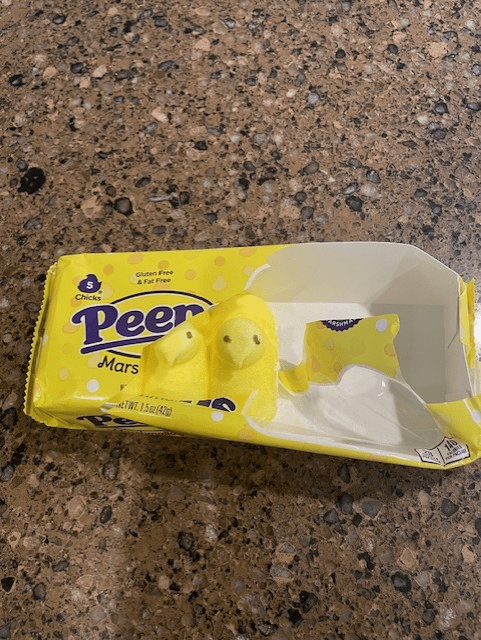
However, it got me to wondering about this candy that always appears around Easter time. According to Wikipedia, Peeps first appeared in the late 1940s although the date is not certain. They were manufactured by the R.E. Rodda Candy Co. of Lancaster, PA, and were initially called “Rodda Marshmallow Peeps” or “Rodda Easter Peeps.”
The Rodda company was acquired in 1953 by Ukrainian immigrant Bob Born. His company, called “Just Born” still manufactures them today.
Here’s the website:
Ingredients for Peeps are pretty simple:”
Gelatin (for the marshmallow part), corn syrup, potassium sorbate (preservative), carnauba wax for the sheen of the Peep’s eyes, various dyes and of course, lots of sugar.
As you might expect with something that’s this legendary, there are Peep’s eating contests and scientific research to prove that they are basically indestructible. I found this tidbit from Wikipedia during my high-level investigative reporting journey:
“Peeps are sometimes jokingly described as “indestructible”. In 1999 scientists at Emory University jokingly performed experiments on batches of Peeps to see how easily they could be dissolved, burned or otherwise disintegrated, using such agents as cigarette smoke, boiling water and liquid nitrogen. In addition to discussing whether Peeps migrate or evolve, they claimed that the eyes of the confectionery “wouldn’t dissolve in anything”. One website claims that Peeps are insoluble in acetone, water, diluted sulfuric acid, and sodium hydroxide (the site also claims that the Peeps experimental subjects sign release forms). Concentrated sulfuric acid seems to have effects similar to the expected effects of sulfuric acid on sugar.“
And yes, I now really regret eating them.
This got me to thinking about our granddaughter’s recent science fair project in 5th grade for which she earned a blue ribbon in the regional fair in Austin, TX. Her project was to determine if there was any difference in the taste of different colored Pepperidge Farms “Goldfish” snack crackers. She and her seven-year-old brother conducted taste tests and determined that they could tell a difference.
So why not the same experiment with different colored Peeps?” They now are available in traditional yellow, blue, purple and pink. Do they taste the same? Inquiring minds want to know.

So I’m throwing out this challenge out to our grandchildren to conduct this very important experiment for next year’s school science fair.
In the meantime, I just heard the last two Peeps calling my name. I’m heading back for them before the ossify and turn into rocks.
 aero-cordero.com