My wife and I are fortunate to have a great long time friend in Cheryl, who has a nose for research, an academic background in library science and a love for oddities in New Mexico. Cheryl, who had a long career at the New Mexico State University Branson Library, has helped me with several of my posts over the years, offering suggestions, corrections or new sources for information about a topic I’ve written.
She recently turned over a file she had assembled about a truly unique incident in southern New Mexico that I’d never heard about and that I suspect many others who love our state’s colorful past never knew happened. Cheryl told me she had been thinking about writing an historical article about this, but just never got around to doing it. So she offered her research to me. I hope I’m worthy of writing about it and hope my blog finds an audience beyond my limited and loyal readers.
Thanks, Cheryl.
Here goes:
In 1911, Hearst newspapers and owner William Randolph Hearst were apparently enthralled about the new age of flight that had been introduced by the Wright Brothers eight years earlier with their demonstration at Kill Devil Hills, North Carolina. A prize of $50,000 was offered to the first aviator who could fly across the United States, with the newspaper mogul and his publications likely getting exclusive access to a story of derring-do in the air. Hearst’s contest said the flight could be conducted from east to west or west to east, but had to be completed in 30 days.
After the contest was announced, four pilots — all trained by the Wright brothers — came forward in to participate in the race to claim the prize. One of those was Robert G. Fowler. Fowler, however, did not claim the prize.
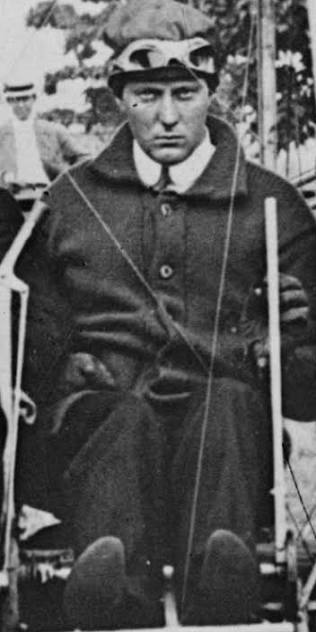
The first person to complete the cross-country flight was Cal Rodgers, who left on Sept. 17, 1911, from Sheepshead Bay, NY, and landed in Pasadena, CA, on Nov. 5, that same year. Unfortunately, he missed the 30-day deadline by 19 days. Not only was his luck lacking in winning the prize, he was also unlucky in the air, dying in a plane crash less than six months later.
Apparently figuring that prevailing west to east winds might make his journey faster, Fowler chose to fly from Los Angeles to Jacksonville, FL, along a more southern route with fewer mountains and bad weather to contend with along the way. He left Los Angeles on Oct. 19, 1911, in his Wright-Cole Flyer while Rodgers was already far ahead in the transcontinental race.
On his first day of flying, Fowler managed to get only as far as Pasadena, but on the second day managed to reach Riverside. He zipped across Arizona in just eight days and reached New Mexico territory on Nov. 4, when he learned that Rodgers had just crossed into the state of California. Undaunted, Fowler pressed on.
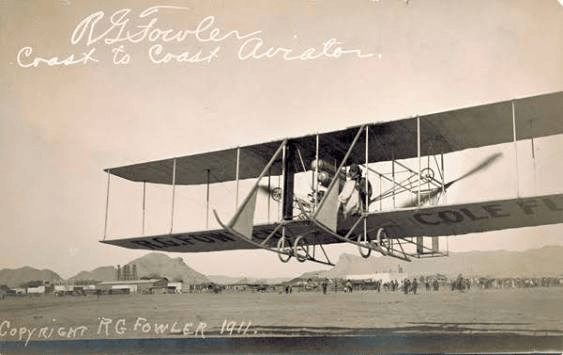
At this point of his flight, Fowler’s journey became truly daring. He had a forced landing near the Southern Pacific railroad stop named Mastodon in what is now southern Dona Ana County west of El Paso and not far from another rail stop named Lizard. (Although some ancient bones were found near Mastodon, an Ice Age creature for which the rail stop was named, scientists later confirmed they were from a similar elephant-like animal called a “Gomphothere.” Lizard, as you might guess, was apparently named for the large population of lizards in that desert area, likely the state reptile, the New Mexico whiptail. That reminds me to write sometime soon about that unique species, all of which are female and who thankfully populate the yard of our home and help eradicate unwanted insects.)
But back to Fowler and his adventure. A blown valve in his aircraft engine forced him to land in a sandy patch along the Southern Pacific railroad tracks near Mastodon and damaged the landing gear in the aircraft. Once he and his crew (apparently following his flight by car) had managed to repair the landing gear, he attempted to return to the air. The deep sand, however, made it impossible for the crude aircraft to gain sufficient airspeed to become airborne.
Then inspiration struck Fowler and his crew. On a spur next to the main railroad track, a simple handcar had been left unattended. Because its movement along the rails offered very little resistance compared to the aircraft landing gear in deep sand, the Fowler crew concluded they could temporarily attach the light aircraft to the top of the hand car. The large levers used to motivate the device were removed to accommodate the aircraft. The modified hand car would provide a moving platform for the aircraft to gain sufficient airspeed from its twin propellers to become airborne.
Although I could find no photographs of the unusual hand car/aircraft contraption, I’m sure it was quite something to behold visually, with the large aircraft teetering on top of the relatively small platform.
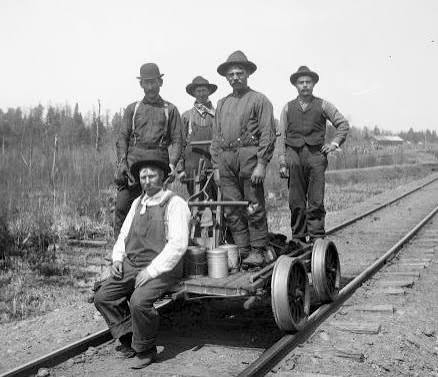
Once on top of the hand car, Fowler fired up the engine of his twin-propeller Cole Flier and set it on the course of a gentle downhill slope. Slowly, the contraption gained speed and was able to move fast enough for Fowler to outdistance his panting and gasping crew running alongside.
But then in the distance coming toward him, Fowler spotted a plume of black smoke and a single glowing headlight. It was a powerful Southern Pacific steam locomotive running at full speed toward him and the unusual launch contraption.
“I was going to be the first pilot to crash into a locomotive,” Fowler later said of his thoughts in that moment that were captured in his memoirs.
But at the last minute Rodgers tugged hard at the yoke and the Wright-Cole flyer managed to gain just enough airspeed to separate itself from the hand car platform and soared into the air a scant 10 feet above the belching smokestack of the locomotive.
The handcar was no match for the multi-ton locomotive and was obliterated when it collided with the train.
The files I received from Cheryl gave me provided no information about what happened in the aftermath of the incident, and I couldn’t find anything more in other historical archives. I wish there was a record of an interview with the engineer when he first spotted the unusual thing hurtling toward him, then saw it separate and part of it flew above him. I suspect he had never seen an aircraft before that moment and was likely assuming it was some premonition of the coming end of the planet. We’ll never know.
At any rate, Fowler managed to continue his voyage. It took him an entire month to cross the massive state of Texas. His trip continued through the end of 1911 and after crossing Louisiana, Mississippi, Alabama and Georgia, he finally landed in Jacksonville on Feb. 8. The entire journey took him 45 days to fly about 2,800 miles. During the flight, he had 65 forced landings and had to change spark plugs in his aircraft’s simple engine 45 times.
Fowler went on to have a distinguished aviation career. He was the first person to fly from the Pacific to the Atlantic along the route of the then under construction Panama Canal. The aircraft which flew that route is now part of the collection of the National Air and Space Museum’s collection.
He founded his own aircraft company, manufacturing trainers for the U.S. Army Signal Corps.
He died in 1966 in San Francisco at the age of 82.
And I’m sure if Cheryl had written this story, she would have done it more justice than I did.

