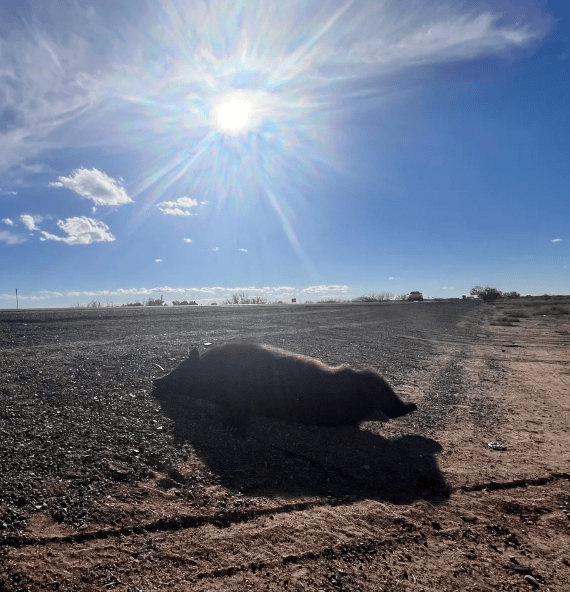
Late last month, a male black bear was struck and killed along Interstate 10 near Deming, in the heart of what I consider to be the most desert-like part of our state. The poor animal either wandered down from the Florida Mountains southeast of Deming or lumbered all the way from the Gila country north of there in search of food.
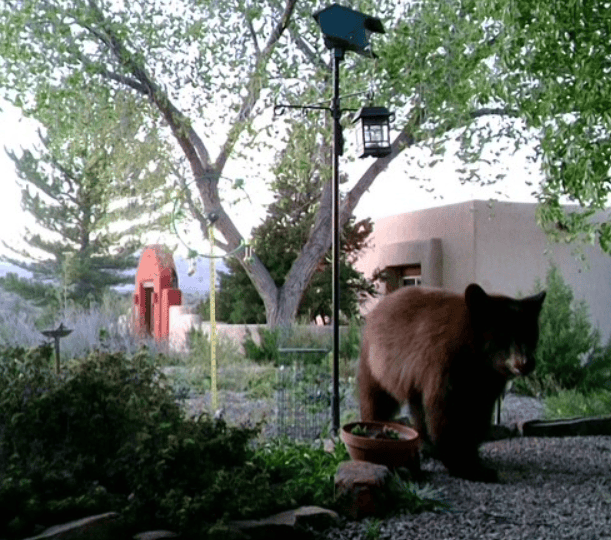
And as reported by my sister in Cochiti Lake, southwest of Santa Fe at the southern tip of the Jemez Mountains, a bear she has named “Wooly Booger” has made multiple forays into her yard during the last two months. It’s been bold enough to walk right up to her north-facing porch and stare into the windows. It’s also been digging through trash bins in the area (luckily not hers, which are kept in a garage) for food.
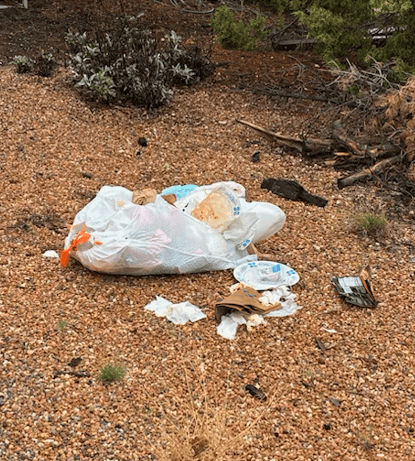
New Mexico’s brutally hot and dry summer this year meant much of what a bear normally eats during that time was in limited supply. The heavy rains starting in September have been a little help, offering bears a better supply of juniper berries, acorns and other natural forage. As a result, bear problems have declined in the last two months, according to the New Mexico Department of Wildlife (formerly New Mexico Department of Game and Fish).
Although considered omnivores, bears mostly prefer natural foods found in the wild. But when desperate, as they were this summer, they’ll eat anything, including garbage left in dumpsters, suet or other edibles in bird feeders and of course fish or even small critters. Since many of the bears found good food sources near humans during their desperation months, they’ve learned to hang around places where people live and food may be easier to get.
And they’re pretty clever. Years ago on a camping trip in Sequoia National Park, my wife and I were sleeping in the back of our Chevy Blazer. We had left much of our camping gear outside the back of the truck, including a supposedly “bear proof” cooler. About 1 a.m., we heard some unusual noises outside the truck and peered out to see a bear rummaging through the open cooler. The next morning we checked to see what damage had been done. The bear had cleverly opened the cooler without damaging it, managed to daintily unwrap packages of cheese and ham before eating them, unscrewed the lid of a jar of mayonnaise (yes, it skillfully unscrewed the lid without any other damage to the jar) and licked it clean, then bit a hole in a can of Coke and finished off its meal with a sip of the sugary soft drink.
I looked online to see how many bears are estimated to live in New Mexico. Estimates range from 4,000 to 9,000, which was way more than I had anticipated. And how, I asked, do you estimate bear populations. Well, the answer is that the New Mexico Department of Wildlife uses something called “bear snares.”
According to the agency’s website: “Bear hair snares are a modern study technique designed to collect DNA and allow biologists to identify the number of bears in an area. … The hair snares will consist of strands of barbed wire stretched across an area with bait in the middle. As bears duck under or step over the wire a small amount of hair will be collected.“
I couldn’t find how they would get a bear count from a few tufts of bear fur from these traps, but I assume they do DNA analysis to calculate how many different animals go into these places to get bait then extrapolate the results into a population projection.
(I’ve often tried to get over a barbed wire fences and caught my jeans on the barbs, leaving blue strands of fabric hanging in the breeze. I wonder if any of those ever showed up on the “bear hair snares” and left biologists wondering about the existence of blue bears — but I digress).
The sad news is that through the end of October, 307 black bears have been euthanized in New Mexico because of the danger they posed to humans and domestic animals. That’s according to a news report in Source New Mexico. Another 51 have been killed in road accidents or other accidents. On top of that, more than 90 bears were relocated, according to the New Mexico Department of Wildlife.
“It has been a particularly rough year for bears,” Michael Sloan, the director that agency, recently told a committee of the state legislature.
According to the news report in Source New Mexico, Jesse Deubel, head of the non-profit New Mexico Wildlife Federation had this to say about the bear problem in human populated areas this year:
“Bears don’t want to come into these neighborhoods. They don’t want to have this conflict. But when a population of an animal, particularly a large alpha predator like a black bear, exceeds the carrying capacity of the habitat — it doesn’t really have a choice.”
One human was killed by a bear on Aug. 20 this year in New Mexico. It happened near the Navajo Nation community of Crystal in southwestern San Juan County adjacent to the Chuska Mountains. Details of the attack were not available, but the bear was subsequently identified and killed. Three other persons were injured this summer when they were bitten by bears near Red River, Cedar Crest and Raton. All those injuries were non life-threatening, but I’m pretty sure they scared the heck out of those humans who were involved.
The NM Department of Wildlife offers these tips if you encounter a bear while hiking in our state’s great outdoors or maybe even in your own back yard:
- Do not run! If you see a bear, stay calm.
- Stand upright. Slowly wave your arms.
- Back away. Slowly back away from the bear.
- Look for cubs. Do not come between a mother and her cubs.
- Fight back. If attacked, fight back aggressively.
Growing up in the mountains of southern New Mexico, I occasionally saw black bears roaming around my home town of Ruidoso. One summer, my family would be awaked almost every night by the sounds of a bear digging through garbage cans in the neighborhood. I remember the comical time when my father shined a flashlight on the marauding bear and it quickly ducked behind a very skinny pine tree that failed to camouflage its large girth and its head peeking around the trunk.
I only had one heart pounding up-close experience with a bear while growing up in Ruidoso. I was fishing on the North Fork of the Rio Ruidoso when I came to a river crossing. As I rounded a corner, a bear on the opposite side of the river appeared at the same time heading toward my side. We both stared at eachother for a milli-second, then sprinted away at warp speed in opposite directions. I clearly violated rule number one on how to deal with a bear in the wilds. And luckily, the bear was not a female with cubs or the outcome might have been different.

