The Albuquerque Journal’s Business Outlook section this week had a story about young kids — mostly teenagers on summer break — getting their first paying job.
There was a lot of focus about Dion’s Pizza, which has always made an effort to hire teenagers for work in their statewide franchises (including two here in Las Cruces.) I love to go into Dion’s and be greeted by the energetic, enthusiastic smiling teenagers wearing their bright red caps and aprons with yellow lettering. I figure for most of them, it’s a pretty good job — learning how to deal with customers in a busy environment. Both of my children did their time in the food service business while in high school and I think it was a good experience for them and taught them some valuable life lessons.
The story in the journal made me think back to my first serious summer employment when I was growing up in Ruidoso.
Of course I had work experience on my father’s newspaper from middle school on. I delivered papers to local businesses on publishing day, poured molten lead pigs for Linotype machines, occasionally set type, operated an engraving machine and did other tasks. The pay wasn’t good, but I did it because it was “family” and I learned a lot.
My first real job was at a small amusement park that set up for the summer months in mid-town Ruidoso. The rides included a carousel, small Ferris wheel, some bumper cars and a small train which operated on a track encircling the park.
My job was to operate the carousel. The work involved making sure everyone from the previous ride got off the contraption, that new riders were seated safely and that they got a certain number of revolutions when I started it up. It was a pretty simple job, but at that age, my mind drifted frequently and I sometimes lost count of how many revolutions the carousel made. Often, I became immersed in wondering how the contraption worked with all its rotating parts.
The aging contraption I operated wasn’t anywhere this nice (or probably as safe).
The owner of the amusement park soon noticed that I had a less than optimal focus on counting revolutions and concluded that I just wasn’t up to the task. He gave me a pink slip and my wages due. However, two days later, he called me back to work because he had forgotten that the busy Labor Day weekend was coming up and he needed more staff. Tail tucked between my legs, I agreed to return and finished up my job that weekend. I suppose I could have asked for a pay increase since I knew he was desperate, but I was pretty sure that strategy wouldn’t go well for me.
I also remember that one of the people I gave a ride to on the carousel was the super-stud quarterback of the high school football team. He seemed shocked and then embarrassed to see me operating the kiddy ride, knowing that I could blow his cool image.
“Please don’t tell anyone — especially the coach and my girlfriend — that I was here,” I remember him pleading.
I kept his secret, and when I joined the football team as a sophomore a couple of years later, he always treated me well.
I guess there are many morals to this story — mostly don’t get caught where you don’t want to be seen. And that’s especially true these days when everyone has a camera in their phone.
For reasons that probably won’t interest anyone, I have rejoined the Boy Scouts of America (soon to be renamed Scouting America) as an adult member of troop 66 in Las Cruces.
In order to join, I had to pay dues and various entry fees of more than $100 and take a course called “Youth Protection Training,” which is a good thing these days.
The whole process made me think back about my son’s experiences in scouting and my own Boy Scout memories in Ruidoso years ago.
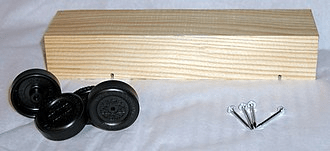
My son was in Cub Scouts in elementary school when he competed in the “Pinewood Derby,” a gravity powered model car race in which vehicles made from blocks of pine wood must use certain components and weigh a specific amount.
A Pinewood Derby kit
My son Tyler and I purchased a kit and not knowing exactly what was in store, put together a green and red racer that basically looked like a wedge-shaped potato on wheels. We accidentally managed to get the weight exactly right by pouring some lead solder in holes we had drilled in the body of the vehicle and then attached the plastic wheels with nails as axles. The wheels looked a bit wonky and out of alignment, but we figured we’d give it a go.
Before the official race, Tyler lubed up the wheels with powdered graphite, most of which got on his face, making him look like an NFL player before a SuperBowl game.
On the race course, which was about a 10-foot ramp at a 20 degree angle, Tyler’s car zipped down fast and won every heat. On the championship round, his car smoked the competition by an eyelash to win.
We felt we had conjured up the perfect balance of wood, plastic and lead and decided that for next year’s race, we would make an even faster car that would win each heat by huge margins.
It wasn’t to be. We crafted a new silver and red car, festooned it with a spoiler and fancy lead weights that looked like a tuned exhaust system from a Formula 1 car. It looked like the fastest car among the competition. But when it rolled down the ramp, it performed like a Ford Pinto instead of a Ferrari. We didn’t even win the first heat, as I recall.
On top, the zoomy looking racer that performed like a Ford Pinto, and below, my son’s original championship Pinewood Derby car.
My recollections of scouting are somewhat foggy, given the many years that have passed since the time I joined Troop 59 in Ruidoso. (Our cheer ended with the incredibly imaginative words “Troop 5-9 — that’s mine.”)
I remember parts of my first overnight camping excursion on the middle fork of the Rio Ruidoso on the Mescalero Apache Reservation. As expected, the older scouts made sure we knew they were in charge. They made us stay up far past our bedtime on a legendary “Snipe Hunt” in which we waved flashlights in front of open pillowcases urging the imaginary birds to run inside so we could capture them. Having heard rumors about such things, we neophytes concluded it was a ruse and quickly gave up.
The worst thing about the trip was that someone squirted something truly putrid in my canteen which I had left outside my tent overnight. When I awakened in the morning, I took an unsuspecting sip and quickly spit it out, gagging afterwards. I have an opinion on what was put in my canteen, but I could never confirm my suspicions. The experience made me always keep my source of water close by my sleeping bag during camping excursions.
What I also remember vividly is when one of our assistant Scout Masters attempted to play the bugle at one of our troop meetings. The adult assistant, Elmer Pirelli, was widely known as the town drunk. He had lost a one or two front teeth over the years from excessive drinking or in bar fights. As a former trumpet player, I can tell you that your front teeth are a necessary for producing nice sounds from the musical instrument.
That fact that he was missing important teeth didn’t seem to deter Elmer. He placed the trumpet on his lips, inflated his cheeks and then blew through the mouthpiece, producing a flatulent sound like a sputtering Cushman motor scooter without a muffler.
I’m not sure what tune he was attempting to play, but it certainly didn’t sound like taps that we hoped would end his bugling career.
During World War II, Britons dubbed the German VI rocket that terrorized London as the “Doodlebug.” It alerted residents of its approach with an annoying pulsing buzzing sound from its primitive rocket motor, then became silent when the engine quit over the city and then after a few moments exploded when it crashed randomly around London.
Well, this post is not about that rocket, but about a real bug that I believe has its largest population base in the world just a short walk from our house.
It’s more commonly known as the “ant lion” or “antlion” and its scientific name is Myrmeleontiformia, (you can click on the name for a Wikipedia link to learn more about it.)
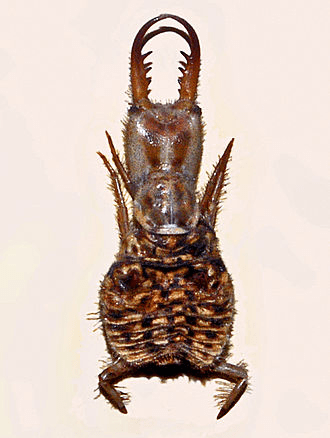
The ant lion, in all of its creepiness
Its sole purpose in life is to catch other small insects in a cleverly crafted pit in loose sand or dirt, attack them with its formidable jaws, inject them with poison and then suck the juice out of them. Sometimes, they can kill insects larger than themselves. On their journey to create the “insect pit of death,” the bugs leave a crazy wandering pattern on the ground looking like someone’s mindless doodling with a pen on paper — hence the name “doodlebug.” For the longest time, I thought earthworms were leaving the meandering paths, but after some research discovered they were created by these weird bugs.
A doodlebug path in the sand with some traps.
Just down the street and around the corner from our house, there is one section of dirt bordering the roadway where there are literally hundreds of the bug traps left by the ant lions. Below are a couple of photos I took recently of the doodlebug-infested landscape:
Almost like craters on the moon.
With the sun casting a shadow on the sides of the traps, they almost look like small mounds.
I’m not sure why the population of ant lions has chosen this particular spot for their home. It’s probably the fine sand that provides the slippery slope that their victims can’t escape from when they fall into the traps.
As I’ve mentioned before, our neighborhood has been home to lots of wildlife over the years — raccoons, skunks, squirrels, javelinas, foxes, owls, wild turkeys, coyotes, etc. I guess there is just something about Mesilla Park that appeals to critters.
I’m happy the ant lions seem to like it here and take care of capturing otherwise undesirable ants, spiders (and maybe scorpions), but I’m especially happy that they’re not large enough to create traps that humans can fall into and have their blood sucked out.
Anyone who’s been in New Mexico for a while knows about the burning of Zozobra, the effigy portraying gloom and doom that is torched every year around Labor Day during the Santa Fe Fiesta.
The burning of Zozbra began in 1924 when Santa Fe artist Will Shuster decided to have a private Fiesta party in which the ceremonial burning of an effigy would rid his guests of any chance of bad luck in the coming year. Schuster and a friend came up with the word Zozobra for the effigy, which is based on the Spanish verb Zozobrar, meaning “to worry.” The roots of the ceremony can be traced back to Easter Holy Week traditions in some Native American communities of Arizona and Mexico, in which an effigy of Judas was led around villages on a donkey and ultimately set on fire.
I once interviewed legendary State Historian Myra Ellen Jenkins about the New Mexico tradition and enjoyed her colorful description of such events in the state’s past.
“There were communities that would goof around with a ceremony every year and set little statues on fire to make sure there was good luck from the coming year,” I think I recall her telling me. “And I think they had some libations with the ceremony which made them feel even more optimistic about the future.”
The burning of Zozobra — now a 50-foot tall effigy that isset on fire every year around Labor Day at Santa Fe’s Fort Marcy Park — now has a new twist.
The cities of Santa Fe and Albuquerque announced this week that they have authorized construction of a 135-foot tall hot air balloon in the shape of Zozobra that will fly this year’s Albuquerque International Balloon Fiesta.
Rendering of what the Zozobra hot air balloon will look like.
Naturally, in keeping with tradition, I wondered whether the balloon will be set on fire after each flight — an expensive proposition given that the balloon is estimated to cost about $300,000 to construct. And of course, hot air balloons already have fires on board to heat air inside them and make them buoyant, so torching them immediately upon landing would be easy.
This made me think about a Federal Aviation Administration regulation, Part 830.5, which defines what constitutes an aircraft incident or accident which must be immediately reported to the National Transportation Safety Board.
It says the operator of an aircraft must notify NTSB in the event of several occurrences, including: “(4) in-flight fire,” and “(5) Aircraft collision in flight.”
Well, duh, you kind of have to have an in-flight fire to keep a hot air balloon aloft. And if you’ve even seen the Albuquerque International Balloon Fiesta, you’ll frequently notice balloons gently bumping into eachother during mass ascensions, which I guess counts as an “in-flight collision.”
In my experience in flying a hot air balloon, I’ve always had an “in-flight fire” and I’ve had numerous occasions at Fiesta where other balloons bumped into me or I bumped into them during a flight without any consequences. I’ve never reported any of these incidents to the NTSB — maybe I should have.
This Labor Day weekend, maybe I should burn a miniature version of Zozobra so I won’t have to worry about reporting myself to the feds.
There was a sad story in the Albuquerque Journal last week about a young man from the Boston area who had died from ingesting too much capsicum in chile extract from participating in a “One Chip Challenge” that was circulating on social media.
The story noted that the young man had a congenital heart defect which made it more difficult for his body to process the intense hot flavor of the chile extract.
Reading the story made me think back to our daughter’s science fair project during middle school involving the effects of hot chile on humans. (I’m proud to say that both of our kids made it to the state science fair at New Mexico Tech with their projects. They didn’t get top state honors since those usually went to the sons or daughters of rocket scientists whose projects were so sophisticated and esoteric that it made my brain hurt when I tried to understand them.)
My son’s winning project involved predicting the time frame for deterioration of adobe bricks exposed to the outdoors. He had another project in which he tried to determine whether Seasonal Affective Disorder affected the behavior of mice kept in a dark closest. (I’ll save that story for a later time.)
Our daughter first tried an experiment to determine how quickly different colors or hot air balloon fabric deteriorated when exposed to constant sunlight and UV rays. She got an honorable mention at the local fair but did not advance to the state event . But her real “contribution to science” was an 8th grade project entitled “Chile Heat.”
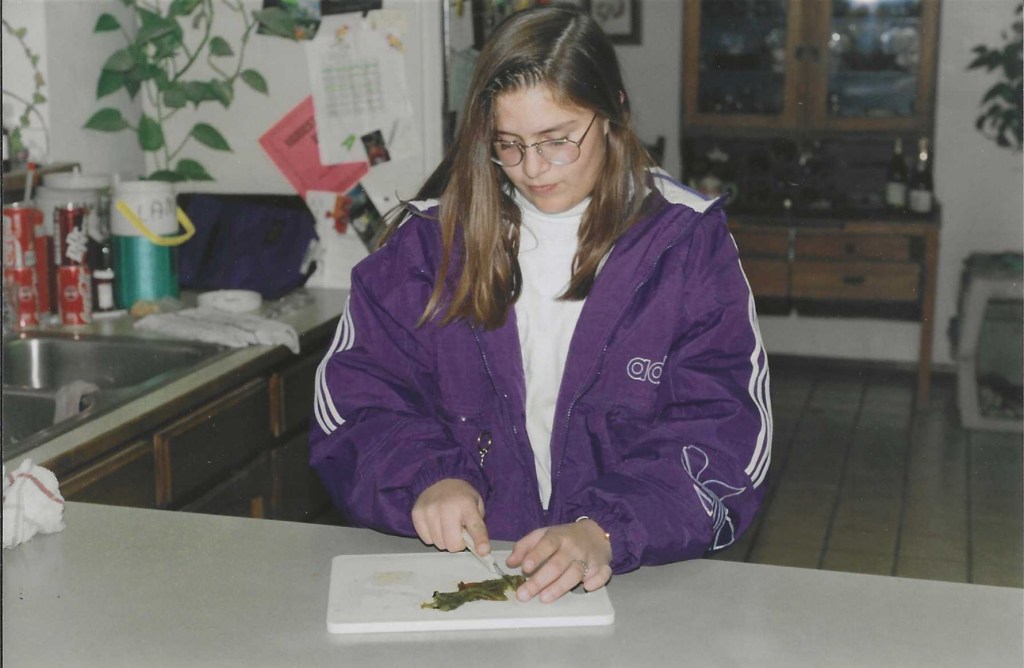
Our daughter, in the 8th grade, preparing hot chile for her science fair experiment.
In the project, she asked almost 50 neighbors, work associates and other individuals to taste some really hot green chile and determine whether it might instantly raise their body temperature. Her thought was that a dose of hot chile or its extract might help raise a person’s body temperature if they had been exposed to extreme cold.
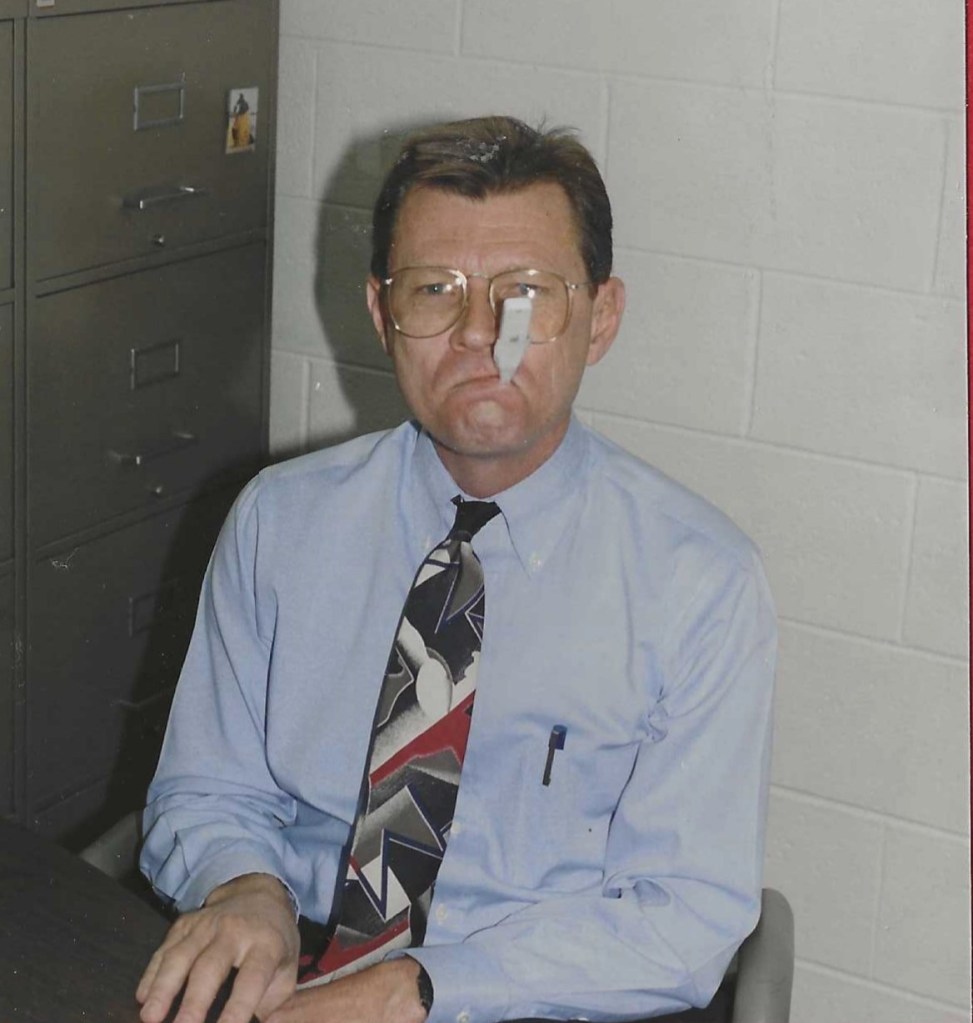
Long-time friend and project consultant Dr. Joel Diemer, taking his temperature after eating hot chile.
The results were pretty impressive. Almost 84% of the participants showed an immediate increase in body temperature of about 1 degree after eating the hot green chile. Many of the participants (including me) had intensely watery eyes, red faces and at least a couple experienced severe hiccups.
Neighbor Kathy Groves, being administered a dose of hot chile for Lindsay’s science experiment.
I know from experience that you can get a pretty severe reaction to hot chile. I once ate a raw chile pepper that was so hot I thought I was going to choke and pass out. Another time, my wife and I peeled so much hot green chile that our hands began to burn. The pain was so intense that we called the state poison control center for help. Their only advice was to stick our hands in ice water for as long as we could stand it to numb the pain. I wore contact lenses at the time and I couldn’t insert them in my eyes for a week afterwards because of the continued burning sensation transferred from my fingers to the contacts and my eyes.
Chile does have its beneficial effects on humans. According to an article in “MedicalNewsToday,” capsicum, including capsaicin, “may help reduce pain and lower the risk of metabolic syndrome and cancer. Research also implies it may reduce the risk of death, as well as fight bacterial infections that are resistant to antibiotics.”
But as much as most New Mexicans love their chile, we have to realize there may be a limit to how much we can tolerate the really hot stuff.
One thing I think New Mexican can ever get enough of is the aroma of roasting green chile. After all, the New Mexico Legislature in 2023 declared it as “the official state scent.” I think that’s a lot more appealing than the smell of crude oil in Texas or feedlots in Nebraska.
I’m easily entertained by people watching at airports when I’m waiting for a plane. I wonder why people are traveling, what their lives might be like and who they might vote for in the upcoming elections. (Actually, I don’t think you can guess that by mere appearance, given my experience as a voter registration clerk in two previous elections.)
So while waiting for my flight out of Austin this week, I noticed a couple across from me, clearly trying to look affluent and cool and hide their age with excessive black coloration of their hair that seemed to conflict with the many creases in their faces. (Yes, I have those age lines too, but my hair is what it is — brown with more and more touches of gray).
On the lap of the man was a tiny dog, a terrier of some sort, with a pink topknot bow apparently indicating its female gender. I doubt the dog weighed more than five pounds and was well behaved. It never made a yip or a bark and only got excited when the man fed it a tiny bit of Amy’s Ice Cream.
Dog ready for her trip to Kansas City. Faces of woman owner and girl next to her are intentionally blurred.
As the couple’s flight was called to board for Kansas City, the woman picked up her medium sized and oh-so-fashionable black leather purse and unzipped it. I suspected she was checking for last minute flight necessities before boarding.
But what happened was not what I expected. The woman scooped up the pup from her husband’s lap and placed it (gently) in her purse. Then she zipped it completely shut and walked toward the boarding line.
The dog never made a noise — not a whimper, yip or a bark.
As far as I could tell, the purse was not made specially for carrying around a small dog. I saw no vent holes or screens where the dog could peek out.
I can’t imagine anything more terrifying for a dog — being zipped into a complete dark case with little or no air circulation and no way of seeing out. And on top of that, I’m sure the high-pitched whine of the jet’s engines and the extremely rough ride we all experienced getting out of Austin that day was even more frightening for the dog.
I love all dogs, even though I’m partial to full sized ones like our pooch Chester. I like it when they are around, but I think there is a limit to that. I see more and more people traveling on planes with their pets these days. These owners must like showing off their dogs or proving how cool they are by traveling with them. (Service animal owners excepted). However, I suspect most dogs (or cats) would much prefer just to be left at home in their familiar places while they are temporarily cared for by someone hired by their owners.
I could not imagine treating an animal like that small dog was treated this week.
Maybe next time I see something like this at an airport, I should rush over and grab the animal’s container from its owner then free it. But of course, that would be terrifying for the animal as well and I would end up in jail. I can just hope people like this dog’s owners will display good common sense in the future.
__________________________
On another topic and speaking of elections, I will start another round of volunteering as an election clerk tomorrow. I work as a same day registration clerk for the two weeks prior to the June 4 New Mexico primary and then on election day doing that same job and working as a “Machine Judge” — essentially the No. 2 person at the polls.
Because of these duties, my blogs may be a bit sparse in the next couple of weeks. But I’ll have lots of time to think about what I hope will be entertaining topics to write about.
And as always, if you have any comments or questions, please forward them to to me at my email address at patrick@aero.cordero.com
My wife and I have become fans of the “Father Brown” mystery series on Brit Box. A meddling Catholic priest in the mythical town of Kembleford in the Cotswold region of England is an amateur sleuth who always manages to upstage the local police in their investigations of murders in the otherwise tranquil British countryside.
One of the characters in the series is Lady Felicia, a woman of nobility who is shuttled around in her classic Rolls Royce by her chauffeur, Sid, who also occasionally assists Fr. Brown in his investigations.
Lady Felicia and her classic 1937 Rolls Royce
And while Sid may have a guaranteed job during the time period of this series, a recent article I read showed more and more Rolls Royce drivers are choosing to drive their own luxury sedans rather than having a chauffeur at the wheel. That means that more and more Rolls Royce chauffeurs may be looking for new work these days.
I once read an excerpt from a Rolls Royce owners’ manual which had a separate section on driving tips for chauffeurs. One of those tips suggested that upon coming to a stop, the chauffer should slowly decrease pressure on the brake pedal so that the passengers do not experience a lurch forward at the final point of stopping. (I actually try to practice that myself, although I’m certain no one has noticed.)
And speaking of cars eliminating jobs, I spotted a related article in my last edition of the “Roundel,” the BMW owners group magazine.
In that article, it said the BMW is currently experimenting with a self driving feature that allows certain high-end Bimmers to valet park themselves. It apparently only works at locations that have the proper technology to guide the driverless car to an appropriate parking spot. Here’s what the article said:
“Cars that can park themselves once you have found a spot are becoming increasingly common, but BMW takes this to a whole new level with the Remote Valet Parking Assistant. The feature has been integrated in a research version of the electric BMW i3, and combines information from laser sensors with digital plans of multi-story car parks to navigate.
The driver can just get out and activate the parking assistant on a smartwatch, for example. The sensors let the car recognize the structural features of the car park and avoid any obstacles that appear unexpectedly, such as incorrectly parked vehicles. Once the car has arrived at the parking space, it locks itself.”
So if you’ve been nervous about tossing the keys of your $165,000 BMW M8 Competition convertible to an overly testosteroned 20-something valet parking attendant, fear no more — Remote Valet Assistant Parking will do the parking for you.
Would you give the keys to this BMW M8 Competition to some guy you’ve never met before?
But if you pull up to that fancy restaurant in a ratted out 1996 Chevy Malibu, you’re on your own to park it. The valet parking attendendant has been replaced by BMW.
Imagine you come to self awareness and realize you are a rainbow trout in a 55-gallon glass prison cell. You constantly bump up against the clear walls that surround you and you endure the endless sound of buzzing machines pumping water. Each day, at least 100 scary animals, mostly small humans, peer at you quizzically through the glass. A larger human occasionally dips testing things into the water, but you’re not sure if she’s trying to help or catch you.
You’d consider swimming so fast that you could leap out of the tank, but who knows what fate might await you once you escaped.
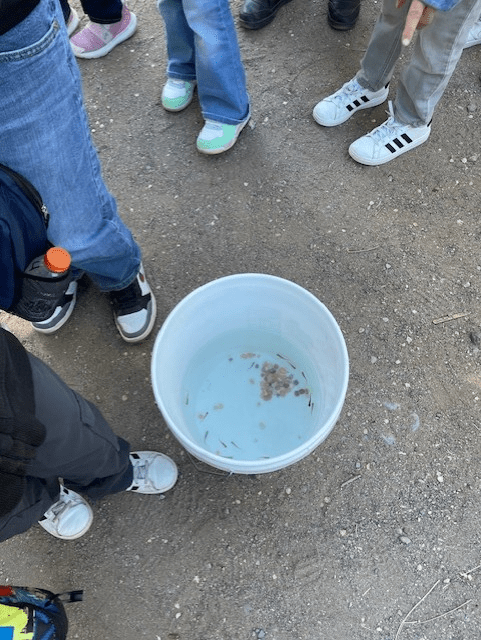
But today, one of the larger human animals dipped you out of the glass prison and put you and your other 12 brothers and sisters in a white round object filled with water. Next you went on a scary rumbling ride in a thing that looked like a giant yellow dragonfly, then were scooped out into a smaller white round object and then … suddenly released in a clear, cold river in the mountains. You are now free to live your life with other members of the Oncorhynchus mykiss in the Rio Ruidoso.
Third grade teacher Rachel Lutterman tells students what’s about to happen on trout release day.
The White Mountain 13 in a bucket awaiting release.
Yes, the White Mountain Elementary Trout In the Classroom fish were freed today into the waters of the Rio Ruidoso.
Okay, enough of the drama. If you’ve been following my blog, you know that I’ve been helping the third grade classes at White Mountain Elementary with Trout Unlimited’s “Trout In the Classroom” program to help young students learn about the importance of clean cold waters by raising trout in their classes and releasing them into the wild.
Today’s event culminated more than three months of raising trout from eggs to fry in the third grade classroom of Michelle Thurston at White Mountain Elementary. Assisted by “Trout Queen” teacher Rachel Lutterman and four other third grade teachers, the fruits of their semester-long effort were achieved today in a grand release party on the river. (You can read my earlier posts on this project by clicking on the blog section and scrolling down.)
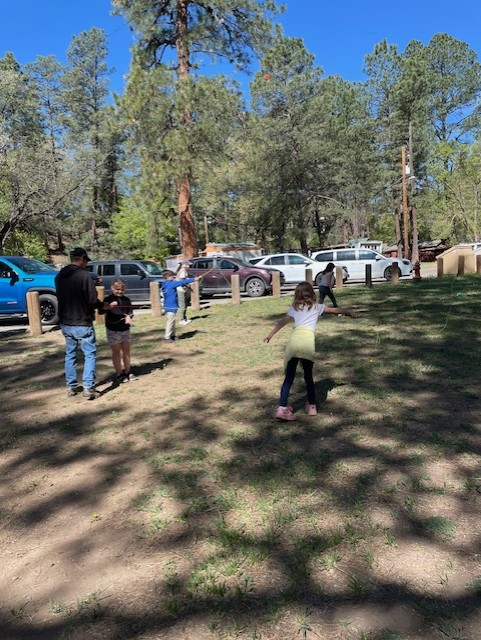
The 125-plus third grade students who were bused to the park enjoyed the day by going on a nature scavenger hunt, checking water quality on the river and learning about fly fishing and casting from my wife and me. Then they all gathered around as we released each of the 13 fish into the waters of the Rio Ruidoso. And then to celebrate, they managed to munch down 35 boxes of pizza provided by Trout Unlimited and other donors.
White Mountain Elementary third graders practice casting, aided by my wife and other volunteers.
I had the honor of releasing “The Big Kahuna,” the largest of the small trout that were raised in the tank at the school. He was in a large plastic bucket with 12 of his brothers and sisters when teacher Rachel Lutterman scooped him into a small paper cup. I took him to the bank of the river with scores of third graders looking on as I loudly announced: “The release of the Big Kahuna.” Then I kneeled down and let him slip out of the cup into the river. It was followed by a big cheer, one of the best I’ve ever experienced.
Me, center, getting ready to release “The Big Kahuna”
It was a happy moment but also sad. One of the teachers actually shed a tear because she will miss them swimming around the tank in the classroom and worried about their survival.
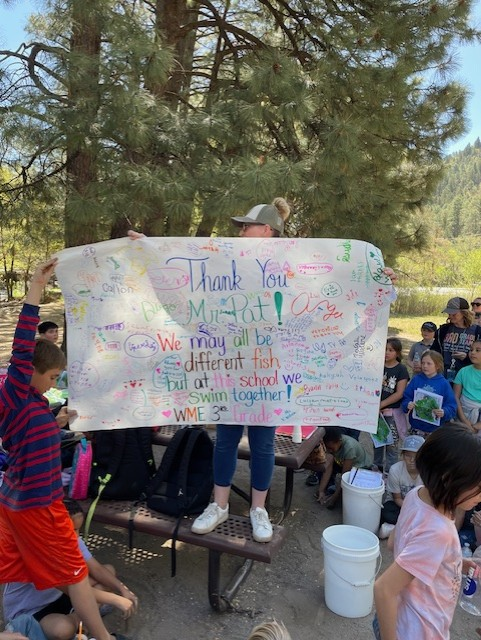
Teacher Rachel Lutterman holds banner signed by all students thanking me for supporting the TIC program
The teachers were so enthusiastic about the program that they are planning to do it again next fall. They put an incredible amount of work into this project and parents should be proud to have their kids in these classes. I hope it all goes well next time around and that the Big Kahuna can be a mentor to the new fish that will be released sometime in December.
Imagine that you’re cruising down Interstate 10 in southern New Mexico. It’s getting close to lunchtime and your Tesla’s charge is getting low. On your car’s navigation screen, a Tesla charging location pops up on the next exit in Las Cruces. You take the exit and there it is — “The Roasted Rooster” with about a dozen Tesla charging ports just waiting for your electrified ride and your growling tummy.
What could be more convenient — a charge and a chicken and waffle combo while you wait.
But wait — what’s this next door? The “Baked Chicken Farm?”
Look closely at the image above and you’ll see that it’s not another chicken-based eatery. It is a marijuana dispensary and a “farmware” outlet.
Note signs circled in blue
Tempted as I was to explore what might be considered “farmware,” I didn’t care to be seen venturing into a marijuana dispensary to determine if they sold overalls. I’ll just have to speculate that they sell farmer-type clothing or maybe other farming accoutrements.
I’m wondering what kind of person might venture into this place. I guess if you are an overall-wearing uber/urban cowboy/farmer who drives one of the weird Telsa Cybertrucks, loves chicken and waffles and likes to stay buzzed on weed, you’ve made it to the promised land.
Tesla Cybertruck
But if you’re the typical southern New Mexico farmer/cowboy, driving a Ford F250 Super Duty in your wranglers, sipping a Coors light and craving a green chile cheeseburger for lunch, I doubt that this is your kind of place.
However, I do have to hand it to the owner of this facility for offering something truly unique in terms of cross marketing and especially for giving me some fodder for my blog.
Warning: This blog may be as close to a political statement as I have made in my four years of writing at Aero-Cordero.com. You are welcome to click out if you don’t want to read it.
If you try to get information about how to contact a local newsroom of the Ruidoso News — the newspaper that my father owned in the town of Ruidoso for about 20 years — you’re out of luck. The newspaper that he fostered and grew into a significant contributor to growth, success and political integrity of the Village of Ruidoso from the early 1950s to the 1970s, doesn’t seem to care about news any more.
I tried last week to send the newspaper a story about the “Trout In the Classroom” project that I have been working on for several months at White Mountain Elementary in Ruidoso. (See previous blogs for more details). I had no success in finding a local number or even an office address for the Ruidoso News.
If you look up Ruidoso News online you can find a website and an 800 phone number. Both give you options on how get a new subscription, what to do if you’ve missed getting a paper or who to contact if you want to buy advertising. But nowhere is there a local phone number or information about contacting the organization about a local news item.
I mean, isn’t the purpose of a newspaper to gather and distribute news?
Headline from 1975 edition of Ruidoso News
Frustrated, I called the Ruidoso of Chamber of Commerce to see if they had a local phone number for the Ruidoso News, now owned by the USA Today network.
“No, we don’t have one. I don’t think they even have an office here any more,” said the person at the Chamber of Commerce.
I called the 800 number for subscriptions and finally was able to speak to a human. I said I wasn’t interested in a subscription, but wanted to know how to get in touch with the newspaper’s editorial staff. After a long wait on hold, I was told “I don’t have a local number for the news operation. I think they’re changing the number.”
Again, a newspaper without the ability to gather news does not make sense to me.
Most people don’t have time to attend every meeting of city council, school board, county commission or other government agency activity. That’s the job of the press — to be there if we can’t. If there’s no one looking over the shoulders of the city council, school board, the county commission or a government agency, they can get away with things that are not in the best interest of the citizens. A report by a group trying to foster local news reporting says there are now more than 200 counties in the United States that do not have newspapers and more than 1,500 with only once source of news. And in my opinion, there are many, many more counties which have a poor excuse for a local newspaper.
Here’s a website by Northwestern University that you may want to look at which shows how dire the situation is:
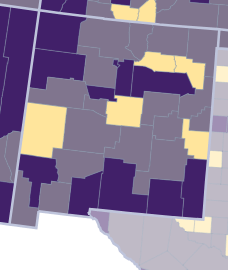
And here’s a map of local news outlets in New Mexico. The yellow shows counties with no local news outlet, the gray show counties which have only one local news outlet and the blue shows counties with two or more more local news outlets.
Map showing local news outlets in New Mexico.
Some political figures these days have called the media “the enemy of the people.” All politicians, left or right, have probably criticized the media at one time or another as being biased against them. As a former journalist, I got heat from several political figures because I didn’t write a story the way they wanted me to — but I wrote the truth. I was once accused of “faulty reporting” because I did not report on one political figure lambasting another at a public hearing. I instead wrote about a report that was released at that same hearing praising advances in women’s sports programs at state universities.
Journalists for legitimate news outlets make mistakes (as I have done), but I truly believe they all do their best to bring the truth to the people.
The phrase “don’t shoot the messenger,” is something any journalist knows. It has been around forever, beginning as far back as the 3rd and 5th century in Chinese dynasties of those eras. As you know, the phrase relates to blaming bearer of bad (or accurate) news for things that have gone wrong. Even Shakespeare referred to the phrase in his plays “Henry the IV” and “Antony and Cleopatra.” The press is often that messenger who gets shot.
Our local daily newspaper, also a member of the USA today network, is a sad example of what it used to be. It appears that it makes most of its money from obituaries of local citizens, then fills much the rest of pages with newswire copy that is at least two days old.
We had a fatal shooting just two blocks from our house two weeks ago. We’ve never seen a story about that incident in the local paper. I think that would have been important for me to know about. My wife’s friend told her about two local high schools whose athletic teams had won state competitions recently. There was nothing about it in the local daily newspaper — again, something I think our community would have liked to know.
There is good news in that we have a strong local weekly newspaper, where we consistently learn more about what is going around Las Cruces than in the USA today publication. Additionally, a former journalist for the local daily has started an online newspaper which you can reach through Facebook.
The bottom line is that you must support good local journalism to keep everyone informed and to keep political figures and government agencies in line.
But the problem is this: Many people these days don’t support local journalism. Neither my son nor daughter subscribe to their local newspapers. I don’t criticize them — their peers don’t value local journalism either. I suspect many of you who read this don’t subscribe to a local newspaper or follow another local news outlet. If newspapers or other local outlets don’t have subscribers, they will fail and we will have no one to look out for our interests. The other problem is that many newspapers are now owned by large corporations, whose focus seems to be more on the bottom line than in actually serving the community with needed news.
These days, many people rely on the internet, television or radio for their news, often choosing to read, watch or listen only to sites or programs which support their point of view.
I’ve made it a point to listen to and read other clearly biased viewpoints on both sides of issues, both conservative and liberal. I want to know what people are thinking and I struggle to learn why they think the way they do. Hearing what they say — on both sides — is often deeply upsetting to me and I fear that bias has spread the seeds of doubt and conspiracy theories.
I’ll close my rant with this statement from Thomas Jefferson:
“If I had to choose between government and a free press, I would choose a free press.”
As my father is rolling over in his grave from the demise of his once great local newspaper, I hope you, my readers, will support good local journalism.
One of the cool things that happens in our neighborhood every spring is the annual plant sale at the New Mexico State University’s Fabian Garcia botanical garden and research center. It’s just a short walk from our house through a nearby pecan orchard.
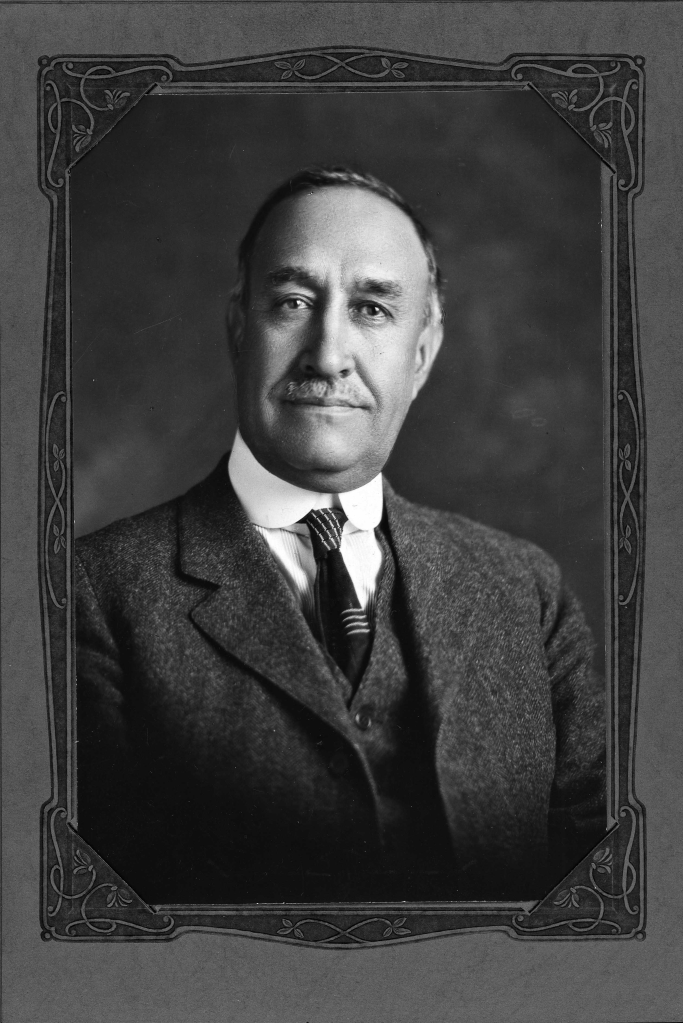
Garcia was a visionary horticulturist at NMSU in the 1900s, noted especially for his research on chile plants. Here’s a link to the NMSU website which gives you more information about Garcia and his work.
The center contains several acres of research gardens, an exhibition of native plants and even a landscaped outdoor space where many weddings are held during the year.
The New Mexico Chile Pepper Institute at NMSU, of which I am proud to say I am a member, organizes and conducts the plant sale. There is a wide variety of plants, which have recently sprouted from seeds and are placed in four-inch square pots for transplanting in your garden. It’s a two-day event, but you’d best get there early to get what you want.
Plants ready for sale
In my case, it was some chile plants — Big Jim and New Mexico Heritage varieties that I manage to squeeze in a row in our raised garden in between my wife’s corn and cucumbers. I forked over $47 for the plants — money well spent, I hope. The chiles seem to go first during the sale. I stopped by the second day of the event last year and they were completely out of all chile varieties.
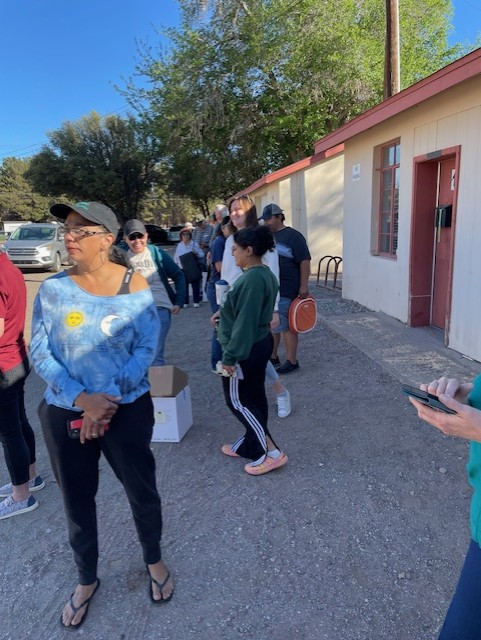
Customers waiting in line half an hour before plant sale starts
Other plants on sale include a wide variety of tomatoes, squash, bell peppers of all colors. and other varieties of peppers, including jalapenos. You can also buy seeds for various varieties of chile, just in case you didn’t find what you wanted. And this year, as an added bonus, we all received a free package of seeds for a “Mystery Pepper.”
Who knows how hot these peppers might be.
I’ll try to plant a couple of these and see what they taste like. I’m betting that they’re going to be really hot.
Anyway, if you’re in my neighborhood next year around the middle of April, stop by for the plant sale at the Fabian Garcia Center. It will be a hot date.
You may recall my earlier high-level journalistic investigations into the smuggling of Mexican bologna into the state. This was prompted by stories that the processed meat from Mexico was being transported across the state’s southern border inside spare tires, beneath car seats and intermingled with underwear in suitcases.
Well now the smuggling game has taken a new an ugly twist.
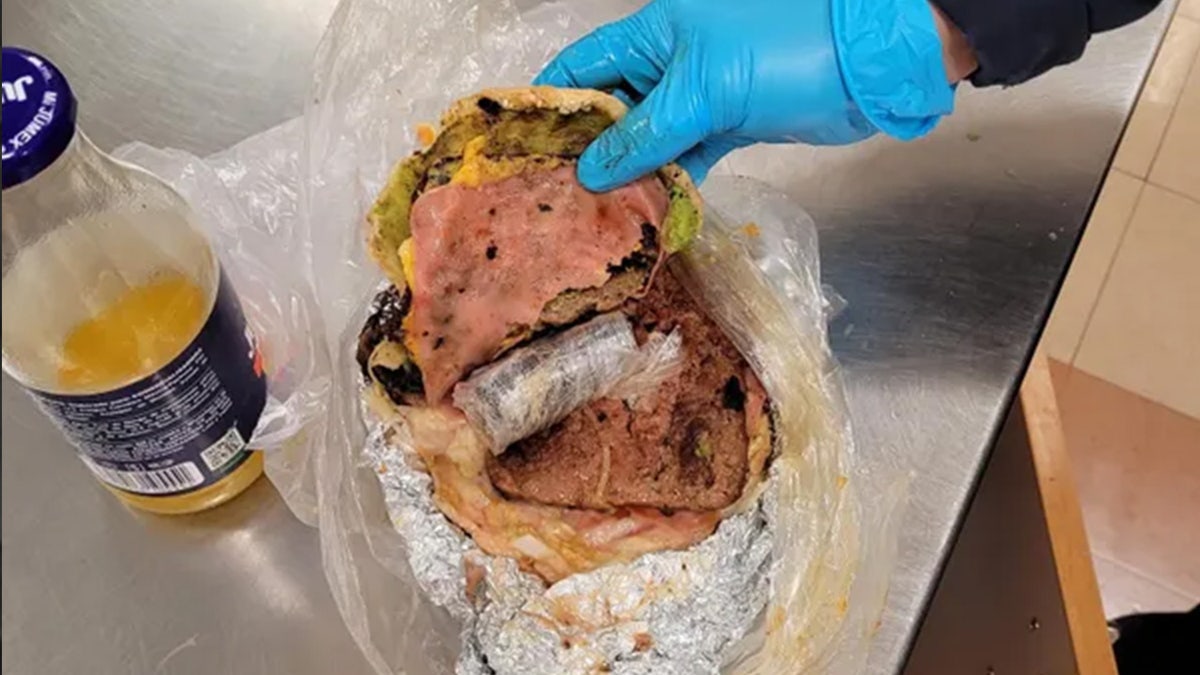
A recent article in the Albuquerque Journal edition says a woman tried to sneak a supply of the illegal drug fentanyl across the southern New Mexico border inside a hamburger.
I don’t think the burger looks very appetizing to begin with, even without the baggie of fentanyl stuffed in the middle.
It also looks like there was green chile added to the burger. Somehow, I think a splash of hot Hatch green chile and fentanyl would make an especially toxic mix.
What concerns me, however, is that it looked like this burger was part of a combo deal which included the drink to the left of the burger. I wonder if they tested the drink to see if it was laced with LSD.
You may recall that last fall, we traveled to Corona, NM, watched the sun’s corona emerge from the edges of an annular eclipse and drank a Corona beer to celebrate. And on the way back, our good friends who rode with us to experience the astronomical phenomena started coming down with a case of the Coronavirus. (Four Coronas.) Luckily, both my wife and I did not catch the virus, even though were cooped up in the same car with our friends for several hours.
That eclipse was an annular “ring of fire” eclipse, where the sun’s outer edges peaked out around the sides of the moon’s disk. It was an impressive experience and it got really cold when it peaked, but it didn’t get all that dark.
Fast forward to earlier this week, when we traveled to Austin to witness a total eclipse with our daughter and grandchildren.
Despite intermittent cloud cover, we were able to experience totality. It got so dark that street lights turned on, birds and insects stopped chirping and churring and it got quite a bit colder.
However, it was far from completely quiet. We went to our granddaughter’s elementary school to witness the event on the playground with about 450 kindergarten through fifth grade students and many of their parents.
It was a cacophony of kids laughing, shrieking and generally talking as loud as they could outdoors. When the approaching eclipse would peek out momentarily from behind a cloud, the kids would cheer “YAY” at the top of their lungs. When the sun slid back behind a cloud, waves of “BOO” would erupt from the crowd. The video below gives you a sample of what it was like.
On the playground at Lee Elementary School during the eclipse. The kids, as you might expect, were wild.
And below is a picture when totality occurred at 1:34 p.m. At that time, the sun was pretty much obscured by the clouds, but you can see how dark it was. (My iPhone did its best to make the picture bright, so this photo is artificially enhanced.)
1:34 p.m., Austin, TX
My wife, daughter and I wore the t-shirts we had created for the eclipse in Corona last fall, and I chose to wear some really goofy-looking welding glasses — all in hopes of providing maximum embarrassment to our granddaughter. (I actually think she found it funny.)
Ready for the eclipse. I‘m in between my wife Margo and daughter LIndsay. Granddaughter Hannah is on the right.
Our grandson Hayes, who was at a different school that day, got to see the totality when the clouds parted at just the right moment. His viewing outfit, as shown below, was even more unusual than mine.
Grandson Hayes ready to view the eclipse at Ridgetop Elementary School in Austin.
It was a great experience and I’m glad we had the opportunity to see the eclipse. The next one will be in 2026, but you’ll have to travel to Greenland, Iceland or Spain to catch it. I think I’ll just stay home, wear my t-shirt, drink a Corona and hope no one nearby has the Coronavirus.




















 aero-cordero.com