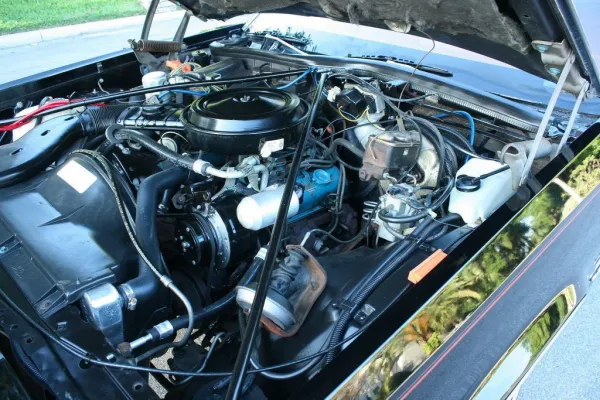
In the late 1970s, General Motors was caught in the act of putting Chevrolet V8 motors into other models in the GM lineup — Oldsmobile in particular. The swap was discovered when a Chicago man went to the dealership and was told by his mechanic that a part that had been ordered for his Olds “Rocket V8” wouldn’t fit, but that a similar part for a Chevy V8 would.
A chevy V8 in a 1977 Oldsmobile.
The matter ended up in a lawsuit and in the end General Motors agreed to pay purchasers of Chevrolet-engine Oldsmobiles prior to April 10, 1977 refunds of $550, while those who purchased one afterward got nothing. Furthermore, there would be no punitive damages assessed against GM. Total settlement cost to GM: $8.2 million.
In fact, engine swapping between brands at Ford and Chrysler had been going on for some time as well, but it didn’t raise the rumble that the GM motor swap did.
I remember years later buying various GM vehicles that had a disclaimer that engines might be supplied by “various General Motors” divisions.
The reason I mention this is that I discovered a parts swapping incident involving my body earlier this week.
As some may recall I had an aortic heart valve replacement four and one-half years ago to fix a murmur that I’d apparently had since birth. The procedure went well, and at my last echo cardiogram, I was told that my new heart valve was doing so well that I no longer needed annual ECGs — I could wait three to five years before I should get another one.
But during the discussion of my results, my doctor casually mentioned that he thought I had received a “bovine” heart valve in the procedure.
Whoa! I had been told when I scheduled the surgery that I would likely get a valve from a pig. I envisioned it would come fresh right before a festive Cinco de Mayo pig roast in Dona Ana, where the remnants of the swine were ultimately turned into chicharrónes.
So the doctor double checked, and sure enough, I had been given a heart valve from a cow. He told me that cow heart valves were a bit more durable than ones from a pig, and that it should last me several years before I might have to have it replaced again.
My donor?
So instead of finding out that I got a cheapo Chevy engine in my Olds, I guess I got a Cowdillac engine. (It’s okay, you can groan).
While the Coronavirus has claimed an estimated 7 million lives around the world since it first appeared in early 2020, it was nothing compared to the plague epidemic which gripped Europe and northern Africa from 1346 to 1353. Estimates are that between 25 and 50 million people died during the plague, also known as the “Black Death.” Half of the population of Paris is said to have perished during the pandemic.
I mention this because the Albuquerque Journal reported last month that the state had recorded its first fatal case of bubonic plague this year. It was the first death from the plague in New Mexico since 2020.
As a reporter for United Press International in Santa Fe, I wrote many stories about plague cases in the state during the 1970s.
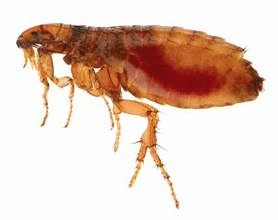
The disease is endemic in New Mexico, usually spread from fleas from an infected animal that a human comes in contact with or from fleas on a pet that has been exposed to an infected animal. The bite of an inflected flea is what normally transmits the disease to a human.
common flea
In Europe, much of the disease was spread as the pneumonic form, which could be transmitted through the air by humans breathing or coughing on another human.
In New Mexico, largely because of our arid climate, the organism which causes the disease has been around forever. Cases usually increase during the warmer summer months when humans (and their pets) venture outdoors. If you live in an area of the state where the plague is common, you can reduce your chance of getting the plague if you avoid any dead wild animals and keep your pets treated for fleas.
One summer when I was a reporter in Santa Fe, there was an unusual uptick in the number of plague cases. In fact, entomologists determined that a dog named “Snoopy,” owned by then New Mexico Gov. David F. Cargo, carried infected fleas and the governor’s mansion had to be disinfected for the insect.
I also remember that the high number of cases had caught the attention of a foreign country — I think it was somewhere in the Middle east — and it banned visitors from New Mexico for a period of time.
The good news is that these cases are pretty rare, and because they occur on a fairly regular basis in our state, doctors in New Mexico are more likely to pick up on plague symptoms and know how to diagnose and treat patients.
There is no lack of wild critters roaming through our neighborhood — skunks, foxes, raccoons, squirrels, pack rats, coyotes — so we’ve been careful about giving our dog a regular treatment to keep fleas at bay.
Which reminds me that it’s time today to force Chester to gulp down a large chunk of medicine which he really dislikes and is no fun for me either. When my hands recover from being bathed in slimy dog slobber, I’ll start writing my next blog.
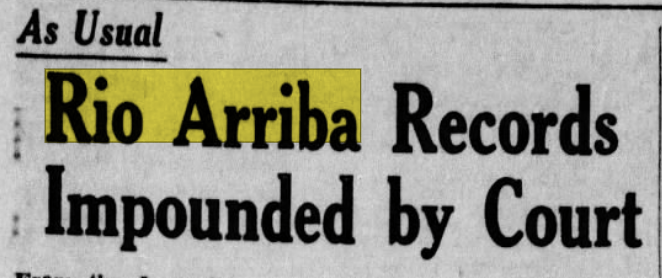
The headline below appeared in the 1966 Albuquerque Journal following the November general election.
For years, New Mexico’s Rio Arriba County has been tagged as the election irregularity poster child, most notably during the tenure of long-time political boss Emilio Naranjo.
Naranjo, who died in 2008 at the age of 92, was a true political patron who at one time or another served as the county’s Democratic Party Chairman, County Manager, County Sheriff and many years as State Senator. His leadership was frequently surrounded by controversy, especially involving voting practices in the northern New Mexico county.
What made me think of Naranjo was an article in this week’s Albuquerque Journal, which said that New Mexico’s elections are “conducted more reliably than any other state in the nation.” That is according to The Elections Performance Index, a project of the Massachusetts Institute of Technology that attempts to measure efficiency and purity of election administration in each state.
I’m proud to say that I might have been part of that “reliability” since I have served as a volunteer election clerk for the last general and last special election in Dona Ana County. I’ve signed up again to work the upcoming primary election in June. My experience has been that everything is above board and I’ve seen no evidence of election irregularity.
That apparently always wasn’t the case in the state, particularly in Rio Arriba County.
I did a search on Newspapers.com for “Rio Arriba County election irregularities” and came up with what seemed to be an endless supply of articles on the subject.
In 1906, an article in the Santa Fe New Mexican said that the final voting tally for a Congressional race for the Territory of New Mexico could not be completed because results from Rio Arriba County were not yet available. (Lincoln County, another political bad boy of that era, also had not submitted its final tally.)
The article noted that the results from Rio Arriba would determine the outcome of the Congressional race, but “for inexplicable reasons, results from that county have not come in any reliable form…”
Two stories from the 1976 general election caught my eye. One quoted New Mexico Chief of Police Martin Vigil saying that 15 additional State Police officers had been assigned to watch for irregularities at voting locations in Rio Arriba County. After the election, there was this lead in an Albuquerque Journal story:
“Rio Arriba County ballots were impounded — as usual — in the general election Tuesday.”
Another article in the Albuquerque Journal following a general election said a voting machine in Chimayo had an inoperative lever for a candidate who was not supported by the Naranjo camp.
But voting irregularities were not unique to Rio Arriba County in New Mexico. I worked in a peripheral role during a campaign in Dona Ana County the early 1980s and remember hearing conversations about “walking around money” that was paid by some political figures to get out the vote for certain candidates — fortunately not the one I was supporting.
Are things finally on the up and up in Rio Arriba County? As recently as 2002, it appears that might not have been the case. An Albuquerque Journal editorial noted that 360 absentee voting ballots had been submitted in Rio Arriba County for the upcoming primary election, compared to just 100 Bernalillo County with 13 times as many residents.
Even if shady things are still going on in Rio Arriba County elections (which the MIT report seems to refute) the good thing is that I don’t think the county has enough votes to impact a national election.
Digging through Newspapers.com this week, I found a newspaper from a town I had never heard of before in southern New Mexico. The town, now considered a ghost town with nothing much to show for it, was called Robinson.
Its site is located north of the remote Sierra County town of Winston and is also near a more famous New Mexico ghost town, Chloride. This region was an active mining area in the 1880s but most of the mines collapsed after the “Silver Panic of 1893” when the metal’s prices plummeted.
The newspaper in Robinson, known as the Range (after the Black Range mountains), was eventually moved to Chloride, but apparently failed during the silver mining collapse.
The website Ghosttowns.com says the town was founded in 1882 as a proposed terminal for the Santa Fe Railroad. Unfortunately, the railroad veered much further east and bypassed the Black Range area entirely and by 1888, all of the buildings were town down. The town’s name may have come from the chief railroad engineer who failed to deliver the promised rail route though the area.
Abandoned building in nearby ghost town Chloride, NM.
Reading through the newspapers of this era often produce interesting stories that are written in a folksy and often heavily opinionated style.
One article in the Oct. 26, 1888, edition of the Range reported the death of a pig owned by a local butcher.
“J.M. Smith took a shot in (sic) one of the butcher’s pigs, the other day, not to kill it but just to scare it out of his yard. The gun was loaded with shot and the range was long, so of course the wounds would hurt nothing even if the shot hit, so Smith supposed, but he was evidently mistaken, for no sooner was his gun off than the hog’s life vanished. Smith is a dead shot.”
Another article reported that there were now “thirty-one ladies resident(s) in Chloride which is more than has ever lived here before, at the same time.”
And finally, the editor chimed in on the recent surge of territorial newspapers clamoring for New Mexico statehood.
“…the Range would like to know what good would be accomplished by having this a state. Nobody could be benefitted except the politicians and their pleasure would be the public’s pain.”
“The chief recommendation of the territory of New Mexico today is its lack of politics,” the editor concluded.
This morning, as I was finishing up my morning walk with our dog Chester, he made an abrupt stop just as we were entering our front door. He was peering upwards at something on the parapet wall of the house and was fixated on whatever it was.
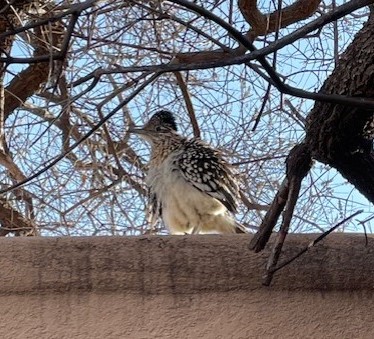
Following his clue, I looked up and there was an adult roadrunner staring down at me and Chester. It wasn’t moving much, knowing that it was pretty safe and that neither Chester nor I could jump up and grab it. After a few moments, Chester began barking at it, but it did not seem to faze the bird.
We live in the valley area of Las Cruces/Mesilla, and roadrunners usually stick to the desert areas where they can munch on lizards and small mammals. You occasionally spot them in town, but it’s a bit unusual. I even had one wandering around a home we owned in the middle of Albuquerque, miles from where you’d expect to see one.
Fluffed up roadrunner on our house this morning.
I had heard that sighting a roadrunner is a sign of good luck, so I’m happy this bird decided that the top of my house was a good place to perch.
I looked online for some information about roadrunner legends and found several interesting things.
I found this on the “Native Languages of the Americas” website:
“The Hopi and other Pueblo tribes believed that roadrunners were medicine birds and could protect against evil spirits. Their unusual X-shaped footprints are used as sacred symbols to ward off evil in many Pueblo tribes– partially because they invoke the protective power of the roadrunners themselves, and partially because the X shape of the tracks conceals which direction the bird is headed (thus throwing malignant spirits off-track.) Stylized roadrunner tracks have been found in the rock art of ancestral Southwestern tribes like the Anasazi and Mogollon cultures, as well. Roadrunner feathers were traditionally used to decorate Pueblo cradleboards as spiritual protection for the baby. In Mexican Indian tribes, it was considered good luck to see a roadrunner. In some Mexican tribes, the bird was considered sacred and never killed, but most Mexican Indians used the meat of the roadrunner as a folk remedy to cure illness or to boost stamina and strength.”
I had previously heard the story about the unique X-shape of a roadrunner’s tracks and how it confused anything that was trying to track it. I learned that the bird’s walking appendages are “zygodactyl feet, with four toes. Two toes point forward and two toes point backward.” I don’t think, however, that I would be inclined to eat one to “boost (my) stamina and strength.”
Photo of roadrunner footprints by Kim Cabrera. Which way is it going?
A graphic image of roadrunner tracks.
Another site, Symbolicmystic.com, said the birds are known for “speed and agility,” “protection and fearlessness,” and “resourcefulness.”
“In conclusion, the spiritual significance of roadrunners is both diverse and profound. Whether they symbolize speed, protection, resourcefulness, or hope, these captivating birds inspire and guide those who encounter them. By understanding and appreciating their deeper meaning, people can find strength and wisdom from these incredible creatures.”
That may be a little too deep for me, but I’m always glad to see one because they are so interesting to observe, particularly how the feathers on the top of their heads raise up and down as they are contemplating running down a road to escape.
And I hope this week finds a roadrunner on your roof as well.
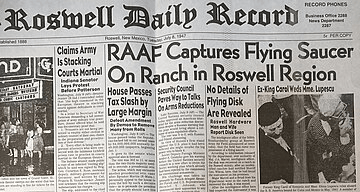
I read with amusement a story about the Roswell, NM, Police Department’s new logo which incorporates the town’s identity with a famous UFO incident and aliens. If you’ll recall, U.S. Army Air Force officials at then Walker Air Force Base in Roswell reported that an alien spacecraft had crash landed on a ranch northwest of the city on July 8, 1947.
The Air Force quickly debunked the story, claiming the debris found on the W.W. Brazel ranch was from a crashed weather balloon. That quickly spiraled into conspiracy theories that continue today about “little green men” and alien spacecraft visiting our planet.
Roswell Police Department’s new logo
As you can, see the department’s logo promises to protect and serve “all those that land here.” As someone who is sensitive to the proper use of grammar, I did notice that the logo used the word “that” instead of “who,” which to me was used in deference to possible otherworldly beings or spacecraft that might want to visit the southeastern New Mexico city again.
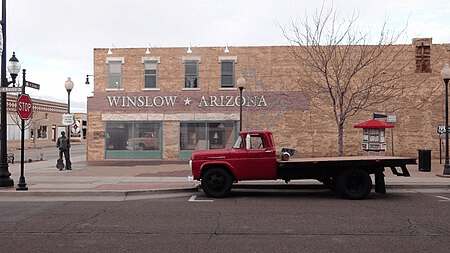
This reminds me of the statue in Winslow, Arizona, that is “standin’ on the corner…” from the Eagles song “Take it easy.”
“Standin’ On The Corner” park in Winslow, AZ.
As the song goes:
“Well I’m-a standin’ on a corner in Winslow, Arizona, and it’s such a fine sight to see. There’s a girl, my Lord, in a flatbed Ford, slowin’ down to take a look at me.”
My very good friend Joel Diemer, a retired professor at New Mexico State University, had a similar idea to help capture the spirit of a town’s character with a project linking historic Route 66 with Tucumcari, NM.
Sign commemorating Route 66 in Tucumcari, NM.
Tucumcari is about the halfway point on the “Mother Road” of U.S. 66 which ran from Chicago to Los Angeles. It’s a legendary highway that has had much written about it along with various songs.
Although Interstate 40 now dodges Tucumcari, the old path of U.S. 66 runs through the town. Joel’s idea was to have a section of the old highway paved with unique tiles that would include a person or group’s name and link to a technical method to replay a recorded message of their memory of U.S. 66. Visitors to the site could have heard many fascinating stories about their personal link to the “Mother Road.”
“It would have made Tucumcari more of a destination,” he said.
Current travelers along Interstate 40 mostly zoom by Tucumcari these days, maybe only stopping at an easy off-on exit for gas or snacks. With Joel’s idea, Tucumcari would have been more of place you’d make time to see and hear about.
I even traveled with Joel to Tucumcari several years ago to talk with local officials about the idea. They seemed to like the idea, but unfortunately, it did not make much progress and seems to have died. It may have been too futuristic for some people to grasp but more likely as Joel said, it was about the money.
“It seems like in New Mexico, if you don’t have a good source of up front money for ideas like this, they won’t go far,” he lamented.
Maybe we could incorporate a similar idea in Roswell, where people who claim to have been abducted by aliens could have their recollections recorded in tiny space capsules placed inside one of the old hangars at Walker Air Force Base. And don’t forget that Elvis Presley’s old private jet haunted the former air force base for years. Maybe we could even conjure Elvis back from the dead to record…
No wait, that’s a little too farfetched. I’ll let Joel come up with the good ideas.
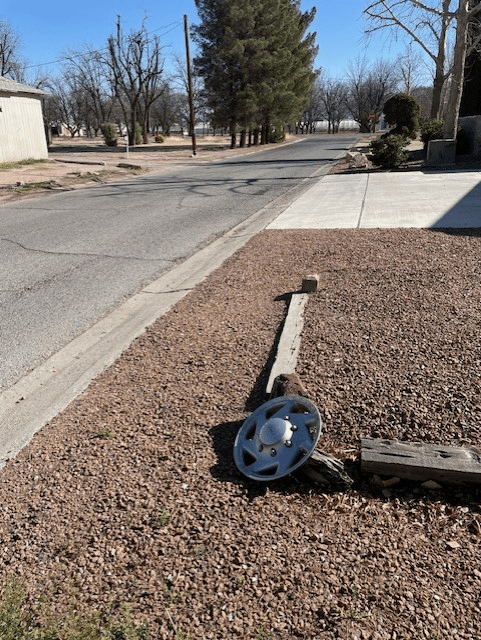
A single wheel cover from a 2000s vintage Ford van or Super Duty truck has been languishing on our street for the last two weeks with no takers. It seems to be in decent shape and I suspect a new one would cost more than $200. With the number of Ford vans and big pickups I see roaming around our town, I’m surprised no one has picked it up.
Waiting for three friends.
It reminds me of the time our friends, Dave and Gloria, had a nice Volvo that was missing a hubcap/wheel cover. There was a place in Albuquerque called Hubcap Annies that sold all sorts of hubcaps and wheel covers that had been found along a road or turned in from an owner who bought fancier wheels for their ride. I found a perfectly matching Volvo wheel cover, which needed some refurbishing, so I bought it for not much money, spiffed it up and installed it on their Volvo. The car looked great. But the next time I saw Dave, he told me that the wheel cover flew off shortly after it was installed during his trip back to Santa Fe. So much for doing good deeds.
Anyway, I’ll keep hoping that someone rescues this wheel cover to reunite it with an appropriate truck or van.
_________________
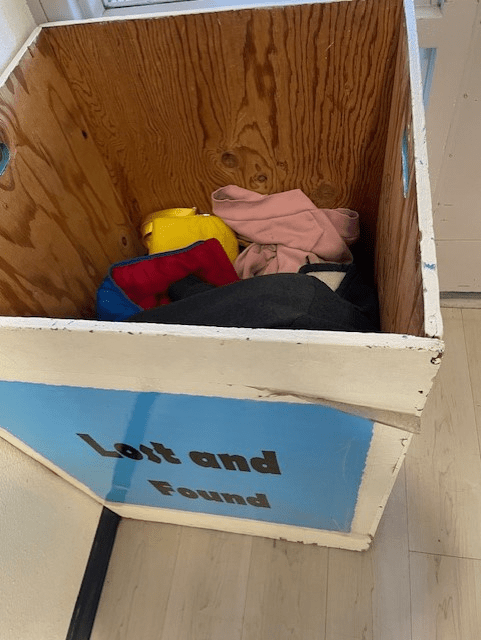
It’s a never ending story. When I was a kid in elementary school, I was known for the number of jackets I lost there. My exasperated parents finally ended up always buying me the cheapest jacket they could find, hoping it would be warm enough to keep me from freezing during the cold Ruidoso winters.
On our trip to Ruidoso last week to check up on the Trout in the Classroom project at White Sands Elementary, I found this box in the school hallway.
Jackets waiting to be reunited...
I think kids this age just get distracted when they dash out to the playground or scramble out of the classroom to catch the bus at the end of the day. Again, nothing ever seems to change for some of us who have short attention spans.
________________
Our church has been asked to help a border ministry serving immigrants who have come into the El Paso area in recent months. The specific thing they were requesting this time was footwear for men — especially larger sizes. I picked up a pair of inexpensive 11 1/2 athletic shoes at Wal-Mart and took them to the church to deposit in a box with other shoes that had been donated for the cause. When I looked in the box, I found these.
I’m sure these will be especially helpful to a 275 pound guy trying to wade the Rio Grande or trudging across the desert near El Paso.
_______________
And finally, I’ve been sort of offended by recent mailers I’ve been getting about the need to buy my burial plot or pay up front for cremation services. It’s called target marketing, and I am clearly in the old geezer target segment now.
A couple of weeks ago, I got another mailing equally annoying regarding my advancing age. It was inviting me to be a “UFO.” To become a UFO, you have to be a pilot of more than 80 years old and join a group called the “United Flying Octogenarians.” While I’m several years away from that 80-year mark, I could still claim membership now as a member of the “Auxiliary Wing.” Once they discovered that I am a hot air balloon pilot, I doubt they would let me participate anyway, so I think I’ll pass for now. However, identifying myself to people as a “UFO” does have some conversational appeal.
Okay, I know you’re getting tired reading about my Trout In the Classroom project at White Mountain Elementary in Ruidoso, but I have a really great story about my checkup on the school last week.
My wife and I were planning to drive up to Ruidoso for the day last Friday to see if we could help with anything and to pick out a date when the fish might be released from the aquarium in the third-grade classroom of teacher Michelle Thurston. (Under the Trout Unlimited Trout In the Classroom program, students raise fish in an aquarium in their classroom, then release them at the end of the semester in a nearby stream or lake.)
Before we left, I got a message from another teacher, Rachel Lutterman (known by her peers as the “Trout Queen”), that they had somehow misplaced or lost the two larger sizes of trout food that was needed immediately for the now inch-long rainbows darting around the tank. It’s a very specific food, and I was pretty sure goldfish chow from PetCo wouldn’t work.
Trout swimming in aquarium last Friday
Then I remembered that the Mescalero Apache Tribe has had a trout fish hatchery for years and it was on my route from Las Cruces to Ruidoso. I’d heard that tribal fisheries programs often operated at arms length from state and federal fish agencies, but I thought I’d give the hatchery a call to see if they could spare some size two and size three trout chow.
To my great pleasure, the people at the Mescalero hatchery were eager to help out with the problem in getting food for the fish in Ruidoso. They agreed to let me have a small bag of the second and third size of trout chow that I could pick up on the drive to Ruidoso. When I got there, the two individuals I dealt with were extremely helpful and supportive. They even gave me some stickers to give to the students at White Mountain Elementary and urged me to invite the students for a tour of the facility in the future.
The two helpful individuals were Tori Marden, assistant manager of the facility, and Robert Morgan, administrative assistant. It was really rewarding to have such great cooperation between our organization, Trout Unlimited, and the Mescalero Tribal Fish Hatchery.
Robert Morgan, administrative assistant, and Tori Marden, assistant manager, Mescalero Tribal Fish Hatchery, with trout raceways in the background
Next, it was on to Ruidoso, where we got to school just at the end of the school day with the appropriate trout food ready to go into the tank before the weekend.
Before we headed home, we got to take a look at what the third graders have done during the Trout In the Classroom project. Their work is pretty amazing. There’s an entire wall in the school dedicated to the project, shown below, that shows their artwork, some stories they wrote about trout and a timeline for development of the fish.
Display Board at White Mountain Elementary showing drawings by students, stories and a time-line for the project.
Excited third graders watching fish in the aquarium
It was also fun to read the students’ stories they wrote about what they thought it would like to be a trout. One of the kids was conflicted about the matter, saying he liked to eat trout, but obviously didn’t want to be someone’s meal. Another wondered what it would be to be like swimming in the tank with weird creatures staring at you all day. And another thought she would find it entertaining to play in bubbles in the tank that are formed by the aerator.
Although the one of the teachers said they would avoid giving the fish names “because they’re not pets,” some names have come up. Among them, “The Big Kahuna,” for its large size, “Big Eyes,” because of its oversized eyes and “Baby Shark,” because it seems to be constantly nipping at some of the other fish in the tank.
As one of the kids’ stories read:
“Hi, my name is Baby Shark. I got this name because I started biting my cusins (sic) and sisters botums (sic). (Because I am the king of the Trout, or at least I was for about two seconds.)”
And for anyone who may be worried about what’s going on in public schools these days, you would feel very encouraged by the enthusiasm of the six third-grade teachers who took on this project. They’ve done a great job in teaching kids about fish, the environment and taking responsibility. I would have been proud to have my own kids in their classrooms.
I wrote in an earlier blog that I my father once told me that Lincoln — honoring the former President — was being considered as the name for our state. I was never able to confirm that story, but I wondered what it would have been like to call the historic town of Lincoln “Lincoln, Lincoln.” With apologies to David Letterman, it was kind of like his line: “New York, New York, a town so nice, they named it twice.”
I recently searched on Newspapers.com recently for any more clues about this matter and found none. But I did find some interesting stories from 1884 about the town in a long-defunct local newspaper called the “Lincoln Golden Era.” There were only three editions I could find, all within the months of July and August of 1884, a few years after the end of the Lincoln County War.
The first story which caught my eye was this two-sentence entry into the editor’s column:
“The village blacksmith’s horse ran away Monday evening. The result: No one hurt but the horse, and he seemed awful sorry of it.”
There was no further explanation of why the wandering equine was “awfully sorry of it.”
There was also a story about a “trout fishing party” that had come to the Lincoln area from Las Cruces. Accompanying them were officials of the Mescalero Indian Agency and about 25 students from the Native American school in Mescalero. The newspaper said of the students:
“They were well dressed and quiet and as well behaved as the average civilized kid.”
So much for political correctness in the 1880s, I guess.
Also in the “New Era” was a depiction of the brands for several local area cattle ranchers, among them Pat Garrett, the sheriff who killed the infamous Lincoln County War outlaw Billy the Kid at Fort Sumner on July 14, 1881.
Sheriff Pat Garret’s somewhat simple cattle brand.
There was also a brand for legendary western cattleman John S. Chisum, shown below:
John Chisum’s brand.
A colorfully worded letter to the editor also caught my eye. The writer was venting against an individual who had somehow spread rumors against him. The nature of the rumor was not disclosed in the letter, but the contents leave little doubt of how the writer felt:
“Mr. Editor: I hope you will allow me space in your valuable paper to reply to this low, cowardly ear of curs who has not got the courage to come face to face and tell what he has to say, but goes behind the press for a shield. Ladies are unprotected from the vile wrath of this low bred, narrow-minded, water brained, red head Ananias.”
I had to look up Ananias, and discovered it referred to “an early Christian struck dead for lying.” And once again, in the old West, so much for pleasantries.
But what really piqued my interest was an editorial in which the newspaper owner announced that from this point on, his publication:
“…may be set down as a Democratic organ in the future, devoted to the interests of the party and laboring the best it knows how… “
He goes on:
“Heretofore, we have been a Republican, but as numerous members of the party have done, we repudiate the nominees on the national ticket*, believing that in the event of their election (which the Lord forbid), no greater calamity could befall this free and glorious country of ours.”
Didn’t I just hear something like that last week — from politicians of either party? So here we are, 130 years later, and nothing much has changed.
*The Republican nominee for President in 1884 was James G. Blaine, who was defeated by Democrat Grover Cleveland.
On Memorial Day a few years ago, I wrote a blog about Lt. Hans Chorpenning, a cousin of my wife’s mother*, who died on his first mission aboard a B-17G bomber shortly after D-Day in 1944. It was a tragic story of a handsome young man, willing to serve his country in a job that had very low chances of his survival. It’s not unlike thousands of other stories of brave young men and women who died in World War II.
Hans Chorpenning, center standing, his father John seated left and Uncle (and my wife Margo’s grandfather) Chester Anderson, seated right.
We recently started watching “Masters of the Air,” a series streaming on Apple TV about men in the 100th Bomb Group of the U.S. Army Air Corps who flew B-17s over Europe during World War II. The series, produced by Tom Hanks, Stephen Speilberg and Gary Goetzman, is based on the book of the same name by Donald Miller and is similar in presentation to the series “Band of Brothers.”
Hans’ squadron was the 349th, which was part of the 100th Bomb Group. I highly recommend the series for anyone interested in World War II, especially to learn about the bravery and almost insurmountable odds of survival these young men faced during their missions to stop the Nazi war machine.
In my first blog, I said Hans was navigator on a B-17G named the “Terrible Termite.” My wife did some more research and discovered that the plane’s name was “Pack of Trouble.” We originally thought that the plane was hit by fire from a German fighter plane on June 12, 1944, near Dunkerque and exploded over the English Channel. Further research by my wife showed that the plane’s right wing was instead hit by German flak which started a fire between the No. 3 and No. 4 engine. The right wing broke off, but one crew member, George Sherback, was able to parachute out of the plane before it exploded. He was captured by German soldiers, held in a prison camp and later liberated.
In a memory of the event written by Sherback, he noted that Chorpenning asked him to wait a minute before bailing out to see if a crew member who had been injured in the foot could be helped. When the injured man said nothing more could be done to save him, Sherback bailed out. Chorpenning apparently hesitated a little longer, possibly still hoping to save his buddy, and died seconds later in the explosion. In “Masters of the Air,” there is a similar scene where a crew member trapped in the B-17’s ball turret could not be released by another crew member who concluded he could no longer help and bailed out. That plane crashed a short time later and the ball turret gunner died but the crewman who parachuted lived. It seemed that the slightest hesitation, for whatever reason, could cost you your life during these dangerous missions.
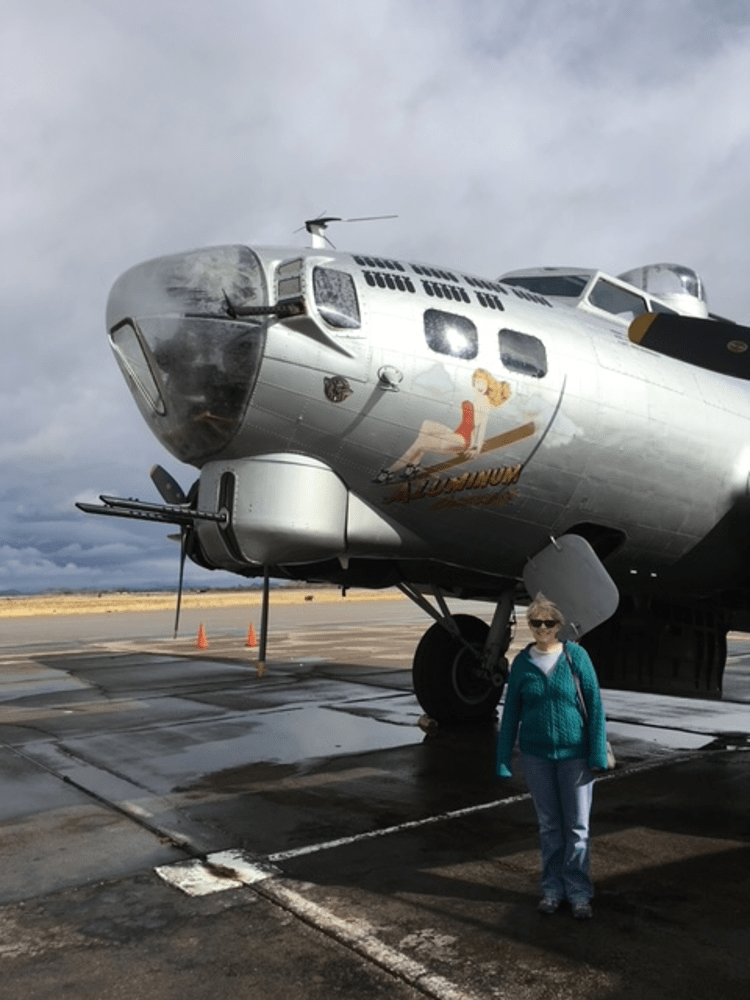
My wife, Margo, in front of a B-17 G which was flow to the Las Cruces airport a few years ago. As navigator on the plane, Hans Chrorpenning would have been seated next to the bulge on the left side of the nose of the plane above the “chin gun.”
Chorpenning was posthumously awarded the Air Medal and Purple Heart and his body is in the “Tablets of the Missing” section of the Ardennes American Cemetery in Belgium.
We have not finished the series yet, but we’ve concluded that it’s highly likely that Chorpenning knew some of the men of the 100th Bomb Group who were featured in “Masters of the Air,” even though he was on duty in England such a short time before his life was cut short. We hope to learn more as the series continues.
100th Bomb Group patch
A humbling lesson that I’m getting out of the series is the amount of bravery and sense of duty these men possessed to fly these missions day after day, knowing that the odds were stacked against them.
And another takeaway is the sadness that we still have to face wars around the globe because of men like Hitler who think they have the right to rule the world.
*He may have been my wife’s “second cousin, once removed.” Someone once tried to explain “second cousin once removed” to me and I looked it up online. I’m still confused and probably got it wrong. I guess I should just say Chorpenning and my wife Margo were “related.”
My wife and I drove to the site of old Fort Cummings in Luna County northeast of Deming this week. We’d heard about it in the last few years and learned more about it from good friend Jack Wilson. Jack is a retired archaeologist, historical researcher and author who submitted a nomination to have the site placed on the National Register of Historic Places in 1975. * The fort was established in 1863 primarily to defend locals and travelers from Apache Indians who roamed that part of southwestern New Mexico. It was abandoned in 1873, then occupied again briefly in the 1880s.
After reviewing several articles on the Internet about the old fort and looking at Google Earth maps, we set out Wednesday in our four-wheel-drive GMC Sierra pickup along with our dog Chester. As several of the internet articles warned, the road was very rough and not fit for normal passenger vehicles. Nevertheless, after a few miles of jolting bumps over large rocks and small gullies, we came to the site and discovered many interesting things.
The only directional sign we found to Fort Cummings. Cooke’s Range and Cooke’s Peak are in the background
All that’s left of the old fort are some crumbling adobe walls, some rock walls and the cemetery. All of the soldiers buried in the cemetery were later re-interred at Fort Leavenworth, Kansas, and there is only one gravestone left. It tells the story of four soldiers who were killed by Apaches on an excursion to get firewood.
Gravestone for four soldiers killed by Apaches.
All that’s left of adobe walls at Fort Cummings. Cooke’s Range and Peak in the distance.
Crumbling rock walls at old Fort Cummings.
The Fort’s site was chosen because of the location of Cooke’s Spring, one of the few reliable sources of water between Mesilla and Tucson. And old well house is still visible, along with a rock corral used by the Butterfield Overland stage that also went through this spot.
The spring and site was found by the Mormon Battalion, which began in 1846 at Council Bluffs, Iowa, and ended in San Diego, CA, in a march by the only religious detachment in U.S. Military history. The battalion, which served in the Mexican-American War, was led from Santa Fe through southwestern New Mexico by Philip St. George Cooke, who en-route named Cooke’s Peak, and the spring at the southeastern end of Cooke’s Range, after himself. https://en.wikipedia.org/wiki/Philip_St._George_Cooke
While I was a journalist in Santa Fe in the 1970s, I knew Cooke’s great grandson, also called Philip St. George Cooke (III), who worked as an information officer for the New Mexico Parks Department. He was an interesting and memorable character, as I am sure his namesake was. The elder Cooke became a Union general in the Civil War.
This route eventually became part of the Wells Fargo stage route, and for many years, I worked for Wells Fargo and helped bring replicas of the famous Wells Fargo stagecoaches for events in New Mexico.
Another Interesting thing we discovered in researching our trip was that the son of John Butterfield, who established the Butterfield Overland Mail stage route, was credited with writing the music for “Taps” which is the military bugle song played at the end of the day and at military funerals.
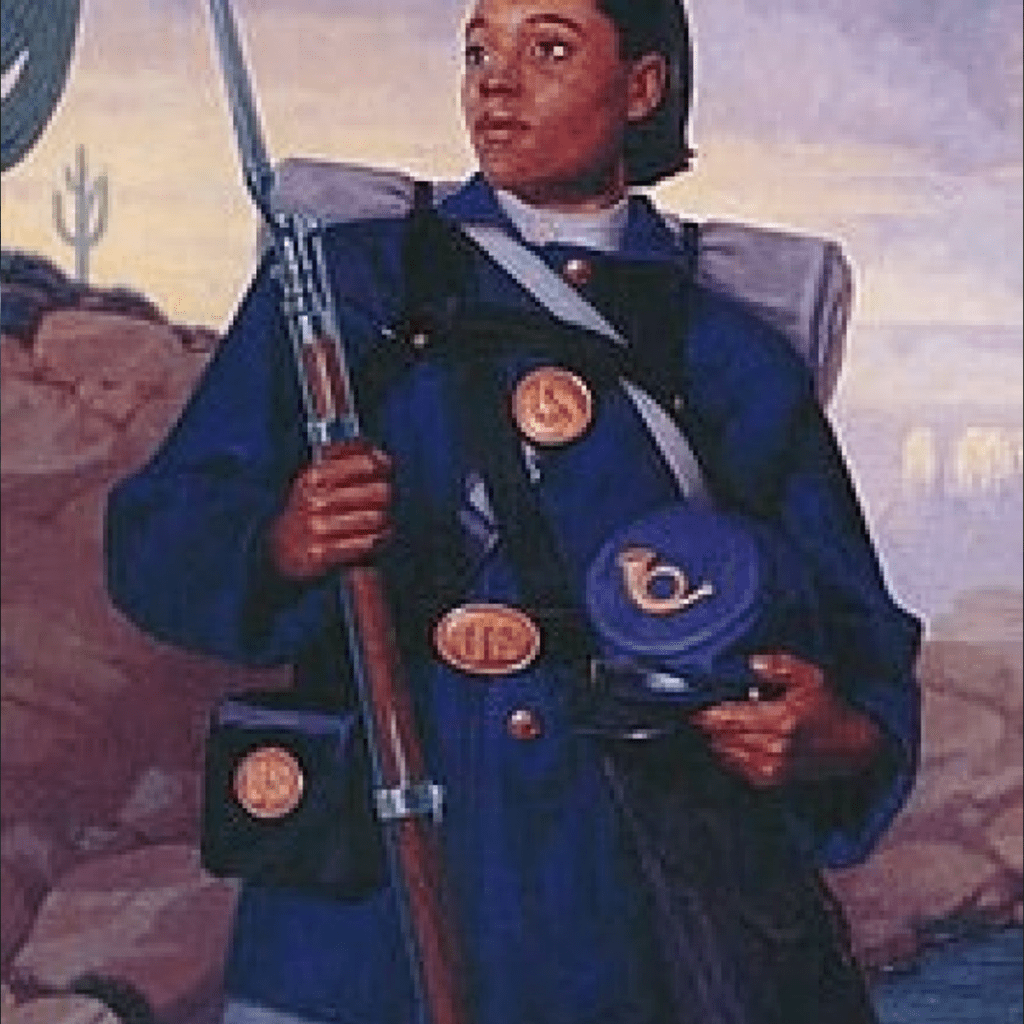
Also of interest is that at Fort Cummings, “Buffalo Soldiers” — black soldiers — were stationed there and at Fort Selden just north of Las Cruces. One of those soldiers was Cathay Williams, a woman who disguised herself as a man to serve from 1866-68 at Fort Cummings. She is believed the be the first black woman to serve as a soldier in the U.S. Military in the 19th century. https://en.wikipedia.org/wiki/Cathay_Williams
Private Cathay Williams, a soldier at Fort Cummings.
And we discovered this final interesting personal connection. At some point during Fort Cummings history, an attempted mutiny was staged. When the soldiers who attempted the mutiny were put on trial, their attorney was Thomas B. Catron, the infamous “Santa Fe Ring” lawyer https://en.wikipedia.org/wiki/Santa_Fe_Ring who represented Interior Secretary Albert B. Fall during Teapot Dome scandal. https://en.wikipedia.org/wiki/Thomas_B._Catron
My wife and I knew his great, great grandson, Fletcher Catron, when we lived in Santa Fe in the 1970s. As I recall, Fletcher frequently took time to defend some of the suspect dealings in which his great great grandfather was allegedly involved.
It just goes to show that when you start poking around with New Mexico history, you’ll never know what you might find.
And of course, the only history that interested Chester was the trail of where a jackrabbit might have run across the desert earlier that day.
Chester on the lookout for jackrabbits with Cooke’s Range and Peak behind him
*Jack says the Bureau of Land Management, on whose land most of the old fort rests, never took action on his proposal to place the property on the National Historic Register. The BLM has placed some signage with historical information around the property but a more robust interpretive display along with a better preservation plan would be appreciated by visitors.
Just got thess great videos from Rachel Lutterman at White Mountain Elementary about the progress of the trout in the third grade classroom. She reports counting at least 22 of the tiny rainbows swimming around in the tank and feeding on the fish food that was supplied with the materials they purchased through a fund raising program.
Rainbow trout fry spotted first thing in the morning swimming in the 55-gallon aquarium at White Mountain Elementary in Ruidoso
As I’ve mentioned before, I’m assisting with the Trout Unlimited “Trout in the Classoom” project at White Mountain Elementary in my old home town of Ruidoso. Third grade teachers Rachel Lutterman and Michelle Thurston have been coordinating the project, which got going late last year when my good friend Ken Tabish from Albuquerque (President of the Bosque Chapter of TU) and I met to set up the equipment in Michelle’s classroom.
In the next video, you can see the fish taking food from the top of the water. Fly fishermen, like me, really like this kind of surface action when we engage in catch and release fishing on our clean, cold fisheries in New Mexico.
They’re feeding off the top of the water!
I’m planning to go up to Ruidoso in the next few days just to check on things. But it’s clear to me that Rachel, Michelle, the other third grade teachers and, of course, the 3rd graders, are really on top of this project. I’ll keep you posted.
I frequently skim through weird things in the newspaper that I suspect most people never look at. One of them is the list of new patents granted to New Mexico businesses or individuals that is posted in the Business Outlook section of the Albuquerque Journal.
Last week, a couple of things in that listing caught my eye.
One was for a patent for “Phosphorylation of Syntaxin 17 by TBk1 controls autophagy initiation.” Wow, that left me speechless and wondering what the heck it was.
I looked up Phosphorylation and found it is “the addition of a phosphoryl (PO3) group to a molecule.” Okay, I’m still in the dark.
But here’s what a phosphoryl group looks like, if you’re interested:
Got it now? Nope, me neither.
I did a little more research and found that Syntaxins are “nervous system-specific proteins implicated in the docking of synaptic vesicles with the presynaptic plasma membrane.”
Okay, now we’re getting somewhere — I think.
I looked up autophagy and found it was “the natural, conserved degradation of the cell that removes unnecessary or dysfunctional components…”
Given that this patent application went through the University of New Mexico’s Rainforest Innovations center and thinking that it has something to do with human cells, I suspect it is a medical advancement helping to clean up something bad in your body — probably cancer.
Here’s a link to the UNM Rainforest Innovations Center if you want to look at some really interesting research underway:
But the great juxtaposition of this scholarly research next to the following patent approval really got my attention.
It was for a guy from tiny Pie Town, NM, who had been awarded a patent for a “hose manipulation instrument.” Really, that’s what the listing said.
Ready to manipulate your hose.
I kind of recall that someone had already invented something like that. As a matter of fact, I think I have two of them. But I certainly don’t have anything that “controls autophagy initiation.”
For the third year in a row, our dog Chester made the wrong pick about who would win the Super Bowl. He picked the San Francisco 49ers over the Kansas City Chiefs — although he did dither for a few moments before running off with the red ball that was the 49ers token.
I tried to talk to him about how he made this mistake, given that he had spent so much time analyzing statistics, past records, results of the Puppy Bowl and the Taylor Swift factor.
This is how he responded:
Yes, that is a look of remorse for failing to guide you, good readers, on where to put your money for the big game. I think it was the Taylor Swift factor that threw him off. Chester, of course, loves everyone, and goes bonkers when he sees someone he really likes. We think he concluded that Travis Kelce would do the same when he saw Taylor Swift in the sky box at the game and would be unable to focus on his duties as a tight end.
Now, we’re having to deal with a bewildered dog wondering what his true purpose in life might be. Oh wait, he just got a treat — everything is forgotten now.
Next, he’ll probably be pondering the Chicago Cubs chances of winning another World Series in 2024. Good luck with that, Chester.















 aero-cordero.com