The Albuquerque Journal had an article recently about a contest to name snowplows in the New Mexico Department of Transportation’s fleet. After the NMDOT reviewed almost 1,600 suggestions — many that had a New Mexico twist — I’ve included some of the ones that made the cut:
Sleetwood Mac
Darth Blader
Bis-Snow-Chito
Mr. Snow-It-All
Better Call Salt
Billy the Skid
SnowZobra
New Mexico Department of Transportation “Name a Snowplow” promotion
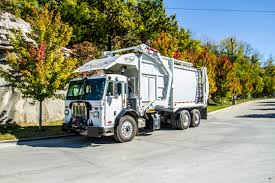
So If we can name snow plows, why not garbage trucks?
Your Suggestion Here
How about:
Landfill Filly
You Only Take Me to Dumps
Flies with Ten Wheels
The Sheriff of Rotting-Ham
Dump Blonde
Trash-A-Rito
Waste Away from Burritoville
I Am Your Mother (Cleaning Up After You)
Trash Gordon
Smelly Sally
The Crap Nebula
Dump Bunny
Garbager Harbinger
Trash Bandicoot
And from the Rock Group collection:
Trashing Pumpkins
Trash Mouth
Garbage (Yes, there was really a band named that)
Trash Test Dummies
And from the financial sector:
Trash Cow
Trash Flow
Trash is King
Okay, these are pretty cheesy. I’m sure you have better ones. So send me your suggestions and the winner will get a plastic bag of our last week’s kitchen garbage and I’ll repeat your suggestions (nothing too political and assuming I get some) in a future post.
I sense that many of you have been huddled around your computer in the last few days anxiously awaiting the news that Chester, our rambunctious Goldendoodle, has made his annual Super Bowl pick. Well, your wait it over.
As you can see below, Chester took this task very seriously. The photo below shows him just minutes before making his selection, contemplating the odds of each team winning, analyzing team data and statistics and most importantly, contemplating whether the Taylor Swift factor was going to come into play.
It’s a tough job, but someone has to do it.
As usual, Chester is given a choice between two differently colored squeaky balls to grab after they are tossed to him in our back yard. This year, the Kansas City Chiefs were represented by a yellow ball and the San Francisco 49ers were represented by a red ball.
The video attached below shows him in action. The sound is bad because it was so windy the afternoon of Chester’s pick.
As you can see (sort of of) Chester went for the red (49ers) ball first, although he did dither back and forth between it and the yellow ball several times after his initial pick. In the end, he ran off with the red ball, no doubt hoping we would chase him down and reward him with a treat.
And now for the complete disclosure: Chester has failed to correctly pick winner of the Super Bowl in the last two years.
Let your conscience (and your bookie) be your guide.
______________
And now for the trout update. The alevin have now grown into fry at the White Mountain Elementary School “Trout in the Classroom” project. They have been moved from the nesting baskets into the main 55-gallon aquarium and are starting to swim around.
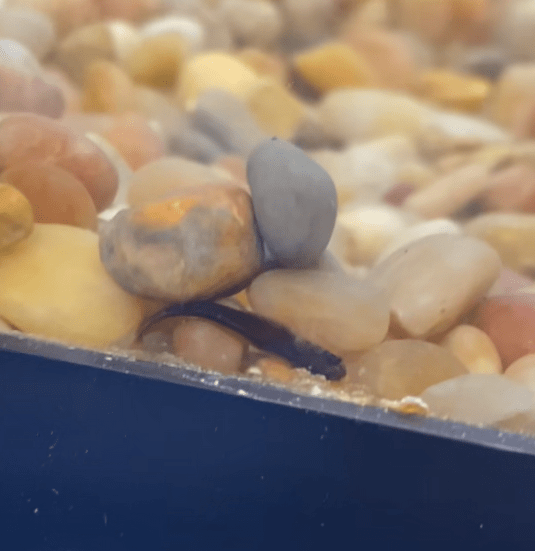
Teacher Rachel Lutterman sent me a video, where she says you can see one of them swimming, but I could not see any movement. However, I’ve attached a clip from the video where you can clearly see the outline of a fish on the bottom of the tank.
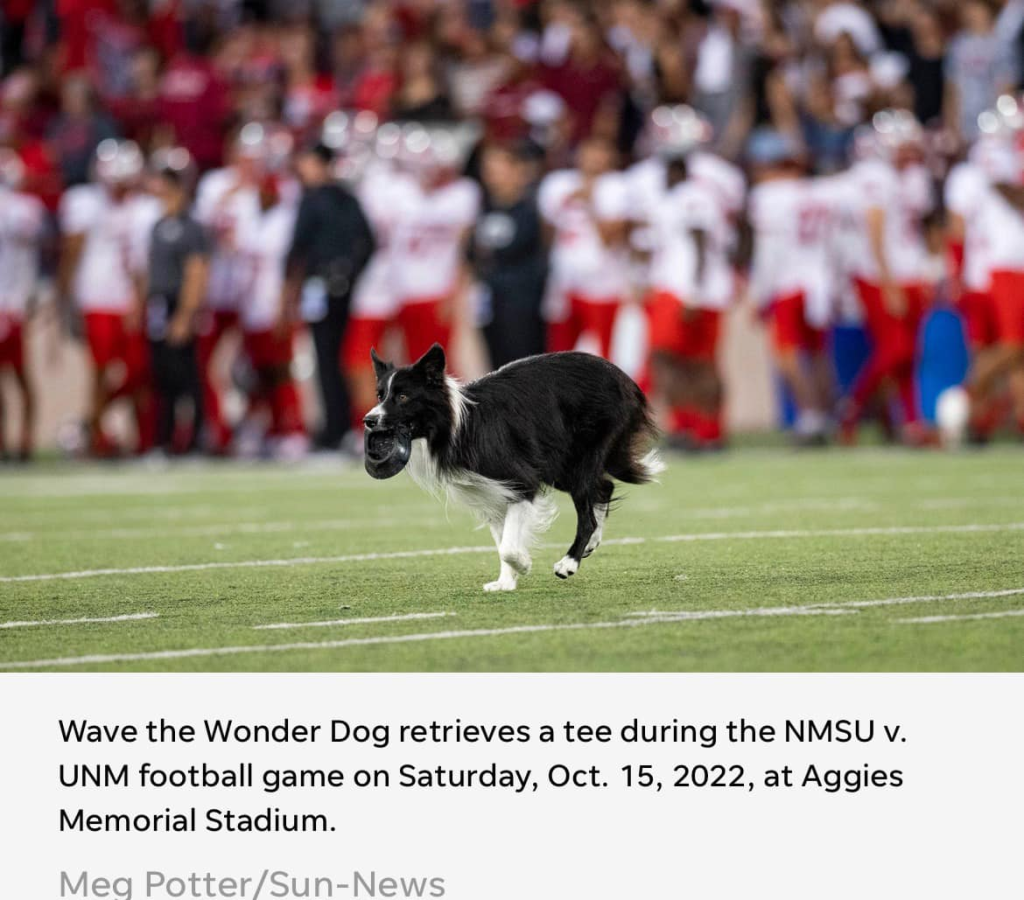
Wave The Wonder Dog, who fetches the tee for the New Mexico State University Aggies after every football kickoff, is entering the transfer portal and plans to go to Vanderbilt University.
Yep, you heard it here first. I completely made that up, but let’s see if it ends up in social media somewhere. Heck, it might even come out in the Presidential Campaign.
Wave even has his own Facebook Page, so if he’s already so famous, why couldn’t he go for a big NIL (name, image, likeness) deal with his own dog food chef, a limo to get him to games and a comfy couch on the sidelines to rest on in between kickoffs.
His fame is well deserved. At the 24th Annual American Kennel Club Humane Fund Awards last year, Wave received one of five awards for “hard working dogs that have significantly improved the lives of their owners and communities.” Not only that, Wave is also a member of the Mesilla Valley Search and Rescue Organization.
So after NMSU football coach Jerry Kill and Aggie quarterback Diego Pavia scampered off for greener pastures in Nashville at Vanderbilt, why shouldn’t Wave have that same opportunity?
I asked my good friend, retired professor Dr. Jim Peach and former faculty athletic advisor Jim Peach, about the rumor.
“That would be awful,” he said, clearly understanding that I had made up the whole thing and understanding the significance of such a dire possibility.
I’m sure it won’t happen. And after what seems like almost everyone in Aggie football heading out to the transfer portal, Wave might be the only thing we can look forward to during the 2024 football season at NMSU. That’s assuming we score and get to kick off to the opponent at some point during the game.
As my friends know, I’ve been a BMW fan for years. We purchased our first one, a metallic red 2002, on European delivery back in 1975. We picked it up at the factory in Munich and drove through Germany, Austria, Italy, Switzerland and France before dropping it off in Paris to be shipped home.
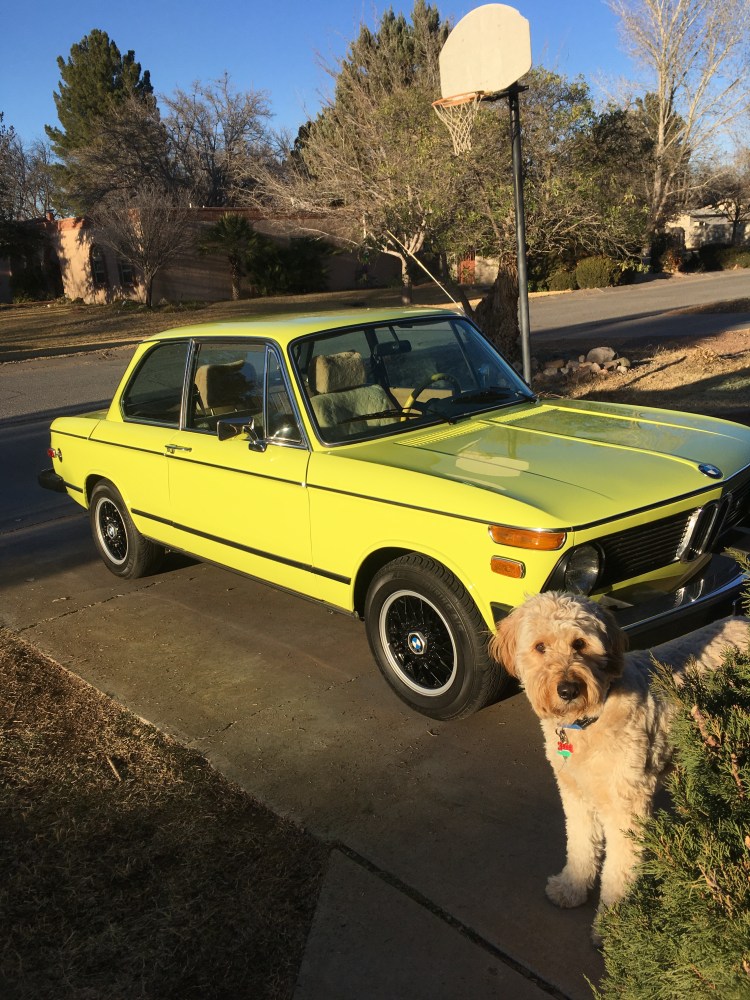
Since then, I’ve owned a dozen more in various models and sizes and currently have two — my 1975 hobby car below and an X3 driven mostly by my wife.
Our dog Chester quizzically posing besides our 1975 BMW 2002
BMWs can be expensive to maintain, particularly if you have an older high-end model out of warranty and you don’t want to do some of the work yourself. Luckily, the last three that I’ve owned have been virtually trouble free.
The car that made the most nervous was a used 1988 735i, a beautiful cruiser for long distance touring. It had a strong reliable engine, graceful suspension and responsive transmission, but it was manufactured at the beginning of use of a lot of electronic features which had not yet been completely sorted out by car makers. When the car was first parked, you could hear a two-minute cycle of multiple ventilation doors somewhere deep inside the dash closing and opening. Beneath the back seat and in the trunk was a collection of electronic black boxes that I had no idea of their function. Troubleshooting the electronics for the ventilation system and then repairing any one of the malfunctioning doors would have meant hours of dashboard removal at a cost that would easily have been more than $1,000. A fellow BMW owner told me he had once spent more than $1,500 to repair the electronics on a power seat on his 735i, and that was at least 20 years ago when that amount was not just a drop in the bucket.
I finally decided to sell it when the reader board at the bottom of the instrument cluster randomly began giving out instructions in German.
“Bitte schließen Sie die Tür,” it instructed me one day. (I was later able to translate it to “Please close the door.”)
“Sie haben wenig Benzin” was another instruction warning me that I was low on gas.
Analyzing what was wrong with the then primitive electronics was not something I could do myself, and it might have cost more to fix the reader board than the car was worth at that time. So I parted ways with it, hoping that the next owner would find the occasional lapse into German amusing and not frightening as I did.
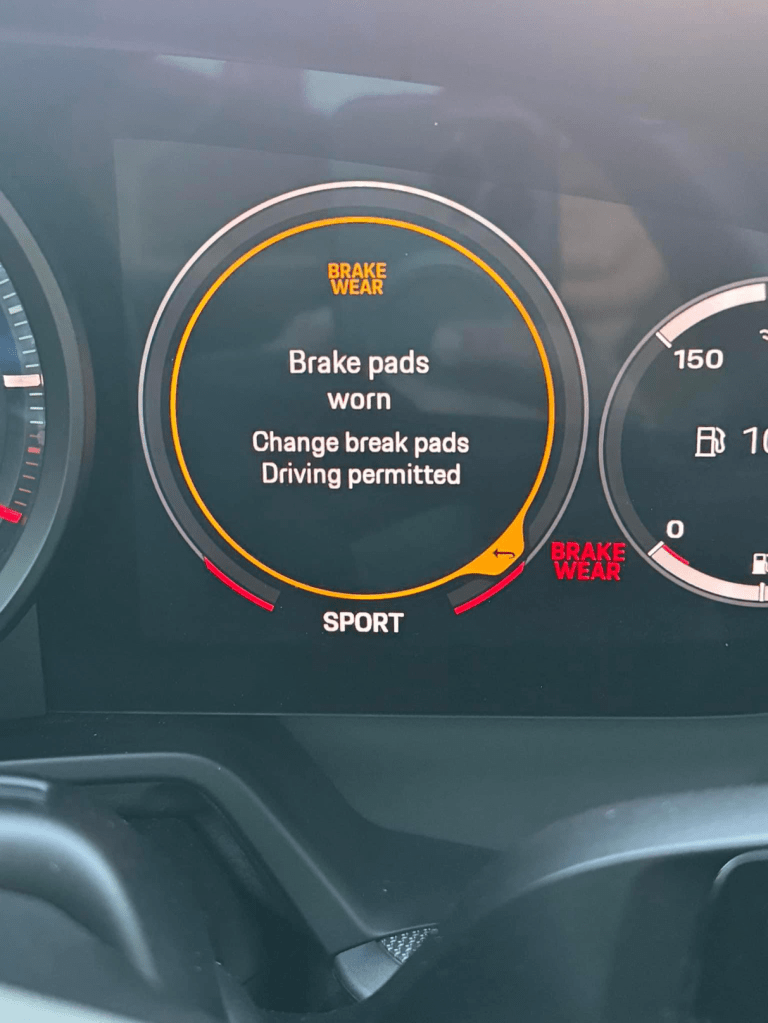
I mention this because I spotted a funny post a few days ago that a very expensive new Porsche model was having difficulty in translating from German to English.
Or maybe Porsche has developed a new feature that surrounds drivers with pads occasionally to give them a “break” if they decide to take a nap while using driverless cruise control. But apparently the feature only works if you’ve changed the “brake” pads in your $150,000+ German sports car.
When I first got news that the first few trout eggs hatched at White Mountain Elementary School in Ruidoso, I was very excited that the project was coming to fruition. The teacher told me: “We have Alvin!!”
I think she meant to say they had “alevin,” which is the word for newly hatched trout or salmon. But I though it sounded cool to say that the kids had named one of the first fish “Alvin,” so I passed that along as fact.
Alvin the alevin?
I offer my apologies for the scrambling of words, but I’m glad to announce that all but maybe two of the 35 eggs have hatched and will soon be transferred from their nesting baskets into the large 55 gallon aquarium.
I’ll keep everyone posted as the “Trout in the Classroom” project moves forward.
__________________
And on another important note, be sure to watch for news of the dramatic moment when Chester, our Goldendoodle picks the winner of the Super Bowl. We toss him two squeaky balls, each one in the color of the two teams competing, and the one he picks will be the winner.
So far in the last three years, he hasn’t picked the winning team. So if you’re a betting person, I’d put your money on the team that Chester doesn’t pick.
But since both teams’ colors are primarily red this year, he might actually make the right pick this time.
Chester smiling as he contemplates who will win the Super Bowl.
Latest news from Ruidoso’s White Mountain Elementary is that 32 of the trout eggs, also known as alevin, have hatched. Three more — which would bring the total to 35 of the eggs that were shipped — look like they are ready to hatch, according to teacher Rachel Lutterman.
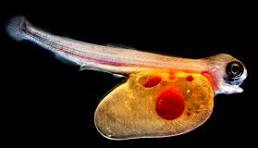
This may or may not be Alvin, the alevin.
Stay tuned for updates on the epic “Trout in the Classroom” event right here at:
Okay, it’s official. I am a new grandfather — well, if you can count a rainbow trout as a grandchild.
I got word yesterday that at least three of the 35 rainbow trout eggs we carefully placed in an aquarium in a 3rd grade classroom at White Mountain Elementary School in Ruidoso have hatched. The kids have named the newest hatchling “Alvin.”
Introducing “Alvin”the trout to the world. You can see his or her eyes forming and the beginnings of a tail while the hatchling is stillattached to the egg sack..
If you’ll recall, I’m helping coordinate a Trout Unlimited “Trout in the Classroom” project at White Mountain Elementary in Ruidoso. Students will help raise Alvin and other trout to maturity in the classroom aquarium, then release them into a local lake or stream. We got the trout eggs almost two weeks ago in what was like a Pony Express delivery during a snow storm. It all worked out, and it’s all going well at this point.
But special thanks to the third graders who helped Alvin get to this point, and to the wonderful team of teachers, headed by Michelle Thurston and Rachel Lutterman, to make this all happen.
As a marketer, I often studied cases focusing on life-cycles of maturing industries and products. The product cycle curve is bell shaped, where best opportunities for profit and growth are early in the beginning of the industry or product. By the end of the cycle, there is deep discounting, increasing competition and declining sales and profits.
Typical business/product life cycle.
In New Mexico, I think the cannabis industry went straight from the introduction cycle to the decline stage.
As of the latest data, New Mexico has 1,063 cannabis dispensaries in the state, which has a population of 2.1 million. Compare that to Colorado, with a population of 5.8 million and only 670 cannabis outlets. For New Mexico, that works out to approximately one marijuana dispensary for every 1,975 persons. In Colorado, the numbers work out to one dispensary for every 8,656 persons.
On recent trips in southern New Mexico, I noticed some signs indicating the state of the industry in the state.
One sign said:”We price match.” Another said: “Watch for our daily specials.” And a third said: “Special Discounts for Seniors.”
Deep discounting is apparently already happening and I’ve noticed several stores that have already closed or never got opened. One is just a few blocks north of where we live on Main Street that was stillborn. The entire building, which used to be a liquor store, was painted in a gruesome black and had bold graphics on the sides of the building and the sign, apparently in hopes of a booming business just off Interstate 10. It never opened, despite what I assume was thousands of dollars spent on the paint job and remodeling of the interior.
Sol Cannabis at the corner of South Main and Valley in Las Cruces never opened, despite this fancy paint job.
I’m not going to comment on whether you think we should or shouldn’t have recreational marijuana. What was interesting to me is that none of the vendors seem to have taken the time to analyze market opportunities and that they made the blind assumption that everyone in New Mexico was “all in” on smoking pot.
Last year, marijuana vendors pleaded with state officials to limit the number of outlets in the state — yet another sign of a maturing industry reaching out to the government to help buoy it.
And to me, the great tragedy of this is that no one — as yet to my knowledge — has opened a dispensary in Weed, New Mexico.
My wife said the whole process sounded like a Pony Express delivery from the 1800s. Only it wasn’t mail that was being delivered — it was rainbow trout eggs.
On the evening of Feb. 11, a batch of freshly fertilized eggs was shipped by truck during a snow storm from a New Mexico Department of Game and Fish hatchery in northern New Mexico at Mora to another NMDG&F hatchery a little further south in Pecos. The next morning, another truck took the eggs from the Pecos hatchery to a distribution point in Albuquerque. From there, the eggs headed south to Ruidoso and then what was left went to Alamogordo.
I’ve written a couple of blogs earlier about the project at White Mountain Elementary School to allow third graders to watch the process of how trout eggs hatch into fry, then grow into adult-sized fish and then get released into local clean cold waters somewhere in the vicinity of Ruidoso. Alamogordo High School is doing a similar program in a science class.
Despite my concerns about the tight delivery schedule and the snow storm, the eggs showed up on time ready to be placed in the 55-gallon tank in the third-grade classroom of teacher Michelle Thurston. The NMDG&F delivered 35 healthy looking peach-colored eggs about half the size of salmon eggs.
Thurston and the other enthusiastic third grade teachers came up with the idea to participate in Trout Unlimited’s “Trout in the Classroom” (TIC) program, which is designed to help young students understand the importance of clean cold-water streams and lakes in the United States. They held fund-raisers to buy most of the equipment needed to raise the fish. The equipment includes a chiller to keep the water temperature at a steady 45-55 degrees, a water filter, an aerator to keep the water oxygenated and various chemicals to test the quality of the water. As secretary of the Gila/Rio Grande Chapter of Trout Unlimited, I volunteered to help facilitate the program and donated the 55- gallon tank to the school.
White Mountain Elementary Teacher Rachel Lutterman prepares to deposit trout eggs in special nesting baskets in the aquarium. Nesting baskets are on the top left side of the aquarium
From left to right: Brad Allen of the New Mexico Department of Game and Fish (who made the next to last leg of the “Pony Express” egg delivery) and third-grade teachers Kaceney Wilson, Michelle Thurston and Rachel Lutterman
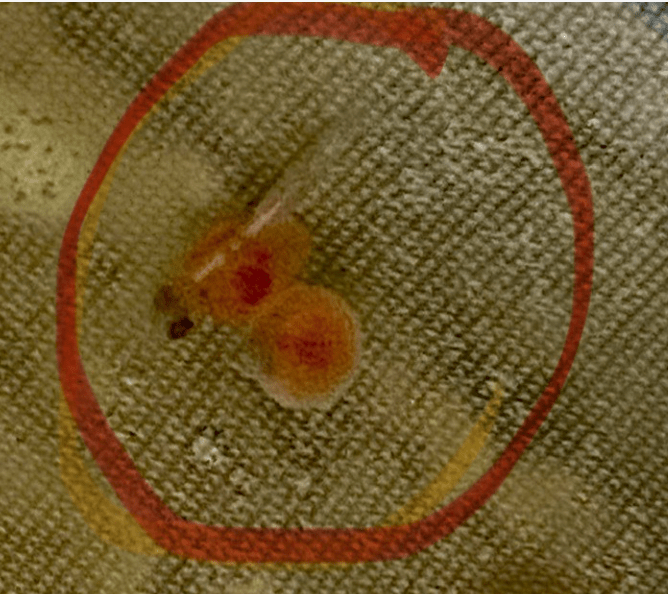
Healthy peachy-pink eggs (circled in yellow) in the nesting basket.Brownishitems in background are pebbles in the bottom of the aquarium.
And so, like an anxious father, I’m awaiting news of the hatch, which should happen in about two and one-half weeks. I’ll send out a birth announcement and maybe smoke a cigar in celebration.
The last time I flew a hot air balloon was about a year ago. It wasn’t much of a flight — just three short hops on vacant field to get current (the FAA required three take offs and landings every 90 days.) At this time, I’m no longer current and I also need to do a biennial flight review to be fully qualified.
I’ve also released my half-interest in my balloon Aero Cordero, so I no longer have my own ride. The envelope was getting pretty old and porous anyway, so it was time to say goodbye to it.
However, last weekend, I helped facilitate balloon club fly in which has been held traditionally over the Martin Luther King weekend in Las Cruces. At one time, as a fully organized rally, it drew 50 hot air balloons from around the region. This year’s event had eight balloons, but it was still enjoyable for me to get back in touch with many friends in the ballooning community and be part of the event. I crewed one day for a long-time pilot and friend, Jim Hoidal.
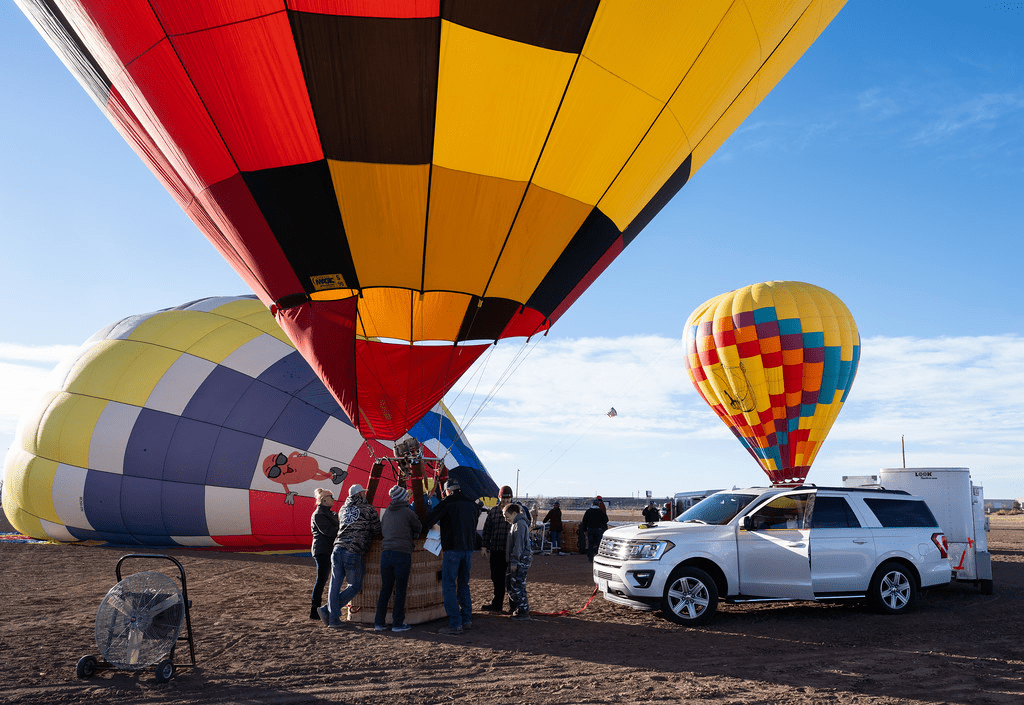
Jim Hoidal’s balloon “Squirrel” ready for launch. Directly behind it is “Cool Beans” piloted by Barney Watson.
I’m attaching some photos from the fly-in. All were taken by a local photographer, Victor Gibbs, and I’ve posted a link below to his site to view all of the images he captured over the two-day event.
As I’ve done for many years at this event, I did the weather briefing for the pilots. Winds for the Saturday flight were a bit iffy, but four of the balloons flew. On Sunday, conditions improved and six of the pilots had great long-lasting flights over the north and eastern sides of Las Cruces.
Here’s a shot of me checking out wind speeds on the field prior to the flight on Saturday.
I do miss flying occasionally, but after 35 years of doing it, it was just time to quit. I’m sure I would have no problem piloting, but because of various medications I need to take after my heart surgery three years ago, it’s best I don’t risk any regulatory issues that might arise if there was an incident.
I’m glad to say that in my 35 years of flying, the only injury that ever occurred to one of my passengers was a tiny fracture of a woman’s pinky finger on one of the softest landings I ever made. The woman was the wife of an orthopedic surgeon, and she didn’t even know she had the minor injury until several weeks later.
“Squirrel” in flight with Organ Mountains as backdropand a flock of ravens monitoring its flight
I skipped writing anything last week because we were really tired. We are still recovering from almost two weeks of fun with grandkids and adult children (who we love very much), but it’s a lot of work and stress as we get “gracefully older. “
Lamb family grandkids in front of Queen Mary on our trip to southern California early this month
I’ll begin by ranting that the Albuquerque Journal did not publish its annual “Cow Chip” awards for silly things that go on in New Mexico during the year. I’ve mentioned things in my blogs that I discovered in previous years’ Cow Chip awards. Memorable events included the time a State Police officer was caught on a dash cam having sex on the hood of his police cruiser (while he was still “mostly” in uniform) as a random Chihuahua dog observed the activity. There was also the time that the inaugural run of the Rail Runner commuter train was delayed after it hit a wandering cow between Santa Fe and Albuquerque. And who could forget the incident in which an Albuquerque city bus driver smacked into the rear of a car in front of him while munching on his burrito. And of course, there was video of a port-a-potty navigating traffic on Central Avenue in Albuquerque during a spring windstorm.
As a backup plan, you can always turn to Dave Barry’s “Year in Review,” which manages to skewer everyone, including politicians on both sides of the aisle, for learning about dumb things that happened during the year. This year, he warns us that the two greatest threats we face in the future are pickleball and Artificial Intelligence.
Finally, my new year’s resolutions this year are to play more golf, go fly fishing more and weed out the thousands of coffee mugs we have accumulated over the years from various vendors, places we worked, events, relatives and national Television News Show appearances (okay, just kidding on that last one).
Hope your 2024 is a good year for you and that you are not overcome by pickleball madness or artificial intelligence.
(Now where did I stash that coffee mug I was given at the 2001 Roswell Old Timers’ Hot Air Balloon Rally?)
I read an interesting article in the New York Times online edition recently about how skiing has become so expensive in recent years, mostly because of the monopoly of two giant corporations which have acquired ski resorts around the United States. One or two of those areas are in New Mexico.
I realize I’m sounding more and more like Andy Rooney from the old CBS 60 Minutes program these days, but I remember the good old days.
When you were in college, you could still find a $5 daily ski pass at what is now Pajarito Mountain outside Los Alamos — a “secret” ski area in the once secret town where the atomic bomb was developed. There was one chairlift and the vertical drop was probably no more than 750 vertical feet, but you could ski all day, then grab a bowl of “Danny’s Chili” for $1.25 and wash it down with some Buckhorn Beer that sold for 99 cents a six pack. What a deal.
I also remember that just four years ago, anyone over the age of 70 could get a free season ski pass at Ski Apache. Now it costs you $600. A daily pass for someone my age is $57 and for an adult, it’s $110. When I was in high school, just after the ski area opened, we had a program at our school that allowed us to count skiing as our PE requirement. We’d get off every Wednesday afternoon and go to the ski area where we could get lift tickets, instruction and rental equipment for about $10. What a deal.
Ski Apache (once known as Sierra Blanca) where I learned to ski as a kid
Making the high ticket cost at Ski Apache even worse is the fact that much of the mountain has been scarred by a terrible forest fire a few years ago. Trees that used to protect slopes from losing snow in gusty winds are gone. At least one major lift is no longer operating because of the fire. And climate change has led to fewer and fewer good snow years on the mountain. Yet, we continue to pay more and more for less and less satisfaction on the slopes.
The New York Times story says that the average cost for a father and mother and their two kids to go skiing for one day in a major resort is now about $500. The article says that skiing is becoming more and more of an elitist sport, similar to what it has been in Europe for many years.
I’m okay with capitalism, but it seems that we’re in a pattern where the incredibly rich just keep taking things away from us that we all enjoyed when we were younger. Some of the best fly fishing waters where I once was able to go for free are now controlled by private landowners. A cheap round of golf is becoming a thing of the past in many places. A visit to Disneyland is almost becoming out of reach for many familes.
Well, I’m not going to give up. This coming year, my goal is to go fishing more, play more golf and yes, go skiing at least one or two more times.
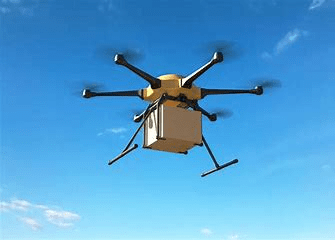
And have I mentioned my plan to develop heavy duty drones with grappling hooks buzzing around ski areas to help older skiers like me get up after a fall? I’ll provide more details later, but I’m fearful some rich guy will beat me to it and it will end up making them a lot of money for my swell idea.
It happens every year right before Christmas. A frantic search for votive candles and the right size paper lunch bags. I start looking for candles in July every year, knowing that the shelves where they can usually be found are stripped bare by the 15th of December.
And while paper bags are not quite as difficult to find, I still find myself making mental notes of where I can find the best ones — not too large and not too small. And most importantly, quality that makes it wasy to fold them.
In our home, while I watch football games and my wife bakes multiple varieties of cookies, I am in charge of folding the tops on our luminaria bags that we put out every Christmas eve. The folding operation, as I’m sure many of you know, is a somewhat delicate procedure. The bags rip easily and you have to train your thumbs to turn down the top of the bag just so in order to have the perfect amount of fold at the top.
Paper lunch bags, sand and votive candles — New Mexico’s most notable Christmas decoration.
But what I have noticed this year is the annoying sound of the folding process that makes it difficult to hear what’s happening in the football game you’re watching or my wife’s attempts at conversation while she is baking.
New Mexico has an official state question (red or green), an official state odor (roasting green chile), an official necktie (bolo), official vegetables (chile and pinto beans) and other nonsensical officialities. So why not an official sound of a New Mexico Christmas — the crunching, crinkling sound of folding luminaria bags.
Okay, that’s a stretch, so I’ll end my Christmas musings with you by sharing my version of a New Mexico Night Before Christmas and hope you readers have a wonderful holiday season.
T’was the night before Christmas in New Mexico
And everywhere luminarias were starting to glow.
The stockings were hung by the horno with care
In hopes that Pancho Claus soon would be there.
Outside on the porch, ristras swayed in the breeze
And as the sun dipped down, it was starting to freeze
Los ninos were dreaming, all warm in their beds
And swung at pinatas that danced in their heads
Mamma and Chester were snoozing away
In a bed that left me no room to lay
So I sat in a chair watching the pinon fire die
When I heard a strange noise coming down from the sky
I ran to the back door to look out on the lawn
Which was soft and white from a snowfall at dawn
We don’t get much snow in the desert, you see
So the view outside was exciting to me.
Then suddenly I spotted something that was even more to behold
It was pack of coyotes with a wooden cart in tow
In front of the coyotes with a beak that was red
Was Rudy the roadrunner, who was always ahead
And driving the cart was a fat jolly man
Wearing a sombrero and a waving his hand
It was Pancho Clause, of that I was sure
And he called to his coyotes as they ran in a blur
“Now Pedro, now Carlos, Jose and Miguel,
On Cisco, Jesus, Juan and Manuel
Over the mesquite bush, don’t linger and stall
Through cactus and sand dunes, now dash away all”
So up on my casa the coyotes flew
With a cart full of toys and Pancho Claus too
And a noise from above gave me a start
Coyotes howling as he stepped off his cart
He slid down the chimney with his bag full of toys
And began his work without any noise.
He wore a pony tail at the back of his head
And his velvet Navajo shirt was a cheery red
His shirt was laced up with fine goatskin leather
And his face was rugged from the Southwestern weather
His eyes were like turquoise, his dimples so sweet
His nose and his cheeks were like red chile heat
The steam from from a pot of posole in la cocina
Formed a shape over his head that looked like a Zia
He was a true Land of Enchantment elf
And I laughed when I saw him, in spite of myself
But seeing his smile, I knew I had nothing to dread
Knowing that soon I would be back in my bed
He said “Ya-ta-hey” to me as he started to work
Filling up the stockings, then turned with a jerk
He’d noticed biscochitos we’d left him for a snack
And stuffed a few of them for later in his pack
Then before I could blink, back up the chimney he went
Leaving only the smell of a sweet pinon scent
He sprang into his cart, gave his coyotes a shout
And was gone just like that, to the next hacienda, no doubt
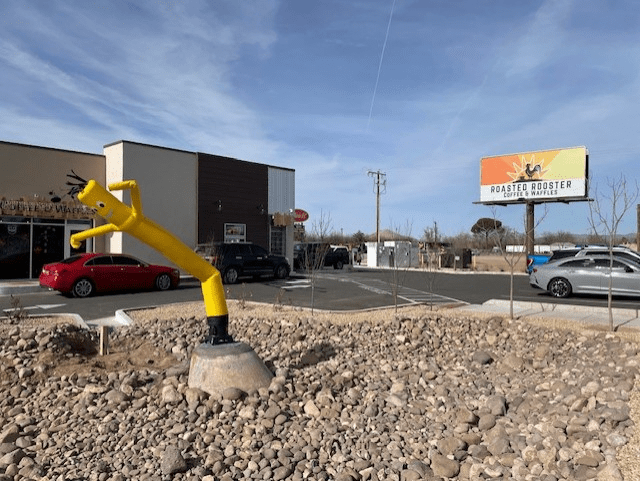
A new type of restaurant opened in the last couple of weeks in Las Cruces that calls itself “The Roasted Rooster.”
Its specialty is waffles and chicken, but they have several other things on the menu, including an odd-sounding green chile and cheese waffle. The chicken is baked, not fried as you would expect from a regular chicken and waffle menu item, and the waffles are a kind of soggy whole wheat variety.
Cars await Roasted Rooster waffles and chicken at drive-up window.
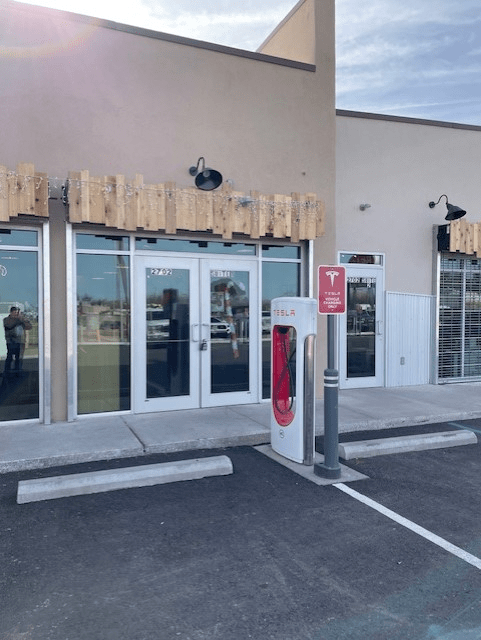
What is interesting about the place is that it has 15 spaces to plug in your Tesla while you await your order at the restaurant. In fact, there are more parking spaces for Teslas than there are for regular cars that rely on that oh-so-yesterday fossil fuel. There is a drive-up window where idling gasoline powered vehicles can spew carbon-based gunk into the air while they wait a long time for their chicken and waffle combo to be hatched, baked and toasted.
Tesla charging ports outside Roasted Rooster.(And no, that’s not a Tesla that is parked illegally.)
I think it’s actually an interesting marketing concept. It’s located right next to busy Interstate 10 — just block from either the west or east-bound lanes. And the menu seems to be geared towards people I think would most likely buy a Tesla — lots of vegetarian options with recyclable serving accoutrements.
Interior of the Roasted Rooster.
A Tesla charging station at the front entrance.
However, I think there’s one flaw with the operation. It was built adjacent to the city’s sewer processing station and waste disposal site. On a windless, cold evening with a temperature inversion pressing the atmosphere close to the ground, the smell around the surrounding area is — well (if you’ll pardon the pun) — fowl.
So if you’re caged at the Roasted Rooster on one of those nights for one to two hours while your Tesla gets charged, you may lose your appetite (or worse) while you wait. I’m sure many Tesla drivers will not have a fond memory of their stop in Las Cruces if they require a charge on one of those days.
There are other dining options nearby if Tesla drivers are willing to “cross the road to get to the other side” and visit the nearby Shell or Pilot truck stops. But of course, you may be forced to smell diesel exhaust fumes while waiting there. And maybe you’ll figure out the answer to that age old question.













 aero-cordero.com