In a holding pattern…

Yes, I’m still here. It’s just taking longer than I thought to recover from this surgery. And to make it worse, I have to go in for a second procedure later this week that I’m hoping won’t be as painful as the first one.

And I promise not to bore you with all the details of what’s going on in my future blogs. I’ll look for something really off the wall to talk about when I’m back.

Taking a break…

This summer, when I managed to bust six ribs and crack two more in a fall in the Gila, the follow-up exam revealed a large kidney stone that I needed to have removed before it further aggravated that organ.

It was too large to pass naturally (I think it was the size of a small bowling ball) so I had an outpatient procedure to remove it last week. My recovery has been a lot more painful than I anticipated, so sitting at a desk and writing has not been in the cards.

I’ll get back to writing again in a week or so, but just wanted any readers to know what was going on.

See you on the web again soon, I hope.

Our roadside image…

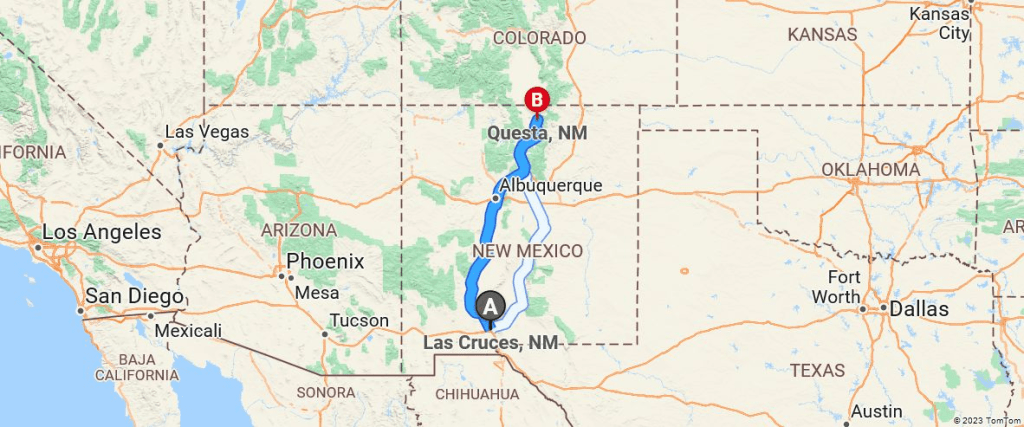
Driving back from El Paso on Interstate 10 last week made me draw the following conclusions about how others perceive Las Cruces and New Mexico.

“They smoke a lot of pot, they’re in a lot of legal trouble, the only eat Mexican food and they don’t know how to spell very well…”

That’s the vibe you get when you read the billboards heading north out of El Paso when you enter the Land of Enchantment.

I counted at least four cannabis “dispensary” signs along the highway. There were a couple more heading south, as I recall.

From a Las Cruces dispensary”

Next seemed like an endless stream of lawyer billboards, many promising big settlements for accidents involving large trucks. Others dealt with basic ambulance-chaser matters. I counted at least half a dozen.

Okay, well, the legendary and imaginary Saul Goodman didn’t actually have a billboard down here, but I’ll be he would have, given the opportunity.

And then next were billboards from several local Las Cruces Mexican food restaurants, all promising the best tacos and enchiladas around. If you counted francises which offer fake Mexican food (think McDonald’s, Taco Bell and others), there were at least half a dozen of those.

Then next was a billboard that has bothered me for years. It is for a desolate looking mobile home/RV park on I-10 about halfway between El Paso and Las Cruces. It is called:

“Western Skys RV Park”

Really? Skys and not Skies?

And, adding insult to injury of the English language, another sign promoting the business is spelled SKYS’ with an added superficial possessive apostrophe.

That’s my rant for the month of August. Stay tuned — I’ll have another one next month.

Thoughts on Little League…

My wife, Margo, was walking our dog Chester last week when she came upon a Little League practice in a park near our home. There were two teams, one practicing shagging flies and the other working on batting.

The one working on catching fly balls needed to hone their skills a bit, she observed.

“They were using whiffle balls, I guess so they wouldn’t get hurt if they got bonked on the head,” she said.

She said the kids were looking up in the air for the ball and waving their gloves around in a frantic manner to catch it.

“Then It would just plop to the ground next to them,” she said.

She said the next group working on batting practice had some great instruction from their coach.

“Remember, you have to take you glove off before you can bat,” he admonished the youngsters.

I’ve been randomly watching the Little League World Series this week. The game on Wednesday between a Texas team and a Washington team was a gem. It was a 0-0 tie after the regulation six innings (for Little League). It finally was won by Texas in the ninth, 1-0

There were some outstanding defensive plays by both teams — stuff you’d expect to see in the big leagues. I think the catcher from Texas will be playing in “the show” some day.

Pitching was great as well. One Texas kid pitched the maximum of 85 throws he could make before he was retired. He managed many strike outs during his effort. A pitcher from Washington was boxed in with three men on base and no outs in two different innings, yet managed to work his way out of the predicament.

Texas players celebrate their 1-0 win over Washington

This made me think about something I believe most New Mexicans don’t know about. In 1956, a team from Roswell won the Little League World Series. I happened to go to college and was friends with one of the kids who played on that team, but never heard him talk about it. My brother-in-law, who lived in Roswell at the time, has a souvenir baseball from the team. He witnessed them boarding the train as they left Roswell for Williamsport, PA, for the series.

Brother in-law Buzz Murrell holding souvenir baseball signed by members of the 1956 Roswell Little League World Series champions.

It is a great feel-good story about a rag-tag bunch of kids from a relatively small town in New Mexico who defeated teams from big city programs around the country on their way to become champions. My hope is to write a short book about it someday.

What do we look like ???

You’ve probably been reading a lot lately about Artificial Intelligence and the dangers that some scientists, politicians and others think it poses for the human race and the planet.

My wife ran across something last week that adds some fuel to those concerns. It was on a website called travlers.com (you should be able to click on the link and you’ll find the article). It is a collection of portraits generated by an AI algorithm showing what best represents the average person or persons in each state may look like.

I’m assuming that the system plugs in things like landscape, climate, cultural identities, history and other things that make each state unique, then uses AI to generate a portrait.

Some of the suggested images of the “average” person in each state are pretty reasonable — a “Bubba” looking guy from Alabama, an older Hawaiian native warrior in what we’d think of as traditional clothing for that state and a cool looking blond dude with aviator sunglasses and a beach shirt for California.

So here’s what AI thinks we New Mexicans look like:

The official NEW MEICO Artificial Intelligence guy

Here’s what the website says the portrait represents:

“Under the canopy of the vast Southwestern sky, the AI representation of New Mexico stands as a weathered elder, his deep-set eyes filled with countless untold stories. There’s an air of gentle, enduring strength about him, as resilient as the desert landscape he originates from. Framed but the backdrop of a clear sky and endless sand, his spirit and both expansive and quiet- just like the endless stretched of sand dunes throughout the state.”

Whew!!! Allow me to catch my breath. I’m sure that bit of prose was penned by an AI robot somewhere in the bowels of a computer lab in California.

Actually, I kind of feel like that guy — a weathered elder with “countless “countless untold stories” waiting to be posted on my blog. I do take offense that New Mexico is nothing but an “endless tretch of sand dunes.”

But if you think AI was a little too harsh on New Mexico, take a look at what it posted for Florida:

Your regular Florida guy

As the website describes the Sunshine State’s representative:

“We’re presented with a character who’s part man, part lizard, and entirely Floridian. From his reptilian eyes to his yellow hat and Summer shirt, he’s got the sun-soaked vibe down to a tee. After all, when you’re in a state that’s almost entirely a beach, why not go full-on sand lizard when you can?”

Hope you have fun finding your home state’s “average” person or couple. And I’m glad (for many reasons) that I don’t live in Florida.

Signs of the times…

You might recall that a good friend of mine was enraged several years ago when he read a New Mexico State Highway Department sign warning vehicles pulling “trailors” to reduce their speed along a section of Interstate 25 north of T or C. He fired off a letter to the authorities — maybe even the Governor — saying that the misspelling made New Mexico look like we were a state full of illiterate dolts. The sign got changed shortly after he submitted his letter.

Well, it appears that the bad sign bandits are at it again.

A new friend recently sent me this photo of a sign on National Forest Service land in western New Mexico:

Ummmm, I don’t get it.

And an Albuquerque Journal article earlier this week had an article about this sign which showed up in several locations in the Gila National Forest.

So many possibilities….

Maybe the “INFORMATION SIGN” should point to the “?” sign.

This reminds me of a bit of semi eco-vandalism that I participated in during a short period of time when I lived in Telluride, CO, and owned the “Telluride Times” newspaper.

A resident of the town who was rehabilitating older buildings in the community became incensed when, while driving along a road through one of the most spectacular mountain vistas in the West spotted a sign with an arrow proclaiming that there was a “SCENIC VIEW” nearby. Maybe Hellen Keller and some really slow people would have missed the view, but I think everyone else didn’t need the reminder to look and appreciate it.

“It’s like putting up a sign that read: “CLEAN AIR. BREATHE,” he mused.

One night, after a couple of beers, he decided to take matters into his own hands and invited me and another local writer along for an adventure to correct the display of the sign he deemed to be obnoxious. He loaded a chainsaw in the trunk of his car and drove to the location of the offending sign. He fired up the chainsaw and then chopped the sign post off at about four feet above the ground with a wickedly jagged cut. Anyone who saw the remaining stump of signpost would have concluded that there had been vandalism. The sign, with about two feet of remaining post, fell to the ground. About that time, a vehicle approached on the highway and we all ran for cover. He had dropped the chainsaw at the base of the mangled signpost, but wasn’t able to turn off the device before he initiated his escape. It was left idling on the ground as the car went by, slowing down for a minute while its occupants tried to decipher a strange rumbling sound, then proceeded on its route at a regular pace.

We sprinted back to the car with the finally silenced chainsaw tossed in the trunk and sped away. We managed to escape incarceration that night, but it was indeed a thrilling moment.

I drove by that mangled sign several times after the incident and I don’t think anyone from the Colorado Highway Department had noticed the infraction before I left Telluride and returned to New Mexico. Maybe it’s never been replaced and some really dense people driving along that road don’t know that there is a spectacular view nearby.

(And I think I’m beyond the statute of limitations.)

Soon to overtake Mexican food restaurants as the most prolific business Las Cruces …

Marijuana dispensaries.

Last week, when I went to pick up a pizza, I discovered two more new cannabis dispensaries that I had not seen two weeks earlier.

I went online and asked for “cannabis dispensaries near me” and found at least 30 of them in the immediate Las Cruces area. I don’t think the map is up to date, given what I see when driving around town.

Really — more than 30 of them. Along Solano Drive and Valley Drive, it seems like every other storefront is how a dispensary. Even residential streets like Conway Avenue in my neighborhood has one and short commercial Wyatt Drive has two.

I do wonder, with more than 30 dispensaries around town, how many people are driving around buzzed. Or how many people may be working at the edge of consciousness at some business I frequent. I hope it’s not at any of the medical facilities where I am occasionally treated.

The map below came from a website called “Weedmaps” and because of the many stores located along some streets, not all store locations can be seen.

I also found it quite ironic that a once-illegal habit and an underground industry for many years has now made a plea to the New Mexico Legislature to limit the number of dispensaries in the state.

In a letter to state lawmakers, the cannabis industry stated:

An unfortunate byproduct of the free-market approach that our state took for licensing new operators is a saturation of regulated and illegal cannabis products in New Mexico. These two factors are resulting in homegrown small and medium-sized cannabis businesses being forced to close their doors or lay off staff. Our local businesses simply cannot compete with the illicit market and the immense oversupply.

After years of hiding from big brother, now they want its help. It’s like liquor license owners, car dealers and other industries asking the state to protect them from the ravages of a free market economy. I think OPEC invented the “let’s limit supply so we can raise prices” business model.

But I’m not here to argue that point. What’s fascinated me is some of the business names that have been selected by the local cannabis dispensaries.

Among my favorites:

“HIgh Horse Cannabis” (Open 24 hours)

“Everest Cannabis”

“Cannaverse”

“Dreamz Dispensary”

“Cloud House Dispensary”

“NM Cowboy Cannabis”

“The Haze”

So I’ve come up with a few names for these kinds of businesses as my own.

“Pot Head Paradise”

“Cannabliss”

“POTSTOP” (an annagram)

“WeedEater” (sales of magic brownies)

“Wheeler Peak Weed” (after the highest mountain in New Mexico)

“Weed Weed” (located in the community of Weed in the Sacramento Mountains)

“Up in Tokes” (after the movie “Up in Smoke”)

“Warm Up For Munchies Dispensary”

“Tia Juana’s Marijuana”

“Not Mary Jane Shoes”

“Spliff Spot” (what they call it in the Carribean)

Okay, these are lame, but send me your ideas for weed merchants and I’ll publish them.

Another 35 million oinks…

I just looked up online how many times the average human heart beats in a day. The number I got from two sources as 100,000. When you load all of those into a year, it totals around 35 million.

Luckily for me, the faithful pig valve inserted into my heart five years ago on Tuesday has flapped along with no problems.

My donor???

I feel very blessed for that and happy that I can continue to enjoy my life and my family as much as I can.

I’m told that my valve is good for several more years. And the good news is that the new procedure for installing an artificial valve in a human heart is now even less invasive than before. Las time, they cut open my chest, removed the heart, sliced it open and sewed in the replacement valve. The process now involves no more external incisions and uses a robitic device to insert the valve in the heart through a vein in the leg.

So here’s to another year of oinking along. And below is the best cartoon I’ve seen about this otherwise traumatic experience.

Keeping a closer eye on my back door…

In our neighborhood, especially during their two-month mating season in February and March, we’re always cautious about the presence of skunks when we let our dog Chester out in the back yard in the early morning or at night.

Yes, he’s been spritzed once, but the second time he saw a skunk he backed off quickly, even though he got a glancing blow of the odiferous critter’s love potion.

However, after reading a recent story in the Albuquerque Journal and seeing a report on an El Paso television station, maybe we should start worrying about another more dangerous species of wild animal — cougars.

A woman in Rio Rancho was surprised recently when she went to open her back door and found a cougar lounging on her back patio with its head on a basketball. She said she almost went out the door and stepped on it before quickly retreating and calling another person in the house to verify what she had seen. She said a cousin who was in the home saw the critter and blurted out “Oh S—, that’s a mountain lion.”

“Curse words do not escape this man’s lips often,” she said of her normally proper cousin.

The Game and Fish Department was summoned to the home and the animal was eventually tranquilized and moved to a safe location away from the urban area.

And in 2011, a young cougar was struck and killed on a busy street on the west side of Albuquerque.

Two weeks ago, an El Paso television station showed a video clip from a phone of a cougar roaming in an arroyo on the west side of the west Texas town. That animal was not found, although there were several other sightings reported in the area.

I looked up information about cougars in New Mexico on various websites and found that there may be as many as 2,500 roaming around the state. There is a hunting season for them and as of the first six months of this year, 27 have been “harvested,” in a euphemistic description offered by the New Mexico Game and Fish Department.

The website also said that our state is a prime mountain lion habitat because of the wide variety of terrain, wide open spaces and plentiful supply of various food sources.

What made me think about this was a story by a next door neighbor who about two years ago told me she saw a cougar on top of the roof of a building just over the rock wall fence behind our house.

“It was very large and it had a long tail,” she insisted.

“Oh sure,” I thought to myself. “She probably had a couple of drinks and saw the fat feral tomcat that drives Chester nuts when he wanders through the back yard.”

Now, maybe I’m not so sure.

They still don’t know much about us…

I was watching an auto auction show on television last week , mostly because there was nothing else interesting on and because it was still too hot to do much outdoors.

During the show, a Chevrolet dealership somewhere in New York, ran an ad boasting that they sold more Corvettes than any other dealership in the country. Part of the ad showed arrows from cities around the nation pointing to the dealership, ostensibly portraying the mass migration of people to buy Corvettes from there.

Albuquerque was one of the points of origin on the map. Only whoever drew up the map apparently didn’t do well in geography. The state’s largest city was spelled: “Alberquerque.”

Then while reading some reviews about the new movie “Oppenheimer,” one writer noted that NBC announced that the first atomic bomb was actually exploded in Los Alamos.

I think we would have noticed that, although the fairly recent Cerro Grande fire made the surrounding forest look like an atomic blast had happened there sometime in the past.

At any rate, I never cease to be amazed by the fact that we’re constantly confused with Arizona or we’re considered to be a foreign country.

And, of course, I’m always finding maps or souvenirs of New Mexico displaying a saguaro cactus.

Maybe they spotted this one just a few blocks from my house.

A saguaro adjacent to to a warm west facing adobe wall near our home.

They can grow here, given enough protection from cold weather. And who knows, with this summer’s heat, maybe we’ll have a saguaro forest surrounding us soon.

The bane of bad restaurants…

An interesting article in the Albuquerque Journal last week told the story of an Albuquerque man who had recently celebrated his 100th birthday and claimed that drinking a can of Coors Banquet beer each day was the key to his longevity.

When Coors heard about Robert Nolen, Jr.’s, accomplishment, the company sent him three cases of its beer, a duffle bag of Coors merchandise and a birthday cake that looked like a can of the iconic brew.

At the time I grew into my best beer drinking days in college, Coors was the stuff of legends. You could only buy it in certain states in the west, since it was brewed only at one location in Golden, CO, and could not easily be distributed nationwide. It also required constant refrigeration from brewery to the consumer, which limited its distribution footprint. It was coveted by those who could not get it, even though they probably had never tasted it.

“”Brewed From Pure Rocky Mountain Spring Water,” was its claim to superiority among all those other mass produced beers. It was a siren song to those who had to settle for Budweiser, Miller, Pabst, Schlitz, and others.

I remember when visitors to Western states from back East would make a point to consume as much Coors as they could during their time in the region. I distinctly remember one Easterner telling me that he visited the Coors plant in Golden and that an entire mountain river was piped directly into the brewery, with nary a drop of water from the stream ever to be seen exiting the plant again except in a bottle or can.

My brother-in-law, Fred, had moved from Nebraska to Louisiana in the 1960s to attend school at LSU. When he returned at Christmas or other times to Nebraska (which was a state in which you could buy Coors), he would load up as many cases of the brand as he could squeeze into his vehicle so he would have a good supply of the brew to last for months in Baton Rouge.

During that time, Coors would distribute free thin paper placemats to local restaurants within their footprint. The placemats for each of the states in their territory showed popular tourist attractions. I found the one below from Colorado on E-bay, with an asking price of $145.

VintageCoors placemat from the 1950s.

These were usually distributed at smaller locally owned restaurants throughout the region. I recall one food critic remarking that if you went to a restaurant using the Coors placemats, it was a sure sign that the food would be sketchy.

“The bane of bad restaurants,” the epicurean authority commented about the placemats.

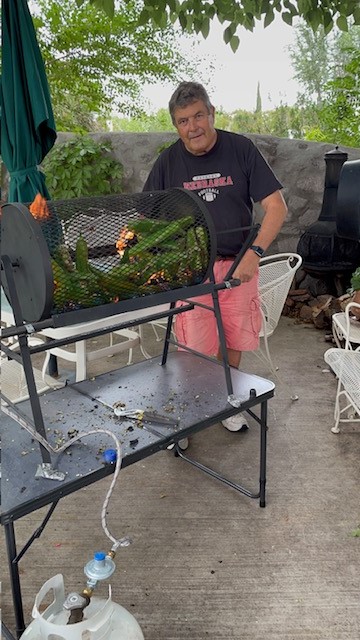
Well, Coors (although mostly Coors Light) is still my favorite beer. (I was harshly chastised once by a native German friend for my incredibly bad taste for liking Coors and not stout German lagers). Ales are too bitter for my tastes and other brews with things like green chile, chocolate or dump-truck-loads of hops are just not for me. I can tolerate a Mexican lager when roasting green chile in my back yard.

And actually, the best chicken fried steak I ever ate was served on a plate protected by a Coors beer placemat.

I guess that says a lot about my taste — or lack thereof.

And I have a really subtle off-color joke about Coors Light that I’ll share with you privately if you ask.

Cutting edge investigative journalism by yours truly…

You’ve probably heard the old adage that “it’s hot enough to fry an egg on the street.”

Well, here’s a new twist. This week, I read online about a couple of staff members from an Albuquerque television station who wanted to determine if, during our current heat wave, there was enough heat to cook a steak on the dashboard of a parked car with all its windows rolled up.

They succeeded in cooking up a medium rare steak in 90 minues in their car, where the temperature reached 140 degrees. Their experiment was a warning to everyone not to leave children or pets in parked cars during the day.

After reading the story, my keen investigative journalist brain kicked into full throttle and I came up with an even more insightful probe.

If New Mexico is known worldwide for our chile, why not see if our favorite vegetable can be roasted in a hot car? I was called to action, just as I was when I investigated and wrote about Mexican bologna smuggling in Las Cruces. (I’m still awaiting my Pulitzer Prize award for that one.)

So bear with me as I unleash a large volume of data, expert analysis, detailed observation and pure guesswork to come to the startling conclusion (spoiler alert) that roasting chile in your car (or the sidewalk) doesn’t work that well.

Mesilla Park”s top investigative journalist (me) at work on another probing story.

Okay, for the four of you still left reading this blog — because you have nothing else to do on a hot afternoon — here goes:

I purchased green chile (just now starting to come in from the fields) from two different sources. All of it was said to be a mild variety.

Innocent chile pods awaiting torture by heat.

When I drove to get the chile, the outside temperature registered on my car was 104 degrees. The shaded back yard of our house had a temperature of 100 (which would rise to 101 by the time the research was completed). The exterior temperature sensor on our truck showed 109 (always a bit optimistic). The interior temperature of our pickup truck at the dashboard was 141, according to a kitchen digital thermometer. (I think it would have gone higher if I had waited another couple of minutes, but I was not willing to roast myself.)

The 141 is hard to read on this digital kitchen temperature probe n the dash of our truck.

I placed some of the two different varieties of in two aluminum foil pans on top of the dashboard and set the timer for 90 minutes.

Roasting on the dashboard of my GMC

I had also placed a cast-iron griddle that I sometimes use for grilling on the driveway at the front of the house. Its temperature had reached 122 degrees when I placed additional chile on top of it.

Temperature of cast iron griddle on driveway

In true scientific method procedure, I also roasted the remaining pods the old fashioned way on the gas barbeque grill. Those took only a few minutes to roast and blister up.

Roasted the traditional way

Things were moving slowly inside the truck and on the griddle on the driveway. The interior of the truck was starting to smell like the Hatch Chile Festival. The chiles were turning a pale color in both locations and getting limp from the heat.

I remembered when I bought the chile from one vendor and proudly explained my planned experiment. He rolled his eyes and smirked, but offered a bit of advice that if the chiles begin to turn white, you’ve roasted the flavor and heat out of them.

As my timer marked 90 minutes, I noticed the experimental pods in both locations were turning white, looking extremely flaccid and appearing very unappetizing. My truck’s interior, however, had an even more pungent Hatch Chile Festival smell.

I pulled both varieties off the dash and the griddle and measured their internal temperatures. Both were at 140 degrees.

There was no blistering of the skin of any of the sun-roasted chiles, so in order to make them easier to peel, I decided to toss them on the grill for a few minutes. Once off the grill, I steamed them for a few minutes and began peeling and taking a small bite out of each one.

The taste was mostly beyond bland and slightly odd — not even as much flavor or heat as an overly ripe bell pepper. Of all the truck or driveway roasted chiles, I only kept two for use in an enchilada dish I made later that evening.

Here’s what they looked like after roasting by sun.

So the conclusion of my investigative reporting is this:

Don’t use the sun, even in our current extreme heat wave, to do the work of the old reliable gas grill or tumble roaster. That is unless you want the interior or your car or truck to smell like the Hatch Chile Festival for the rest of its life.

The little engine that could…

During my career as a journalist for United Press International in the 1970s, one topic that I wrote about many times was the joint effort by the states of New Mexico and Colorado to acquire the old Denver and Rio Grande Western narrow-gauge railroad between Antonito, CO and Chama NM.

It was an almost impossible task that was pursued by a group of railroad nerds who sought to preserve one of the few steam-powered narrow gauge railroads left in the United States. There were daunting obstacles, including negotiating terms between two states with differing sets of laws, rights of way issues and turning what was essentially an antique railroad line into operational status after sitting idle for almost 30 years.

In 1970, the legislatures of both states agreed to pay a little more than $547,000 for 64 miles of deteriorating track, nine rusting steam locomotives built in the1920s and a collection of dilapidated freight cars and other railroad equipment. Luckily, it all worked out, and the train began operating again in 1971. I was fortunate to be one of the first people to ride the train when it started up again and have ridden it several times since.

I’m writing this because during our 50th anniversary trek to Durango earlier this month, we took our entire family on the Durango and Silverton narrow gauge railway, which was once part of the Denver and Rio Grande Western Railroad that included what is now the Cumbres and Toltec section of the line.

I’ve ridden on that railroad several times as well and always marvel at how these railroads with three-foot wide tracks (as opposed to the standard 4-feet, 8-inch tracks) were built in incredibly adverse terrain and weather conditions during the late 1800s. The railroads were needed to reach the rich ore deposits and timber in the southern Rockies. The brakeman on the Durango & Silverton train told me that the difficult route between those towns took only nine months to construct.

“They couldn’t do that today, even with the advances in construction techniques and materials,” he said. “There weren’t that many rules and regulations, so they just did whatever was need to build the railroad.”

The photo below gives you an idea of how difficult it must have been for the railroads to cut through the narrow rock canyons of Colorado and New Mexico.

Durango & Silverton Railroad near Rockway

Both trains are worth the ride. Most of the Durango & Silverton train follows the narrow Animas River canyon, which can get a bit boring except for the section in the photo above. The Cumbres and Toltec passes through a wider variety of mountainous and high desert landscape, with broader views. The eastern end of that train can be a bit boring as well, however.

Cumbres and Toltec Railroad near Cumbres Pass

One of my best memories when I was writing about the acquisition of the Cumbres and Toltec was the opportunity to interview one of the original engineers on the then Denver and Rio Grande. His name was Herb Greathouse, and I interviewed him while taking one of the first trips on the newly acquired Chama to Antonito Route. A grizzled old veteran, he pronounced the original railroad’s name as the “Rye-O Grand” and talked about how difficult it was for the trains to go through Cumbres pass after a heavy snowfall. He also explained a little about the old Baldwin locomotives which, at the time they were built, were at the top of the steam engine technology.

“The steam literally exploded in the pistons, kind of like the explosion in your car,” he said. “They had to be that powerful to get up into those hills.”

I’m sure Herb is long gone, still at the throttle of a smoke-belching steam locomotive somewhere in the sky. But I’m glad, for his sake and for other railroad nerds like me, that these powerful little locomotives are still getting up into those hills and thrilling passengers just as they did more than 125 years ago.

Recovering…

My regular blog posting has been interrupted by a long-planned 50th anniversary vacation with family and the subsequent grandparent collapse after being flogged by our four grandchildren for several days.

The 50th anniversary was supposed to happen two years ago, but Covid and other complications delayed it until this summer.

We went to Durango, CO, for five days and four nights. We rode the Durango and Silverton narrow gauge railway, visited Mesa Verde National Park, fished, rode horses, hiked, caught up with some old friends who live in Durango, dined with family and enjoyed a really great cabin on the banks of the Florida River.

Below is a photograph of the gang:

From left to right: Daughter Lindsay, grandson Hayes, grandson Maxwell, son Tyler, daughter-in-law Jessica, granddaughter Hannah, Margo, grandson Truman and me.

We’re all wearing jackets that we purchased for every member of the group that have the image of a black sheep (lamb) with the number 50 below it. We’re on the deck of our cabin, River Song. You can barely catch a glimpse of the river on the river on the right side of the photo.

Here’s a photo of the back porch of the cabin, which looks out on the river just 50 feet to the left.

River Song on the Florida

It was a great time to be with family and reflect on all the good things in our lives.

And we hope you’re staying cool, wherever you are.

I’ll be back next week with more silly things to write about.