Fishing for normalcy…

It’s fairly certain that many of the students at White Mountain Elementary School in Ruidoso lost their homes in the devastating fire and flooding early last summer in the mountain resort community where I grew up.

When I learned about how widespread the damage was, my thoughts first turned to the third graders at that school — many of whom I had met during the spring semester Trout in the Classroom (TIC) project. I feared that some of them, as well as some of the inspiring teachers who coordinated the program, had lost homes in the fire and/or flooding.

As a quick refresh, Trout in the Classroom is a program sponsored by Trout Unlimited, a national organization dedicated to protecting and restoring cold water fisheries in the United States and encouraging fishing in those waters. The program involves having students participate in the raising of trout from eggs to adults in classrooms (preferably elementary) and then releasing the adults in nearby approved lakes and streams. Its intention is to give young students hands-on learning about the life cycle of trout and instill the importance of preserving and protecting fish habitat.

I had assumed that because of the chaos created by the Ruidoso disaster and the uncertainty of the future for the school and the community, the Trout in the Classroom program would likely be put on hold for a year or two.

But to my surprise, I got an e-mail mid-summer from one of the two teachers who coordinated the TIC program last year saying they were ready to do it again. I was thrilled and excited.

The teachers also said they wanted to start the program this fall so the fish would be much larger when they will be released next spring. We quickly determined that the new release site would be Grindstone Reservoir instead of the Rio Ruidoso ,where we released the fish last spring. I’m fairly certain none of the fish we released in the river survived the terrible flooding. The river is still recovering so the reservoir is a great alternative.

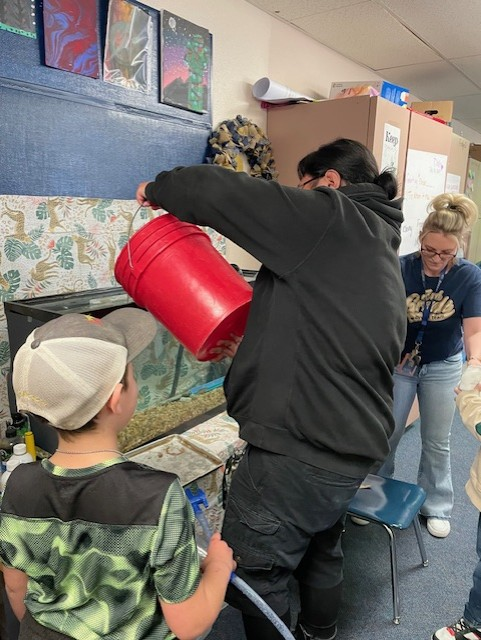
The rainbow trout eggs were delivered to the school mid-October and when I drove to Ruidoso about two weeks later, some of the eggs had already hatched and the fish were in the alevin stage. (Alevin are trout or salmon that have hatched from their egg but still carry a yolk.)

The small pinkish colored objects — mostly toward the top of this picture — are rainbow trout alevin in the aquarium in the classroom

The students in the five classes participating in the program are already excited about this year’s fish experiment. They have drawn posters showing the life cycle of trout that have been placed in the school hallways. A picture is below.

Student drawings and a local newspaper article about the program are posted on this bulletin board.

I spoke briefly with students in the classroom last week and answered some of their questions about trout. Then I asked them a question I’d been wondering about.

“How many of you lost your home in the fire or the flood?”

About three or four hands went up in each classroom.

“How many of you know someone who lost a home in the fire or the flood?”

Virtually every one of the students raised their hand.

I think the impact of the fire and flood was a lot for the third graders to process. I’m hoping that the fish project will be a metaphor for new growth and optimism about the future and can help them move forward.

I’ll keep you posted about this year’s project.

Except for the punishment, maybe it was a good law…

Like any state, New Mexico has its share of strange laws.

For example, we may be the only state that has an official question: “Red or Green,” referring to our choice of chile on our favorite Mexican food dish.

And I’m pretty sure we’re the only state that has an official aroma: “the smell of roasting green chile.”

And there’s the 1953 law that stipulates that election ties are to be resolved by a game of chance — usually a poker hand.

A card table ready to be used to determine winner of the House, NM, election in 2021

That law was most recently used in 2021 when two candidates for town council of the tiny Village of House (population approximately 80) in eastern New Mexico received exactly the same number of votes — 17 each. Each of the two candidates drew cards and when the incumbent’s 9 topped the challenger’s 6, the race was decided.

There are several other strange laws in New Mexico that you can find on this website:

https://www.onlyinyourstate.com/state-pride/new-mexico/crazy-laws-nm

My favorite on this list was one which stipulated that “idiots” were not allowed to vote in New Mexico. That might be particularly appropriate in this election year, depending of course, on how each party defines someone as an “idiot.”

What brought all of this to mind was a story last week in the Albuquerque Journal about the ghost town of Shakespeare, which you’ve driven by if you’ve traveled to Tucson, Phoenix or San Diego from Las Cruces. It seems the town, just shy of the border with Arizona west of Lordsburg, once had a vigilante law enforcement code which provided that anyone convicted of being a “damned nuisance” could be hung. That severe outcome happened to a “real bad man” named Sandy King. King earned his reputation when he went to a local general store to buy a silk handkerchief to celebrate his arrival in the town of Shakespeare. When the store clerk asked for payment, King drew his pistol and shot off the man’s little finger.

A former resident of Shakespeare named Emma Marble Muir wrote an article about the incident for the New Mexico Magazine several years ago.

“The jury could see no homicidal intent in this, for Sandy could have shot him through the heart more easily; but could not consider it an accident,” Muir wrote. “So after deep thought, the jury convicted him of being ‘a damned nuisance.’ In that day and place it was just as great a crime to be ‘a damned nuisance’ as a horse thief.

King, along with a real horse thief named “Russian Bill” were subsequently hung together on the streets of Shakespeare.

I suspect we all know someone who we consider to be “a damned nuisance.” So now you can tell them this story next time they annoy you, in hopes that it will tone down their attitude.

Well of course, the City of Irvine would have one of these…

My son sent me this photo last week of the latest edition to the Irvine, California, police department.

Irvine, California’s Tesla Cybertruck police vehicle

Yes, it’s a Tesla Cybertruck, decked out as an intimidating official police vehicle in Irvine, CA, where my son and his family live.

Having visited my son and his family several times in Irvin, I suppose this purchase by the Irvine Police Department doesn’t surprise me. Irvine is a town where everything is, as Mary Poppins said — “practically perfect in every way. ” It is the epitome of a master planned community with beautiful landscaping, strategically located shopping, a perfectly functioning surface street system and a Tesla in every driveway. Well almost — my son (thankfully) doesn’t own one.

Everything is so perfect there that the police department would probably be more concerned about the noise generated by the firing of a Smith & Wesson .357 Magnum than discovering a victim on a city street who got blasted by it. And of course, the local maintenance crews would be on site within minutes to mop up the blood from the victim before someone complained about the dirty street where the murder occurred. But how silly of me — the place is so perfect there are probably no murders there.

The following is a true story: Several years ago, my wife and I observed a city crew wiping down and polishing the surface of a stop sign on an Irvine street.

So how will the Irvine coppers use their fancy Tesla Cybertruck? Well, it goes from 0-60 in 2.6 seconds, so it should be able to keep up with most speeders, unless they are driving an even fancier Tesla sedan. It can tow 11,000 pounds, so it could be used to tow away a yacht that someone had parked slightly crooked in their driveway. It’s high-strength stainless steel body might be used to deflect any unwanted vehicles driven by individuals who don’t meet the city’s minimum income requirement.

And did I mention that the sticker on this probably tops $125,000 after all the cool lights and other security gizmos are added to it.

I was very jealous when I saw the photo my son sent, so I thought I’d check up on what our local law enforcement officers drive in the Town of Mesilla, where I live.

Two 2005 Chevy Impalas, a 2006 Chevy Suburban and a 1998 Ford F-150

These fine vehicles, all with peeling paint, low or flat tires, rotting interiors and odometers that have probably spun past the 100,000 mile mark several times, are currently mothballed behind the Mesilla Town Hall, where I am currently working as an early voting election official. The town does have at least one operating police vehicle, a somewhat new Dodge Durango, painted the same intimidating dark gray shade as the Irvine Cybertruck. At least they’re on the right track, I guess.

But it could be worse. I Googled “unusual police vehicles” and came up with this:

It’s a 1950s era Nash Metropolitan. Maybe the police department that owns it thinks that if a perp is being chased by this, he or she will start laughing so hysterically that they’ll crash into a light pole and make the arrest by the cops fairly easy — if this vehicle can get to the scene in the next 30 minutes.

The Bermuda Triangle of truck parts…

There is a mysterious vortex in our part of town sucking up random truck parts and spiriting them away to places unknown. I have photographic evidence.

A vintage Toyota Tacoma, sans wheels and tires, down the street from our house

Clearly, if you were trying to sell this vehicle — as the sign on the front bumper suggests — you’d want to offer it with wheels and tires. But the truck parts snatcher got there first.

And then there was this gem down on Motel Boulevard a few years ago.

Also for sale, a Ford F-250 missing some essential things like, doors, seats and a front grille.

Since it still had wheels, you could at least tow away this emaciated vehicle before the parts snatcher got the rest of it. But as you can see, the snatcher already got the doors, seats and front grille.

What brought this serious matter to my attention was the discovery earlier this week of an entire truck engine languishing in the middle of the intersection of Motel Boulevard and the on-off ramps of Interstate 10. What I saw was just a very large truck engine — no accompanying chassis or body.

A lonely truck engine, without a body or chassis

I’m thinking that the persons in the picture next to the abandoned engine are comparing theories about how some unquantifiable force surgically separated the engine from the rest of the truck. Of course, the explanation might have been as simple as someone failing to secure the heavy object on the back of a flatbed trailer as he zoomed through the intersection. I might have seen that trailer nearby this location, but I’m going to stick with truck parts snatchers, just to keep things more entertaining.

My recommendation is this: be sure your truck mudflaps, retractable running boards, custom wheels, dual exhaust system and 20,000 pound trailer hitch are securely bolted down if you venture into our part of town. And maybe you should put locks on your wheels and the bolts holding your doors and engine.

Skillful writing with a dose of Oncorhynchus and philosophy…

I learned last week of the death of John Gierach, a writer whose work I’ve admired for years. His subject was invariably fly fishing, but his messages were always far beyond just the nuts and bolts of the sport and his experiences on the water.

He had written more than 20 books and countless articles for various sporting magazines, including Trout, the official publication of the group I’m heavily involved in, Trout Unlimited. He is credited with coining the phrase “trout bum,” which is one of the titles of his books.

He died Oct. 3 of a massive heart attack at an age dangerously close to mine.

I’ve come to appreciate his careful selection of words, his clever humor, the timing in his writing and the close attention he paid to detail — particularly of the natural world around rivers, lakes and mountains.

Most of what he wrote was about his experiences fishing around the world, but mostly in Colorado where he lived. But always interlaced with his writing was philosophy. Take, for example, this passage from his essay “Trout Candy” in his book “Even Brook Trout Get the Blues.”

“Fly fishing, you see, is supposed to be a very difficult and painstaking business in which success can be rare and fleeting and with complex philosophical undercurrents. That’s the sport’s main attraction and why so many of its practitioners are such misanthropes. We don’t actually hate society, we just feel like we’re plugged into something bigger, better and more interesting, so that the more alienated we become on one hand, the more at home we feel on the other.”

As I said, most of his writing was based on personal experiences, but he did venture into fiction on occasion.

One of my favorite John Gierach fiction pieces is also in his book “Even Brook Trout Get the Blues” and is entitled “The Poacher: A Fictional Fish Story.” The story involves the fictional narrator’s friendship with a larger than life character named Harvey who enjoys the thrill of fishing — uninvited — in private waters to catch lunker trout while risking being caught or even shot at by irate landowners.

Harvey is a philosopher himself.

“Organizations,” he said, “are by definition organized, and therefore both predictable and ineffective. Clear thinking and effective action emanate from a political party focused enough to have only one member.” Harvey then goes on to describe himself as a “Jeffersonian Zen Buddhist Agrarian Anarchist. There are few committee meetings.”

Harvey convinces the narrator to try fishing at a fabulous private lake which he has scouted earlier in his red pickup. He later confesses that he even cut the lock to the property the day before. On the day of the secretive fishing excursion, he drives a different vehicle — a heavily banged up and bandaged Land Rover — to the property and hides it behind some obscuring bushes. Prior to this, he had assured the narrator that he had obtained the landowner’s full permission to enter the property. The reluctant narrator, after catching some giant trout on the lake soon forgets about the danger of poaching. But then both are spotted by the landowner who is literally hopping up and down mad on the other side of the lake before chambering two rounds in his rifle and firing it threateningly into the air.

Harvey quickly concludes they’ve caught enough fish for the day and says it’s time to head home. The two perps escape without harm but are later confronted by the incensed landowner and a sheriff’s deputy at Harvey’s home. The landowner claims to recognize them both and says they snuck into his property in a red pickup. They claim no knowledge of the incident and point to a disabled red pickup in the back yard of Harvey’s house. Cleverly, the day before, Harvey had dismembered the truck’s transmission and scattered its innards on the ground next to it. That way, in case someone wanted to point to it as evidence of a mode of illegal entry, they would find it completely immobile. Harvey then fabricates a story that he was fishing in plain view of the world by a bridge on public waters earlier that day and the narrator quickly invents a claim to have come to Harvey’s house only moments ago “to borrow a pair of pliers.” With no solid proof, the Sheriff convinces the landowner to tuck his tail between his legs and go home.

After another such adventure involving an irate landowner, the storyteller concludes: “So that’s when I stopped going fishing with Harvey.”

And of course, they go on another similar memorable escapade not long afterwards.

As said, it’s great writing in my humble opinion. The stories are short and full of entertainment, some genuine fishing tips and spiked with doses of humor and philosophy. I’d recommend any of his books, which are available in paperback on Amazon.

In a tight spot…

Mercedes Benz joined with Chinese automaker Zhejiang Geely Holding Group in 1994 to produce the “Smart” brand of very small two-passenger cars for urban markets outside of China.

You still see a few of the “Smart fortwo” models buzzing around, but sales in the United States stopped in 2019 because of a declining demand for such small vehicles. BMW had the better idea for very small cars when it revived the legendary “Mini” brand 2000 and has since sold thousands in America. The cars come in a variety of models and normally seat four people.

I personally think what led to the death of the Smart brand in the United States was the use of a Smart fortwo model driven by the hapless Inspector Clouseau (played by Steve Martin) in the movie “Pink Panther 2.” If anyone as goofy as Clouseau chose a vehicle like the Smart fortwo, then your ownership of one might brand you as being in the same category as the bumbling inspector.

I mention Smart cars because on my way to my temporary job as an election official, I passed by the car in the picture below.

A very tight fit for the Smart fortwo

As you can see, the tiny car is squished between the house and a fence on the edge of the street right-of-way. My lumbering GMC Sierra 1500 pickup would have protruded almost halfway to the median of the street if it was parked in the same spot.

And also as you can see in this photo, the vehicle is very well protected by a flotilla of equally small but yappy Chihuahua dogs that made sure I was not welcome when I took the picture. I’m sure these small but fierce dogs can easily fit in the Smart fortwo. Our dog Chester, however, takes up most the entire back seat in our pickup and instead of barking at any dangerous person, he’d be drooling and expecting a treat from them.

__________

And as a note to my very few readers, my posts will likely be fewer in the next few weeks as I work as a volunteer early voting election clerk. If I have time before or after the days I work, I’ll try to post something if I think it might be interesting to you.

A mooooving chorus…

My wife and I attended the Southern New Mexico State Fair last month to watch the Ranch Rodeo competition, which is always a fun event if you’re never seen one. As opposed to professional cowboys riding bulls, busting broncs and roping calves, the Ranch Rodeo events are closer to what real cowboys do during their work. Teams of up to six cowboys from real ranches compete in a variety of entertaining events and are timed for a combined score.

The event I like the most is when a team has to rope a steer, load it into a trailer (which is no easy task with an agitated bovine), then load a horse in the same trailer, then dash to jump into the bed or cab of the pickup pulling the trailer. The horses are particularly entertaining to watch because of their speed, agility and uncanny ability to work with humans to keep ropes tight while the cowboys do their jobs.

My next favorite is the wild cow milking contest, where roping is a bit more difficult because cows don’t have the horns that steers sprout and the animals are much larger than the roping livestock. Cowboys usually resort to pulling on the animal’s tail while two others try to hold it by the head while a fourth tries to get a small amount of milk from the unruly bovine.

Well, they were sort of on key…

But the best part of the evening was when a young woman was singing the Star Spangled Banner and a group of calves being held in pens for an upcoming event decided to join the chorus. I hope you can see and hear the video attached above. It was quite comical, and I’m amazed that the young woman was able to keep her cool while being joined by the calf cacophony.

Otherwise we spent $36 for two corn dogs, one small freshly made lemonade and a pile of curly French fries that probably could have fed the entire population of a third world country (think of El Guacador) for six months. Admission to the fair was reasonable — $15 for each of us with access to everything except for carnival rides. We chose not to go on any of the rides, mostly because I feared I would toss most of my $15 French fries at the top of the “Loop of Death” or whatever the most treacherous ride was called.

Glad to be part of something that’s ranked #1…

I start my duties today, Oct. 8, as an election clerk, Machine Judge and Same Day Registration official for the Nov. 5 general election. My first job is fairly simple — retrieve absentee ballots from the collection box outside the polling place where I will be working during the election and turn them into the Bureau of Elections at the Dona Ana County Clerk’s office. I’ll collect any absentee ballots there three more times before I begin my twelve days of on site work as a Same Day Registration official and Machine Judge and then finish up with one r-e-a-l-l-y long day on election day, Nov. 5.

I’ve already attended two training sessions in preparation for my work. Our procedures will be pretty much the same as they have been for the three previous elections for which I have volunteered. The overriding emphasis in our training is making sure the process is fair and accessible to everyone eligible to vote. As I have said in posts about this previously, the number of security steps we go through make it virtually impossible for someone to manipulate results of the election.

Voter using voting machine.

One of the things we learned during this year’s training is that the Massachusetts Institute of Technology’s Election Data and Science Lab has ranked New Mexico’s election process as the best in the nation. MIT’s ranking system analyzes each state’s voting procedures. New Mexico got the top spot after MIT reviewed “a variety of performance indicators measuring aspects of election administration such as voter registration rates, post-election audits, security protocols, ballot rejection rates, wait times, and more.”

Here’s a link if you want to read more about it:

New Mexico’s Elections Ranked Number One in Nation | Maggie Toulouse Oliver – New Mexico Secretary of State (nm.gov)

New Mexico often ends up 48th, 49th or 50th on many rankings evaluating our state’s performance in such categories as poverty, education, child care, bad drivers, etc., so it’s nice that we are on the top of this particular review.

One thing of interest that was emphasized during our training is that this election is expected to have the highest turnout in recent history. We also learned that in New Mexico there have been more people who have registered as for this election as challengers, watchers and observers than in any previous election.

It will be an interesting election. I urge all of you to exercise your right to vote and have confidence that the process in New Mexico is working well.

Stonewalled, at least for now…

“You are requesting information which we have determined does not currently exist and would, therefore, require the TRD (New Mexico Taxation and Revenue Department) to create a new public record.  We are, therefore, unable to provide for inspection of the records that would include the information that you have requested.”

The above is the state’s response to what I thought would be an easily accessible bit of information that I suspect is actually available somewhere and would be of use to quite a few people — automobile manufacturers and dealerships in particular.

What I was seeking was the number of Ferrari and Rolls Royce vehicles registered in the state, by county. It was just something I was personally curious about. I was able to access this exact information easily more than 40 years ago when I was a journalist and Bureau Chief for United Press International in Santa Fe.

When we get our annual registration form or get a title to our vehicle, it clearly contains the make and model of that vehicle. That information is stored in the bowels of some computer mainframe in Santa Fe. I’m not a computer nerd, but I suspect it’s much easier today to do cross reference searches and calculate vehicle type by county than it was four decades ago.

Yet, I’m told by the state that information “does not exist.”

Imagine, if you will, that you are Subaru of North America and you want to see what sales opportunities are in Las Cruces, New Mexico. Las Cruces used to have a Subaru dealership but it disappeared many years ago and we don’t have one now. Yet when you drive our streets, the number of Subarus you see clearly indicates the popularity of the brand. We have one family just down the street from us that has three of them — all relatively new models. When our daughter visits us in her Subaru, I’m sure she would appreciate it if a dealership was available locally if she had any service needs or even wanted to buy a new one.

Do you really think that nobody knows how many of these are roaming our streets in Las Cruces?

Yet, according to the New Mexico Motor Vehicle Department (under the Taxation and Revenue Department), Subaru of North America could not determine exactly how many of their vehicles are owned in Dona Ana County and therefore could not determine what kind of market penetration they already have and project the potential for new sales.

I’m sure I’m simplifying what factors are involved in determining what vehicle franchises are awarded in certain markets, but I am pretty sure the type of information I was seeking would be something they would look at before making a decision on a dealership.

And imagine this scenario. State Police are seeking a serial killer somewhere in Valencia County. One of the things police know is that the suspect drives a 1998 dark green Ford van — license plate unknown — that was seen at multiple crime scenes. They try to narrow their search by determining how many of those are in Valencia county, and who they’re registered to, only to be told by another agency that the information “does not exist.”

But I’m not giving up. I suspect that if a representative from a vehicle dealership called the MVD to find this information, they would probably have a more direct line to a data center that could supply that Subaru count in Las Cruces. I have a couple of friends in the new car business that I may ask to see how far they can get with my simple request.

And yes, I know that this is not the kind of hard-hitting investigative local journalism like Woodward and Bernstein did, and I know 99.9% of my readers don’t care. But in my mind, there is a principle about how easy it should be to get information from our state government — especially if it becomes something very important to a larger group of its citizens.

I’ll keep you posted. But of course, you’re free to just ignore my ramblings.

And the search goes on…

(Imagine you’re listening to the tune of Sonny and Cher’s “And the beat goes on…”)

If I was a resident of New Mexico trying to address a serious problem that I thought state government could help me with, I would have concluded after two days of searching online and by phone that there are no actual humans working for us.

I am college educated, reasonably smart and had a good record of tracking down information from state government when I was a journalist many years ago. For those reasons, I thought it would be relatively easy for me to find out a simple bit of information about how many Ferrari automobiles are registered in our state for a post I wrote on my blog earlier this week. Not so.

So far, I have run into an endless string of dead-end loops of recorded phone menus, useless websites and nothing resembling a place or person where I can find the information I am seeking.

After two days of searching online, I’ve only been able to talk to two live human beings. The first live person I was able to speak to was at the New Mexico Department of Taxation and Revenue, which oversees the New Mexico Motor Vehicle Department, He quickly referred me to a phone number at the Motor Vehicle Department, which — guess what — turned into another endless loop of recorded phone menus.

I thought I’d give my state legislators a call. Neither one of them, Sen. Carrie Hamblin or Rep. Micaela Lara Cadena, had phone numbers listed in the official legislative website. There are e-mail addresses listed for them, but I thought I’d continue to try to talk to a live person.

So I decided to do a moon shot and call the governor’s office. Amazingly, someone in person answered the phone. I told him what I was looking for and his first response was that “I don’t think anyone has that kind of information.” But he agreed to help me and said he would contact someone at the Motor Vehicle Department and have them call me back. I was skeptical that I’d ever hear anything more.

But I guess when the governor’s office calls, people hop into action. I received a call back within about five minutes from a woman with the Motor Vehicle Department. She also said she didn’t think that information would be available, but said I could go on to the New Mexico Department of Taxation and Revenue Department website and fill in a request for that information.

So I submitted an online request form with the simple request for “Number of Ferrari and Rolls Royce vehicles registered in the state by county.”

I will let you know how this turns out. But in the meantime, I can’t help but feel sorry for anyone who lacks the skills to navigate websites or state government phone numbers to get information that they might desperately need. I suspect what I experienced is similar to what one might experience in another state or with the federal government.

I know I’m starting to sound more and more like Andy Rooney, the late curmudgeon from the CBS 60 Minutes TV show who routinely berated what he thought were silly departures from common sense.

The late CBS 60 Minutes contributor Andy Rooney

But I really think our governments could make things simpler and not let computer nerds or “AI” dictate our choices.

Going down a rabbit hole, Italian style…

Many years ago, when I was Bureau Chief with United Press International in Santa Fe, the news cycle would predictably slow down during the summer months when the New Mexico Legislature was out of session and bureaucrats went back into hiding to lick their wounds inflicted by the lawmakers.

On top of that, many people were on vacation and people’s focus turned away from state government.

During those times I often wrote longer, more in-depth feature stories about interesting people, places or things in the state.

One summer, as I walked to the post office from my office at the state capitol building, I spotted a bright red (what else) Ferrari zipping around the federal building office building north of the historic Santa Fe plaza.

I can’t tell you what model it is, but I’m sure a Ferrarista would be able to identify it immediately.

In New Mexico, Ferrari sightings were pretty unusual then and even now (except when I see some used models on the showroom floor of a car dealership that I visit on occasion).

The sighting prompted me to wonder how many of these magnificent Italian machines were registered in the state of New Mexico, and where were most of them domiciled. At that time, it was pretty easy to call the New Mexico Motor Vehicle Department and drill down the call list to their statistical division and request a report on vehicle registration by type per county. So I wrote a feature story based on that easily obtained data.

Although I can’t recall the exact number of Ferraris in the state, I do recall being surprised when the number at that time was more than 100 (I think I remember it being more like 350, but that memory has long since faded.) And what was most surprising to me was the discovery that at least five of these 12-cylinder beasts were registered in Sierra County, home of Elephant Butte Lake and Truth or Consequences. I figured most would have been domiciled in Bernalillo or Santa Fe Counties, but I found them in such far flung places as Gallup and Clovis.

I do know this is a Testarossa model, which probably every overly-testosteroned male in the 1980s (maybe me included) lusted after.

Fast forward to today. I decided to investigate the Ferrari population in our state at the current time and discovered… that’s it’s almost impossible to get that information.

I started with the New Mexico Motor Vehicle Department. After endless menu selections without a live human voice to respond, I was finally put on hold to listen to classical music. No one ever answered, although I was assured someone would call me back if I left a message. (“Good luck with that,” I thought. ) And none of the menu selections seemed to be pointing me in the direction of the information I sought.

The MVD is now under the auspices of the New Mexico Taxation and Revenue Department, so I thought I would give that agency a call. I got another endless chain of menu selections sounding nothing like I was interested in.

It makes one wonder how you can ever get in touch with a real person in state government, except by driving to Santa Fe and boldly entering into an office and announcing you want to talk to a human. (I’ll hold off writing that blog until another time, however.)

So I decided to try another route. I asked Google “How many Ferrari cars are registered in New Mexico?” I found a site called “Statista,” which sounded Italian, but could not provide the information I needed. I also stumbled across a Ferrari owner’s club site, which had some interesting chats and questions from Land of Enchantment owners.

I found this breathless post:

“My f430 ships tomorrow from Ohio. Would be happy to talk cars or just visit. I am in High Desert NE Albuquerque above tramway.”

It was followed by this tragic response:

“Well you are surely luckier than me. The wind damaged our garage door, and the damaged door was nailed shut trapping my 360 inside. Thus, I am Ferrariless!

But nothing I found on the Ferrari owners website could point to how many Ferraris are in the state. I suspect that no one but me cares, but I am going to do my journalistic best to get to the bottom of this important issue, which I am sure will somehow influence the upcoming elections.

However, I did come across some other rather startling information regarding vehicle registrations in New Mexico: There were 1,783,151 vehicles registered in the state in 2020, including cars, trucks, buses and motorcycles. There were 2,117,000 residents in New Mexico, according to the 2020 Census, meaning that there was more than eight-tenths of a vehicle per person, including a whole bunch of people who weren’t even eligible to drive.

And, if you look at our roads and streets, you’ll surely guess this — there were almost twice as many trucks as there were cars on our roads. And I’m betting at least half of those trucks were Ford F-150s.

Salmonid stories…

A couple of quick updates regarding fish.

Apache trout recently downlisted from “endangered” and “threatened.”

Last month, the once endangered Gila trout’s cousin, the Apache trout, was removed from the federal endangered and threatened species list, which is worth another cheer from all of us who love the outdoors. Interior Secretary Deb Haaland, formerly a New Mexico member of Congress, made the announcement.

Work on preserving the strain had been underway for more than five decades, about as long as efforts had been in place to remove the Gila trout from the endangered list.

The Apache trout’s habitat is in southeastern Arizona, and there are apparently no known populations in New Mexico. The Gila trout is found mostly in the Gila country of southwest New Mexico, but also has been found in populations in southeastern Arizona. The species are very closely related, but slightly different genetically.

The U.S. Department of Interior says at least 30 separate populations of the Apache trout now exist in southeastern Arizona along 175 miles of streams, almost all of those in the White Mountains of that state.

Having seen photos of the Apache trout and having recently caught several Gila trout, I have to say that the Gila trout appears more colorful, with brighter yellows on its fins and body and more colorful spots.

Here’s what I found on the internet describing the differences in appearance:

“Apache trout are similar in coloration to the Gila trout (Oncorhynchus gilae), however, the yellowish coloration is restricted to the ventral region of the Apache trout (Behnke 2002). Additionally, the Apache Trout have larger and fewer spots compared to the Gila Trout.

So even if they’re not as pretty as the Gila trout, I’m glad the Apache trout has been taken off the endangered list and will continue to be monitored even though anglers can now catch them in their native Arizona.

__________

And speaking of Gila trout, things are finally underway to start raising a population of that species in a classroom at Stout Elementary School in Silver City next spring. Because the species is currently being raised in only two hatcheries in the state, getting the okay for the Trout Unlimited’s “Trout in the Classroom” project was a little more complicated than starting a similar program using rainbow trout at Ruidoso last spring. If everything goes according to plan, the fish will be hatched in a tank in a classroom in Silver City early next year and will be released as fry in Lake Roberts in late May.

Meanwhile in Ruidoso, plans are underway to start raising the rainbow trout in the classroom at White Mountain Elementary beginning in late October. It’s hoped that the fish will be a little larger than the ones we released into the Rio Ruidoso last May and will have a better chance of survival. We’re virtually certain that all of the fish we released last spring in Two Rivers Park in Ruidoso died during the intense flooding that followed two major forest fires.

I’m really proud that the teachers wanted to do the program again this year, given what a difficult time it has been for everyone in Ruidoso this summer.

I’ve already been to Ruidoso this fall to help the teachers get set up for the program. I’m scheduled to deliver trout eggs to the class on Oct. 18, driving them from Lisboa Springs hatchery near Pecos to Ruidoso on that date.

Although I’m sure this is getting boring from some of my readers, I’m still enthusiastic about the program and hope we can see more of these started in the future.

It’s not just the scratchy sheets…

Various news agencies have recently reported the closing of the historic St. James Hotel in Cimarron, a property in northeastern New Mexico known for housing many famous Western characters during its heyday.

The hotel, as several other older New Mexico hotels have claimed, is also suspected to be haunted.

Take, for example, the Lodge in Cloudcroft, where the ghost of Rebecca reportedly wanders through the halls at night. Rebecca, whose name is currently used for the hotel’s restaurant, was a chambermaid working at the hotel when she was caught by her lumberjack lover in the arms of another man. Rebecca, who was described as having “shocking” red hair and brilliant blue eyes, disappeared after her tryst was exposed, never to be seen again. The hotel says her ghostly actions include unexplained opening and closing of doors, moving of furniture and objects on tables and lights that go off and on without explanation.

Another interesting hotel in New Mexico is the Hotel Parq Central in downtown Albuquerque, originally a hospital for railroad employees and later an institution for the mentally ill. People have said they occasionally see a woman looking out a window on the top floor of the facility and guests complain that their sheets have been ripped off their bed during the night without any explanation.

The St. James in Cimarron has hosted such guests at Buffalo Bill Cody, Wyatt Earp, outlaws Jesse James and Black Jack Ketchum, famous western author Zane Grey and artist Frederick Remington. About 20 bullet holes in the ceiling of the hotel’s main dining room are attributed to various gunfights staged there over the years.

Reports say at least two of the hotel’s bedrooms are haunted. One was open to guests, but one article said the other was permanently closed because it was occupied by a ghost “so malevolent that occupation was considered hazardous.”

I’m sure the closing of the hotel will come as a great disappointment to paranormal sleuths. But although I never visited the hotel, its closing also is a great disappointment to me and others who relish unique things in our New Mexico history.

The hotel owners say the facility was closed yesterday, Sept. 16, apparently because of problems in finding enough staff to keep it open.

For information on other hotels in New Mexico that are reportedly haunted, you can go to this website:

https://www.onlyinyourstate.com/stays/new-mexico/haunted-hotels-nm

Stating the obvious…

There have been two articles in the Albuquerque Journal recently about an apparent bat infestation at Presbyterian Hospital in that city.

My most memorable bat experiences was the time I was coaching my son’s soccer team in an evening game under the lights and the players — 10 to 12 years old at the time — were more interested in watching bats flying around the field lights to catch bugs than concentrating on their game. Luckily, the kids on the other team were just as distracted and I think we played to a 0-0 draw. The bats, however, scored big on catching bugs flying around the stadium lights.

A Mexican free-tailed bat, common around here.

Presbyterian has hired a company called “Get Bats Out,” a national company specializing in removing the flying mammals that have infested homes and businesses.

However, one California man visiting his uncle at the hospital managed to take care of the bat problem on his own. Nicolas Mascarenas said he first thought a bird had fluttered by him in a hall inside the wing where his uncle was hospitalized, but then realized it was a bat. He noticed hospital employees scurrying around with sheets, hoping to trap the critter,s so he decided to join in the hunt.

But instead of using a sheet, he clapped his hands loudly to scare an animal as it fluttered around a corner and flew — “splat” — right into a glass window.

“It was laying on a white ledge,” Mascarenas said. “I returned to the staff and told them the bat would be easy to catch.”