About seven years ago, likely on a Sunday morning in the summer, I went out our front door to fetch the daily newspapers that are tossed onto our driveway. It was before I had my one and only cup of coffee for the day, so I was still slowly assimilating full consciousness.
When I heard a clattering sound coming toward me on our paved street, I was startled by the noise, then began searching for the source. Trotting down our street in a mostly urban area was a completely unexpected group of four javelinas — three adults and a juvenile.
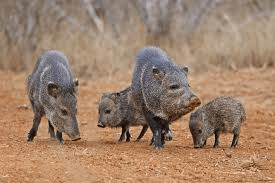
In technical terms, a group of javelinas is called a “squadron” and juveniles or babies are called “reds.”
The squadron was running westward on our street at a fairly fast clip, likely scared that they had ventured into an unfamiliar environment and were urgently looking for a less urban area. They seemed not to take any interest in me. As I watched from my driveway, they trotted by just in time for a neighbor across the street to see them and confirm that I had not just imagined this unexpected intrusion. Later in the day, I spoke with a neighbor further west from our home on the same street who confirmed he had seen the animals. He even claimed that they had left snout marks on the front window of his house, which I never checked to confirm (It was too good of a story for me to attempt to debunk.)
Javelinas are common in the American desert Southwest, ranging from Texas to Arizona with a fairly common presence in southern and southwestern New Mexico. They are common in Mexico, Central and South America They’re usually found in arid deserts away from urban areas, so the sighting in our neighborhood was unusual but welcome.
Usually thought to be wild pigs, they are in fact a different species called peccaries. According to various sources, they are highly social and travel in groups of four to up to 20. They have a keen sense of smell but their eyesight is extremely poor. They are generally timid unless backed into a corner and with young in tow and can be rather menacing looking with their long tusks. It’s sometimes believed that when they appear to be charging, it’s only because they don’t see well enough to know they are heading towards a human.
According to an online source, javelinas rely heavily on a musky scent gland on their backs instead of their vision to stay connected. Members of the herd rub against each other’s glands to create a unified group scent, allowing them to easily identify one another. Because of that, they are sometimes called “skunk pigs.” Some countries adopt them as pets, but I suspect it would take a but of adjustment to get used to their smell.
They differ from pigs in several ways. One is that they have four toes on their front feet and only three toes on their hind feet. (only the middle two toes function as hooves.) Pigs have four toes on all four feet.
The mostly nocturnal animals can weight up to 80 pounds and are omnivorous, preferring roots, grasses and grubs — often ripping up gardens on the outskirts of an urban area.
I’m always excited when I see a group of javelinas running through our high deserts because their presence is so unique to our area. I always thought because of that uniqueness they would be great mascot for our New Mexico State University’s athletic teams. Well maybe “Stinking Javelinas” wouldn’t be that much better than “Aggies.”

