I know all of you are busy getting ready for a big Thanksgiving feast, so I’ll keep this short.
For several years, Thanksgiving became a bad luck day for me. This mostly happened when I was much younger and I think the stigma has gone away.
For example, one year I was playing in some rock rubble next to a house we were renting in Ruidoso. As I recall, the city was planning on installing sewer lines and had dug up a street next to our house. In the long term, that was a good development, since our house had a septic tank that my parents warned my sister and I to avoid for fear it would collapse if too much weight was placed on it.
So while apparently trying to discover a cave in the rock rubble I dislodged a rather large flat rock the size of a card table and it fell on my back. I was pinned underneath it, but luckily someone nearby either saw what happened or hear me screeching for help. Some people rush to help remove the rock, including my embarrassed father, and I suffered no injuries.
On another occasion, my sister and I were playing a game of “Where do you think you are?” by blindfolding the other sibling and allowing them to wander around to try to figure out their location around our house. (Luckily, we no longer lived in the house where we feared falling into a septic tank). When it was my turn to be blindfolded, I decided to try to explore the area surrounding me by crawling on all fours. Unfortunately, there was a four-foot cliff right in front of me, and I crawled straight toward it, then tumbled into it. I suffered a cut on my head when I hit a rock but did not have a broken neck. My sister swears she tried to warn me of my impending doom, but either I didn’t hear it or thought she was just trying to throw me off my quest of determining where I was.
I can’t recall the other bad Thanksgiving incidents that happened to me over the years, but I do remember being very cautious about everything on Turkey Day for a long time after that.
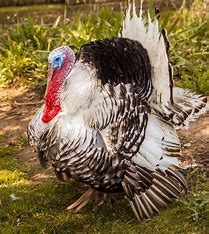
Anyway, hope you and your family enjoy a nice Thanksgiving and avoid rock piles and being blindfolded — or being a turkey.
Police in Albuquerque are searching for two armed robbers who came into a Halloween store before the holiday and forgot something essential for someone contemplating such a crime.
A mask.
The store was probably full of them, but the armed robbers apparently were clueless about security cameras in place and allowed their faces to be clearly shown in a video from inside the facility inside a West Side mall. They may have even tried to grab one off the shelves before the store manager figured out their motive.
The only thing the one of the robbers was wearing on his head or face was a backward-turned baseball cap. After the manager confronted the individuals, she was threatened with a gun, then the two fled on foot. Police could not locate the suspects in the area of the store.
Police made a statement that kind of seemed incongruous to the clear photo of one of the robbers that was printed in the Albuquerque Journal.
It said that “Due to the lack of identifying information and not locating the subjects (near the store)…” the report of the robbery was referred to detectives.
I don’t know about you, but I think a clear photo of the suspect would be “identifying information.”
Maybe next time, the robbers will remember to wear a mask and not try to grab one off the shelves after they enter. I think I’d go with one of these:
A befuddled bicycle rider recently wrote to the Albuquerque Journal concerning the sudden appearance of spiders painted on bike lanes in the city.
“Riding my bicycle throughout the city, I have spotted stenciled spiders in various colors in the bike lanes,” the note to the Journal said. “I was thinking they were some kind of signal.”
According to the bicycle rider, the spiders were 12-14 inches in size in shades of yellow, red, blue, green, purple and other colors.
A spokesman for the city said no one knows who is painting the spiders or what their meaning might be. They are considered to be graffiti, so they are being erased as soon as they pop up, they said.
Better painted spiders than this real spider hatch spotted on a street in Vancouver, British Columbia, some time ago.
More than 50 years after I graduated from college, I still have occasional dreams about not finishing a final assignment in class, missing too many classes, flunking a final exam and not being able to graduate. I’m told that this is a fairly common phenomenon, probably because for the first time in our young lives we were faced with the responsibility and stress of getting things done without our parents nagging or having a watchful eye on our schoolwork.
I think lots of students do this. They wait until the last minute to cram for an exam, throw together a semester paper a week before classes end or try to speed read a textbook that was gathering dust on a shelf in the dorm for most of the year.
Of course, the goody two-shoes students who got 4.0 gradepoints were always on top of things. I wasn’t one of those, but I did make it through in five years while working full-time and graduated with a gradepoint that actually improved significantly in my last four semesters. (Patting myself on the back “:^)
This kind of procratinating student behavior was evident on general election day when I worked as a same day registration clerk at a voting site near the campus of New Mexico State University.
Apparently, the waiting lines at the NMSU voting site at Corbett Center were extremely long, especially toward the end of the day. Our site was the next closest polling place to the campus. As a result, students who didn’t want to keep waiting in line to vote, thought they could get an easy way out of procrastinating by coming to our polling location.
Traffic at our polling place had been steady all day long, with never more than about 10 people waiting in line to vote.
Then at about 6:30 that all changed when we had a flood of students show up to vote. Many of the students had registered in their home town in a different county and some had never registered to vote. As the same day registration clerk, it was my job to process all of these students so they could then vote legally. When the polls closed at 7 p.m., all of the regular voters had been able to cast their ballots. But I was faced with a line of 30 students needing to register or change their address before they could cast their ballot in Dona Ana County.
It was frustrating. One kid showed up and forgot his driver’s license, which was needed for identification so he could change his address. He sent someone to the dorm to fetch it for him. When he appeared before me the next time, he forgot his Social Security number — also needed to change voter registration.
“Would your parents have it,” I asked.
“Uh well, maybe. I don’t know,” he said.
A few minutes later, he had managed to track down his parents on the phone to give him his Social Security number.
I put in that information, along with his driver’s license number and then asked him for his new address.
“Uh, I live on campus,” he said.
“I have to have a physical street address,” I answered.
“Uh, I don’t know what that is. I’m in Pinon Dorm Roof 252D. Does that work?” he asked.
I told him again that I needed a physical street address and suggested he might look on Google Maps to come up with one. Finally, he found one and after three tries, I was able to change his voter registration to Dona Ana County.
This wasn’t the only such case. Most students on campus didn’t have the slightest clue about what their street address might be or remembered their Social Security number. At one point, with about 25 students still waiting in line, I stood up and somewhat gruffly announced that they would all need a driver’s license or other photo ID, Social Security number and a physical street address. There was an audible groan and you could see many of them frantically checking their phones for that information.
When I finally processed the last registration/address change, it was about 8:30 p.m. All of the other workers at the poll had been done with their jobs shortly after closing time at 7 p.m. And by the time I took the ballots to the Election Bureau warehouse, it was after 11 p.m. I had started my day at the polls at 6 a.m.
Overall, my time as a poll worker was a satisfying experience. There was a lot of dead time during my two and one-half weeks at an early voting site. Election day was satisfying, helping people correct the information on their voter registration records or registering first time voters.
And I thought it was important to see the process from an insider’s viewpoint, given all of the claims of voter fraud that had been circulating in the past two years. I can say without hesitation that I saw nothing of that nature during my tenure an election clerk. And I have great respect for all the people who work long hours for very little pay to make sure Democracy is working.
But for Pete’s sake, if you’re going to change your voter registration address or register to vote for the first time, come prepared. Bring your darn photo ID, Social Security number and current physical address with you.
I’ve written two earlier blogs about people who were reported dead, even though they were very much alive. One involved our good friend Cheryl who discovered on her Ancestry family tree that she had been listed as dead since 2011. She is still very much alive. Another involved a woman struck by a bicycle in Albuquerque who police listed as dead when she was placed in an ambulance, yet turned up to be very alive at the hospital the next day. Chagrined police issued a profuse apology to her and her family.
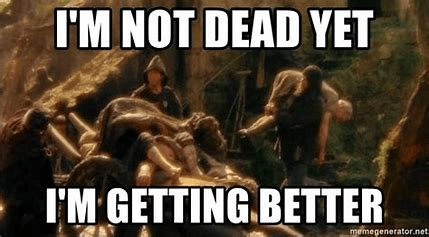
And I know I’ve mentioned this before, but for fans of the extremely silly movie “Monty Python and the Holy Grail,” you might remember a scene in which a man believed to be dying from the plague is brought to a cart carrying dead victims to the grave. The cart is accompanied by a man who rings a bell and calls out “Bring out your dead” as it rolls along gritty streets somewhere in England.
As he is about to be loaded onto the cart, the presumed dead man calls out “I’m not dead yet,” then later says “I’m getting better” and concludes with “I think I’ll go for a walk.”
Frustrated that they can’t complete their gruesome work, one of the workers whacks the complaining man in the head, making sure he is in fact dead.
“Ah, thanks very much,” replies the worker who brought the man to the cart.
Below is a link to a short You Tube video of the scene if you’re interested:
What leads me to this discussion is a story I read in a book by good friend and author Jack Wilson about the Lincoln County War. His book, Merchants, Guns & Money, is an excellent and thoroughly researched accounting of the bloody Lincoln County War in the late 1800s. I strongly recommend it for anyone who wants to learn the whole story about this slice of New Mexico history.
An episode in the book that caught my attention involves the hanging of a murder suspect, William Wilson, who shot another man in response to some harsh words at an earlier political convention. Following a quick kangaroo court trial in which he was convicted, Wilson was sentenced to hang in Lincoln. On the day of his hanging, Wilson was asked if he had any last words. He began to say that he blamed Maj. L.G. Murphy — one of the key players in the Lincoln County War — for his predicament.
“You promised to save me,” Wilson said, “but…”
And at that moment, before Wilson could finish his dying accusation, Murphy kicked the trigger to the trap door of the gallows and the convicted man’s body jerked and started swinging.
After nine and one-half minutes, the authorities took down Wilson’s body and placed it in a coffin. Shortly thereafter, someone noticed that Wilson was still breathing. A group of soldiers from nearby Fort Stanton took the body out of the coffin, put a new noose around Wilson’s neck, then hung him a second time for another 20 minutes.
I’ve completed my first week as a clerk in an early voting polling place at the Mesilla Town Hall.
Everything has run smoothly, except for a couple of hiccups I created when registering people to vote. My fat fingers on a tiny keyboard didn’t help and some misunderstanding on birth dates and name spelling by both me and my registering voters were to blame. We got it sorted out, and everyone got to vote.
Nothing has happened that would suggest any vote tampering. It simply isn’t possible at the level I’m working at with the abundant checks and balances that are in place.
Nevertheless, we’ve had at least 10 Republican challengers (more like observers) show up to watch what we’re doing to make sure everything is above board. They’ve asked a lot of questions, which we’ve been able to answer. Unfortunately, the only person who was turned down to vote was a Republican. It seems his wife accidentally sent in his absentee ballot, which had already been counted. The County Clerk’s office is trying to work through the issue and hopefully, he will be able to case his own vote. We’ve only had one Democrat show up to observe. I’m glad all are there to see the process in action.
Our early voting polling location crew of eight people includes five Democrats, three independents and no Republicans. I am sorry there are no Republicans. From what I’ve been told, there were not enough GOP members who volunteered for the election jobs to make sure there was representation by both parties at all polling locations.
Tedium is the biggest issue I’ve faced so far. There is a lot of waiting around for people to come to the polling place. Most of them simply vote and don’t see me for same day voter registration. A few, however, are new to the area and need to have their voter registration changed to reflect their new address. A couple were new to the state, but had all the proper credentials to vote — at minimum a confirmed local address and a photo ID.
In between those times when I help people register to vote, I’m reading books, chatting with my fellow poll workers or taking strolls around the building. But mostly, it’s really a lot of deadly time killing.
We usually have a burst of voting activity right when polls open, then a steady stream of voters until mid afternoon followed by the time-dragging last three hours before polls close at 7 p.m.
So far, my most interesting experience involved the change in registration for an elderly man who had moved from Rio Arriba to Dona Ana County. He was assisted by his daughter and granddaughter, who apparently live in the Las Cruces area.
As I went through the relatively simple process of changing his address so he could vote in Dona Ana County, he was asked what his party affiliation was. He had previously been registered as a Democrat — not unsurprising for someone from Rio Arriba County where the Democratic party has had a stronghold even since before the legendary party boss Emilio Naranjo ruled the roost there. But he said he wanted to be a Republican.
His daughter and granddaughter thought he had made a mistake.
“Don’t you mean Democrat?” the daughter asked.
“No, Republican,” he answered.
“Really, are you sure?” asked the granddaughter, her eyes rolling in protest.
“Yes, Republican,” he said.
The daughter and granddaughter accompanied him to get his ballot, then helped him vote, which I’m certain resulted in more eye rolling and some votes for the relatively few GOP candidates on the Dona Ana County ballot.
At my temporary job as an election clerk for the November general election, I’ve been tasked with doing same day voter registrations. We don’t expect many of them — at least at my polling site — but we do have to follow specific procedures in order to register someone on the same day.
Me at my same day voter registration desk at the Mesilla Town Hall polling station
One of our primary conditions for approving a same day voter registration request is confirmation of a local address within Dona Ana County.
Two Sundays ago, a homeless man named Keith came to our church and sat in on the service. He even put five pennies in our collection plate and asked for a copy of the Bible, which I gave him. I noticed last Sunday that he had signed our guest book. I’ve edited out his last name, phone number and information about a previous guest. Our homeless guest, listed his address simply as “under the bridge,” apparently meaning the bridge on I-10 over South Main adjacent to our church.
Entry in our guest book
I doubt this would qualify as an approved local address, so Keith probably wouldn’t be able to register to vote. He did, however, seem to have a phone with an area code (575) number, which is proper for Dona Ana County. And I noticed that his home church is “open.”
He seemed like an intelligent, decent guy — much easier to deal with than previous homeless people I’ve written about who have appeared at our church. It just makes one wonder what led up to his current situation. I hope that some day his address will be more permanent than “under the bridge” and that he can register to vote if he wishes.
During the next couple of weeks, my posts may be a bit sporadic — if at all. I decided earlier this year to answer the call for people to serve as election clerks in Dona Ana County and I’ve been assigned to do an early voting job in Mesilla starting Saturday, Oct. 22. By the time you read this post, I will have worked my first shift.
With all the rhetoric surrounding the security of our elections, I thought it would be worthwhile to volunteer my time to get involved in the vote gathering process.
I’ve already attended a couple of training sessions and my role will be to process same day registration requests.
My observation so far is that the entire election process, at least here in Dona Ana County, is very professionally done with multiple security steps to ensure that the process is free of any outside influences, political or otherwise. No one has told me to flip a switch to favor certain candidates or do anything like that.
However, when doing my training last week to check the absentee ballot drop box outside the Mesilla Town Hall, my trainer, Carlos, passed on some interesting information. I asked him if the drop boxes sometimes contained unusual things that people had dropped in them.
“It’s pretty hard to get anything large in there because the slot is so small,” he said. “However, at the Las Cruces City Hall drop box, there are occasionally black widow spiders living inside that you have to be careful about.”
I’m hoping not to find any of these in my drop box
So is a spider infestation a Democrat or Republican ploy to keep voters away? Or just a random act of nature? I’m sure it is the latter, but if you have comments or thoughts, I’d love to see them. And with the recent infestation of scorpions in our neighborhood in Mesilla Park and probably in Mesilla, I hope none of those critters decide to make a home in the drop box I will be attending.
So far, I’ve been sort of overwhelmed by learning the acronyms for the process and remembering the steps I have to go through to take same day registration requests. I still have a lot of “what if” questions, but I think I can get the job done.
There was a story in the Albuquerque Journal last week quoting our Secretary of State, Maggie Toulouse Oliver that she expects additional challenges during the election process this year. I can understand that, given the current political climate, and am looking forward to see how that may play out in what I will be doing.
At any rate, I promise to be completely apolitical during the process (I willingly took an oath to that effect) but I will be observant about what I may report on this blog in the future. Because I’ll be working several hours per day, I may not have time to write new blog posts, so I hope you’ll forgive me for the lapses.
Last weekend, I attended a reunion of the New Mexico State University rugby team, which I coached for many years starting in the early 1980s. I think I was coach for more than 10 years. During that time, I had one team which finished third in the national championships, several teams which won regional championships and had the pleasure of coaching two fine young men who ended up being All Americans in rugby.
I wish I could say all the successes we had were because I was a great coach, but as they say — when the team wins, it’s because you have great athletes, but when you lose, it’s the coach’s fault.
A bunch of former NMSU rugby players, posing with Pistol Pete. I’m in the row that is kneeling, third from left, with NMSU rugby team founder and longtime great friend Joel Diemer on my right and former All-American Adam McPherson on my right . The young man I coached in soccer and who later played rugby, Cory Micander, is last person on the right sitting on the ground.
I also had the pleasure of coaching my two children’s youth soccer teams, beginning when they were in elementary school and going through middle school. In retrospect, I’m not convinced the difference in attention span between elementary kids and testosterone fueled college guys was much different. But that’s what makes it challenging, entertaining and fulfilling.
I’m proud to say that most of the rugby players I coached have turned out to be fine young men, with families and good careers. And most of the kids I coached in soccer have turned out to be fine mothers, fathers, public servants and career successes. And ironically, one of the kids I coached on my son’s soccer team in middle school ended up playing rugby at NMSU after I finished coaching that sport.
I’m convinced that everyone who has the opportunity should coach young men and women in some sport. It is a black hole for time and energy and is often frustrating, but in the end well worth it. Coaching rugby was particularly gratifying in that none of the young men had ever played — much less seen — the sport before. Unlike football, baseball or basketball, rugby was completely new to them and they really listened to what the coach said.
Here are some comments I got from former players following the reunion:
“I’ve always appreciated everything you’ve done for me and this rugby family. You were a great coach…”
“I’m really glad you convinced me to keep playing prop (a position on the front row of the scrum). I wanted to play flanker, but you said I could go further if I stayed with being a prop, and you were right.” (This was from a young man who ended up being one of my two All American players).
“… it’s hard to believe how much fun we had and the huge impact you had on so many players, myself included.”
“Thanks for everything you have done for us as young men and the club in general.”
It made me feel that I’ve done some good during my life.
I read with amusement in last week’s Albuquerque Journal about some skullduggery by two contestants in an Ohio walleye fishing tournament. The two claimed to have won the tournament by catching fish that weighed more than those of any of the other contestants.
After some eyebrows were raised because the winning fish seemed to be much heavier than comparably sized walleye, they were slit open to reveal that someone had added weight to them with some lead pellets and fillets from another fish. The contestants were disqualified and are now facing charges.
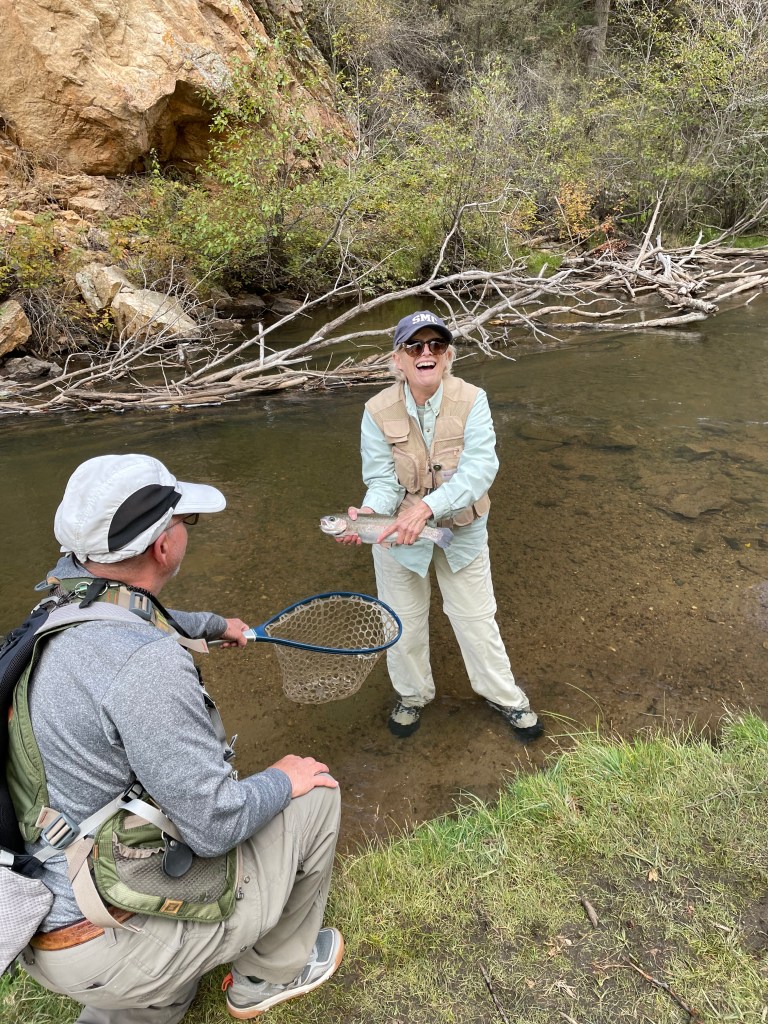
I focused on this because my wife and I just returned from Northern New Mexico on a great fly fishing adventure with another couple, Dave and Gloria, who we’ve known for years.
A big rainbow for Margowith Dave, who netted it
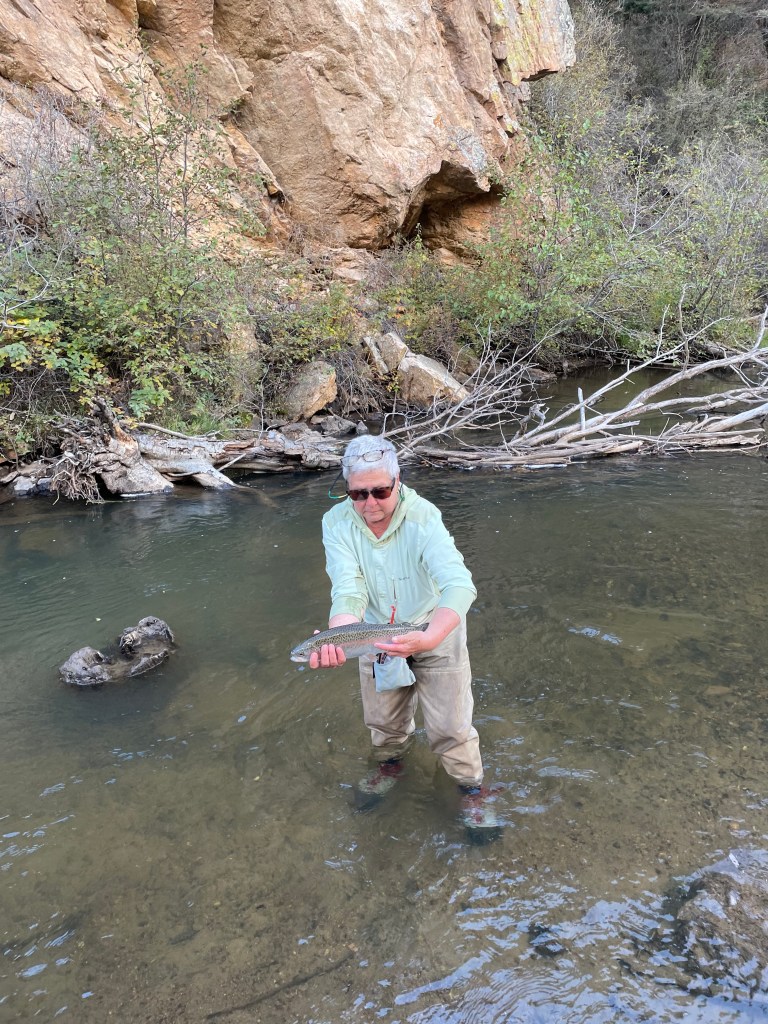
All of us caught nice fish on the trip. Gloria had the biggest and Margo caught the most. None of them were stuffed with lead pellets or fillets from other fish. All were returned to the river.
Gloria’s biggest rainbow
The fish we caught were on the Rio Costilla, about 45 miles north of Taos near the Colorado border. It was beautiful fall weather, with a new dusting of snow on top of the Sangre de Cristo mountains and vibrant fall colors in the valley.
New snow above timberline on the Sangre de Cristos with the Rio Costilla below
Our temporary home away from home
No, I won’t tell you exactly where our best fishing spots were or even the name of the place we stayed. I will, however, guarantee that our fishing stories will get bigger — not heavier.
And yes, I caught the smallest fish, a feisty, plump German Brown
The October 2022 issue of Car and Driver magazine arrived in my mailbox last week and included a story which triggered memories of another story which I helped circulate many years ago when I was New Mexico bureau manager for United Press International.
The story in the car magazine talked about research being done on a plant called guayule (pronounced wy-OO-lee). This desert shrub grows in the arid Chihuahuan desert of southern New Mexico, southeastern Arizona, far west Texas and parts of northern Mexico.
Guayule plant in its native environment in the Chihuahuan Desert of New Mexico, Arizona and West Texas
The research involves extracting a rubber substitute from the bush to replace rubber produced from more typical rubber trees, mostly grown in tropical areas of South America.
The story from years ago was written by a member of my staff at UPI, John Webster, a talented journalist who had a knack for finding interesting science related stories. We distributed his story on national wires regarding research being done at New Mexico State University to grow the plant commercially.
I hadn’t read any stories about the plant or the research for years, but always wondered what might have happened to plans to develop the plant as a more sustainable rubber substitute.
As it turns out, tire maker Bridgestone has been continuing its research into guayule and has already started testing tires made from rubber from the plant. It plans to begin commercial production of tires made from guayule rubber in 2030.
(Full disclosure: My new GMC pickup was equipped from the factory with Bridgestone tires — unfortunately made from regular rubber. I’m hoping when I wear them out, I can replace them with tires from rubber grown in New Mexico, but that depends on whether my current tires will last that long — not likely.)😉
There are many good things to recommend guayule rubber, according to the Car and Driver article. Being native to the arid high desert, the plants don’t require much water, can grow in rocky-sandy soil that doesn’t suit many other plants and grow in areas that would not otherwise be used for food plants. The article also notes that there are “no transoceanic supply chain issues, (and it) is far less labor intensive than (traditional rubber)… to grow and harvest.” The plants also seem to be naturally resistant to pests and the harvesting process is mechanized, as opposed to hand-harvesting rubber from traditional plants.
So promising is guayule that Bridgestone plans to invest another $42 million toward operations to expand the research and development program. Unfortunately, most of the company’s research is currently being done near Eloy, AZ, and not in New Mexico at this time.
Bridgestone guayule farm in Arizona.
Here’s a website link to Bridgestone’s guayule research.
The rubber is also hypoallergenic, which makes it an ideal application in the medical field and may also produce biofuels and other bio-based chemicals.
I did a follow up to see if NMSU is still doing research on guayule and through the help of my good friend and former Acting Dean of the College of Agriculture, Consumer and Environmental Sciences (ACES), Dr. Jim Libbin, found someone still involved. He is Dr. Kulbhushan Grover, an Associate Professor of Sustainable Crop Production with the College of ACES who came to NMSU in 2009. Originally from India, he was most informative, enthusiastic and a delight to give me more information about research into finding what kinds of productive commercial crops can grow in arid lands (think New Mexico). Most of his research now focuses on another desert plant, guer (pronounced GOO-are) that produces a gum that can be used in a variety of consumer products like cosmetics and certain foods. Dr. Grover said its biggest application currently is in the fracking process used in so many oilfields these days.
NMSU’s original work on guayule started many years ago with a federal grant that drew in collaborators from the University of Arizona, Colorado State University, the U.S. Department of Agriculture, Bridgestone and others.
There is still some guayule research going on here and specimens of the plant are currently being grown in one of NMSU’s experimental farms (possibly at the Fabian Garcia Research Center — literally just down the street and around the corner from where we live. I plan to check it out.)
Dr. Grover game me the name of a professor currently working on that research and I’ll probably give him a call in a couple of weeks to find out what’s new.
I’m sorry if this was boring to a lot of you, but I think research like this at our public universities is a bright spot in New Mexico that we need to know about and appreciate why our Land of Enchantment is such a special place.
This will be kind of a mish-mash of short subjects that occurred to me last week and during one mostly sleepless night when a late evening glass of iced tea was responsible for my caffeine-charged brain wandering around aimlessly in my skull.
__________
The first involved a trip to the Southern New Mexico Fair, where we attended the “Ranchers Rodeo”. We got there early enough to enjoy all the usual hoopla and pageantry that seems to be required for any rodeo event that I’ve ever attended.
Of course one of those elements was the singing of the national anthem. The rodeo organizers had lined up a talented female singer with a strong voice that would carry easily through the noisy indoor-outdoor arena. Unfortunately, in preparation for the first event of the rodeo, about a dozen calves had been penned up in the center of the arena. When the woman began singing the young cows responded with unabated loud bellows for their mothers. It was as if they were singing along with her.
I recorded it on my I-phone because I thought it was so hysterical, but unfortunately the endless sorrowful moos of the calves were drowned out by a more powerful PA system so I decided the video wasn’t worth including. I hope the young singer didn’t feel offended by the calves response to her performance.
__________
I have no idea why I thought of this.
While working in Albuquerque about 10 years ago, one of my colleagues was discussing her family roots in the city. It turns out her father was a hard working plumber who had retired after many years doing a job many of us home owners dread doing ourselves.
When I asked her what her father was doing in his retirement years, she answered in a manner that left me nonplussed
“He’s writing a book on the history of the plumbing industry in Albuquerque.,” she answered, possibly with a slight tone of embarrassment in her voice.
You can’t beat that for page-turning reading.
__________
When in Ruidoso recently, I spotted this vehicle at a car show.
A shocking pink and yellow Mustang with hyper rear wing and unusal tow devicecircled in blue
Aside from its eye-popping color scheme and ridiculously tall rear wing, the thing that most drew my attention was the heart-shaped tow ring at the right rear of the car. It was rather flimsy looking, and I’m not sure it would have endured even a minor tug from a Ford F150 four-wheel drive truck to pull it out of a snow drift.
I’ll leave it to you to interpret that feature.
__________
Speaking of cars, my sister informed me after reading my recent blog that she had no memory of my near-death experience when she launched our 63 Chevy Belair station wagon into the stratosphere as it zoomed over the top of “Thrill Hill” in Ruidoso. I guess as a perpetrator of such a potentially life-altering event, her brain had erased it some years ago.
What both of us did remember, however, was when she was flung out of the back door of our 57 Chevy 210 sedan when it rounded a sharp corner. She was leaning against the right rear door of the vehicle when my mother rounded a corner on the main street in Ruidoso. The door had apparently not been properly latched and seat belts were a thing of the future. I was sitting on the left side of the back seat when I saw her tumble out of car and disappear in a cloud of dust. I don’t remember her crying or making a big fuss about it, but from that point on she made darn certain that her door was shut properly.
I attribute that incident to her lifelong passion for following the rules. And maybe having an occasionally weird hiccup in her brain.
And speaking of dumb things that happen to teenagers in cars, I also recall an incident in which I almost impaled myself with a falling tree top. I had acquired a World War II surplus Ford-manufactured Jeep that I drove to high school and used to explore the back roads of Ruidoso. On several occasions, I got it stuck on a back road and had to be rescued by a giant four-wheel-drive tow truck. I did dumb things in it.
Full of invincible teen-age hormones, I was always seeking new tricks that I could do with the virtually indestructible Jeep. On one trip, I spotted a dead ponderosa pine that I was sure I could topple with a solid punch of my all-steel front bumper while the Jeep was in low-range four-wheel-drive mode. When I hit the trunk of the tree with a jarring thud, the bottom part of it remained intact. Then I heard a snap and looked up to see at least 20 feet of the top of the tree hurtling down directly toward me in the driver’s seat. Luckily, we wore no seatbelts at the time, and I was able to eject myself from the Jeep before the top part of the tree hit my seat, leaving a ragged hole in the cushion where I would have been sitting.
Who says kids don’t have guardian angels?
_________
And lastly — I’m sure you wanted to know this — I captured another squirrel this week. During my squirrel eradication campaign, I managed to trap six and Chester nabbed one. I hope the one I got earlier this week the last one.
My disposition of the critter was not a fond memory, however. I had been taking them to a field south of Mesilla where there was lots of cover, water and a pecan grove nearby. This time, I decided to cut corners and stopped at a vacant lot just west of us to let it out under a thicket of pecan tree trimmings.
Just as I let it out, I heard a booming voice behind me asking “what did you just release?”
“A squirrel,” I said as I turned to see a stern looking young man who had approached me unnoticed from behind.
“Is this lot your property?” I asked sheepishly.
“Yes, and we already have enough of those around here,” he said. “I’d appreciate it if you didn’t do that again.”
I apologized profusely, never suspecting that the weed-infested lot was something that anyone nearby owned. I drove away quickly, continuing to apologize and hoping he did not write down my license plate number.
Lesson learned.
But at least I think (hope) I’m out of the squirrel trapping business.
You’ve got to give it up to the kids in Clovis. They know how to get in on the latest online challenges. And also how to get the attention of their school nurses.
A report last week said that the nursing staff in Clovis schools had suddenly been inundated with treating kids eating a new kind of hot chile flavored snack — Paqui.
Apparently it is a single corn chip slathered in Carolina Reaper and Scorpion pepper and then — just for the effect — sold in a coffin-shaped package for about $5. To entice people to try it, there has been a “One Chip Challenge.”
An e-mail was sent out by the Clovis schools urging parents to tell their kids not to participate in the challenge.
“As of Friday (Sept. 16), more than 20 students in our district have required medical intervention after either ingesting of touching One Chip Challenge Chips,” the school memo said.
Just one and you’re done…
Some of you may remember that when Flamin’ Hot Cheetos were first introduced, many kids became semi addicted to them. In fact, a health official in an unidentified New Mexico school district sent out an impassioned warning to parents saying kids should avoid the snack. She mentioned that the snack could cause health problems from eating such a spicy food, gave a warning that germs could be spread by kids sharing the Cheetos and raised the issue of how much trouble it was to scrub off sticky red fingerprints on school desks and tables. Another school district in Illinois completely banned them.
My thought is that if incredibly spicy foods made from chiles entice people to participate in goofy challenges, why can’t we create our own New Mexico hot chile challenge? I mean, we are the chile capitol of the world, right? I know our own New Mexico State University has done research on the incredibly hot “ghost chile” or bhut jolokia. So why not challenge people to each so much of it that they hallucinate and start seeing ghosts?
Okay, bad idea. Someone will probably try that and I’ll get blamed for it. And then I’ll have to clean up all those smudged red fingerprints on water glasses and on their cell phone screens when they had to call an EMS team.
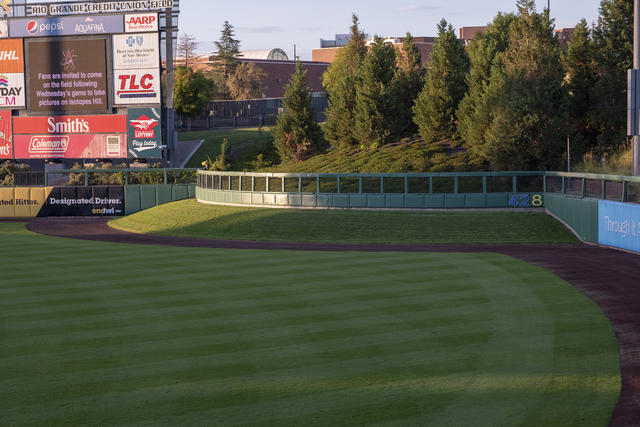
An article in this week’s Albuquerque Journal announced that the iconic slope in the center outfield of Isotopes Park was being removed.
‘Topes Slope will be removed at the Albuquerque Isotopes Ballpark
It was a unique feature that was installed when the park was completely redesigned in 2003 in an apparent nod toward eliminating the “cookie cutter” approach to baseball parks that had been panned in the previous decade. And although there were never any recorded injuries to players, the “thrill hill” feature is being eliminated in the interest of safety.
The slope was a tricky challenge for center fielders who had to gauge the edge of the outfield with a warning track then negotiate the 20 to 30 degree upslope when looking up at the sky to try to snag a long ball. I think I can recall a few stumbles when players caught near home runs on the slope, but nothing dangerous.
For the Isotopes pitchers, it became a boon when they gave up a long blast to center field and forced opposing outfielders to stumble with the change in terrain and miss the ball. For Isotopes outfielders, it became a familiar challenge and friend that they mastered better than their opponents.
In one way, it reminded me of a section of a street in my home town of Ruidoso where a sharp rise between two small valleys created an exciting experience in a car for teen-aged drivers. If you were driving about 40 miles per hour on the street, you’d experience momentary weightlessness and shrieks from passengers as you went over what became known as “Thrill Hill.” Eventually the local traffic engineers and cops figured out what was going on with the local kids and knocked off the top 15 feet or so of the hill and smoothed out the approach to it so there was no more “thrill.”
I particularly remember an incident when my sister was at the wheel of our ’63 Chevy station wagon and drove over the crest at what was probably an irresponsible rate of speed. When she got to the top of the hill and the lumbering Chevy briefly became airborne, she apparently became afraid she would be tossed so far up that she would no longer be able to reach the brakes. She responsively put her right hand up to the headliner to keep her planted in her seat, but unintentionally jerked the steering wheel about a quarter of a turn to the left. When we landed, the mushy two-ply Goodyear whitewall tires on the Bel Air wagon howled and pitched us into the opposing lane before she could correct our trajectory. Luckily no one else was approaching from the other direction and we all survived. The only damage to the vehicle might have been a wet spot on the seat.
I’ve attached a link to the Albuquerque Journal story in case you missed it, along with a video produced by the Isotopes about the end of the “‘Tope Slope.”






 aero-cordero.com