The woman in Albuquerque who lost her pet cockatiel is still advertising periodically in the Albuquerque Journal for the bird’s return. As mentioned in a previous blog, she used an “animal communicator” to determine that the bird is still alive and was rescued by someone else after it flew away from her house several months ago. She apparently remains hopeful that the “someone else” will eventually feel guilty and return the bird.
And on another note, the Village of Chama continues to receive a minimum .01 precipitation every day, according to records furnished by the National Weather Service and published daily in the Albuquerque Journal. That’s even on days when there is not a cloud in the sky anywhere in New Mexico. I called the National Weather Service office in Albuquerque about a year ago to ask whether the .01 daily precipitation recording was the result of some equipment malfunction at the local weather data collection point in Chama. I was assured that it probably was a problem with the equipment and that it would be corrected soon. But the daily report still doesn’t change, unless the northern New Mexico town actually picks up some real precipitation like it did today at .15 of an inch (likely .14 of an inch but with a gratuitous .01 added.) Yes, I know, no one else but me cares about this.
Moving on to steam, an advertisement in the Journal last week said Laguna Pueblo schools were seeking applicants for a “Steam Teacher.” I’m pretty sure they meant STEAM (All caps for Science, Technology, Engineering, Arts and Mathematics) but at first glance I thought maybe they were looking for someone to teach plumbing or pipefitting.
Regarding Cheetos, a recent article by the Associated Press said that an accidentally dropped a bag of Cheetos in Carlsbad Caverns was a source of great concern for Park Rangers. Rangers said that the the unique moist and cool environment triggered a growth of mold on the cavern floor and on nearby cave formations.
“To the ecosystem of the cave, it had a huge impact,” the Park noted on its social media post. It said cave crickets, mites spiders and flies organized to eat and disperse the powdered orange snack and spread the contamination away from where the opened bag was dropped.
Help keep it Cheeto free
Park officials say they regularly check for items left or dropped by the more than 2,000 people who trek through the cavern on its busiest days. Many times, some of the items can fall into dark crevasses inside the cave and not be immediately discovered.
Park Officials say the best defense against allowing litter to contaminate the cave is to constantly remind visitors not to bring any food items with them and to be careful not to leave any other non-food items.
And finally, a recent obituary in the Las Cruces Sun-News lamented the passing of someone who appeared to be a true New Mexico cowboy.
“He died in his sleep of a heart attack — his dog, his horse and his cowboy hat nearby,” the obituary read.
New Mexico hasn’t had the best record on public executions for bad guys over the years.
I previously wrote about the botched hanging of notorious outlaw Tom “Black Jack” Ketchum during which his head snapped off when he plunged through the gallows at Clayton, NM, April 16, 1901.
Ketchum, who had made a career of robbing trains with the “Hole in the Wall” gang and other desperados, had been convicted of attempting to hold up a train by himself on Aug. 16, 1899, at Twin Forks in northeastern New Mexico. During the robbery attempt, an agent on the train shot Ketchum in the arm, making his subsequent capture relatively easy. While in prison awaiting his trial, his arm was amputated and he gained significant weight. Both of those things appeared to be factors in his unfortunate ending at the gallows.
According to a Wikipedia entry about him:
“Ketchum was executed by hanging… but no one in the town had any experience with the procedure. The combination of too long a rope, Ketchum’s significant weight gain while in jail, and the mass imbalance due to the amputation of his arm caused him to be decapitated when he fell through the trapdoor. His last words were “Good-bye. Please dig my grave very deep. All right; hurry up.”
Historic photo showing aftermath of Tom “Black Jack” Ketchum’s hanging in Clayton, NM, April 16, 1901
I recently finished reading John P. Wilson’s excellent book on the Lincoln County War, during which one man had to be hung twice before the executioner could complete his job. In that incident, William Wilson (no relation to author John Wilson) was convicted and sentenced to hang on Dec. 10, 1875, for a fatal shooting in the turmoil leading up to the Lincoln County War.
Author John P. Wilson said William Wilson had apparently made disparaging remarks earlier about Maj. L.G. Murphy, one of the principals in the Lincoln County War and now probate judge and the person in charge of the execution. While standing on the gallows, Wilson was given a chance to make his last remarks. He began by telling Murphy “You know you are the cause of this. You promised to save me but…” At that point, apparently not wanting to hear anything more negative said against him, Murphy cut the rope to the trap door and silenced Wilson.
According to John Wilson’s book, the convicted Wilson hung for six and one-half minutes, then was cut down and placed in a casket. But one observer at the hanging noticed that Wilson appeared to still be breathing while in the casket. Another rope was placed around his neck and this time he swayed from the gallows for 20 minutes to make sure the deed was done.
At least Wilson didn’t suffer the consequences of being hung three times like Texas outlaw Wild Bill Longley. The story goes that Longley was hung the first time by a lynching party for being involved in a horse or cattle theft. But while swinging from a tree branch, an errant bullet fired in celebration by the retreating posse severed the rope attached to the noose and freed Longley. He was later convicted of murder in another case and sentenced to hang on Oct. 11, 1888, in Giddings, TX.
When he gave his last remarks, he told the crowd of about 4,000:
“I deserved this fate. It is a debt I have owed for a wild and reckless life. So long, everybody!”
This time, the hanging party used a rope that was too long. When Longley fell through the trap, he landed upright on his feet. No longer trusting their skills with the gallows, the sheriff and deputy sheriff simply pulled up hard on the rope themselves until Longley expired.
New Mexico outlawed capital punishment in a bill signed by then Gov. Bill Richardson in 2009. Prior to that, the last execution occurred in 2001 by means of lethal injection.
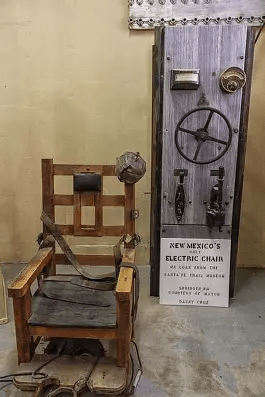
Before lethal injection was used, New Mexico executions used “Old Sparky,” the somewhat gruesomely named electric chair in the infamous old state prison outside of Santa Fe. The last time it was used was in 1956 in what also turned out to be a less than textbook execution.
“Old Sparky,” New Mexico’s electric chair last used in 1956
The prisoner, James Larry Upton, was convicted for the 1954 murder of a Kirtland Air Force base airman in Albuquerque. His execution date was set for Feb. 24, 1956.
When that date came, it was found that the standard cap used for the electric chair did not fit Upton. Prison officials decided to make it fit by using a cap from a parka that had fur around the edges. As the electric current surged through the chair and Upton’s body, the fur of the parka ignited and smoke billowed from the improvised cap. This incident provided further impetus for the state to discontinue using the electric chair for future executions.
Needless to say, we’ve had some less than stellar attempts at public executions in New Mexico. But at least we can say there are no records in the Land of Enchantment of public stonings or burnings at the stake.
I’m finishing up a more than two-week stint as an election official for early voting in the Nov. 4 primary in Dona Ana County. My location, as it has been in the previous four elections, is the town hall of Mesilla.
Surrounding me are displays about the history of Mesilla, many focusing on the connections between legendary Western outlaw Billy the Kid and this town that was once an influential center and hub of southern New Mexico.
Specifically, William H. Bonney was convicted in a trial in Mesilla in 1881 for the murder of Lincoln County Sheriff William J. Brady during the years leading up to the famous Lincoln County War during the late 1870s. Following the trial, he was transported back to the town of Lincoln where he would be hanged on May 13, 1881. But before his date with the gallows, he staged a daring and lethal escape from the Lincoln County Jail on April 28, 1881, killing two more lawmen, Deputy U.S. Marshall Robert Olinger and Deputy Sheriff J.W. Bell. On July 14, 1881, he was shot and killed by Sheriff Pat Garrett in Fort Sumner, New Mexico.
Famous photo of Billy the Kid.
Deputy Sheriff Robert Olinger, probably Billy the Kid’s last victim. (Photo courtesy Lincoln County Heritage Trust)
There have been hundreds of thousands, if not millions, of words written about Billy the Kid and the Lincoln County War. On top of that, 52 movies (not including TV shows and documentaries) have been made about the outlaw’s escapades and the Lincoln County War. Needless to say, I’m not going to try to add anything new about Billy the Kid or the Lincoln County War because the subject has been worked to death.
Old Lincoln County Courthouse and former Murphy Dolan Storewhere Billy the Kid made his famous escape.
However, while here at the polls during lots of slow periods, I thought it might be fun to read more about the subject while I was surrounded by Billy the Kid lore. I had previously read parts of a book by good friend, John P. “Jack” Wilson, entitled Merchants, Guns & Money, The Story of Lincoln County and Its Wars. This seemed like an opportune time to delve further into the subject by thoroughly reading his work.
The book was published by the University of New Mexico Press in 1987 and, in my opinion, is the most thoroughly researched publication on the subject of the Lincoln County War. To that point, the book has 50 pages of additional documentation, notes and references. Wilson, a Harvard graduate and long-time resident of Las Cruces, has had a distinguished career in archaeological and historic research. He’s written several books, one of which I’ve reviewed in previous posts on my blog. Wilson clearly knows how to do thorough research.
I highly recommend his book, which you can still find on Amazon and I suspect in local bookstores, like COAS.
Be prepared for lots of detail in the book, especially regarding financial matters, government records and population statistics. But as Wilson said, to find the real truth about the cause of the Lincoln County War, you have to “follow the money.”
As he wrote, the Lincoln County War “was not a cattle or a range war, nor even a feud. Essentially it grew out of a struggle for economic power in a land where hard cash was scarce and federal contracts…. were the grand prizes. The competition for these contracts became bitter and frequently ruthless.”
What struck me most when reading his book about the war was the number of people who were killed, many of them senselessly.
One sentence in Wilson’s book sums it up succinctly:
“Of the 30 funerals the Reverend (Taylor) Ealy conducted during his five months in Lincoln (during 1877-78), only one resulted from natural causes.”
You probably have seen Westerns where opposing sides are blasting away hundreds of shots with their pistols, rifles or shotguns. I always thought that was Hollywood going over the top in portraying the Old West. Not so in Lincoln during the war.
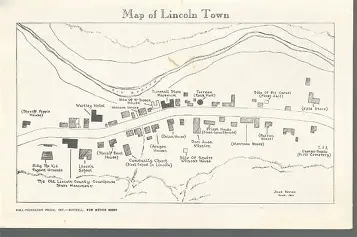
Street Map of Lincoln.
The peak of the War was “The Five-Day Battle” in Lincoln July 15-19, 1878. Wilson told me that “as many as 50” men participated in that shootout between the rival Murphy-Dolan group and the Tunstall-McSween group during those five days. Lt. Col. N.A.M. Dudley, commanding officer at Fort Stanton, estimated that 2,000 shots were fired on one night alone. At one point, troops at Fort Stanton brought a Gatling gun and a 12-pound howitzer to position in the middle of Lincoln’s main street in hopes of subduing the fighting. Wilson’s books contains many descriptions of individuals being wounded or shot dead during that and other skirmishes between the two groups.
The mayhem went on outside of Lincoln. A retreating party of Murphy-Dolan supporters later shot and killed three men harvesting hay further down the Rio Bonito “without the least provocation,” then on the same day randomly killed the young son of a rancher and raped two women at another ranch.
One of the principals in the war, Alexander McSween, said he had heard reports that “there were 200 armed men in the field” during the height of the war. The post surgeon at Fort Stanton commented that there was “depredation and murder by a band of miscreants” throughout the county.
An interesting statistic from the 1880 census showed that 20 percent of the 167 households in Lincoln were headed by women. Digging further into this statistic, Wilson discovered at 33 of those 39 women said they were widowed — likely many because their husband was a casualty of the Lincoln County War.
I asked Wilson how many people had likely been killed in the events leading up to the war, during the peak of the war and its aftermath. He said although the number isn’t certain, he suspects it is around 60. He noted that many of the deaths of Hispanics (Identified by locals as “Mexicans” at the time — even though they were born in the United States territory) and Indians were not counted.
To show why you shouldn’t believe everything on the Internet, I asked Google how many people were killed during the Lincoln County War. The number it gave was 19. If you read Wilson’s thoroughly researched book, you’d agree that number is far too low and that Lincoln was a frightening and lawless place to be in the 1870s and 1880s.
When I fly commercially, I always try to get a window seat so I can look out of the plane at the landscape and wonder about things I see on the ground. I even pick a specific side of the plane I’m on if I know there’s something special along the route that I can study from the aircraft 40,000 feet in the air.
I know that’s a weird concept for most people who like to sit on the aisle so they don’t feel as confined, can take an easy mid-flight bathroom break and can make a quicker exit from the plane when they get to their destination gate. And of course, no one wants to sit in the middle seat unless there are no other options except perhaps to cram yourself in the overhead luggage bin.
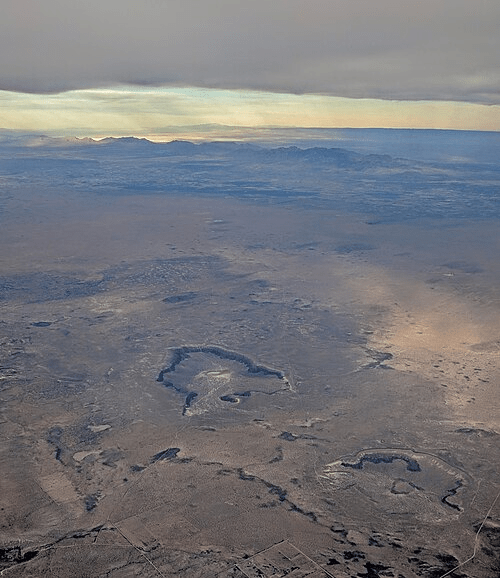
If you’re on a flight out of El Paso to Phoenix or the Los Angeles area and suffer the annoyance of sitting in a window seat, you might spot something interesting on the ground about 30 miles west of the city near the Potrillo Mountains. It’s a shallow crater more than a mile wide and about 430 feet deep, lined with volcanic rock and an occasional small lake in its center.
Kilbourne Hole, located in the Organ Mountains-Desert Peaks National Monument on Bureau of Land Management land in the in far southern New Mexico is what is known geologically as a “maar volcanic crater.”
Looking northeast toward Kilbourne Hole, lower center, and less defined Hunt’s Hole lower right. Organ Mountains are in the background with White Sands just peeking behind them.
Sources on the internet describe explain that these craters are formed when rising volcanic magma encounters a saturated underground water table above it. The intense heat of the magma brings the water to above boiling and eventually the magma/water mix explodes toward the surface in spectacular style. It’s kind of like having a pressure cooker (remember those?) suddenly blow off its lid when the pressure inside the kettle gets too strong for the seals to hold. It would have been a pretty loud and dramatic explosion if anyone had been around to hear it.
Kilbourne Hole and its little brother Hunt’s Hole are located in the Potrillo Lava Fields of southern Dona Ana County, part of the Rio Grande rift which runs roughly along the path of the Rio Grande through all of New Mexico. There are numerous volcanic features along this rift though its north-south route, including Albuquerque’s West Mesa volcanoes, the Jemez Mountains and many lava outcroppings along the way.
According to Wikipedia, the Rio Grande Rift is an area where the earth’s crust is being constantly stretched and thinned. This stretching and thinning allows magma from deep within the earth’s core to push toward the surface. Additionally, Kilbourne Hole and Hunt’s Hole are located on the Fitzgerald-Robledo fault system, making magma’s path to the surface even easier.
Geologically speaking the two maars are not that old — between 24,000 and 80,000 years when they exploded. It’s like it was in the last millisecond in a year-long calendar of our planet’s history.
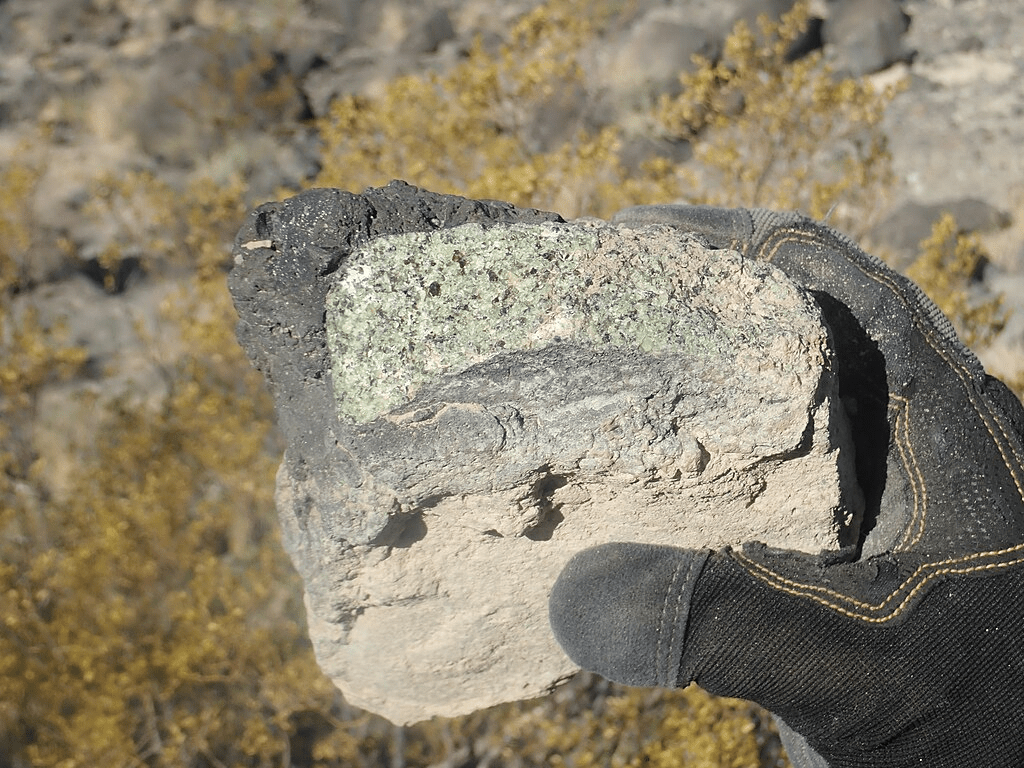
Kilbourne Hole is noted for the large amount of xenoliths that were blasted out during the explosion. Xenoliths are lower mantle and upper crustal rocks that form lherzolite, a greenish tinted rock with black flecks.
Xenolight from Kilbourne hole. Note greenish color with black specks.
Getting there is kind of an adventure over somewhat primitive roads, from what I can find online. Here’s a Bureau of Land Management link with a route that you can take there from New Mexico 28 in southern Dona Ana County:
And reverting back to a my post last week before Halloween, I wonder if La Llorona occasionally haunts the shallow pool of water that occasionally forms in the bottom of the crater. That would be pretty spooky to witness on a dark night in the middle of the desert wilderness, I think.
Like many in the Land of Enchantment, I always assumed that our state’s name was derived from Mexico, the nation to our south. I figured that our state was named after Mexico had been established as a country. I was wrong. Read on.
I made that assumption when you consider the pattern that many places in the United States were given the prefix “New” in their name when settlers moved here from somewhere else.
Consider the names New Jersey, New York, New England, New London, New Hampshire, New Brunswick and New Rochelle. You’d think the early settlers could have come up with something more original. And if Great Britain was so bad as to make you want to escape on a harrowing ocean voyage to the New World, you’d think they’d want to forget the names of the places they’d left behind.
But in New Mexico, that was not the case. In fact, New Mexico was given its name sometime in 1562 when Spanish explorer Don Francisco de Ibarra first used the name “Nuevo Mexico” in an official document.
New Mexico territory map from 1800s, which included all of present day Arizona and parts of Colorado and Nevada
According to both AI sources on the internet and the book “New Mexico Place Names,” the word Mexico was derived from the Nahuatl language of the Aztecs. The word was used to identify the place they migrated to near the present Mexico City. Mexico is a mishmash of the words Mexihco, Mexicas or just Mexi. Loosely translated, it means “place of” or “in the center” of the moon.
Early explorers Cabeza de Vaca and Friar Marcos de Niza used the words Cibola and Quivira to refer to much of what is now New Mexico, but it never fully caught on (although there is a Cibola County in the state.) So Nuevo (or New) Mexico was the official name through the rest of the Spanish occupation
Later, when another Spanish explorer named Antonio de Espejo returned from a two-year exploration, he referred to the region as “Nuevo Andalucia,” for reasons I could not determine. It might, however, be that the terrain of New Mexico reminded him of the Andalusia region of southern Spain. I think the name it has a nice ring to it.
Countryside of Andalusia region of Spain. It does look a little like New Mexico.
In 1598. Don Juan de Onate, took possession of the region and declared himself to be “governor, captain, general and adelantado of New Mexico and of its kingdoms and provinces, as well as those in its vicinity — and contiguous thereto.” In 1771, Onate’s boastful claim to a “kingdom” was reduced to a territory. And then in 1846, American troops occupied the region and declared it to be known as the “Territory of New Mexico.”
You may recall an earlier blog I wrote about four and one-half years ago that suggested that the name “Lincoln” might have been considered for our state. I could find no evidence to support that, but I’ve included a link to that post if you’re interested. There was a suggestion at one point that the state’s name be “Montezuma.”
Meanwhile back in present day Mexico, the locals had not officially determined what to call their nation until the country gained its independence from Spain in 1821.
Anyway, we’re stuck with the name New Mexico at this point. I think it would be difficult to change, even if some people wanted to do that. I remember that a few years back, South Dakota wanted to change its name to simply “Dakota.” That suggestion never seemed to gain much momentum.
What if we could just drop the “Nuevo” and call our state Andalucia. Maybe I’ll start a movement.
In Las Cruces on the banks of the Rio Grande where the old highway to Deming, Tucson and California crosses the river is La Llorona Park. The river here is shallow and slow even during the summer when water from Elephant Butte reservoir is released for the irrigation needs for farmers. In the lean precipitation years — which happen most of the time — the river is bone dry in the winter while water is diverted upstream to fill the lake about 75 miles north of Las Cruces. At night, it is the perfect place for a ghostly apparition.
The city park is the dedicated to the legend of La Llorona, a legendary figure in Mexican and New Mexican folklore. The story of La Llorona is about a tortured woman who drowned her two children in a fit of rage, then drowned herself after she realized the terrible thing she had done. It is said that she now wanders the banks of the rivers or other bodies of water while searching for her dead children. The legend says she floats effortlessly just above the ground while moaning in sorrow for her lost children.
Sources say the legend began in Mexico in 1850, possibly out of an Aztec folk story. One version says she fell in love with a man who loved her two children more than he loved her. To spite him, she drowned her children.
In New Mexico, there is a story about a Native American woman named Malinche, who was an assistant to Cortez in his conquest of Mexico and the Southwest. When Cortez married a Spanish woman and spurned Malinche’s love, it is said she killed her two children for spite after being betrayed by the explorer.
There have been many reports of sightings of La Llorona over the centuries in New Mexico. In the 1930s, a young man in Santa Fe said he saw a woman wearing a shimmering white dress gliding effortlessly just above the ground near his home as she floated toward a body of water. No footprints were ever found.
During my current job as an early voting clerk for the Nov. 4 local election, two people told me stories about La Llorona in Las Cruces. One main claimed to have seen her when he was fishing one evening near the Mesilla Dam. A woman said her mother would tell her if she wasn’t good “La Llorona will get you.”
And now, just in time for Halloween and Day of the Dead, Mattel has introduced a La Llorona Barbie. You could have had one for just $110, but they’re already sold out. In fact, a story in the El Paso times last week said they were sold out almost immediately after the dolls were offered.
The story in the El Paso times says the doll “is is a hauntingly beautiful representative of the Mexican folkore. She is draped in white lace with a corset bodice, blue underskirt and sleeves that lay over her frosty blue hands.” Her neck and face are painted in traditional Day of the Dead designs and she wears a black rose headdress.
No doubt it will be a valuable collector’s item.
La Llorona Barbie
A close up of her face.
Our daughter had various Barbie dolls when she was growing up, but she didn’t treat them like collectors items. In fact, when she was done with them, some looked more like “Weird Barbie” in the recent Barbie movie. Some of their hair was whacked off and on one of the dolls, the toes were chewed off.
If she had treated the La Llorna Barbie like that, she might have been haunted for life. But our daughter is now a successful young mother of two and I’m glad she’s moved beyond the Weird Barbie phase.
Actor Kate McKinnon, left, who played “Weird Barbie” from the Barbie movie and a “Weird Barbie” doll.
I’ve been silently fuming for years about the dumbing down of the elevation of Sierra Blanca, the tallest mountain in southern New Mexico that was once listed as 12,003 feet in elevation.
I grew up in Ruidoso, with Sierra Blanca looming to the west and towering over any other mountains south of Interstate 40. It’s not that it’s just the tallest, it is clearly its massive presence when viewed from almost any angle. But some unidentified bureaucrat (likely with the U.S Geological Survey) concluded sometime in the late 1990s or early 2000s, that the top if mountain was actually 22 feet lower. That placed it below the more impressive 12,000-foot mark at a wimpy 11,981 feet.
You can read my original probing journalistic post about this tragic development, which I wrote about two years ago. Here’s the link:
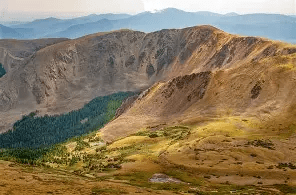
Consider Wheeler Peak, the tallest point in New Mexico 13,161 feet. And note that I don’t call it the highest “mountain.” What it lacks is “grandeur.”
Essentially, Wheeler peak is just a high point on a ridge, as shown below:
Wheeler “Peak” — if you can spot it .
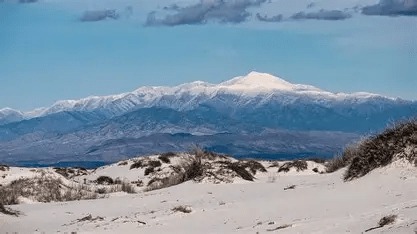
Now this is a real mountain peak, which has “grandeur”:
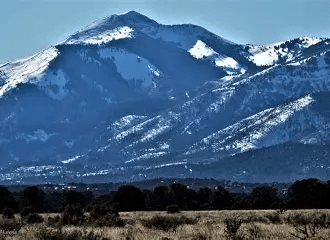
Sierra Blanca, prominent when viewed from any direction.
Sierra Blanca from White Sands National Park. You couldn’t mistake this for a “bump on a ridge.”
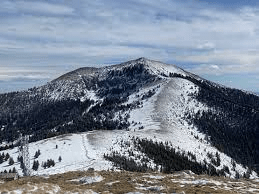
Sierra Blanca is a pretty interesting mountain geologically. It is, according to various publications and studies an “ancient and complex volcano” which during the last ice age actually had a glacier on its northeast side. It is estimated to be between 36 and 28 million years old and contains numerous geological formations.
This view of Sierra Blanca’s northeast side shows the rugged classic glacial cirque that was carved out during the last ice age.
The glacial cirque is 900 feet deep — reaching almost to the mountain’s summit — and half a mile wide.
So why, you ask, am I bringing all this up? I just finished reading a recent article in the National Geographic entitled “Have we been judging the size of mountains all wrong?” It basically says that just considering a mountain’s height is not enough to gauge its “grandeur.”
The subject of mountain “grandeur” was considered by a Yale University student, Kai XU, when he saw 13,652-foot high Mount Tom in the Sierra Nevada range and found it “more extraordinary than any view could impart.”
He came up with the calculation of “jut,” which not only measures a mountain’s height, but it’s height compared to the surrounding landscape and its steepness. Here’s a link to the article, if you want to read more about the subject:
Essentially “jut” means how abruptly does a mountain face “jut into the sky.”
After applying his formula to major mountains around the world, he placed 29,032-foot Mount Everest — the tallest peak in the world at — as 46th in terms of its “jut.” And the most impressive example of “jut” in the world? Annapurna Fang, also in the Himalayas, at almost 4,000 feet lower.
One excellent example of this calculation in the United States is Grand Teton in Wyoming, which has a significant “jut” because of how it rises abruptly from the flat Snake River valley floor from virtually no foothills and great steepness.
On the other side of the equation, Dome Argus in the Antarctic has a height of 13,428 feet, but as the National Geographic article says “you could stand on top of it and not necessarily recognize it as a mountain” because of the generally flat terrain surrounding and leading up to it for miles.
So if you compare the pictures above of Mount Wheeler and Sierra Blanca, it’s clear which one has more “jut.” And it would be even “juttier” if we could just recover those 22 feet of elevation that the USGS erased.
If you want to look at the list of mountains that have “jut,” go to the website:
There is a search function and indeed, Sierra Blanca has a “jut” of 422, compared to Wheeler Peak’s wimpy “jut” of 288.
And speaking of “jut,” look at our Organ Mountains just east of our home in Las Cruces. Rising to 9,012 at their highest point, they won’t make to the top of any “highest mountain” list. But with near vertical faces and no foothills, they’ve certainly got “jut.” In fact, peakjut.com lists the Organ Needle “jut” at 407, again more impressive than Wheeler Peak.
Organ mountains at sundown
And pardon me if I drift off into another thought. There was a 1979 skit on Saturday Night Live in which Bill Murray, posing as a Mexican game show host, posed the question “Quien es Mas Macho” while comparing Latino movie stars or sports figures. So comparing Sierra Blanca and Wheeler Peak, I think it’s clear that Sierra Blanca “es Mas Macho.”
As a rugby player and coach for many years, I learned about the New Zealand tradition of performing the Maori warrior Haka dance before matches. The dance, which involves the players standing in a semi-circle facing their opponent, is performed prior to the start of the game as a way of intimidating the other team.
New Zealand All Blacks national rugby team performing the Haka before a match
The New Mexico State University rugby team which I coached for many years witnessed one of these performances in person when a touring side from Otago University in Dunedin, New Zealand, stopped in Las Cruces to play the local college team. Rugby is the national sport of New Zealand, and since young men there began playing the sport about the same age as our kids begin playing soccer or T-Ball, my NMSU team didn’t stand much of a chance to win.
The dance is the trademark of the New Zealand national rugby team, the All Blacks (so named because of their black uniforms). The All Blacks are considered to be one of top teams in the rugby throughout the world. But even though it was originally associated with rugby, the Haka has started to be performed for many other things. I even watched an episode of comedian Conan O’Brien participating in a Haka with a community group when he did a stop in New Zealand on his world travel series.
With participants beating on their chests in a low crouch and occasionally sticking out their tongues with their eyes wide open in an intimidating fashion, the dance begins with the words “Ka mate! Ka mate!” which means “it is death, it is death.”
Similar dances are performed throughout many islands in the Pacific, all with the intent of frightening any opponent that the indigenous people may face.
I mention this because something of rugby has apparently crept into the small village of Hatch north of Las Cruces in Dona Ana County.
A 16-year-old football player for the Hatch Valley High School Bears is now performing a rugby-style drop kick for point after touchdown conversions. The player, Peet Bothma, is from South Africa, whose Springboks national rugby team is also a perennial world powerhouse.
They don’t perform the Haka in South Africa, but they do start the kids young in learning the game, which is what happened to Peet before moving to the United States.
Peet Bothma, a 16-year-old player from South Africa, performs a rugby-style drop kick during practice for the Hatch Valley High School Bears. (photo courtesy Albuquerque Journal).
Bothma says he was at a summer football camp when he decided to try a rugby style drop kick over the goal posts.
“The coaches saw it,” Bothma said in an interview with the Albuquerque Journal. “One coach looked it up to see if it was legal.”
Turns out, it is.
Bothma moved to New Mexico two years ago with his mother and younger brother to join his father who is a chile farmer in nearby Salem.
Bothma said since there was no rugby in Hatch, he though he would try football.
“I had no experience (with football),” he told the Journal. “I just wanted to play something where I could hit someone.”
At 6 feet, 200 pounds, Bothma is more than just a kicker. He’s an outstanding linebacker and fullback, according to Hatch coach Manny Rodriguez. But he’s darn good at point after kicks. Though the middle of the season, he has made 24 of 36 attempts, using a ball which is much more difficult to control than the fatter, rounder rugby ball.
With rugby-style punters growing in number the collegiate ranks and the NFL, maybe Bothma is on track to start a new trend in in football using a drop kick for PATs.
When a natural disaster hits, what’s usually the first thing to go during the emergency? The electricity of course.
I thought of this today when I walked by the Dona Ana County County Office of Emergency Management’s official vehicle. It is a Chevrolet plug-in electric car.
Waiting for an operational plug in during a disaster emergency?
So when the power goes out and you haven’t fully charged your emergency vehicle, what do you do? Maybe you could just carry one of those portable generators in your back seat and hope it can charge you up enough after six hours to get you a few blocks down the road. Maybe just wait until the emergency is over? Or maybe borrow the neighbor’s monstrous four-wheel-drive Ford F-150 that can slog through anything thrown at you in a natural disaster emergency.
Now I’m not against electric vehicles. Our new car is even identified as a “mild” hybrid vehicle which uses electric power to boost performance and range. It does not, however, have to be plugged into an electrical circuit to continue to function.
And although I’d strongly consider one for buzzing around a major urban area, I don’t think electric vehicles are a good fit for much of the rural landscape that defines New Mexico. For example, I’m thinking about what resources I might find to charge up my Tesla Cybertruck in Reserve, Pie Town, Amalia, Grenville, Antelope Wells or a hundred other towns in the Land of Enchantment that might have a gas station but no EV charging point.
I’m sure the county agency had the best of intentions, but I think at this time, a reliable (but polluting) internal combustion heavy duty truck might be the best alternative.
And speaking of alternatives, I ran across another “What were the thinking” moment on my morning drive today.
Sitting forlornly at an intersection miles from any major population location, I spotted this food truck selling burritos. Truth be told, I almost considered ordering one of their culinary delights, but I could see no evidence of life or movement inside the cafe on wheels. Anyway, I don’t think this location was the best alternative for a robust burrito selling business.
Lots of desert, sky and gravel, but no customers.
I also have to report that at this same intersection last week, I spotted a woman sitting under a canopy shade with a sign advertising pies for sale. I didn’t see her on this trip, so I assume she quickly figured out that the location was a bust for hawking food — even for what might have been award winning pies.
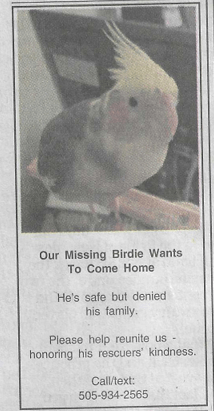
For several months, an advertisement has consistently appeared in the Albuquerque Journal’s classified section seeking information about a missing bird — a cockatiel.
After seeing the ad for so many times, I finally decided that I should investigate the matter — giving in to my ingrained journalistic instincts. My first reaction was that the bird was long gone and no longer alive and that the owner’s quest was a hopeless pursuit. However, if you read the ad below, you’ll see that the owner does not believe that’s the case.
Long-running ad in Albuquerque Journal Classified section
So I called the number and expected a hang-up when I began explaining why I phoned. A very pleasant woman named Diane seemed eager to answer my questions when I explained that I wanted to write about the matter in my blog. She said she hoped that what I write might reach someone who has information about the missing bird.
Not knowing much about bird species, I found this online about cockatiels:
“Cockatiels can make excellent pets for dedicated owners due to their affectionate, intelligent and social nature, but they require significant time for daily interaction, training, and care, including proper housing, a good diet, and managing their tendency to produce dust.”
She explained that the bird had escaped from her Albuquerque Northeast Heights home on Sept. 14, 2024.
“But I knew it was rescued,” she said. “I know he’s safe somewhere but I’m confused about why someone hasn’t come forward and returned him since I’ve been very public about looking for for him.”
She also said that a local TV station had picked up on the long-running advertisement and did a short segment about the missing bird and its owners’ long search for it.
I asked how she knew that the bird was still alive. She said she had been in contact with it through an “animal communicator.” I wasn’t quire prepared for that response, but I thought I should look up the practice online. I found this AI generated explanation:
“An animal communicator is a practitioner who claims to connect telepathically with animals to interpret their thoughts, feelings and needs for their human companions. Also known as “pet psychics” or “animal intuitives,” they assert that they can serve as translators in a two-way, energetic dialogue.”
The response also added this:
“Claims of telepathic animal communication are not supported by scientific evidence. The scientific community generally views these practices as pseudoscientific, attributing perceived successes to a combination of factors.”
I also asked Diane for the name of the bird. She declined to give it to me, saying that if the individual or individuals now keeping “Birdie” knew its name, they might use the name to confuse the Cockatiel into thinking that these people were its rightful owner.
Now I confess to being a skeptic about many things, probably due in part from my experience as a journalist. However, if our dog Chester went missing, I’m sure we’d try lots of things to try to find him. I’m not sure if I’m convinced that an Animal Communicator would fit the bill, but Diane was convinced it would work. Because of that information, she remains optimistic that she will find the bird alive some day soon. I hope she does.
Her number in Albuquerque is (505) 934-2565, if you have any information about the situation.
The Albuquerque Journal carried a story this week about a plan floated by University of New Mexico and New Mexico State University students to establish some kind of traveling trophy to be awarded to the winner of the annual football game between the two rivals.
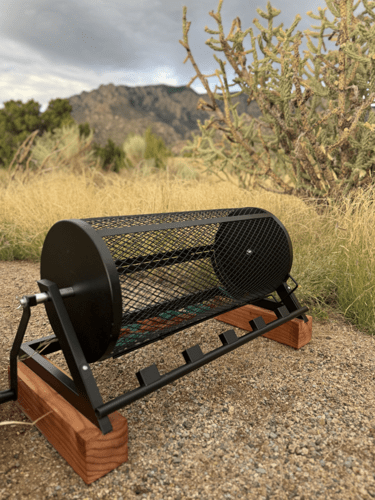
Their idea was to mount a table-top chile roaster on a wooden platform, with the logos of each school literally burned into the wood that holds the metal contraption.
Proposed UNM-NMSU football trophy. Photo courtesy Albuquerque Journal
I own one of these devices myself, and find it’s rather unruly to move out of my garage and set it up on an outdoor table during chile roasting season. But for some strong young men who have massive doses of testosterone and adrenalin pumped into them after winning the rivalry game, it should be no problem to hoist the roaster into the air to seal the victory.
There was an earlier trophy used to commemorate the winner of the annual UNM-NMSU game. It was the idea of the late New Mexico businessman George Maloof, who wanted a rifle reportedly owned by famous New Mexico frontiersman Kit Carson to be awarded to the winner of the UNM-NMSU game. Everyone assumed it was to be a traveling trophy.
UNM won the trophy the last time it was presented and the story goes that then Lobo coach Rocky Long simply decided to keep it permanently for the school or maybe in his personal collection of sports memorabilia.
College football rivalries have many unusual trophies presented to winners of the annual matchup. For example, there is the “Little Brown Jug” awarded to the winner of the Michigan-Minnesota football game. Minnesota also vies for winning the “Paul Bunyan’s Axe” when they play Wisconsin.
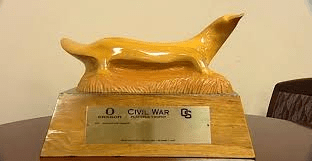
Oregon and Oregon State just competed for the platypus trophy, a wood carving of an animal that appears to capture the features of both a duck and a beaver — those schools’ mascots.
Oregon-Oregon State Platypus trophy
There’s also the “Keg of Nails” trophy between Cincinnati and Louisville, the “Old Brass Spittoon” between Michigan State and Indiana and the Jeweled Shillelagh for the USC-NotreDame game.
My favorite is “The $5 Bits of Broken Chair” trophy presented to the winner of the Minnesota-Nebraska football game. The award didn’t exist until Nebraska joined the Big 10 Conference several years ago and fans wanted a trophy of some kind to commemorate the event. The trophy was established in 2014 prior to the November Big 10 football match-up between the two schools. In an exchange on Twitter, accounts for Minnesota’s mascot Goldy Gopher and a parody account of then Nebraska football coach called Fake Bo Pelini (@FauxPelini) made a wager. With a good amount of humor and teasing between the two schools, “The $5 Bits of Broken Chair” was created.
“$5 Bits of Broken Chair”Trophy
The unusual trophy has continued in use and has also become a focal point to raise funds for charitable purposes in both Minnesota and Nebraska.
Here’s a link to most of the rivalry trophies in college football:
As I researched this, it occurred to me that there might be more iconic things to represent the essence of New Mexico in the UNM-NMSU football rivalry.
How about the “Plastic Wal-Mart Bag tangled in a Tumbleweed or Mesquite Bush” trophy? We seem to have those everywhere in the Land of Enchantment.
Or how about the “Green Chile Cheeseburger” trophy? We have contests at the New Mexico State Fair for our favorite burger in New Mexico. Why not preserve one in plastic on top of a Coors beer place mat?
Then there’s the “Rubber Tire Roof Protector” trophy idea. How many times when we’ve driven around New Mexico do we see car tires spread across the roof of mobile homes to protect them from the howling springtime winds that we tolerate in our state.
Car tires protecting the roof on a mobile home somewhere in New Mexico
Or how about a “Book of Espanola Jokes” trophy? Nothing says New Mexico like a rude joke about that city.
Or we could dig up a piece of greenish glass Trinitite from the first atomic bomb test site near Socorro. Of course, it still might be radioactive, so it would probably need to be encased in a large lead box — maybe a little awkward to carry on the football field after the rivalry game.
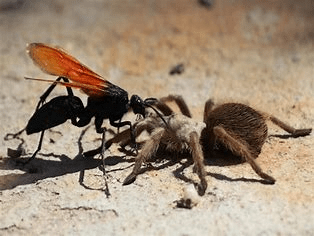
Since New Mexico is one of only a few states that has a state insect, we could create the “Tarantula Hawk Wasp” trophy. The wasp is known for paralyzing tarantula spiders, then laying eggs in the arachnid’s body. The eggs hatch and then devour what’s left of the spider. The idea for the state insect was promoted by some ghoulish school children several years ago.
Tarantula hawk wasp doing her thing on an unsuspecting tarantula
And what’s even more traditional in New Mexico than people not using their car’s turn signals. How about the “Never Been Used Turn Signal Assembly” trophy. There are lots of pristine examples out there
The list could go on forever. Send me your suggestions and I’ll post them in a follow-up. In the meantime, let’s all cheer for the chile roaster trophy to be brought to Las Cruces this weekend.
The town of Ruidoso had its beginnings around 1868 with the construction of a water powered mill that was first used to cut timber, then later used to grind grain produced by farmers in the area.
It became the hub of activity in Ruidoso in the late 1800s, attracting such visitors such as Billy the Kid, Pat Garrett, Gen. John J. “Black Jack” Pershing and the Apache chief Geronimo. It served as a post office for many years, as well as a general store and blacksmith shop. It was a regular stop for travelers from El Paso, Fort Stanton and the Mescalero Apache reservation. At one point, the name “Dowlin’s Mill” was considered for the name of Ruidoso. Anyone who has driven along the main drag in Ruidoso — Sudderth Drive — has seen the structure that gives such historical significance to the southern New Mexico mountain community.
Known originally as Dowlin’s Mill for its builder, Capt. Paul Dowlin, and later as just “The Old Mill,” the historic structure is still standing. Its iconic water wheel is still visible but currently not operating and in need of repair.
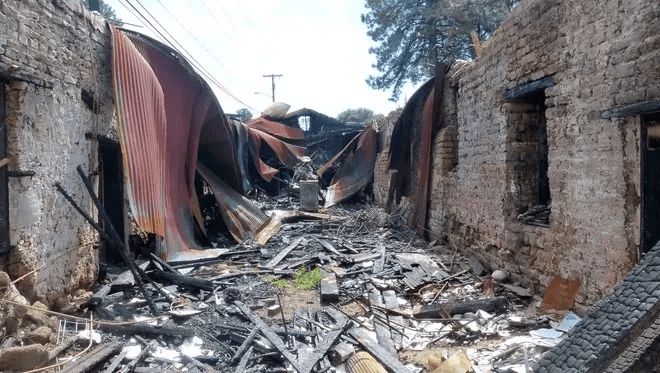
The building, which was placed on the National Register of Historic Places in 2013, has had its share of hardships in recent years, including an explosion in 2017 from a gas leak which severely damaged the adobe and rock structure. At one point, plans to demolish the structure were considered.
Damage to interior of Old Mill following 2017 gas explosion
I remember the Old Mill fondly from my childhood in Ruidoso. It was owned and operated by the family of Carmon Phillips. Phillips was a good friend of my father’s, who operated it as a bookstore. He was also a photographer who also processed film for others, including photos for my father’s newspaper, the Ruidoso News.
I also remember that years ago, my wife’s former boss at the New Mexico State Library in Santa Fe was Ed Dowlin, who claimed to be a descendant of the mill’s founder.
I got a tour of the work underway to restore the Old Mill two weeks ago when I attended a Ruidoso High School reunion. The tour was given by Michael and Delana Clements. Delana is the daughter of Carmon Phillips and she and her husband have started an effort to restore the historic structure and turn it into a gift shop, museum and performing arts venue.
The Old Mill as it appeared during restoration on my recent trip to Ruidoso
The mill itself has an interesting history. It was first built on land just north of its present location across Sudderth Drive, but a flood severely damaged that structure and it was moved south to its present location. Ironically, that original location was swept clean again just last summer in one of several flooding events following heavy rainfall on burn scars on the slopes and foothills of Sierra Blanca.
The water-powered mill was first used to cut timber for use at nearby Fort Stanton, then later powered a grinding wheel inside the main structure to process grains.
It is said that outlaw Billy the Kid of Lincoln County War fame was a frequent visitor to the Old Mill. Apparently well liked, he occasionally attended dances there. However, one day when authorities were searching for him, friends hid “The Kid” inside a flour barrel in the building to help him avoid capture.
In the mid 1870s, mill founder Paul Dowlin sold half of his interest in the building to Frank Lesnett, who operated the mill part of the operation. Dowlin, who was also the village’s postmaster, was fatally shot in 1877 outside the building by a local cowboy and mill employee during a heated argument. His brother, John, then took ownership of Paul’s half interest.
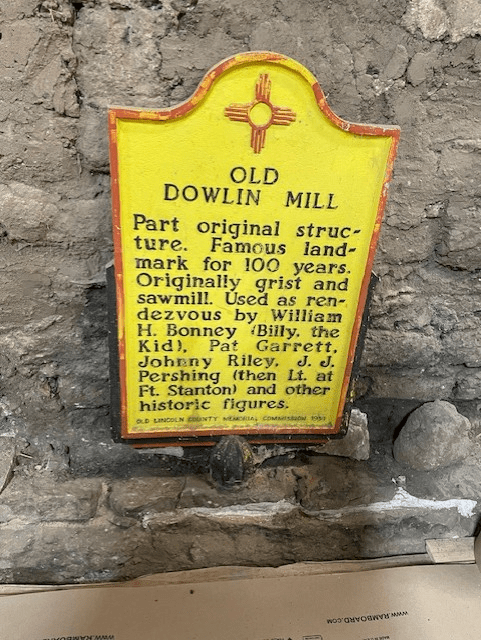
This historic marker was outside the Old Mill for many years.
The building was originally made of adobe and rock, which has held up surprisingly well for more than 150 years. There are still places that you can look from the inside the building through cracks in the rock and adobe to see the outside, but the walls seem to be fairly sturdy.
Typical wall construction inside the mill of adobe and local rock
The wheel was powered by water that was channeled to the site from nearby Carrizo Creek by a viaduct, parts of which can still be found today. The wood and metal wheel — more than 20 feet in diameter — was in bad repair when the Phillips family acquired the property in 1950. They rebuilt it with timbers from a nearby abandoned mine and put it back into operating condition. I remember its steadfast rotation during my years growing up in Ruidoso, kind of like those big clocks on large urban buildings that were a reassuring reminder that things were always in motion but running smoothly.
But now, according to Michael Clements, the wheel in need of another restoration.
“It’s more bolts than wood,” he lamented.
The water wheel, in need of another refresh
I’d strongly recommend going to the website devoted to restoring the Old Mill to learn more about it and its history. Here’s the website:
There are a couple of videos on the website you can watch and there is a link for making donations to the restoration project, which I also recommend.
The Clements say they hope the restoration work will be completed next year. If you’re driving through Ruidoso sometime next spring or summer, I recommend stopping by to see what it looks like and enjoy being in a building with a lot of character and history.
Well, maybe I am a bit smarter than the squirrels I’ve been trying to catch in my back yard woodpile.
After tormenting our dog Chester and annoying me for almost two months, I finally came up with a way to outfox — oops, I meant outsquirrel — a couple of them.
I had about decided to let them live in the woodpile, where they would continue to be a source of entertainment for our dog, but then concluded that they might start chewing the wiring in our pickup truck, which we park outside. We also are warned occasionally about plague, hantavirus and other animal borne illnesses that squirrels might carry, so I moved ahead with my new plan to capture them.
After applying the diminished amount of logic left in my human brain, I concluded that I wasn’t catching the critters because they were too light to trigger the mechanism that closes the flap on the end of the humane trap I’d been using. It appears that after the mother accidentally died in the trap last week, the only squirrels left in the woodpile were juveniles. I suspect they weighed about half of what an adult would weigh.
Because of their light weight, they could sneak into the trap, scarf down the pecan, peanut butter and club cracker gourmet squirrel sandwich that I had concocted, then escape without pressing down too much on the metal plate which releases the trap door.
I came up with a plan to add two heavy flat washers on the triggering plate that would be just shy of enough weight to release the trap door, then wait for the squirrels to visit.
You can see the two heavy flat washers on the plate that triggers the closing of the flap door. The squirrel sandwich is to the left of the plate.
And voila! It worked.
After setting out my first modified trap mechanism, I caught my first squirrel in about 15 minutes.
The first one I trapped
I reset the trap and in about another 15 minutes, I caught the second squirrel.
The second squirrel I caught.
We had guests coming over, so rather than continue my pursuit of other squirrels (I think there are two juveniles still left), I postponed my activity until the next day.
Both squirrels were released in a pecan orchard in the country about two miles away from our home. Both bolted out of the trap and ran toward the nearest tree they could find. I hope they are doing okay at their new home.
I reset the trap this morning and so far have had no success in capturing any more of the rodents. Maybe they moved on after concluding that our backyard was too dangerous, since three of their friends are no more to be found.
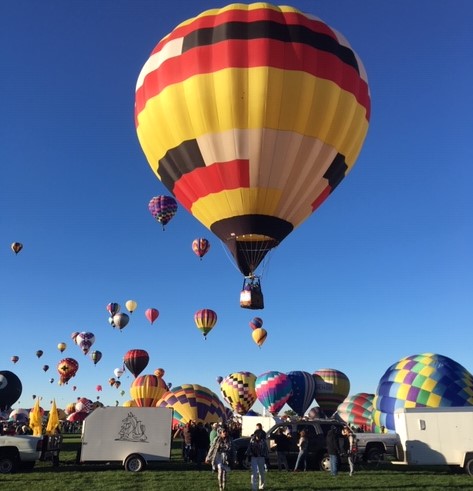
As I’ve done many times in the past, I did a presentation to a group of elementary school students last week about hot air ballooning. I usually did a demonstration with my balloon on the school playground, but since I no longer have a balloon and stopped flying about four years ago, this presentation was just in the classroom.
The students were third graders at White Mountain Elementary in Ruidoso, where you may remember that I’ve done work with the Trout Unlimited “Trout in the Classroom” program. One of the teachers at White Mountain Elementary remembered that I was a hot air balloon pilot and asked me if I’d talk to her class about that. I was honored that she had asked and agreed to do a presentation to about 140 third graders since I had to travel to Ruidoso last week for another event.
Me piloting my otherwise useless travel device
The presentation by PowerPoint went well enough, I thought, based on the attentiveness of most of the eight- or nine-year-olds and the questions they asked. They usually want to know things like how far I fly, how high above the earth can I go, where I can fly and whether I get scared when I’m in the air.
I tried to be sure to answer questions randomly around the group of students gathered in the school cafeteria. Toward the end of my time, there was an especially attentive young girl who kept poking her hand up every time I paused for a new question. I decided to call on her and her question was this:
“Why would you fly in a balloon when you could just walk?” she asked.
I have to admit I was perplexed with that question.
I attempted to answer by rambling on about why we should be curious about discovering new things, like flying, and saying that the view from above would be much more interesting than just walking the three or four miles traveled in a typical balloon flight.
But she did have a bit of a point, except that you usually don’t travel in a hot air balloon just to get somewhere. In fact, most of the time I flew balloons, I never knew exactly where I was going to end up, given the variables of winds at different altitudes. I think that’s one of the things that makes ballooning interesting — it’s an adventure, not just a boring destination-specific exercise.
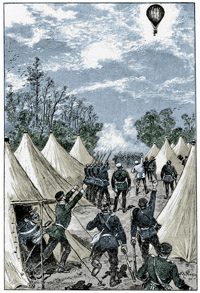
And to add a bit of historical background, some early ballooning did have destinations in mind, such as in the Siege of Paris in 1870-1871 when the Prussian Army surrounded the French city. Unmanned hot air balloons — no doubt following the discoveries by the Montgolfier brothers — flew mail and communications from the inside the city to sympathizers in the surrounding countryside to help with breaking the siege.
Painting showing an unmanned balloon carrying messages from Paris to sympathizers outside the city
But I was really more curious about why this young girl didn’t see the value in pursuing the unknown — like giving humans an opportunity to fly above the earth.
As I pondered her question the rest of the day, I could think of other examples. What if we hadn’t pursued inventing a phone that we could communicate with anyone else on the earth. What if we just continued to use smoke signals to communicate with nearby friends and neighbors? What if we hadn’t invented a phone that we could take with us anywhere?
What if we hadn’t invented things like comfortable homes, plumbing, electricity, heating and cooling so we didn’t have to live in dark, cold caves the rest of our lives.
What if we hadn’t become interested in fire and figured out a way to harness it to cook our meals and heat our homes.
In the end, I’m not sure I ever understood the core of her question. But she was right. Flying in a balloon just to get from point A to point B is a pretty dumb way of doing things, involving a lot of work that good two feet could do more efficiently.




















 aero-cordero.com