Meeting in the middle wasn’t a good outcome…

If you think political division is troubling today, a quick look back at New Mexico history shows that things haven’t changed much in more than 150 years.

A brief excerpt from a book by noted New Mexico historian Ralph Emerson Twitchell shows how rough things got during a political campaign in 1871. The story was contained in a book entitled The Best of the West, an anthology of classic writing from the American West,” edited by noted New Mexico author Tony Hillerman.

According to Twitchell’s account, a meeting held in the town of Mesilla regarding the upcoming election prompted a group of Democrats and a group of Republicans to stage a march around the village. The only problem with the two political groups demonstration of support for their party was that they chose to march around the town in opposite directions.

Historic Mesilla plaza, possibly before a disagreement broke out in a political dispute. Photo courtesy National Park Service.

My suspicion is that the Democrats were walking to the left around the historic plaza in Mesilla while the Republicans were marching to the right. Eventually, the two groups came face to face. A leading Democrat named I.N. Kelly and a leading Republican, John Lemon, then “engaged in an angry political discussion…” Twitchell says at that point, a man named Apolonio Barela (whose political inclination was not disclosed) fired a pistol into the air.

Apparently fearing for his life and seeing the event disintegrate into chaos, Kelly grabbed a “pick handle” and struck Lemon in the head. An instant later, another participant drew a pistol and fatally shot Kelly.

That quickly led to more shots being fired and in the end, nine men had been killed and a reported 40 or 50 others were wounded.

A district judge was dispatched to Mesilla from Albuquerque to try to sort out blame for the incident. But as Twitchell notes, after three days, he returned to Albuquerque “without taking any action.”

“No indictments were ever returned and no one was punished,” Twitchell concludes.

I’m not sure if the Democrats or the Republicans in Dona Ana County won in the ensuing election. What I do know is that we need to careful about discussing politics these days, just as it was 150 years ago.

The big fish dump…

The Trout in the Classroom program at White Mountain Elementary school in Ruidoso, which has had its ups and downs this year, concluded last week with the release of three fish that we think were raised in the 3rd grade classroom of teacher Rachel Lutterman. The 150 kids who witnessed it, along with a tour of a fish hatchery, were squealing and cheering during the whole process, so it must have been a success.

It’s a long story.

A batch of 35 triploid rainbow trout eggs that the New Mexico Game and Fish Department had donated to the school for the second year of the Trout in the Classroom Program (sponsored by Trout Unlimited) were delivered to the school in November. Unfortunately, all of the fish that had hatched died during the holiday break, for reasons still unknown.

The Mescalero Apache hatchery, which has been a great partner in the program, agreed to give the school three juvenile rainbow trout to continue raising in Ms. Lutterman’s classroom. These three fish were thriving until a major power outage cut off electricity to the tank filter, water chiller and oxygenating systems. The outage was intentionally triggered because dangerous winds threatened to knock down more powerlines in the Ruidoso area and start fires that would be disastrous to the mountain community. Two years ago year, if you’ll recall, much of the forest land around Ruidoso and many of the homes in the area were burned in a devastating forest fire.

When teacher Lutterman became concerned about the viability of the fish during the power outage, she asked the Mescalero hatchery if she could rush them the 25 miles south and place them in tanks with their siblings. The hatchery agreed and the three Ruidoso trout were back swimming around in tanks and fish raceways that had been their home three months earlier.

Friday, May 2, was the date scheduled for release of the remaining Ruidoso three, along with about 150 pounds of other fish from the hatchery. To be truthful, we’ll never know if the Ruidoso trout were actually in the batch that was released that day, but in the students minds, I’m sure they were all there swimming around with their rainbow trout buddies.

Trout raised at the Mescalero fish hatchery being dumped into the lake at Inn of the Mountain gods, with 150 third graders from White Mountain Elementary in Ruidoso cheering them on.

Prior to the release of the fish, the Mescalero hatchery gave all 150 kids a grand tour of the fish hatchery. As you might expect with just a couple of weeks to go in the school year, a chance to get out of class for the day and a field trip on an activity bus was a really big deal for a bunch of third graders. (My ears still hurt from the the shrieks, laughs, squeals of delight and amplified chatter that the kids offered up during their adventure.)

Third grade students from White Mountain Elementary in Ruidoso observe rainbow trout swimming in raceways at the Mescalero fish hatchery.

As a member of Trout Unlimited, I’ve acted as an advisor and facilitator to the Trout in the Classroom program in Ruidoso and now in Silver City. But the majority of this program’s work falls on the dedicated teachers who clearly love their jobs and the students they teach.

My proudest moment for the event was when I was able to rescue a fish that had slipped through a net when they were being loaded into the tank on the back of the truck that was taking them to the release site.

I managed to grab it while it flopped around on the ground, held it up to show to the kids, tossed it in the tank and got a resounding cheer from them. It made my day.

Me in the yellow fleece top, holding the fish that I had “rescued” from the ground before I tossed it in the tank to be released at the Inn of the Mountain Gods Lake.

And the smell of a just caught trout on my hands, when I am preparing to release it back into the water, is still one of my favorite scents to this day. I need to go fishing again soon.

On Cybertrucks and soup kitchens…

About 40 years ago, we planted a cottonwood tree in our front yard, hoping the species would be appropriate for the Rio Grande valley area in which our home is located. The tree has done well but is beginning to show its age with several large branches dying and some infestation by mistletoe.

I called an arborist who had done work for us before and asked him for a bid on trimming up the tree so our home wouldn’t have a “Grapes of Wrath” patina.

He silently rolled up to our front house the next day in a sinister looking Tesla Cybertruck, painted in flat black with windows deeply tinted. I was curious about who might be driving the truck and why that was his vehicle of choice.

When I first seemed to be interested in his vehicle, the affable young man immediately offered this:

“I apologize if my truck offends you,” he said. “I bought it about five years ago. I always tell that to people when I go to give them a bid.”

Being a longtime “grearhead,” I was interested in the truck and asked if I might look inside and also have him explain some of its features.

An all black Tesla Cybertruck like the contractor drove to my house.

It turns out it is a pretty good choice for his work. He has to drive around town to various locations all day and it has sufficient range to do that, without sipping a drop of fuel. In addition, he said it has a 220-volt electrical outlet which can power his welding machine and some other heavy duty equipment. The bed is covered in a fully retractable cover. Having known of several contractors who have had equipment stolen off their trucks during work projects in the middle of the day, I’m sure that was an important factor.

Despite what you may think about the owner of the company who sells the truck, it probably makes good sense for some people who have a need for several of its advanced features. It’s a bit too showy for my tastes, but as it’s said, beauty is in the eye of the beholder.

He told me he gets lots of obscene gestures, rude comments and loud outbursts when driving the vehicle around town, but he’s become accustomed to them.

I read a recent feature article in the New York Times about a young writer who had rented a Cybertruck for a week to gauge what kinds of response he would receive when driving around the area and in New England. It turns out that he got a lot of “single finger salutes,” obscene yells and other negative responses during that time.

The author said his mother’s response when he first told her about his proposed experiment was: “I don’t think that’s a very good idea.”

You may have noticed that a lot of Tesla drivers recently have offered up some kind of apology with stickers on the back of their now controversial vehicle. One Cybertruck driver plastered what looked like a genuine “Toyota” banner on the tailgate of their truck in hopes it would fool someone who is not adept as distinguishing different vehicle designs. Another that I saw said “I’m pretending this is a Riven.”

I never did ask the young man about his political preferences, which really wasn’t any of my business. I just hope his crew does a good job on making my old tree look good.

__________

As my wife and I have done times in the past few years, we volunteered this week with members of our church to serve food at our local “El Caldito” soup kitchen for the homeless and disadvantaged. We worked alongside members of the church who we know are on both sides of the political spectrum, but their dedicated work showed no bias and only an understanding that this kind of thing needs to be done by all of us.

Members of St. James’ Episcopal Church working at El Caldito Soup Kitchen

As always, it’s a humbling experience that makes one realize how fortunate most of us are. And as always, the people receiving the meals of soup, salad, chicken or turkey patties and desserts appeared to be thankful for the food.

What amazed us was that we served almost 500 people during the three hour shift that we worked — far more than we had served when we did this in previous years.

I’m not writing about this to seek compliments for me or my wife. My only thought is that if you have an opportunity to work in one of these services serving the poor and needy, please do so. Every little bit helps.

There weren’t any EV charging stations back then…

Imagine that you’re walking along the dusty main street of Taos, NM, 125 years ago in April. It’s a pleasant day with fragrant flowers and fruit trees in blossom, temperatures in the low 60s, no blustery spring winds and a receding cap of snow on towering Taos Mountain just to your east.

Somewhere in the distance, you hear a steady “pop, pop, pop” noise approaching you. Up the street you spot the source of the noise. It looks like a moving horse-drawn carriage, but without any horses.

As the strange device gets closer, you recognize the person sitting on the bench seat where someone would normally be holding a set of reins to guide the horses. Instead of reins, the man is holding onto what looks like a boat tiller. The popping noise is coming from a crude gasoline fueled engine.

The man on the contraption is Dr. T.P. Martin, the local physician everyone in the small town knows simply as “Doc Martin,” whose office is right on Paseo del Pueblo.

According to an article in the April 30, 1900 edition of the Santa Fe New Mexican, Martin has had an automobile shipped to him from Denver on the old Denver & Rio Grande “Chile Line” narrow-gauge railroad that stopped 50 miles west in Tres Piedras.

“Dr. T.P. Martin, secretary of the New Mexico Board of Health and for years a practicing physician at Taos, recently received from Denver a strictly up to date automobile or gasoline carriage which he intends to use in making trips over the comparatively level road between Taos and the railroad station at Tres Piedras,” the article said. “The distance is about 49 miles and can be covered with the automobile at the rate of fourteen miles per hour. It is expected that the doctor will ride into the capital city (Santa Fe) on his new carriage before many weeks.”

It is believed that this was the first automobile in the state of New Mexico, and it’s likely that it was first driven from Tres Piedras to Taos within a few days of this date, 125 years ago.

Records don’t show what kind of vehicle it was, since there were not many automobile manufacturers in existence at that time, but the newspaper article seems to suggest it was gasoline powered. There is some speculation that it was a design which featured a tiller as a steering mechanism instead of a round steering wheel.

Dr. T. P. Martin, wearing the hat, gives residents of Taos Pueblo a ride in his automobile. in 1908 This particular vehicle was not the first car he brought to Taos in 1900.
Photo Courtesy of Taos Historic Museums.

Martin was an interesting character in the early history of Taos. He brought modern medicine to the nearby Taos Pueblo, and to the Penitentes religious sect that was common in northern New Mexico. He was a surgeon and served on the New Mexico Board of Health and also was involved in various civic organizations. His office and home was on Paseo del Pueblo, the main north-south street in Taos. After his death, his widow turned the facility into the “Hotel Martin,” which later became the historic “Taos Inn.” The portion of the hotel which was once his office is now a restaurant named “Doc Martin’s.”

Historic Taos Inn, former home and office of Dr. T.P. Martin, with Taos Mountain towering overhead.

Martin was also involved in the arts scene in Taos, hosting the first meeting of the “Taos Society of Artists” at his home. That meeting on July 19, 1915, was attended by famous artists Ernest Blumenschein, W. Herbert Dutton, Bert Phillips, Joseph Henry Sharp, E. Irving Couse and Oscar E. Beringhaus. They were originally known as the “Taos Six”.  Martin’s sister was married to Bert Phillips.

Here’s a link for the “Taos Society of Artists:”

https://en.wikipedia.org/wiki/Taos_Society_of_Artists

It is believed that the second automobile in New Mexico was brought to Albuquerque in the fall of 1900 by local businessman R.L. Dodson. This particular vehicle was a steam-powered “locomobile” which featured a tiller instead of a steering wheel.

Photo of first automobile in Albuquerque participating in a parade. Vehicle is a “locomobile.” Courtesy Cobb Collection, Center for Southwest Research, University Libraries, University of New Mexico

The third car brought to New Mexico was purchased by H.L. Galles, who was born in Hillsborough in Sierra County. He started New Mexico’s first automobile dealership in Albuquerque in 1908 which still operates today under his name. His Cadillac dealership was said to be the third one granted by the luxury car makers in the United States.

Although I could not find the specific connection in Ancestry.com, I believe he must have been a nephew of Nicholas Galles, the man credited with founding the community of Hillsborough and the first president of the old First National Bank of Dona Ana County, where I worked for many years.

I also looked up information about the first automobile in Las Cruces and found that it was a 1915 Ford Model T had been converted into a fire truck. It continued to serve the city until 1934 when it was decomissioned. It was owned for several years by a private individual and was gifted back to the city in 2022.

It’s hard to imagine what it must have been like to drive one of those vehicles in the early 1900s, given the lack of decent roads and primitive technology which could often leave you stranded at the side of the road. When I get into my new GMC pickup truck, I am greeted by color TV screens larger that our first 13-inch black and white home television set. When I drive, I can monitor camera views from at least eight different angles, determine the air pressure in my tires and my fuel consumption. I am protected by a warning system that beeps when I get too close to an object and automatically jams on the brakes when I’m about to hit something going forward or in reverse. I have a satellite connected roadmap of virtually anywhere I go and a source any kind of music or news that I desire to hear. It’s a highly protected and comfortable transportation pod that can lull your senses into forgetting that you’re hurtling down the highway at 75 miles per hour.

I guess drivers in the early 1900s just had to endure enjoying the scenery and the visceral jolting experience as they chugged along at 14 miles per hour through the New Mexico landscape. Actually, come to think of it, that’s not so bad.

Roadside relief…

The chair I’m sitting in as I write this and used while writing all my previous blogs was a roadside find. A home just down the street from us had placed it outside in hopes someone might want it. It was a classic design, solid oak, in need of a new cushion and some structural repairs, so I thought it was worth a chance.

It has fulfilled my needs for several years now, although at sometime in the future I think I’ll have to replace the base, which you can find at furniture repair parts sites on the internet. Once that’s replaced, I think I can get several more years of use from it. It will still squeak, creak and wobble a bit, but I think those flaws give it character that make it a perfect place for writing.

I thought about replacing it, but the new ones I looked at just didn’t have as much character.

What brought my chair to mind was the discovery of another roadside offering earlier this week that was quite unexpected. One the curb off South Locust Street, just south of Missouri Ave., was an almost complete toilet. The tank was broken but the bowl part of the unit seemed to be intact, except without a seat. I guess you could replace the tank and buy a new seat to make it functional.

Yours for the taking.

Although I got a good deal when I picked up my office chair for free, I think I’ll pass on this offering.

But maybe I’ve got it all wrong. Maybe someone actually put it out by the road in hopes that a passer by who has a bowel or bladder emergency will find relief in a completely unexpected place. I do think it might be an (un)attractive nuisance and could generate traffic problems by gawkers in passing vehicles.

Either way, I guess it’s an act of somewhat warped kindness. I’m just hoping this doesn’t start a trend and one ends up on my street. Old office chairs are okay — toilets not so much.

A World Series gem it wasn’t…

My wife and I try to make a few NMSU Aggie baseball games each spring. This year has been a little harder than usual because the wind gods seemed to show up on several of the nights we were thinking of attending at game at Presley Askew field.

The wind at one game that we were hoping to attend was so bad that the event was postponed for several hours because the players couldn’t see the ball well enough in the dust clogged air.

But on Tuesday, it looked like it would be a good one. Weather was perfect and the Aggies were playing archrival New Mexico.

It quickly turned into a comedy of errors, even though the box score showed no actual errors during the portion of the game we witnessed. It was like the Bad News Bears playing the Bad News Bears. The final score was UNM 12, Aggies 10.

The first inning was disastrous, especially for the Aggies. They gave up six runs in the first inning, at least three of them from walks when the bases were loaded because of really bad pitching. Two Lobos were sent sprawling to the ground when they were hit by wild pitches. Another pitch was so bad it went behind the batter. I’d never seen that before in a baseball game.

After the starting Aggie pitcher could only claim one out after the score was 5-0, he was replaced. The Lobo pitching was not much better, with their starting pitcher getting the axe after the Aggies came back late in the inning with three runs.

Aggie pitcher Hazen Wright of Carlsbad throws in the fifth inning. Note scoreboard in background.

The first inning took one hour and 15 minutes to complete, with the Aggies giving up seven runs. The second inning was not good for the Lobos, who as you can see let the Aggies almost get back in the game with three runs.

We gave up and went home after five innings (more than three and one-half hours into the contest), but the Aggies seemed to have cleaned up their error-prone ways toward the end of the game.

Trailing 12-6 in the bottom of the eighth inning, the Aggies staged a comeback and got the store to 12-10 with one of their scores a walk-in bases loaded pitching choke by the Logo hurler.

In the bottom of the ninth, the Aggies got a runner on base with a bunt, but could never muster the hits or walks to bring him home.

This hasn’t been the Aggies best year, with their overall record 18-19. UNM isn’t a whole lot better at 20-16. The Aggies will play the Lobos one more time this season, in Albuquerque on April 22.

Overall, it was a fun evening, with the sights and smells of a ball game making you relax and focus on things other than the latest national crisis.

A red wall…

The morning was eerily calm, but the sky had an unusual appearance. It wasn’t quite opaque like a high thin cloud cover, but thinner and with a faintly reddish hue. Shortly after about 1 p.m., the western horizon began to take a more menacing appearance, with the reddish color intensifying higher in the atmosphere and starting to reach over the top of our community. And within half an hour, the winds began and clouds of dust and sand whipped up from the ground as the sun began dimming from the higher overcast of red dust.

I’ve lived in Las Cruces more than 45 years. I’ve endured some ferocious winds here but I don’t recall a weather event like this where the visibility was so choked off by the dust in the air and the amount of sunlight that was able to filter through made it seem like dusk. The constant noise of the wind seemed to overpower any other sounds. It was difficult to make out homes at the north end of our block. — less than 200 yards away.

That storm occurred in Las Cruces on March 18, almost 90 years since the date of the “Black Sunday” storm that roared through the dustbowl states of Oklahoma, Texas, Kansas, southeastern Colorado and the northeast corner of New Mexico.

The Las Cruces wind event and the one on April 14, 1935 were termed a “haboob,” which usually occurs during the summer months when towering thunderstorms fall over dry desert landscapes and the intense wind generated by heavy rainfall scour the dry ground in an outflow from the storm.

However both the April 2 event and the “Black Sunday” event were of a march larger scale and did not feature much — if any — rainfall.

Photo taken in Clayton, NM, on April 14, 1935, of the “Black Sunday” dust storm. The photo, which was included in an Albuquerque Journal article about the storm last Sunday, is displayed in the Herzstein Memorial Museum in Clayton.

The Albuquerque Journal had an informative article about the event, which was published last Sunday, April 13. Here’s a link if you want to read more:

https://www.abqjournal.com/news/article_31cfd2c0-000b-11f0-94ed-bb6c05e5e8bb.html

I tried to find more about how the storm impacted Clayton on that day in 1935, but was not able to find much in searches on Newspapers.com. The town did have a newspaper in the early 1900s — The Clayton Citizen — but it had ceased publication by the time the great storm occurred. There were brief mentions of dust storms in the Albuquerque Journal and Santa Fe New Mexican in the days following the April 14 event, but nothing specific about Clayton.

I found one mention of a dust storm that day in the Carlsbad Current-Argus, which noted that a local man, described as the “Horace Mann” of the city, slept through the dust storm. It noted that he had left “all windows (in his home) and his lungs open” and “lost his usual loquacity.”

“He could not talk,” the newspaper article concluded.

The Santa Fe New Mexican reported that a local baseball game had been played during the “driving dust storm” and concluded with the El Rito Eagles beating the local gas company team.

Another “sporting” event that was disrupted by the April 12 storm was a “rabbit hunt” around Hooker, a small town in the Oklahoma panhandle not far from Clayton. An article said that the dust was so intense that hunters would occasionally be run into by a rabbit that they could not see. The article said there were “hundreds (of hunters) who were unable to reach their own cars and were marooned for yours in any car they could reach.”

Shortly after the April 12 storm, there was another intense weather system that produced dust but also included moisture. Denver reported almost 2.3 inches of precipitation in that storm, which spread so far south that Ruidoso, NM, received large hail.

Another article that I found interesting was a report in the Albuquerque Journal on April 25, 1935, that the U.S. Weather Bureau would soon be starting daily flights up to 17,000 feet over New Mexico to began gathering data to better predict the weather. I’m sure that kind of information would have made life much easier for the residents of the dust bowl.

The storms became so bad that at one point, dust from the dust bowl drifted over Washington, D.C. during a Congressional hearing about the need for better soil conservation techniques. An advisor to President Franklin D. Roosevelt who was lobbying for the cause pointed out a window of the capitol at the dust in the air and said: “This, gentlemen, is what I’ve been talking about.”

And finally, American folk music legend Woody Guthrie, who lived in the panhandle of Texas during the dust bowl days, wrote an entire collection of songs about the event. The lyrics from one are below:

“A dust storm hit, an’ it hit like thunder;

It dusted us over, an’ it covered us under;

Blocked out the traffic and blocked out the sun,

Strait for home all the people did run.”

Neglecting things…

Yes, you few and far between readers, I haven’t posted a lot in the last couple of weeks and my anemic statistics on “WordPress” prove it. I write when I’m inspired by something interesting I’ve seen or read and anything with an edge of humor to it. Lately, I haven’t seen a lot of that kind of inspiration, but I do have a couple of updates I wanted to share.

__________

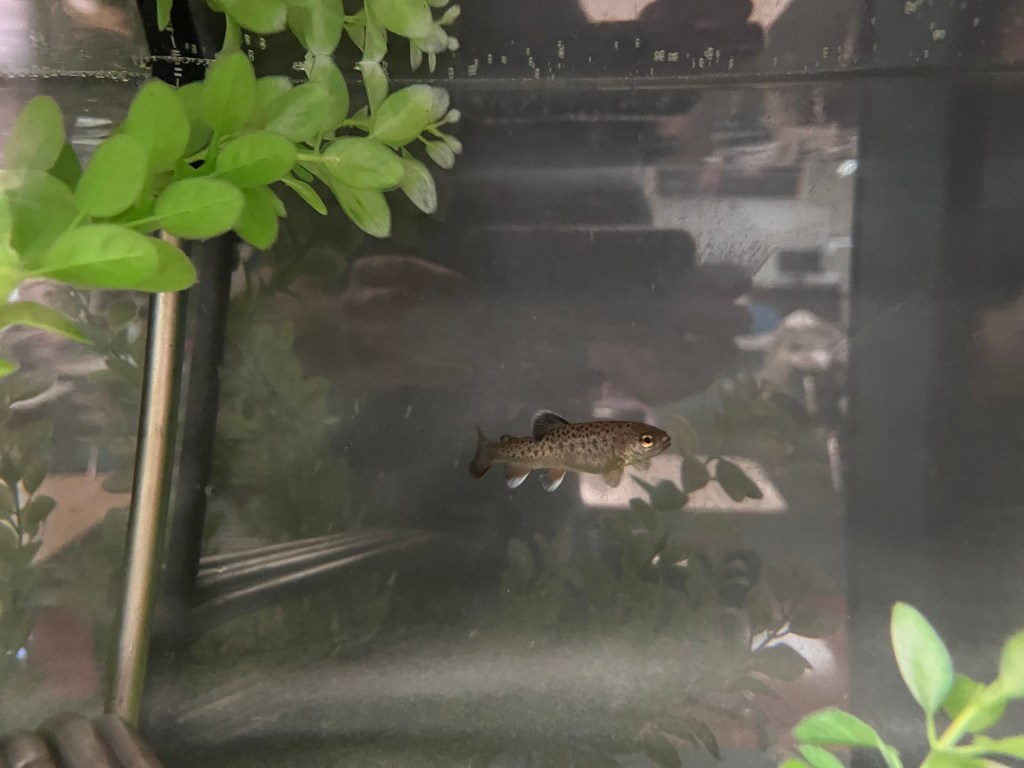
First is an update on — I know this gets boring to some — Trout in the Classroom. We’ve just started up the TIC program at G.W. Stout Elementary in Silver City where for the first time, students will be raising once endangered Gila trout native to that part of New Mexico.

The eggs arrived about a week ago from the U.S. Fish and Wildlife hatchery near Mora, NM, and were placed in two baskets in a 55-gallon aquarium where they will hatch and eventually be released into the larger tank.

Tiny Gila trout eggs ready for placement in a new home in a tank in Stout Elementary School in Silver City.

By fall, they should be large enough to release in either Lake Roberts or in a Gila River tributary where there are other Gila trout populations.

What makes this significant is that Gila trout were on the edge of extinction about 25 years ago when a cooperative program between state and federal wildlife agencies and volunteer organizations led to the eventual delisting of the species from endangered status. Now you can fish for them on several streams in the Gila. I have caught a few in the last year and saw many more swimming last week in Whitewater Creek, which was once my favorite trout stream in the region.

Eric Head of Trout Unlimited and 6th grade teacher Keith Rogers prepare to place
Gila trout eggs in aquarium G.W. Stout El;ementary in Silver City.

Meanwhile, things are going well in the other Trout in the Classroom program that I’m also helping coordinate at White Mountain Elementary in Ruidoso. Those fish — rainbow trout donated by the Mescalero Apache Tribe — will be released May 2 at the lake at Inn of the Mountain Gods just outside Ruidoso.

__________

Earlier this week, there was a story on our local NPR station on the 100th anniversary of F. Scott Fitzgerald’s classic novel, The Great Gatsby. The first movie version my wife and I saw of the novel was released in 1974 and starred Robert Redford and Mia Farrow. I suggested we watch it again because I honestly only remembered some parts of the movie. I have to say it was really worth watching again, and I’d recommend it to you.

It generated a lot of discussion and we found that several of the themes in the movie are relevant today. On top of it all is a very good story. You can rent it for about $3 on either Amazon or Apple. There are older and newer versions of the movie, but I think the 1974 version is the best.

__________

Finally, the New Mexico Chile Pepper Institute at New Mexico State University held its annual spring plant sale Thursday and Friday. The sale is held at the Fabian Garcia complex which is literally just a short walk from our house.

Each year, the organization sells a variety of plants which have been started by students in the NMSU Agriculture, Consumer and Environmental Sciences program. Most are varieties of chiles, peppers, tomatoes, basil and squash, along with a few varieties of flowers.

I purchased some New Mexico Heritage 6-4 chile plants to grow in our raised bed garden, which we are in the process of preparing this week. I’ll keep you updated on our garden progress, which always holds a few surprises each year.

Gardeners shop for varieties of plants at the annual NMSU Chile Pepper Institute annual spring plant sale.

Canine chronicles…

An update on the story about the Mexican Gray Wolf below. The Albuquerque Journal reported this morning that the wolf had been found dead. Cause of death or location of her death has not been confirmed. Very sad.

Two stories in the news last week about canines caught my attention. Both showed how clever these animals can be.

In the first case, another Mexican gray wolf has slipped into northern New Mexico, hundreds of miles from where she was being held in Arizona.

Pity poor Wolf F2996. She can’t read road maps to stay where she’s supposed to be and she can’t even be given a real name. (photo courtsey Albuquerque Journal).

Last year, you may recall, a female wolf named Asha who had been released in southwestern New Mexico was tracked roaming as far north as the Taos area. She was eventually recaptured and returned to her “approved” roaming area in the Gila country of New Mexico and southeastern Arizona.

The latest roaming female wolf was spotted last week somewhere near Mount Taylor, north of I-40 and Grants. She had been captured in late January and then cleverly escaped from a holding pen in Show-Low Arizona.

As of this writing, the wolf’s location is being monitored with a tracking collar, but she has not been recaptured. Wildlife experts suspect she may be looking for a mate, just as Asha apparently was doing when she wandered around northern New Mexico.

It always amazes me to find out how much territory these animals can cover in a short period of time, avoiding the dangers of crossing such a busy thoroughfare as Interstate 40 and finding sufficient water, food and shelter to sustain them. And yes, I understand that ranchers worry that they’re endangering their cattle operations, but you still have to admire their tenacity.

I’ll keep you posted if I hear any more about Wolf F2996 — especially if she finally gets a proper name and maybe hooks up with a guy.

__________

The next canine caper involves the discovery of a smuggled shipment of — guess what — Mexican bologna. (Please look up my previous posts about my smuggled bologna investigation “:^).

In this case, a man from Albuquerque was caught at a checkpoint in El Paso when a dog trained for sniffing out drugs managed to catch the scent of 22 giant tubes of Mexican bologna being brought over the border for delivery in Albuquerque from Cuidad Juarez.

The dog, a black Labrador retriever named Harlee, alerted his handler after the owner of the vehicle claimed he had no “fruit, vegetables or meat products. This “crafty” smuggler had already been caught once trying to bring bologna into the United States from Mexico. Instead of trying to stuff the bologna inside a spare tire or a mattress — which are techniques used in previously bologna smuggling escapades — this time he merely heaped a bunch of junk on top of it. He was apparently hoping he’d be dismissed as a just another sloppy vehicle owner.

Customs dog Harlee, salivating in hopes of being rewarded with some of what he sniffed.
(photo courtesy of Albuquerque Journal)

I’m not saying Harlee wasn’t a well-trained smart dog who was good at sniffing out drugs, but I think our dog Chester might have been able to point out a large stash of bologna in the same cirumstance.

As my wife and I have learned, Chester can hear the sound of a “Milk Bone” treat box being opened or the sound of cellophane unwrapping a cracker from five rooms away in our house. And his keen sniffer knows the instant when a package of any kind of packaged meat, raw chicken and especially cheese has been opened. His instant alert for food happens even while snoozing on our bed while twitching and yipping in the midst of an action packed doggy dream.

Chester, preparing to leap into action after getting a scent of bacon, raw chicken or cheese

I have also realized Chester has the talent for validating times set by the international atomic clocks we rely on for everything from our phones to our watches and clocks. At precisely 4 p.m. every day, Chester knows it is time for a “Minty,” a dog treat that supposedly cleans his teeth and his breath.

At that moment in the day, he will begin scratching at his kennel, annoying my wife or me in whatever task we’re doing at the time, until we finally realize “It’s time for his Minty.” As I was writing this today at exactly 4 p.m., he wandered into my office and as I was attempting to type, he stuck his nose under my hand to lift it away from the keyboard and get him the treat he wants.

So I interrupted my chain of thought, got up from my desk and gave him a Minty, then let him go out in the back yard to chew it up. The process allowed me to continue my writing but unfortunately has done nothing to de-fumigate his noxious breath. Maybe some day I’ll be clever enough to find an application for his vile dog breath scent that wakes us up every morning about 6 a.m.

Atomic rocks…

Last week, we accompanied our grandkids on a tour of Lincoln County where I grew up in southern New Mexico. Our trip included stops at the Smokey Bear museum in Capitan, the Malpais lavabeds north of Carrizozo, old Lincoln, Fort Stanton, Ruidoso and other points in between. On the way, we stopped at the International Space Museum in Alamogordo, which the grandchildren thoroughly enjoyed, including a stop at the museum’s gift shop.

At the gift shop, pieces of “Trinitite” were on sale, starting at $80 for the tiny sample shown below and up to $450 for larger chunks of the “mineral.”

You can buy this sample for $80.

For those of you unfamiliar with Trinitite, it was created when the first atomic bomb was tested on July 16, 1945 at the Trinity site southeast of Socorro. The heat generated in the blast of the atomic bomb was so intense that scientists first concluded it had melted desert sand at ground zero into a strange greenish glass-like substance that was dubbed Trinitite.

The bomb was developed by scientists in the 1940s at the secret Los Alamos laboratory as part of the effort to end World War II. Los Alamos is about 200 miles north of the test site, a remote desert location on what was then the White Sands Bombing Range. Main components of the bomb were driven from Los Alamos to the test site, with final assembly done in an abandoned ranch house on the property. Code named as the “gadget,” the bomb created temperatures in excess of 14,000 degrees (8,430 Kelvin) when it exploded on that stormy morning about 5:30 a.m. Residents as far away as 150 miles felt and saw the explosion, which the U.S. Army explained away as an accidental munitions explosion on the bombing range.

After the explosion, the ground around ground zero was covered with the greenish glass-like material. Later research led scientists to conclude that the substance was created when sand was sucked up into the fireball of the explosion, then literally rained back down on the ground. Some of those pieces of melted sand formed tiny spheres which scientists now believe were “drops (like water) that cooled and hardened enough to keep their shape when they hit the ground.”

Fireball from first atomic bomb test

The site remained off limits to the public for many years, and in 1952, the Atomic Energy Commission scooped up much of the still radioactive contaminated dirt and trinitite and hauled it away. There were still enough pieces of the crusty green glass around that people found a way to acquire and collect it.

For some reason, my brother managed to get a piece of Trinitite when he lived in New Mexico in the late 1950s or early 1960s. I suspect he had arranged a tour of the site as a reporter for the Albuquerque Journal and picked up a sample of it of it then, but I never got a chance to ask him about it before his death in 2004. I inherited it after his death and have it displayed at our home. It is about an inch and one-half long and about an inch wide and is encased in a round piece of clear plastic, which I assume was done to limit any radiation danger. To be honest, it’s not very attractive — maybe looking like a ragged fossilized booger from an ancient dinosaur. A photo is below.

I’m hoping it’s not very radioactive.

The U.S. Army now allows tours to the Trinity site twice a year. My wife and I took a tour a few years ago and enjoyed the visit. You can still see pieces of Trinitite on the ground nearby the blast site, but it is illegal to pick them up and take them away as a souvenir. However, I recall that when we came to the gate to get on the Missile Range to begin the tour, there was a guy sitting behind a roadside table with a canopy cover selling Trinitite samples he had acquired somewhere over the years. Of course, they might just have been fossilized dinosaur boogers.

When you come to a fork in the road, take it…

Yogi Berra’s famous quote may have more significance than I thought, given some developments around our house.

My wife recently started noticing a dramatic decline in certain items in our every day eating utensils. We were down to just two forks and four spoons after originally having eight of each when we acquired the set years ago when we were first married.

I used the word acquired rather than purchased because we got the set using S&H Green Stamps we had saved when grocery stores and other retailers offered them as a sales incentive.. They peaked in popularity in the 1950s through the 1960s, but were still around by the early 1970s when my wife used them to buy the flatware set from Oneida.

If you remember these, you’re officially old

There’s a whole other story about S&H Green Stamps, but I won’t go into it now, except to say that my mother was a great fan of them. I remember licking glue on large blocks of the stamps and pasting them into thick paper books about the size of a pocket calendar and accompanying her to the “Green Stamp Store” to redeem them for what seemed to be many of our household furnishings.

But on to the mystery of missing forks and spoons. My wife’s suspicion was that when we have guests (mostly family members with young children), they accidentally get tossed into the trash when everyone tries to help clean up the kitchen. It sounded like a reasonable explanation, but I decided to look up the phenomena online and see if we were the only family suffering from this insidious plot to spirit away forks.

When you go to Google and start typing “missing for…,” the queue of answers fills up instantly with many explanations before you even finish typing the last letters “…ks.”

Here’s one story from the search:

“Something “is definitely happening in my kitchen drawers. Suddenly I have nothing but 87 butter knives, a smattering of spoons and a couple shrimp forks. I am down to eating with toothpicks and plastic cutlery from gas station delis.”

And another:

Those forks are spirited away by the Fork-Faction, taken to a secret, underground bunker where they are melted down and turned into wire coat hangers.

And another:

I am seriously wondering if tricks are being played on me? Is there a fork conspiracy going on? Are they being thrown away while everyone pleads the 5th? I have asked the rest of my flatware if they can shed some light on my dilemma. Like everyone else, they just sit there and stare at me, not uttering a word or giving up any information on the whereabouts of my missing forks. Geez!

And this spiritual offering,:

You might be wondering, ‘What could possibly be spiritual about missing forks?’ Well, it turns out that the Universe has a way of communicating with us through the objects and situations we encounter in our daily lives. In this article, we’ll explore the spiritual meaning of missing forks and discuss the six messages that the Universe may be trying to communicate to you.

I chose not to read any more after the first paragraph.

And although I’m not a user of TikTok, I found this link when I searched for “missing forks”(Clicking the link may bring in some other posts, but the one about forks is the only one I wanted):

@ezsnb

Its basic mom math…The case of the missing forks🍴#momproblems #momsoftiktok #ezsnb #fyp

♬ original sound – Emma Banes

So below are some of the new forks my wife ordered after doing her own search for “replacement flatware” on Amazon.

Ready for a portal to the missing fork black hole

But if you come to a fork in the road, pick it up and put it in your pocket. You might just need it some day.

Why did the chicken cross the border?

Being as close as Las Cruces is to the border with Mexico, it’s not surprising that smuggling — in both directions — has been going on in this area for centuries.

As you may recall, I resurrected my finely honed investigative reporting skills (yes, that was a joke) about three years ago to find out if Mexican bologna was available in our area. There had been several news reports about large scale smuggling of Mexican bologna into the United States and I wanted to determine if this evil encased meat was lurking in the dark alcoves of local ethnic-oriented grocery stores. Indeed, I was able to acquire some and even consumed it, only to conclude that it wasn’t as tasty as the good old American-made Oscar-Meyer brand.

Last week there was a news story about eggs from Mexico being smuggled into the United States at El Paso because of the dramatic rise in prices due to the bird flu epidemic. I haven’t yet decided whether I’m going to try to track down some smuggled eggs in Las Cruces, but I did decide to look up the topic of “smuggling” in the Las Cruces area in old newspapers.

In my subscription to “Newspapers.com,” I set a range from 1850 to 1925 to search for stories using the word “smuggling” in old issues of the Las Cruces Sun-News and the Rio Grande Republican. I found a lot and some are worth mentioning.

In the early 1900s up to the mid 1920s, it appears there were quite a few instances of Chinese being smuggled into the area from Mexico, apparently to be used a laborers.

On Feb. 20, 1909, a story in the Rio Grande Republican spoke about the preliminary hearing for a train conductor and a “Negro porter” who had put eight men from China in a train going from El Paso north to Santa Fe. A man who was identified as a “Chinese inspector,” admitted on the stand that for some “financial consideration,” he looked the other way when the Chinese were put on the train.

Another story in the Rio Grande Republican about a similar incident from 1911 announced that an investigation had been initiated into “Smuggling Chinks.” (Pardon the politically incorrect terminology).

In another story about that same period, the local newspaper announced the latest smuggling scheme as “The Japs are Coming.” (More non-PC terminology)

“Commission (not identified) men report that a great influx of Japs may be expected in the (Mesilla) Valley right after the first of the year,” the newspaper reported. “Many of them are preparing to leave California, where unfavorable laws have been passed.”

Smuggling involved other things, as you might expect. There was one story from 1905 about smuggling of Mexican horses across the border and another one about cattle a few years later. There was also a report from the Prohibition era in the El Paso Times of two men who had smuggled 72 gallons of tequila and one gallon of another unidentified intoxicant headed for New Mexico. The report says the smugglers were spotted by “sentinels perched in the top branches of a lofty tree that stood starkly against the sky along the New Mexico-Mexican border…”

And of course, things go the other way as well. Two wholesale grocery establishments in El Paso were shut down for “smuggling four and sugar to the Mexican side…” sometime in the early 1900s, according to another story in the Rio Grande Republican.

The strangest smuggling story I discovered was about a group of men in the Rincon area (north of Las Cruces) who had decided to round up dogs they thought “deserved banishment” and “smuggled them in empty (railroad) box cars” to be sent off and discovered days later in depots of towns down the line. The scheme was reported in a letter to the editor of the Rio Grande Republican from Oct. 6, 1893.

“This company (of men), in their zeal to promote the welfare of the public, forgot to ship any of their own dogs,” the letter to the editor said. “It (the smuggling of dogs into outbound box cars) seems to be comprised of a few unworthy citizens who propose to reform the old time-honored style of dog (ownership)…”

It was a heartless approach and I am hopeful it was discovered and stopped.

So based on the stories I read, smuggling efforts seem to get caught, including the latest attempt with Mexican eggs. But I’ve thought of a plan to get us more cheap eggs in the United States. What if someone just releases a flock of laying hens in Mexico near the border with New Mexico. They could easily slip in between the gaps in the border wall, strut into New Mexico, and suddenly become “free range” chickens — even better for the quality of eggs, as we’ve been led to believe.

We recently bought a dozen eggs from a “natural grocer” in Las Cruces for $12+ a dozen — more than a dollar per egg. I think I’ll give my “free range” chicken — border style — a try.

Fur bearing trout…

I’ve been working my way through a book edited by my former journalism professor, Tony Hillerman, entitled “Best of the West: An Anthology of Classic Writing from the American West.”

The book contains 142 short stories on a variety of subjects, mostly historical in nature. Under the section of the book entitled “Tall Tales and Practical Jokes” is an entry called “How trout survive mountain waters.”

The gist of the story is that old timers in the Salida area of southern Colorado, just north of the San Luis Valley (which many people think rightfully belongs to New Mexico) claim that winters were so cold in the region that some species of trout grew fur. A story in the 1938 Pueblo (CO) Chrieftan claimed someone from Kansas had written to the Chamber of Commerce in Salida asking if there was truth to the rumors of fur-bearing trout. The tongue-in-cheek article concluded that one old timer claimed that “There’s still some of them around, if you know where to look, which I do, but I ain’t tellin'”

“Their fur is pretty few and fur (sic) between compared to what it was,” the old timer said. “And they ain’t near as fur-bearin’ as they wuz, not near.”

This made me think of my years-long quest to catch a Gila trout in the Gila Wilderness of southwestern New Mexico. I wrote a post about this last August, when I was finally able to catch some of the elusive species on Mineral Creek, just north of Whitewater Creek. I had written many articles during my career as a journalist about efforts to help the trout species recover in the waters of southwestern New Mexico.

Aerial depiction of Mineral Creek in blue, with Whitewater Creek just below

While attempting to dig through some old photographs, it occurred to me that I might have actually caught a few Gila trout years earlier when my son, daughter, a friend and his son hiked into the upper part of Whitewater Creek in the Gila Wilderness. All of the kids, I recall, were still in elementary school, yet managed a several mile hike on a tough trail just east of the ghost town of Mogollon to the upper reaches of Whitewater Creek. We caught several fish on the hike and at the time, I assumed they were just rainbow trout, since they are fairly similar in coloring.

I vividly recall a photograph of my daughter, Lindsay, holding a stick with four or five tiny trout we had managed to catch on that hike into the Gila wilderness. I did a cursory search for that image and could not locate it in dusty boxes in our hallway closet where we stash photographs chronicling many fun adventures with our children. Even if I could find it, I doubt I would be able to verify the species of trout we caught because the fish were so small and the quality of the photograph likely left something to be desired.

What I though was my first Gila Trout, caught on Mineral Creek last fall.

At any rate, the Gila trout are not a fur-bearing variety, as the old timers in southern Colorado claimed they had seen. My biggest concern for the species is the dramatic decline in precipitation we have experienced this winter in southern New Mexico. I think the Gila Wilderness has had a little more moisture than we have had in the Las Cruces area. But for an already challenged ecosystem, the coming of the spring winds makes the risk of devastating forest fires an even bigger challenge for the Gila country and the Gila Trout.

The wind outside my home office is howling as I write this, sucking out what little moisture might be left in the arid landscape of southern New Mexico. I hope the Gila is spared of more disastrous springtime fires that have threatened this tiny yet hardy species.

Ramping up…

A friend and neighbor asked me last week if I was interested in helping with a project that I had never known about until he extended me the invitation. It’s called the “New Mexico Ramp Project.” It is a volunteer-based program to construct wheelchair accessible ramps to homes of low-income disabled residents in 15 New Mexico counties.

Individuals who qualify can request a ramp be constructed at their home at no cost. Several private companies in the state have provided funds for the program as well as receiving some support from the New Mexico Mortgage Finance Authority. Those seeking a ramp must fill out a simple request form that is reviewed by the organization before approval is given. Tools, decking screws and lumber are supplied by various organizations or through donations. A shipping container in a lot in an industrial area not too far from our home is used to store the equipment in between projects. It’s not unlike the Habitat for Humanity program, which I have volunteered for in the past, but on a much smaller and more focused scale.

I agreed to help with the program last Saturday. In about two hours, a crew of about 15 people were able to construct a wooden ramp with a 5% grade at the side of a mobile home that it turned out was owned by a woman I knew who used to work for a local car dealership.

Work on the ramp begins earlier in the week before installation, with construction of a standardized framework which is attached to the home or mobile home at the front door or on an existing porch. Once the framework is installed at the home, workers complete the ramp by installing treated wooden decking and railings.

At the project last week, we seemed to have an overkill on volunteer workers. I think we could have done the job with about half the number of workers we had, but no one complained and everyone offered some bit of assistance.

Volunteers installing new ramp at mobile home in Dona Ana.

It’s one of those programs that many people don’t know about that goes on in our state and is a great reminder — despite all the turmoil in the nation these past few weeks — that good things can be done to help the needy by volunteers. According to the organization’s website (which I have shown below), this kind of program exists in several other states around the nation and was started in Texas several years ago. The New Mexico program was started in 2019, largely through the efforts of an individual who worked with the highly successful Texas program.

nmramp.org

Dolores standing on the new wheelchair accessible ramp at her mobile home

The program received accolades two years ago from New Mexico Magazine as one of the state’s “True Heroes.”

Here’s a link to the video below if you want to watch. It gives kudos to several volunteer programs throughout the state, but it runs about half an hour. You can fast forward to the segment about the New Mexico Ramp Project at about 11:50 into the video.