You’ve heard of a monkey on your back…

This sheep, in a pen behind the historic Wortley Hotel in Lincoln, NM, has a guest on its back, which according to the owners of the hotel, spends a lot of time there. The chicken, which is one of several that provides eggs for guest breakfasts, apparently gets along fine with the sheep, which seems content with the arrangement as well. I guess you could call the combination a “sheepicken.”

A chicken on the back of a perfectly calm sheep in Lincoln, NM

The Wortley is an excellent base for a couple of days of exploring Lincoln County and historic old Lincoln, where outlaw Billy the Kid staged a shootout in a daring escape during the Lincoln County War. Unfortunately, it is temporarily closed because of the COVID-19 pandemic.

https://wortleyhotel.com/

A wilderness on the edge…

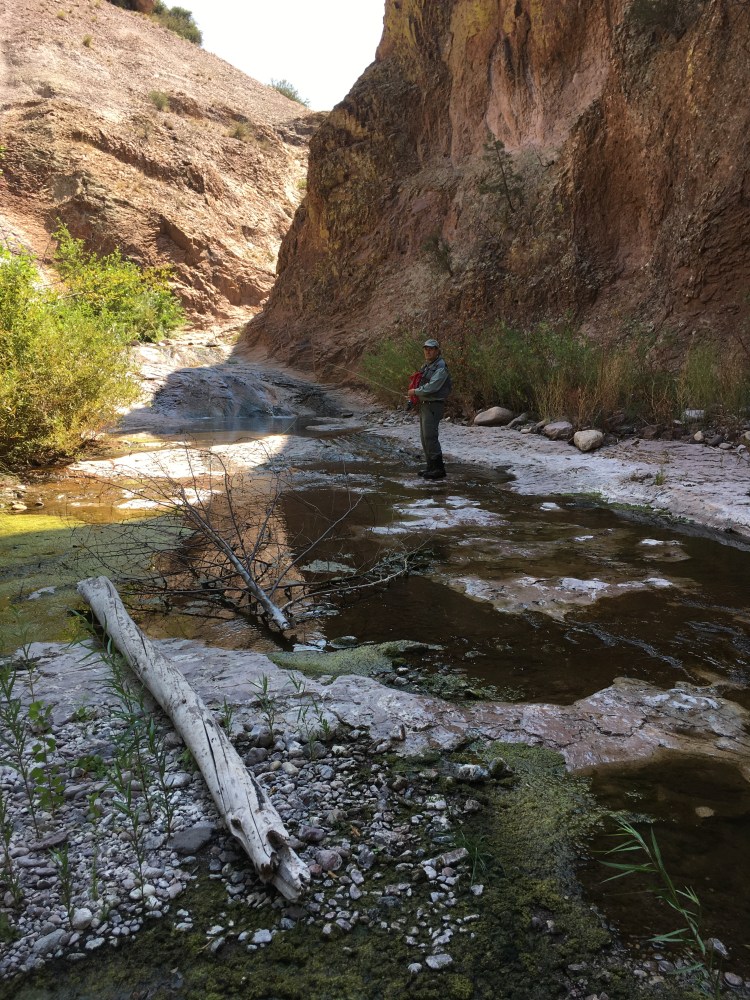
My wife Margo, our dog Chester, and I completed a day trip to the Gila Wilderness last week, with my goal to finally catch an elusive Gila trout on one of the streams where they have been re-introduced.

Thanks to very low water, failure to venture far enough up the stream and my dog’s need to investigate every hole before I could sneak up on it, I didn’t catch anything. I think I spotted a couple of very small Gila trout, which was encouraging.

But the trip was far from a failure. I renewed my appreciation of this first designated wilderness area in the United States and forced me to think about how much it is “on the edge.”

https://www.fs.usda.gov/recarea/gila/recarea/?recid=4826https://en.wikipedia.org/wiki/Aldo_Leopold_Wilderness

Why is it “on the edge?” First, it’s one the very western edge of New Mexico, far away from population centers and largely forgotten by many in our state who have never ventured south of Socorro to that “drive-though” part of the state. It’s on the edge of catastrophic destruction from wildfire, thanks to climate change and already challenging meteorological, geographical and geological conditions. And for me, it’s “on the edge” of my ability to understand how such a complex eco-system exists in such an arid landscape.

Rock tower in MIneral Creek Canyon

It’s easy to love the wilderness areas with snow-capped mountains, lush meadows, lakes, roaring rivers and dense forests. At first glance for many, the Gila is probably not easy to love — too rugged, too dry, too far away, not enough big mountains, too few rivers, hardly any lakes and maybe just too ugly for some.

But if you take time to explore it, you’ll find it fascinating and spectacular in its own way.

I think the thing that amazes me most is the incredible contrast in the eco systems of the rugged slot canyons on the western side of the wilderness. Small streams wander though narrow solid rock walls towering hundreds of feet above you. In the bottom of the canyons is an unbelievable variety of lush vegetation, including giant sycamore and walnut trees, flowering bushes, vines and grasses. But if you glance up just a hundred feet above you, the canyon walls sprout cactus, yucca plants, stunted pinon trees and mesquite bushes better suited for a high desert landscape.

Our trip took us up Mineral Creek canyon, and I’ve included some photos. Some parts of the canyon make you fear a delicately balanced rock formation is about to fall on you. Other sections look like someone took a giant ice cream scoop and carved a trough through a layer of pumice and volcanic rock. Remnants of mining activity a century ago are everywhere — rusting pipe, iron anchors in the stream bed and canyon walls, slowly rotting timbers from a mine shaft or a mill. I’ve seen spectacular waterfalls tumble off the overhead cliffs following summer thunderstorms. I’ve encountered elk and other critters, thrashing through the underbrush. But I only occasionally see another human in these places.

Chester, wading through low water on Mineral Creek

Mineral Creek Canyon is very similar to nearby Whitewater Creek Canyon, which was my favorite place in the entire world for fishing and solitude until the 2012 Whitewater-Baldy Complex fire transmogrified it. The horrifying blaze destroyed the watershed and subsequent thunderstorm-induced flooding wiped out virtually every fish in the stream. The fire, the largest in New Mexico recorded history, burned 465 square miles of forest. At least, finally, native Gila Trout (I’ll post a blog on Gila Trout later) are being re-introduced to populate the stream, but I fear it will never be the same as when I discovered it more than 20 years ago. I remember noting in my fisherman’s log that day that I caught more fish in one day than I had ever caught in a single day before. All were tiny 6-8 inch hybrid Gila/Rainbow trout, feisty for their size, colorful and all were returned alive to the beautiful waters of that spectacular canyon.

I hope you’ll forgive my rambling. It does my soul good to go to places like the Gila, and I hope you’ll consider going there yourself and discovering why it’s such a significant and spectacular place. And I hope someday it won’t be “on the edge.”

P.S. There are many wonderful books written about the Gila, much more eloquent in their description of the country than I can do. And be sure to note the contributions of M.H. “Dutch” Salmon to preserving the mystique of the Gila. https://en.wikipedia.org/wiki/M._H._Salmon

Carved out section of Mineral Creek Canyon

New Mexico “weed wheel”…

You’ve probably seen videos of the strange ice wheels that form in streams during colder months in northern climates. They spin slowly and mysteriously on top of the water, apparently formed by just the right combination of temperature, speed of the current and shape of the stream bank.

This morning, on our daily walk through the neighborhood and farmland surrounding our home, we found an unusual sight. It appears that the Rio Grande Irrigation District had been mowing weeds and grass along the Laguna Lateral which bisects our Mesilla Park neighborhood. As the grass and weeds fell into the ditch, they flowed with the current and through a culvert underneath McDowell Road. Just below the culvert, two eddies of water gathered up some of the weed and grass clippings and formed these two “weed wheels,” slowly spinning in the water.

Weed wheel” in an irrigation ditch in Mesilla Park

They should patent this password…

There is a neighborhood Mexican restaurant/carryout in our neighborhood that is much beloved for many reasons. Their carne adovada burritos are tops, rolled tacos were once voted best in the city and their folded tacos come with double crunchy shells (probably to prevent them from dissolving from the ample grease — er, I meant juice that drips from the ground beef. (probably 60-40 at best). And of course, it’s pretty cheap.

Perhaps its most interesting culinary feature is the shredded cheese-like product sprinkled liberally on just about everything edible at the restaurant. Affectionately known as “mystery cheese” by the locals, it is heaped on tacos, rolled tacos, burritos etc. from a large metal pan at the end of the food assembly line. Yes, it’s yellow and kind of looks and tastes like cheese, but I question whether a cow was ever involved in its production. It does have some good melting properties, but so does shredded plastic. I still love it.

I won’t name the place for fear it will be “discovered” by trend-seeking outsiders, and more likely because they might take exception to some of my descriptions. But what they serve is extremely tasty (if not always healthy) and I’m sad to say that I haven’t been there is several months because of the COVID-19 situation.

Late last year, however, this humble eatery moved into the modern era with the announcement to customers that they now have their own wi-fi hotspot. The best part of that high-tech advancement is the password to gain access to the wireless network, as shown below:

Network and restaurant name redacted for fear of it becoming a trendy upscale cuisine destination, but highly appropriate password is proudly displayed

The “s” was lost, but at least a “w” didn’t appear…

I grew up working around my father and mother’s weekly newspaper in the New Mexico resort town of Ruidoso. I’m not sure what my first gig on the newspaper was, or when it started, but by the time I left for college I had delivered papers, poured hot lead “pigs” for the Linotype machines, inserted advertising flyers, folded papers, ran an engraving machine and even set type. I’m sure there are other things I did, but one of them was particularly memorable.

My father had written a feature story about a Ruidoso resident who owned race horses that ran regularly at Ruidoso Downs. The story was added very late to the paper’s feature list this particular week, and because of time constraints, it never was proofread.

The newspaper usually had two sections in the summer, sometimes with additional pages having to be inserted by hand. The feature story in question was printed on one of the pages that would be inserted in the first section of the paper.

After it was already printed and awaiting insertion, someone took a quick look at the layout of the page and glanced over its contents. And there it was for all the world to see.

The story identified the subject of the article as a “local hore owner” — the “s” apparently dropping out of the line of type when it was set. My father, understanding the gravity of the error — even though the implied offending word was not spelled correctly — knew he had to do something to avoid a libel suit.

There wasn’t enough time to reprint the section, and the cost of doing so would have been prohibitive. So he did the next best thing, put his 12-year-old son to work to fix it.

Of course at that time, I knew what the misspelled word implied, and even knew how to spell it correctly. I decided to press him on the issue of why we had a problem with that word, in hopes of forcing my father into a embarrassing explanation that would lead to a more robust and graphic discussion about the birds and the bees. But he delicately deflected my question with an ambiguous response, never giving me the embarrassing conversation I thought I wanted.

So my job became taking a black crayon to every one of the 1,800 insert pages, and drawing a smudgy line through the word “hore.” I tried to add a bit of creativity to the process by making my black mark appear as a blob of ink that had dripped on each of the pages during the printing process.

It took me several hours to complete the project, just in time to slip the page with the almost titillating story into the main section of the newspaper. As far as I know, there were never any repercussions or libel suits filed over the incident. But I do know that my hand cramped up for several days following my furious scribbling.

I hope she doesn’t moo…

I spotted this advertisement in an edition from the Albuquerque Journal last year. It’s seeking candidates for the Bernalillo County Sheriff’s Posse queen. But if you’ll notice, it was published in the “LIVESTOCK, MISC” section of classified ads. Now I get that a cowgirl/4H/FFA kind of candidate (or her parents) might be inclined to look at that section of the classified ads on a regular basis. But I think if I were a fetching young lass, I’d be offended by the suggestion that I was just livestock on the auction block, especially of the “miscellaneous” kind. And I hope the contest winner’s name wasn’t “Patty.”

It sounded like a good idea at the time…

As a marketing director for most of my working life, I was always amused when someone introduced me as a “marketing guru.” It was a buzz phrase that sprung up somewhere as a compliment to someone who had true genius in the area of marketing, but undeservedly became applied to almost anyone who worked in that field. Given some marketing blunders I pulled, I certainly wasn’t deserving of the title.

In one promotion I created, I saw a chance to boost sales of a particular product by tying it into the “green” movement. The idea was that if a customer bought that particular product, they’d get a small pine tree to plant in their yard. Good for the environment, good for the customer, good for the company — right? I even went to a local greenhouse to buy an eight-inch pine tree in a planted in a six-inch diameter pot to demonstrate the promotion to the store managers, who praised me that it was evidence of a “marketing guru” at his best.

I found a supplier of small “eight-inch” pine trees and ordered several hundred of them to be distributed to stores to hand out to happy customers when they bought the targeted product. But when the trees arrived, they were clearly not what I had expected. Yes, they were eight inches, but instead of eight inches above the top of a six-inch diameter pot, they were eight inches of long-skinny weed-like trees — including long bare roots — packaged in indivudal clear plastic bags. Store managers, some of whom had borrowed large pickup trucks to haul the trees back to their stores, looked on in stunned silence when they saw what they thought were just weeds in a bag.

Needless to say, I hadn’t thoroughly investigated what I had ordered, and the thing turned out to be a big bust, with most of the trees ending up in the trash can.

On another occasion, a group of marketers for a larger region came up with what all of us “gurus” thought was a splendid idea. We concluded that we could help increase sales by sending a “Fiesta in a Box” to help already overburdened employees get excited about an otherwise uninspiring promotion.

The “Fiesta in a Box” that would be sent to each store included snacks and other inexpensive promotional items and props to carry through the theme. One of the snacks was a jar of salsa, to go along with some tortilla chips included in the box. One of the props was a tiny box of Mexican jumping beans that you find at those cheesy curio stores throughout the Southwest.

The first problem occurred when the “Fiesta in a Box” items were being flown in an un-pressurized courier plane to some store locations in far West Texas. Somewhere over the vast emptiness of that region, the salsa jars began exploding because they had been sealed at a factory at sea level, then subjected to thin air at 12,000 feet. Some of the bags of chips may have loudly popped open as well. The pilot of the aircraft, made an emergency landing for fear his aircraft was disintegrating or that he had picked up a cargo of terrorist bombs. Needless to say, we quickly cancelled delivery of the remaining boxes and were left with an endless supply of salsa and chips for our future team meetings.

Now imagine if you are the manager of the U.S. Post Office in Post, Texas, (yes, there is such a place and it was named after the guy who started the Post cereal brand https://en.wikipedia.org/wiki/Post,_Texas) and you suddenly hear something ticking inside of a box scheduled for delivery to a local business. Yes, the Mexican jumping beans had awakened, and were twitching like crazy in their tiny plastic boxes. Convinced that the ticking was the timer on a bomb, the postmaster called the Fire Department, Police and nearest bomb squad while the building was evacuated. After the careful extraction of the suspect package from the post office, it was gingerly opened, only to find the jumping beans happily leaping around their plastic box and oblivious to their perceived role as agents of destruction.

I had a colleague who did something similar, which also resulted in a post-office shut down. He had dreamed up a beach theme for a promotion and sent small packages of white beach sand in the promotional box. This was at the same time that a number of national political figures and news anchors had received envelopes with anthrax-laden powder in them. So when white sand began leaking out of the promotional boxes, postal officials feared it was part of the anthrax conspiracy, shut down the post office and contacted those responsible.

Gurus indeed.

Instead of a farm tractor, it’s a tractor farm…

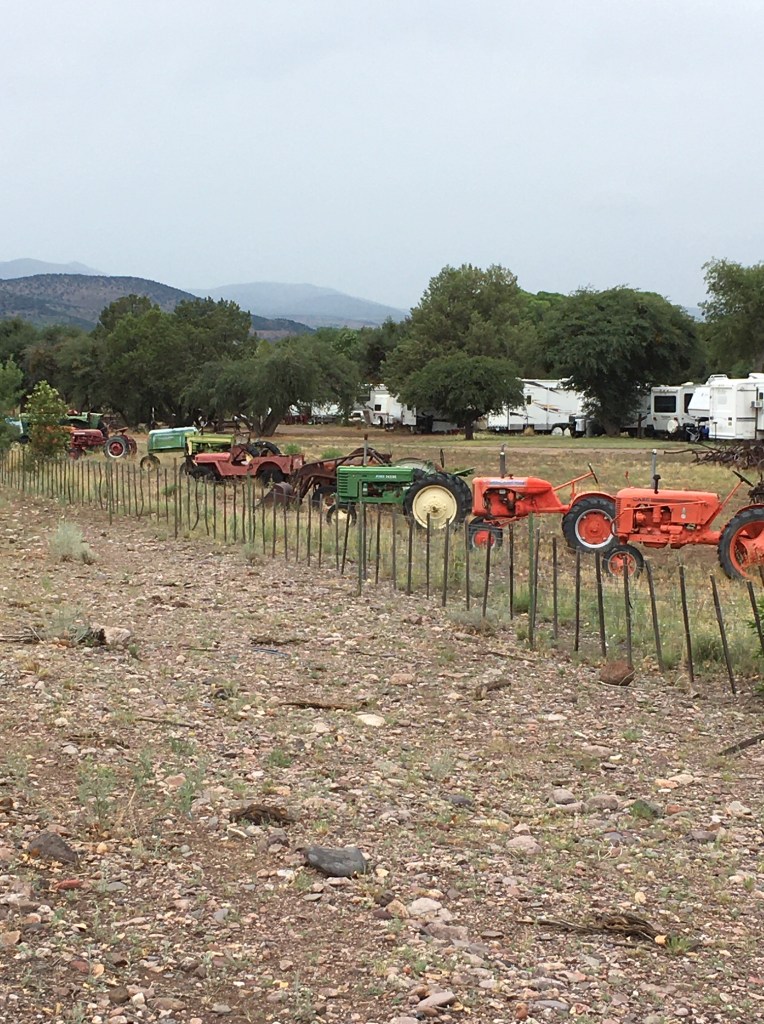
Located just east of Alma on the edge of the Gila Wilderness is this half-mile row of classic farm tractors of just about every American make, many no longer manufactured. It looks like the tractors just grew out of a big garden. I also noticed, like a weed poking up between your rows of vegetables, there’s an old Jeep.

For all you vexillophiles out there…

The New Mexico state flag, officially adopted in 1920 from a design submitted by Santa Fe archaeologist Harry Mera, has won many accolades over the years for its elegantly simple design. In 2001, the North American Vexillological Association (no, I didn’t know there was such an organization either: https://nava.org/ ) rated its design as the top state or territorial flag in all of the United States and Canada. It’s also the only state flag in the United States which does not have blue or white as one of its colors. You can look up more information on the New Mexico flag on wikipedia or other websites but here is the most important thing you should know about our flag:

It’s dummy proof — you can’t rally hang it upside down or backwards. It always looks the same.

New Mexico 3ft. X 5ft. Spectra Pro Flag

Benefits for a burger…

Earlier this year, a female undercover police officer in Albuquerque, posing as a prostitute, was approached by a man seeking her “services.” The man explained that he wouldn’t get his paycheck until Friday and wondered if he could make a deal. Observing that the man had just purchased a hamburger, the officer suggested a trade — a Big Mac for time in the sack? Or maybe his “Whopper” would do the “trick?” Or if the burger was a “Double” or a “Triple” from Wendy’s, he might knock in some extra runs. At any rate, before the deal was finalized, she revealed her true identity and promptly arrested him for soliciting. It’s not known if his tater tots were part of the deal, in which case he could have traded a “Tit for a Tat(-er tot).” (Okay, I admit that was pretty lame).

Okay, this is creepy weird…

But typical of surprises in New Mexico…

So what I thought was an albino praying mantis showed up on my new hand-cranked chile roaster after I had completed roasting half a burlap sack of Big Jim chile and a smaller batch of Sandia chile.

After searching the internet, I determined that it’s really not an albino at all, but a fairly common phenomenon as a phase of the critter’s molting sequence. Still weird and creepy looking, however.

The internet also tells me that seeing a praying mantis is a good omen in many cultures. Yay for that.

HOWEVER, what is the significance of a weird looking white bug being on your chile roaster? A sign that the chile is going to be white hot this year? A sign that we will have an apocalyptic disease on chile that will turn it all white? (And a deeper issue, what will become of the official State Question: “Red or Green… or White?”) Maybe the much dreaded chile weevil is about to make a new appearance on New Mexico’s chile crop. Or maybe it’s just a sign that I have gone COVID-19 goofy looking for meaning in a benign appearance of a strange bug.

I invite your interpretations as a “comment” on my website. Your ideas will be posted, unless you object.

p.s. For you ASPCA and Animal Humane Association readers (is an insect considered an animal?), I made sure it scuttled away to safety. I have not seen him or her since. My chile is still green. Oh wait — maybe it’s turning white!!!! No, that’s just the frost on the bag in my freezer.

I hope they got some chicharrones out of it…

(Or, heart surgery, as I imagined it might have been done, New Mexico style…)

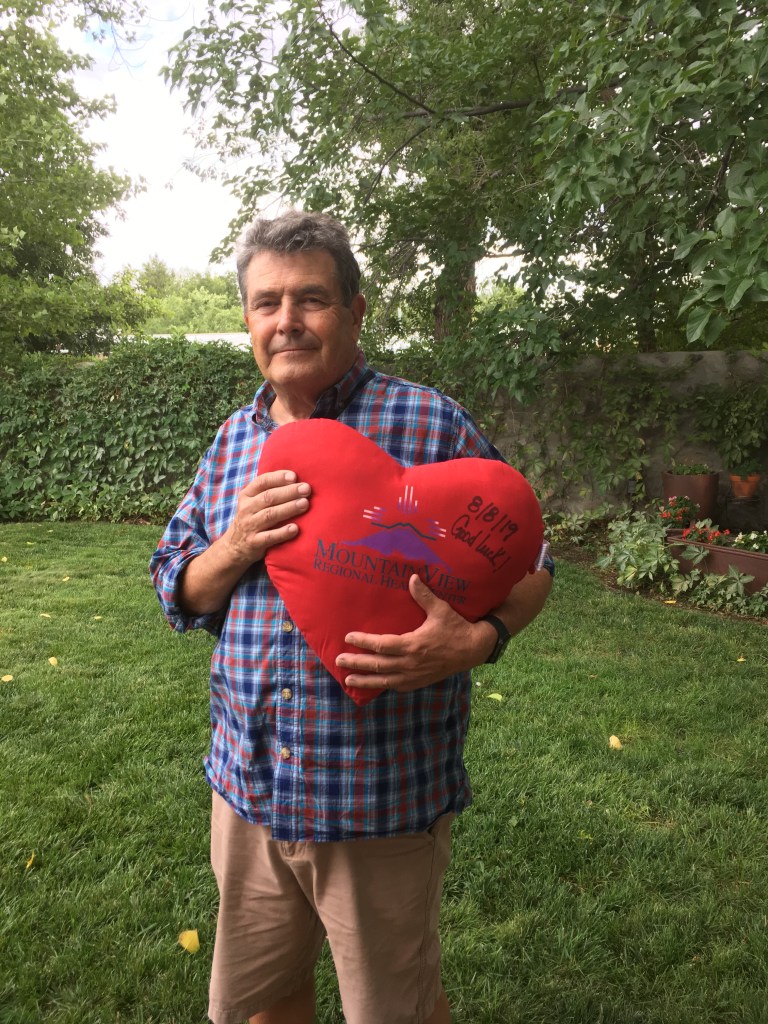
A year ago tomorrow, Aug. 8, 2019, I underwent open heart surgery to replace a bad aortic valve that manifested itself as a heart murmur and nagged at me all through life. I’m fully recovered, at least from what doctors tell me and how I feel, but I still think about it every day when I see the four scars on my chest.

And although my memory is still foggy about many of the details, I do remember the support and care I got from my wife, children, neighbors, friends, church members and of course, the very professional doctors, nurses and staff at Mountain View Medical Center in Las Cruces. I couldn’t list them all for fear of leaving someone out.

Doctors discovered the heart murmur in the early 1960s when I was 15 and took my physical to play football at Ruidoso High School. They pronounced it as “no big deal,” but suggested I check on it every few years. I did have it checked periodically but it did not seem to be getting any worse — it was just “there.” I did not feel any ill effects until about two years ago when I started experiencing shortness of breath on walks or while mowing the lawn. Up to that point, I had been very active — skiing, hiking, running regularly, playing rugby, fly fishing on remote mountain streams, working into contorted positions on my garage floor to work on cars, chasing grandkids around the back yard, etc.

Following various tests and consultations, doctors concluded I would need the valve replaced. As I learned, it’s a procedure that many people have undergone and it has worked out fine for the vast majority of them. Conversations with friends about my upcoming procedure often ended up with comments like: “Oh yeah, my brother in law had that done a few years ago and he’s fine.” The rector at our church at the time even told me she had the procedure done, with no ill effects. She refers to her heart as her “Miss Piggy heart.”

After more consultations, it was decided that the recalcitrant aortic value would be replaced with one from either a pig or a horse — most likely a pig.

On the day of my surgery, with my wife faithfully at my side, I was wheeled into the operating room after being injected with brain fogging drugs. Obviously, I don’t remember anything that happened in the operating room. When I woke up, I found myself attached to a tangled web of sensors, probes and tubes. There were various masked people hovering over me, who I was absolutely convinced were aliens conducting exotic experiments on my body. (I really did believe that for the first day of my recovery in ICU. No wonder they’re called mind-altering drugs.)

Having no memory of the procedure, and being attuned to New Mexico culture, here is how I think the procedure went.

I think the first person who worked on me was a 90-year-old gray haired curandera, who sprinkled potions of ground pinon nuts, chamisa flowers, Thunderbird wine and adobe mud on me. Then the doctors, probably rejects from an on-line medical school in the bananna republic of El Guacador, had their turn.

I’m sure they cut me open with a rusty Craftsman Sawzall, pausing occasionally to lube it up with WD-40. Once inside, they pulled out my heart and kept my blood moving by bypassing it through a used and calcified 1/4 horsepower swamp cooler water pump. I suspect a wheezing hair dryer from Rita’s Hair Salon (on the cool setting, I hope) was used to keep my lungs inflated. Then they hacked out my faulty valve with a Stanley utility knife that had been used the previous day to cut roofing paper. I’m sure rolls of duct tape, rusty bailing wire and Elmer’s glue were used to attach my new pig valve. My heart was then reinserted, probably by using a crowbar to leverage it into place. Then my chest was was sewn up, again, using leftover bailing wire (maybe barbed wire from the way it feels on certain days) and the usual strips of duct tape. Doctors even might have used a mix of adobe mud and straw to make a useful bonding agent, New Mexico style.

It seems to work. But what about the pig?

I think it was committed to participate in a pig roast that same afternoon in Dona Ana. I can see what was left of it, turning on a spit in a pecan orchard, where the smells of the first green chile of the season being roasted floated through the air while happy families gathered and large quantities of Corona beer were consumed. I hope there was mariachi music being played. I’m sure there were some chicarrones being served.

Someone, apparently looking for a deal, must have liberated the heart valve prior to the pig roast and traded it to the curandera for a potion to cure hangovers.

Which brings me to this: was it a male or female pig whose valve is now pulsing regularly in my chest? I think I’ve become more sensitive and a more focused listener lately, and I definitely feel a more urgent need to ask for directions. I think I have my answer.

And she probably didn’t even look like her…

Earlier this year, police in Las Cruces began following a car driving erratically through a residential neighborhood. As the car continued to weave and bob through the streets, police decided it was time to stop it.

The driver, however, ignored the flashing lights and siren and continued to terrorize the neighborhood until it rolled into a driveway and parked. Upon approaching the vehicle, police saw a young woman get out. When asked for her identification, she responded:
“I’m Beyonce.”

When pressed by police about why she did not stop, she responded a in celebrity-like attitude that she “didn’t feel like it.”

Her imagined celebrity status, however, did not preclude an arrest and a trip to the police station for charges that likely included resisting arrest, careless driving and maybe even impersonating a celebrity (if there such a crime.)