On a recent drive across the southern tip of the Black Range northwest of Las Cruces, we stopped by the cemetery in Hillsboro to find the grave of a former Episcopal priest and his wife who we knew were buried there.
As we often do when we visit older sections of cemeteries, we look for familiar names or historical details recorded on the grave markers. A few years ago, we toured the Cedarvale Cemetery outside the Lincoln County ghost town of White Oaks and found a gold mine of historical information.
In that cemetery, there were graves of several individuals who played a role in the infamous Lincoln County War of the 1880s. Among them was Deputy Sheriff James W. Bell, who was shot and killed by notorious outlaw Billy the Kid in a daring escape from the Lincoln County Jail on April 28, 1881. Also buried there was Susan McSween, known at one time as the “Cattle Queen of New Mexico.” She was the widow of Alexander McSween of the Tunstall-McSween merchant group, who was gunned down by members of the rival Murphy-Dolan group in an event that lit the fuse for the Lincoln County War. Another grave we found was that of the first governor of the State of New Mexico, William C. McDonald, who died six years after the state was added to the union.
Back in Hillsboro, we found the graves of the Episcopal priest and his wife, who was herself a Quaker minister — a fact which we had never known. We looked around for gravestones of other interesting individuals and my wife discovered this interesting one.
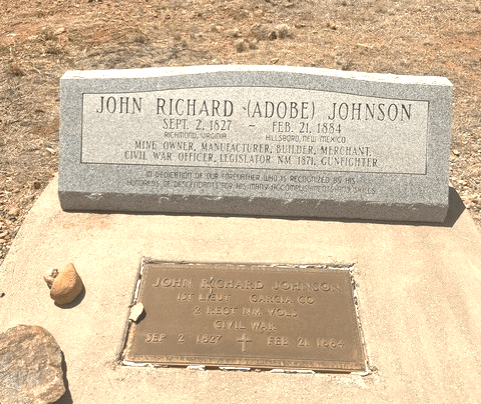
Born in 1827, Johnson had a full life until his death at 57 in 1884. The gravestone notes that he was a “mine owner, manufacturer, builder, merchant, Civil War officer, Legislator NM 1871, gunfighter.”
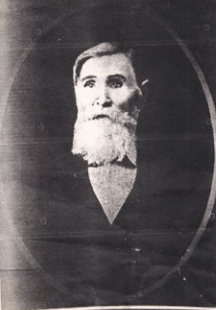
Having seen this gravestone, I became intrigued by Johnson and his story. I looked him up online and found an interesting entry online written by a great grandson, Gilbert J Flores.
Flores’ recollections of his great grandfather included a mention of Johnson’s shooting death in Hillsboro appearing in a Feb. 29, 1884, obituary published in the Silver City Enterprise.
“The story in the “Enterprise” depicted a justified ending of life to a ruthless killer,” said Flores. “To the contrary, our research revealed the history of a man whose life was full of accomplishments and rewards.”
Flores learned Johnson was born in Richmond, VA, in 1827. Records of his early life in the Richmond area were apparently destroyed during the bombardment of Richmond during the Civil War. The next record of Johnson found him as a crew member on board a steamboat on the Mississippi river operating out of St. Louis in 1850.
According to Flores’ account, Johnson arrived in New Mexico in the early 1850s, married a local woman in 1853 and had “some success” in finding gold in the hills of the southern part of the state. An 1860 census report showed him living in a community called “El Manzano” in what is now Valencia County. Later that year, he joined a group known as the “Jose Francisco Chaves Company of the New Mexico Mounted Volunteers” whose purpose was to protect settlers from raids by Native Americans in the region.
The next year, he enlisted with the Union Army in Albuquerque and served as a First Lieutenant in the 2nd Regiment of New Mexico Volunteers under Col. Kit Carson. He apparently was involved in the battle of Glorieta Pass, east of Santa Fe, against the Confederate Army on March 28, 1862. He mustered out of the Army in Santa Fe later that year and returned to mining activity in the southern part of the state. His first wife died, leaving him to raise their three children. He later remarried a woman from Mexico living in Las Cruces.
Most of his mining activity was centered around Silver City. His mining claims included such names as “Esperanza,” “Species Basis Number One,” “Grangiabird” and “La Providencia.” His “La Providencia” mine was said to be a major producer of silver.
In 1871, he was elected as a Democrat to a term in the New Mexico Territorial Legislature. At one point he served in an unusual position as co-Speaker of the House of Representatives because of a political tiff between the Democrats and the Republicans.
According to Johnson’s great grandson, one of his other endeavors, that of a manufacturer of bricks, tiles and adobes, earned him his nickname “Adobe.” He built what was said to be the largest house in Silver City in 1873 but returned to his passion for mining in Hillsboro in 1881 after reports of new discoveries of silver and gold in the area. He opened a store there to serve the booming mining town. Newspapers reported that Johnson was involved in several disputes that ended with guns being fired, some resulting in the death of the other party. Flores said that Johnson was cleared of all of those deaths because the shooting was considered an act of “self defense.”
A dispute with a neighbor involving and unpaid bill and an argument over a property line on a mining claim led to Johnson’s fatal shooting in February of 1884.
Flores concluded his story about Johnson with the following:
“The J.R, Johnson story is far from complete.
His accomplishments were varied and his activities portray a man of ambition and courage. His skills as a miner, soldier, politician were many. He believed in his rights and was forced to use his gun to defend his property and honor. The fact that he killed a number of men in self defense indicated he had the courage to pursue his goals. He had been subjected to numerous claim jumpers, marauding native tribes and thieves. He took their lives to make a better place for his family.”
I leave you to draw your own conclusions about this interesting character in New Mexico history.

