Just a brief warning to anyone who is ready to venture out into the Gila Wilderness in the next few weeks. Be REALLY REALLY careful with fire or any source of heat.
My wife, dog Chester and I took a day during the Memorial Day weekend to get out of town and drive up to the Gila. We took the New Mexico 15 from Silver City through Pinos Altos to Lake Robers and looped back around through the Mimbres Valley.
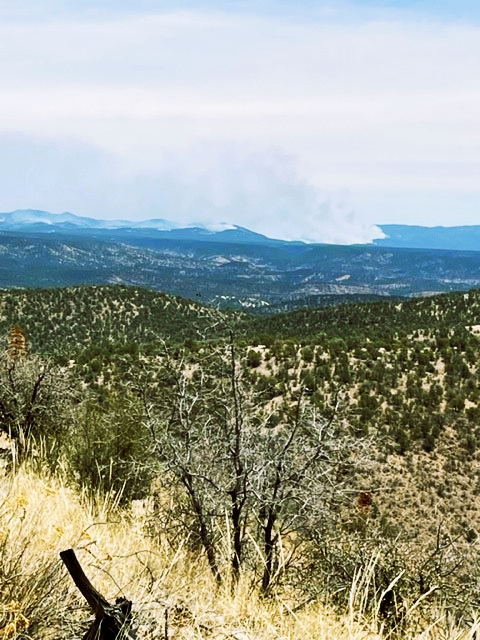
We were just stunned by how dry everything was. It was the driest I’ve ever seen that spectacular corner of New Mexico. And off in the distance to the northeast in the Black Range, we could see the huge plumes of smoke from the Black Fire, now the third largest in state history.
Looking northeast from New Mexico 15 to smoke from Black Fire in the Black Range. Note dry vegetation in foreground.
Small creeks, such as the Sapello which runs out of Lake Roberts, were completely dry when we crossed or drove alongside them.
The Gila was already battered in 2012 with the Whitewater Baldy fire, which scorched almost 300,000 acres — the largest in state history.
It has always been a fragile landscape with scant little rainfall during the summer, not much snow in the winter and incessant winds during the spring. I guess that’s why I’ve always felt it was such a unique environment — it has to work so hard to hang on to the little vegetation it has. It’s the contrast of unexpected lush vegetation in deep canyons alongside high desert cliffs, gnarled rock formations and mesas that make it spectacular for me.
And the surprise of finding tiny native trout swimming in its infrequent creeks has always been amazing to me. Unfortunately, many of the trout populations in those streams are probably going to wiped out by the latest fire.
So let’s all hope for an early monsoon rainy season with not much lightning.
And when it does start raining, take the time to see this beautiful country. The drive from Silver City to Glenwood at the end of the summer when it’s at its greenest is worth every bit of the $5 per gallon gasoline it will cost you to get there.
It was uplifting in the last couple of weeks to read stories about humans going out of their way to rescue wildlife babies that had been separated from their mothers.
The first involved a great horned owl baby that had tumbled out of a nest from a cottonwood in the Rio Grande bosque in Albuquerque. It was discovered by two Albuquerque residents who contacted Wildlife Rescue of New Mexico, Inc. The wildlife group said the bird’s parents, who usually mate for life, were probably nearby but just couldn’t get to the owlet on the ground. They recommended bringing the bird to the organization so it could be rehydrated overnight. It was returned to a makeshift nest the next day where it was hoped the parents would be able to spot it and begin caring for it again.
Great horned owl baby waiting for mom and dad
While the owl rescuers could hear the mother and father hooting at night to locate their baby, it became apparent that the makeshift nest was too close to a light source. Since owls are nocturnal, lack of light is important to their behavior. The rescuers were able to convince the electric company to shut off the light in hopes that the parents would come to the darker temporary nest to feed it.
At last report, the owlet seemed to be hanging on with its parents back in charge of its feeding.
In northern New Mexico, a firefighter working to suppress the immense Hermits Peak/Calf Canyon fire came upon an elk calf huddled in the middle of a field of ashes. At first, the firefighter believed the calf was dead, then when he discovered it was still alive, tried to find its mother. The mother, however, could not be found nearby and it was assumed she had been killed in the fire.
Elk calf named “Cinder” found in area of Hermits Peak/Calf Canyon Fire
The 32-pound baby was scooped up in the firefighters’ arms and taken to a veterinarian to be checked. Other than a few singes, the bull calf appeared to be okay. It has since been introduced to a herd of elk in a wildlife rehabilitation center near Espanola. The calf appears to have been adopted by another mother elk at the center and will be released back into the wild late this fall after elk hunting season is over.
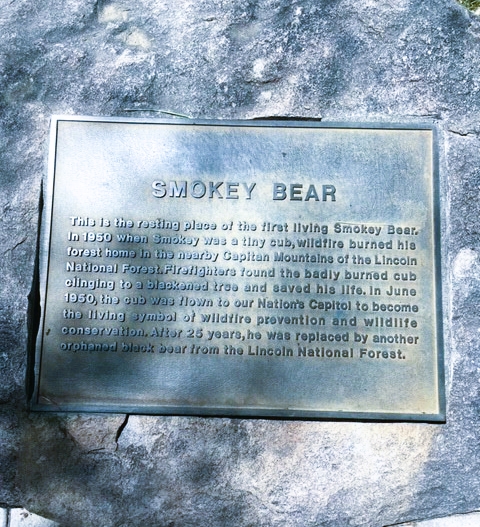
That story was reminiscent of the discovery of Smokey, a bear cub found clinging to a scorched tree during a major forest fire in the Lincoln National Forest in the 1950s. Smokey, as you know, went on to be famous and was kept at the National Zoo until he died in 1976.
Smokey the Bear’s burial site at the Smokey Bear Museum in Capitan, NM
After his death, Smokey’s body was returned to New Mexico and buried at what would become the Smokey Bear Historical Park in Capitan, near where I grew up. When I was a journalist in Santa Fe, I remember listening to debate in the New Mexico Legislature about funding for the park. I specifically recall some crusty lawmaker grumbling about why the New Mexico taxpayers had to foot the bill to bury “some dumb old bear.” I’m glad his view didn’t resonate with other legislators who eventually approved funding for the park. And if you’re ever in the area of Capitan, it’s worth a stop.
The annual first release of water down the Rio Grande from Elephant Butte and Leasburg Dam happened Wednesday, June 1.
And as usual, large blocks of white foam accompanied the welcome rush of water down the watercourse that had been dry since early last fall. At first, it looks like the entire river has been taken over by some kind of toxic disaster. You might think that an entire load of Styrofoam has accidentally been dumped in the water when a truck smashed through a guardrail over Interstate 10.
But nope, it’s not toxic and it’s just something that happens every year for the first couple of days after the initial water release in the river. The amount of foam decreases rapidly until it’s all gone in just a few days.
The last gasp of the Annual foam flotilla on the Rio Grande
Longtime Elephant Butte Irrigation District Manager Gary Esslinger took time on Friday last week to explain what’s going on.
“It’s just a chemical reaction between the water that has been stored upstream and the dry riverbed,” Esslinger said. “It’s not a contamination and it’s not toxic. It’s just a natural phenomena that happens every year.”
He said that during the dry months, all kinds of natural debris blow into the river and when the water is released, the material in the riverbed creates a chemical reaction with the water that results in the temporary foam.
Rio Grande foam up close, showing sculpting by river currents.
It looks kind of icky and I’m not sure I’d be willing to wade around in it, but on the day my wife and dog Chester investigated, there were already some people wading in the turgid and foamy water.
The good news is that water is returning to the river and parched looking willows along the banks will soon be turning greener and the wildlife that lives along the bosque will be back. The birds that live along the river, especially the trilling red wing blackbirds, always make me happy when I hear their sound.
The lateral canals in our neighborhood will be getting water soon, making it feel like a creek runs through the area.
And of course, Chester will be all too eager to slosh around in the muddy water and get loads of sand in his fur that will result in a back yard hose down that he doesn’t particularly like. Ah summer!
My wife and I were enjoying a glass of wine on the back patio on Wednesday afternoon last week when we were startled by two thundering booms that we could feel.
I was pretty sure it was a sonic boom, but we haven’t heard many of those around here in years.
Shortly afterwards, something popped up on Twitter that explained it all. It was the re-entry of the CST-100 Starliner spacecraft returning from the International Space Station to land at White Sands Missile Range just northeast of us over the Organ Mountains.
Starliner floating down for landing at White Sands Missile Range last week.
The spacecraft was unmanned and returning to earth as part of a test by NASA. The sonic booms were triggered as it broke the sound barrier upon re-entering the earth’s atmosphere.
It had been on a six-day mission to the International Space Station as a test for future manned missions. NASA and Boeing’s Orbital Flight Test-2 launched successfully May 19 from Cape Canaveral, Florida. It landed in New Mexico at 4:49 p.m. MDT last Wednesday, four hours after leaving the orbiting lab. Flight engineers said it made a “virtual bull’s eye” landing, less than three-tenths of a mile from the landing target in the Tularosa Basin.
NASA sources said the re-entry was probably visible over the Gulf of California and northern Mexico. Our skies at the time were clogged with smoke from the Black Fire scorching the Black Range on the eastern edge of the Gila, so we probably could not have seen anything.
What was interesting to my wife and me was that neither of us had seen any advance notification or publicity about the landing. NASA says it hopes to be using the spacecraft in the future to shuttle astronauts back and forth from the International Space Station. It makes us wonder what kinds of other things go on out at White Sands that we never know about. Our good friend and neighbor Frank, who at one time temporarily became be the top non-military officer to command the base, would probably have the right to kill us if he divulged any of that information. Knowing Frank, I doubt he’d do that.
What I would like to know is whether NASA plans to use WSMR for the regular landing site for future manned Starliner missions. I think the Achilles heel for parachute landings in this part of the world is the strong winds we have each spring.
An interesting side story was that the returning spacecraft had a full-sized human dummy, named Rosie after Rosie the Riveter, on board during the re-entry. It survived the test and I’ll bet it didn’t flinch as much as we did when the capsule broke through the sound barrier. And I’m sure she didn’t need a glass of wine to calm her nerves.
When the New Mexico State University baseball team made arrangements to go to Mesa, AZ, for the Western Athletic Conference baseball tournament last week, the school didn’t have the budget to charter a fancy jet to make the relatively short journey to Arizona. The plan was to charter a lowly bus.
Well, it turns out the bus was even lowlier than they had anticipated. Two times on the 388-mile journey, the bus broke down, leaving the team stranded for about one hour and 40 minutes the first time and about 45 minutes the second time. Team members were forced to wait for repairs for more than two hours parked alongside Interstate 10 while temperatures were blistering near or above the 100 degree mark.
Getting into the tournament itself wasn’t easy, with the Aggies just barely sliding into the brackets by winning its final regular-season series against Utah Valley. The game included a seven-run ninth-inning comeback for the Aggies.
However, the Aggies were undaunted and managed to work their way into the championship game by knocking off two of the top seeds. The aggies first defeated top-seeded Utah Valley State, then punished the University of Texas Rio Grande 10-0 in a game called by the mercy rule in the 7th inning.
Aggie baseball players celebrate in game at WAC championships in Mesa.
And on Friday, the underdog Aggies defeated Abilene Christian University 7-1 to take the WAC championship and earn an automatic bid to the NCAA baseball tournament.
The Aggies will now travel to Corvallis, Oregon, to face the No. 3 seeded Oregon State Beavers on Friday, June 3.
I’m sure they’ll get there on a plane for this game. But maybe traveling by a “break-down” bus would bring them good luck.
I wrote last week about my grandfather, Charles Hurst, and his talent for writing, painting and creative engineering designs. The post was the result of a friend commenting about what an interesting man he must have been.
After reading that, our good friend Cheryl dug a little more into my family’s past and came up with some information about my father, Victor Lamb, that I had not known before.
My dad was always involved in newspapers, acting as editor and publisher of the Ruidoso News in the 1950s and 60s, and as editor and writer for at least three newspapers in West Texas. It turns out his father was involved in the newspaper business in Florida as well.
My father was a good writer, even though he never completed high school and banged out his stories blindingly fast by using just two fingers on each hand on his old typewriter.
I also knew he was an artist as well, mostly drawing cartoonish things for special publications but occasionally venturing into artwork which we displayed in our home in Ruidoso.
What I did not know is that he had created a cartoon character named Archibald that appeared on the front page of his newspaper in Abernathy, TX.
A character created by my father, Vic Lamb
A story in the Lubbock Avalanche-Journal from Sept. 24, 1933, profiled my father and his cartoon creation in the Abernathy Review newspaper.
“We are the only weekly (newspaper) in the U.S. printing a home drawn cartoon,” my father boasted. “And if there were another, it wouldn’t be printing a comic drawn by the editor.”
The character first appeared in a newspaper in La Mesa, TX, where my father worked before moving to Abernathy.
“When Lamb went to Abernathy, Archibald went along too,” the Avalanche Journal article noted.
I looked online and could not find any examples of the cartoon in old newspaper files. A search of comic strip or cartoon characters on Google did not find any examples of my father’s work. It appears that there were other cartoon characters named Archibald, so my father apparently never copyrighted or trademarked the character or the name.
I’m not sure what kinds of topics Archibald addressed in his cartoons. I’m sure it was mostly just corny, folksy stuff, based on a few cartoons of his that I had seen earlier. I’m sure he followed humorists of the time like Will Rogers and cartoonist Mort Walker (“Pogo”).
However, I don’t think Archibald would be politically correct now, since he is depicted as having a cigarette dangling from his mouth and dressed in a way that makes him appear to be homeless. But who knows, maybe pants with obnoxiously big patterns will make a comeback for men’s fasion.
It was fun to discover a little more about my family’s history. I’m sure my readers (all three or four of you) have interesting stories about people in your family tree. I encourage you to dig into Ancestry.com or Newspapers.com and find undiscovered stories about your own family. I’m still looking for things about my family I didn’t know. Hope I don’t find anything too embarrassing.
And thanks again Cheryl, for finding out about “Archibald.”
It was amusing to read last week that the U.S. Forest Service had implemented a 90-day pause on any controlled burn operations in forests the agency manages in the United States. It was also incredibly sad what had prompted that decision.
“Wildfires are increasingly extreme because of climate change, drought and dry fuels across many parts of the country,” said U.S. Forest Service Chief Randy Moore when announcing the pause after New Mexico officials pushed for its implementation.
Well, duh.
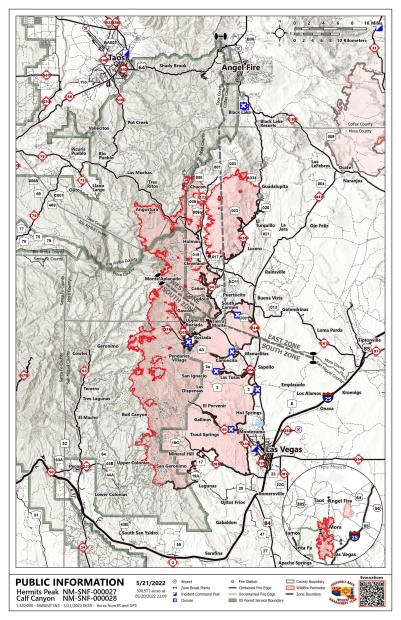
Moore’s decision comes after a controlled burn by the USFS in the Santa Fe National Forest got out of control and has ravaged more than 300,000 acres of pristine forest on the east side of the Sangre de Cristo range. And it’s still burning.
Damage from Hermit’s Peak/Calf Canyon Fire
It breaks my heart to see the areas of burned trees that once were lush ponderosa, spruce, fir and aspen forests. I will be long gone before any of these areas recover completely.
The Forest Service has clammed up about how the fire got out of control, using the usual “cause is under investigation” blanket to cover the agency’s butt.
Well, here’s why it got out of control. A foolish decision was made to start a controlled burn in the always dry, always windy spring in New Mexico. And it was already an exceptionally dry and exceptionally windy spring. Yet the fire was started instead of waiting for a less windy time of year and a time of year when humidity and moisture content in the forest would have been higher. And to make things worse, the Forest Service apparently didn’t have a decent emergency plan with air tankers and other fire suppressing equipment ready to dispatch at a moment’s notice in case things went bad.
Area of Hermit’s Peak-Calf Canyon Fire as of May 21, 2022
But no, this wasn’t the first time the U.S. Forest Service did such a foolish thing. The giant Cerro Grande fire in the Jemez Mountains was ignited by a controlled burn in the year 2000.
I understand that controlled burns are an effective tool for keeping naturally started forest fires from spreading. But for Pete’s sake, can’t anyone at the Forest Service come up with a better time of year to do these things?
Seeing New Mexico’s forests burn up has been very painful for me. My favorite place on the planet for fly fishing, Whitewater Creek on the west side of the Gila Wilderness, went up in flames 10 years ago. A stream once teaming with tiny feisty trout was choked to death when ash from the fire swept down the narrow canyon a few days after the fire had been extinguished. All but a few fish survived. The one good thing is that the temporary destruction of the watershed has resulted in a plan to re-stock the stream with native Gila trout. Unfortunately, with the grindingly slow governmental process to restock the stream, I probably won’t be in good enough physical shape to fish the upper reaches of Whitewater Creek when it is finally opened up.
That fire was started by lightning strike during a dry thunderstorm. It consumed just shy of 300,000 acres of forested land.
Forest fires will happen from natural causes. That’s a given. But do we have to keep starting ones ourselves that do just as much or more damage because of incredibly bad planning?
At the rate we’re going, there may not be many forests left in New Mexico in the not-to-distant future. I hope I’m wrong.
My good friend Don from Montana sent me an e-mail recently that made me think about doing a blog about a grandfather I never knew, Charles M. Hurst.
I had mentioned in an earlier post (regarding tongue sandwiches) that my mother and her family came from England and that my grandfather had an interesting background. Don described him as sounding like “an awesome guy.” I always thought he was and I’ve been able to find out more to confirm my feeling about him.
I think “renaissance man” is a good way to describe him. Friends of the family once described him as “brilliant with a photographic memory.”
Charles M. Hurst
He was born Oct. 1, 1874 in Manchester England. Although I haven’t had time to uncover more details, he became an engineer. In 1899, he married Hannah Mason in the town of Wigan northwest of Manchester. The marriage certificate listed him as a “bachelor” and Hannah as a “spinstress.”
They had four children, all born in England,. They were Jack, who lied about his age so he could enlist in the Royal Navy for World War I; Mary, who never married and was a veteran registered nurse for many years in a Fort Worth children’s hospital; a son James who apparently died of suicide; and my mother, Joan, who would have been about 12 when she arrived in the United States.
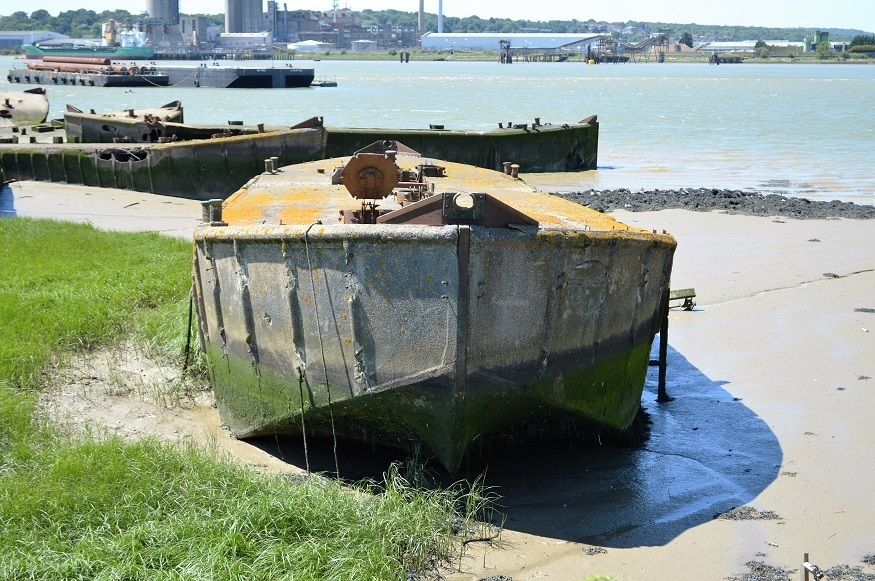
While living in England, I am told he was involved in the design and building of ships made of concrete. I have not been able to find his name listed in any research about concrete ships, but they were definitely around at the time. Concrete ships and concrete floating docks were used in both World War I and World War II.
Long-ago abandoned concrete ships in the Thames River near London
Records from Ellis Island show Hurst arrived in the United States in April of 1921, leaving his family to come to join himat a later date. He left England reportedly because jobs for engineers were scarce after World War I and because he had a relative who encouraged him to move to the Dallas/Fort Worth area. I understand he worked for a cement manufacturing plant there — a likely connection to his concrete shipbuilding legacy.
He gained U.S. citizenship in January of 1923 in Dallas, TX. I noted in his naturalization record that he still listed his occupation as “engineer” and that he was required to “renounce” his citizenship in England and any allegiance to “George V, King of England and Ireland.”
Before moving to the United States, he wrote at least four books, three of them apparently textbooks with the sleep-inducing titles: “Valves and Valve Gearing,” “Hints on Steam Engine Design” and “Construction” and “Stationary Engines.”
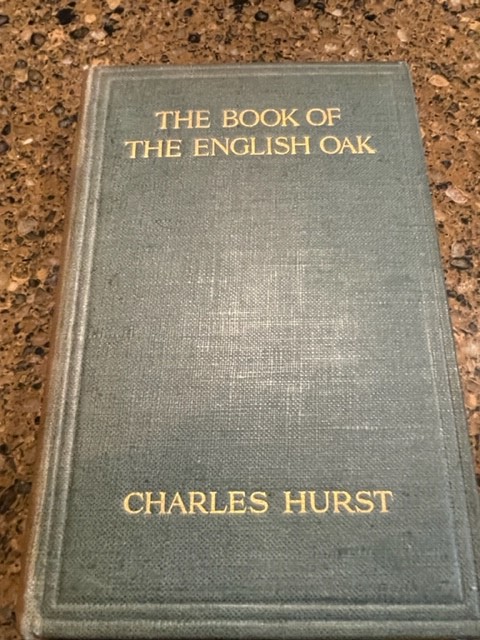
Of more interest was his novel, “The Book of the English Oak,” published in 1911. He described the book as an effort to “arouse greater interest regarding the English Oak.” At first glance, the book appears to be an autobiographical story about him planting acorns around the country while taking photographs to document existing historical oak trees. However, family members say the story was entirely fiction and he really did not do a “Johnny Appleseed” kind of adventure around the English countryside.
The Book of the English Oak by Charles Hurst.
It does make for interesting reading. There’s one part in which he befriends a stray dog, who he names “Pontiflunk.” He describes it as being terrier sized but with a mix of almost every breed. He said the most interesting feature that contributed to the dog’s “eccentric appearance was a trick or habit of thrusting its tongue about a quarter of an inch beyond its teeth.”
I had thought about giving the name of Pontiflunk to our present dog, Chester, when we adopted him, but it just didn’t seem to fit.
Through some online research by my friend Dave in Santa Fe, we discovered a few years ago that a group in England had discovered the book and was planning to do a play based on it. I ultimately got in touch with the producers, who were excited to make the connection with my family. At one point, my wife and I toyed with the idea of traveling to England and re-creating at least part of the route the author said he took while planting acorns. That never came to pass, however, and I’ve lost contact with the people who were planning to stage the play. I don’t know if the play was ever performed.
My grandfather also wrote a two-act play, which I doubt was ever performed, that was entitled “The World Debated.” It was published in 1931, after he had moved to the United States.
The play focuses on a debate among celestial spirits in the Milky Way about who created our world. Ultimately, the debaters conclude that only God could have created it and leaves “Lucifer” sulking for not getting any credit for the creation.
Maybe I should try to sell the movie rights.
Charles Hurst’s two-act play, The World Debated
One passage in the play seems to be particularly applicable in today’s times.
“Beware exaggeration and false light. To curve the trend far from the line of truth till positive is negative and plus is minus, light is dark and wrong is right.”
At some point, he began developing an interest in newspapers in West Texas and ended up being editor and publisher of one in Abernathy, TX.
While in West Texas, he painted landscapes, including the one below, which we have in our home. It was painted on a watercolor mat attached to the back of a Parcheesi game board. We framed it so you can still see the Parcheesi board if you look at the back of the painting.
Charles M. Hurst paining
Continuing his interest in newspaper, he acquired or planned to acquire a weekly publication, “The Hale Center American,” in the town of Hale Center, where I was born. Apparently while there, his daughter, my mother Joan, met my father Vic, while he was working at the newspaper. We were told by family members it was “love at first sight.”
Hurst apparently did not feel my father, who did not even have a high school diploma and was self-educated, was a fitting match for a proper English girl. Nevertheless, they became infatuated with each other and hatched a plan to marry. As I am told, my mother and father left town to elope but Hurst was determined to chase them down and stop it. During the chase, as I was told by my older sister, Hurst was involved in a fatal car wreck somewhere near Hale Center.
The accident occurred Dec. 18, 1931, a week before Christmas. The death certificate listed cause of death simply as “auto accident.” His obituary noted he was publisher of the Abernathy Review at the time. He was buried two days later in La Mesa, TX.
I probably got some of the facts in his story wrong, and I’m sure my sister Wendy will correct me. My other two siblings, Jim and Kay, are now gone, but before they died gave me some of the details that I hope I remembered correctly. The whole matter of the elopement and death of my grandfather was never discussed by my parents.
I wish I could have known him. I think a conversation with him would have been fascinating. Unfortunately, I don’t think I inherited any of his talents, except possibly for a desire to write.
And thanks Don and Dave, for encouraging me learn more about my grandfather.
Police have arrested two people in conjunction with a shoplifting effort at a Wal-Mart in Edgewood, east of Albuquerque on Interstate 40.
According to police reports, a woman set fire inside the bathroom of the Wal-Mart, by igniting paper in a trash receptacle. Then she and an accomplice went to the paper goods section of the store and set fire to what may have been toilet paper rolls.
When the first fire was reported, Wal-Mart employees grabbed available fire extinguishers and headed toward the smoke-filled bathroom to extinguish the blaze. They didn’t seem to notice two women heading toward a shopping cart full of high-dollar items nearby.
With all the chaos underway, the women managed to slip out of the store and headed toward their car where they began unloading their booty from the shopping cart. At that point, security guards wised up to the scheme and arrested them.
Two other men, who had oddly given an unsolicited confession about that same time to security guards about shoplifting at the store the previous day, are also being sought. Police believe their “confession” was an attempt to distract attention and divert the security guards from the real shoplifting scheme.
As most of us can probably remember, a shortage of toilet paper was a subject of extreme concern when the COVID pandemic began a couple of years ago. I’m hopeful that the shoplifting caper in Edgewood didn’t put a dent in the toilet paper supply and return us to that harrowing experience.
Recent news articles shared that researchers at the University of Florida had succeeded in growing plants in lunar soil harvested from the moon’s surface during the Apollo 11, 12 and 17 missions.
In what might be considered an affront to vegetable hating youngsters, the plant selected to be grown in the lunar soil was Arabidopsis thaliana — a plant related to mustard greens, as well as other cruciferous vegetables, including broccoli and cauliflower, I mean really, even President George H.W. Bush couldn’t stomach broccoli. I, for one, actually do like broccoli. However, if the noxious weed known as okra and eaten by some taste-challenged humans had been grown in the lunar soil, I probably would have been offended at the choice. But I’ve drifted off point here.
The story about use of the lunar soil to grow plants reminded me of a spat in 1971 when I was just starting my career as United Press International’s Santa Fe Bureau Chief and State Political Editor. It seems that when Republican Gov. David F. Cargo cleaned out the governor’s office to make room for incoming Gov. Bruce King, a Democrat, much of the office seemed to have been stripped bare of any trinkets that are routinely presented to governors from citizens during their tenure.
When he went into his office for the first time after being inaugurated, King commented about the bare space he inherited. Notably missing was a collection of lunar rocks that had been scooped up by the Apollo 11 astronauts.
Moon rocks
“All he left me was this woodpecker,” King told a journalistic colleague of mine, pointing to a carved wooden roadrunner donated to the governor’s office by the state’s Prison Industries Division
Besides the humor of King calling a roadrunner a woodpecker, the response from Cargo was equally humorous.
“I can do whatever I want to with them,” Cargo said of the moon rocks. “The President gave them to me. If I want to give them to the museum, I damned well can.”
Cargo eventually did give some of the rocks to the Museum of New Mexico after it was determined that the inscription on the capsule containing them noted that they were “Presented to the People of New Mexico.”
Sunday night’s blood moon made me think that perhaps the reddish shade of its surface was lingering anger that someone had made off with some of its possessions more than 50 years ago.
Another incredible gaffe showing why New Mexico is always going to provide fodder for the “One of Our 50 Is Missing” column in the New Mexico Magazine.
Well duh, someone wasn’t paying attention
Yep, that Arizona’s name plastered over our beloved state on the national ABC Good Morning America broadcast. So who’s that state to the west of us? I and I wonder how Colorado and Texas now feel about having Arizona bumping up against them.
I mean really, did these people flunk or not even take a geography class?
To be honest, I doubt that Fox, CBS or NBC is even sure where we are. For years the networks confused our late Sen. Pete Domenici with Arizona’s Senator Dennis Deconcini, even though Pete had a longer and much more distinguished career. I once found a kitchen magnet in the shape of New Mexico with a saguaro cactus on it with the words “Arizona” emblazoned on it. If you’re a New Mexico resident, you’ve probably had similar experiences over the years.
I point you to an earlier blog I wrote asking whether New Mexico’s continued ranking at or near the bottom of most measurements of a state’s progress might somehow be tied to our name.
Here’s the link if you want to read it again (or maybe for the first time).
My hypothesis in the blog is that New Mexico’s name is always going to tie us in many people’s mind to our poorer neighbor to the south and as a result, not expect us to be very important. We certainly weren’t very important in the mind of the ABC cartographer.
A few years ago, our late dear friend Alice, called me to help her with a car problem. She said she had run over a nail and had a flat tire on her lumbering Lincoln Town Car.
I drove to her house to put a spare on the vehicle and take the damaged tire to Big-O for a quick patch job. When I got there, however, I discovered it was a bit more than a nail. It was a six-inch lag bolt that entered the bottom of the tire and then managed to protrude through the sidewall. The tire was mangled and not repairable.
Through absolutely no fault of her own, my wife will find any errant nail on her route around the city. She has a flat-inducing encounter at least once a year. I can’t think of the last time I had a flat caused by a nail or screw in the road.
Victim of New Mexico road junk
I bring up this topic because a recent article in the Albuquerque Journal seemed to be proof that there is a lot of unwanted tire-piercing junk on our roads. I honestly think that over the years, I’ve found enough nails on our roads to build an entire house and enough car parts to build an entire Toyota.
The story in the Journal was about a retired German fire fighter who was fulfilling his dream of crossing the United States on a bicycle. He had started in San Francisco and made it to Silver City, about 1,400 miles, in several weeks. During that time, he had four flats. Upon arriving in New Mexico, he experienced two flats on the same day while traveling from Silver City to Belen.
“I had two flats yesterday, ” said Jorg Richter. “It’s definitely no fun changing the tube on the shoulder.”
He noted that his ride through New Mexico was essentially safe “with the small exception of all that (trash) on the shoulder.”
I hate to think what his experience would have been if he had encountered Alice’s lag bolt when he pedaled across Emory Pass in the Black Range.
I ran across this disgusting display a couple of weeks ago at our local Sam’s Club.
Get a case of tongue, get a discount!
Yep, a display of cow tongues, and even cheaper if you buy a whole case of them.
I recall that my mother made a tongue sandwich for us to eat when I was younger. I think after hearing me and my sister complain about how disgusting they were, we were never served that delicacy again. Since my mother was born in England and lived there until she was about 14, I thought maybe this was an English specialty. The Brits are known for mostly insipid and unhealthy food, like fish and chips, Yorkshire pudding, kidney pie, water cress sandwiches, etc. I looked online, and I could not find any proof that it was an English “delicacy,”,except that throughout Europe it seems to be on menus fairly frequently. I also discovered that it is used frequently for the meat in tacos in Mexico. Remind me never to order tacos when visiting our neighbor to the south.
Normally I try not to think too much about the animal when I’m enjoying a nice steak, a rack of ribs or a piece of fried chicken. But somehow, when I saw this display, I felt a twinge of sadness for these critters whose tongues and other body parts were sacrificed for us humans.
I get that cows don’t talk. But somehow removing an animal’s ability to do so — if it ever figured out how to do that — seemed kind of cruel. You know the cow, if it could talk, would be pleading “please don’t do this to me.”
The Albuquerque Journal has been writing stories in recent weeks about controversy over a plan to build a mortuary/creamatorium in the north valley just west of Balloon Fiesta Park.
Area residents have become alarmed that the facility will emit toxic and unwelcome smells, noting that a nearby animal rendering facility/crematorium nearby is already making the neighborhood more odiferous than they would like.
Smoke plume allegedly from “Lasting Paws” animal crematorium in Albuquerque North Valley
The human facility is to be located in a building that was vacated by a plumbing company. That made me wonder if one day, one of the customers will assume that a large white porcelain object left by previous owners in the back yard might be a new kind of funeral urn.
“Gladys, isn’t that one of them fancy new funeral urns? Maybe Vern would want to be in that,” Lester might ask.
“Um no, Lester, it’s a toilet,” responds Gladys.
The business planning the funeral home/crematorium has told Bernalillo County officials that the facility will be fully compliant with air quality regulations and will dutifully scrub toxic smells like those allegedly coming from the nearby animal depository.
However, it made me think of my years of flying at Balloon Fiesta, when on most days flying south, you could always encounter the sticky-sweet smell of Cocoa Puffs cereal being manufactured at about 250 feet above the General Mills plant just off Paseo del Norte.
If nothing else, it was always a good backup in case your altimeter wasn’t working.











 aero-cordero.com