Another incredible gaffe showing why New Mexico is always going to provide fodder for the “One of Our 50 Is Missing” column in the New Mexico Magazine.
Well duh, someone wasn’t paying attention
Yep, that Arizona’s name plastered over our beloved state on the national ABC Good Morning America broadcast. So who’s that state to the west of us? I and I wonder how Colorado and Texas now feel about having Arizona bumping up against them.
I mean really, did these people flunk or not even take a geography class?
To be honest, I doubt that Fox, CBS or NBC is even sure where we are. For years the networks confused our late Sen. Pete Domenici with Arizona’s Senator Dennis Deconcini, even though Pete had a longer and much more distinguished career. I once found a kitchen magnet in the shape of New Mexico with a saguaro cactus on it with the words “Arizona” emblazoned on it. If you’re a New Mexico resident, you’ve probably had similar experiences over the years.
I point you to an earlier blog I wrote asking whether New Mexico’s continued ranking at or near the bottom of most measurements of a state’s progress might somehow be tied to our name.
Here’s the link if you want to read it again (or maybe for the first time).
My hypothesis in the blog is that New Mexico’s name is always going to tie us in many people’s mind to our poorer neighbor to the south and as a result, not expect us to be very important. We certainly weren’t very important in the mind of the ABC cartographer.
A few years ago, our late dear friend Alice, called me to help her with a car problem. She said she had run over a nail and had a flat tire on her lumbering Lincoln Town Car.
I drove to her house to put a spare on the vehicle and take the damaged tire to Big-O for a quick patch job. When I got there, however, I discovered it was a bit more than a nail. It was a six-inch lag bolt that entered the bottom of the tire and then managed to protrude through the sidewall. The tire was mangled and not repairable.
Through absolutely no fault of her own, my wife will find any errant nail on her route around the city. She has a flat-inducing encounter at least once a year. I can’t think of the last time I had a flat caused by a nail or screw in the road.
Victim of New Mexico road junk
I bring up this topic because a recent article in the Albuquerque Journal seemed to be proof that there is a lot of unwanted tire-piercing junk on our roads. I honestly think that over the years, I’ve found enough nails on our roads to build an entire house and enough car parts to build an entire Toyota.
The story in the Journal was about a retired German fire fighter who was fulfilling his dream of crossing the United States on a bicycle. He had started in San Francisco and made it to Silver City, about 1,400 miles, in several weeks. During that time, he had four flats. Upon arriving in New Mexico, he experienced two flats on the same day while traveling from Silver City to Belen.
“I had two flats yesterday, ” said Jorg Richter. “It’s definitely no fun changing the tube on the shoulder.”
He noted that his ride through New Mexico was essentially safe “with the small exception of all that (trash) on the shoulder.”
I hate to think what his experience would have been if he had encountered Alice’s lag bolt when he pedaled across Emory Pass in the Black Range.
I ran across this disgusting display a couple of weeks ago at our local Sam’s Club.
Get a case of tongue, get a discount!
Yep, a display of cow tongues, and even cheaper if you buy a whole case of them.
I recall that my mother made a tongue sandwich for us to eat when I was younger. I think after hearing me and my sister complain about how disgusting they were, we were never served that delicacy again. Since my mother was born in England and lived there until she was about 14, I thought maybe this was an English specialty. The Brits are known for mostly insipid and unhealthy food, like fish and chips, Yorkshire pudding, kidney pie, water cress sandwiches, etc. I looked online, and I could not find any proof that it was an English “delicacy,”,except that throughout Europe it seems to be on menus fairly frequently. I also discovered that it is used frequently for the meat in tacos in Mexico. Remind me never to order tacos when visiting our neighbor to the south.
Normally I try not to think too much about the animal when I’m enjoying a nice steak, a rack of ribs or a piece of fried chicken. But somehow, when I saw this display, I felt a twinge of sadness for these critters whose tongues and other body parts were sacrificed for us humans.
I get that cows don’t talk. But somehow removing an animal’s ability to do so — if it ever figured out how to do that — seemed kind of cruel. You know the cow, if it could talk, would be pleading “please don’t do this to me.”
The Albuquerque Journal has been writing stories in recent weeks about controversy over a plan to build a mortuary/creamatorium in the north valley just west of Balloon Fiesta Park.
Area residents have become alarmed that the facility will emit toxic and unwelcome smells, noting that a nearby animal rendering facility/crematorium nearby is already making the neighborhood more odiferous than they would like.
Smoke plume allegedly from “Lasting Paws” animal crematorium in Albuquerque North Valley
The human facility is to be located in a building that was vacated by a plumbing company. That made me wonder if one day, one of the customers will assume that a large white porcelain object left by previous owners in the back yard might be a new kind of funeral urn.
“Gladys, isn’t that one of them fancy new funeral urns? Maybe Vern would want to be in that,” Lester might ask.
“Um no, Lester, it’s a toilet,” responds Gladys.
The business planning the funeral home/crematorium has told Bernalillo County officials that the facility will be fully compliant with air quality regulations and will dutifully scrub toxic smells like those allegedly coming from the nearby animal depository.
However, it made me think of my years of flying at Balloon Fiesta, when on most days flying south, you could always encounter the sticky-sweet smell of Cocoa Puffs cereal being manufactured at about 250 feet above the General Mills plant just off Paseo del Norte.
If nothing else, it was always a good backup in case your altimeter wasn’t working.
I stumbled upon a recent article in the Wall Street Journal which had the startling headline:
“I Hate Doodle Dogs”: Endless Poodle Hybrids Spark Backlash
“The ultra-popular pets have driven a wedge between owners, breeders and people who say they’re tired of seeing the pooches everywhere“
I mean really, who could hate this guy…
The story says the growing popularity of the cross breed between poodles, Labrador retrievers, golden retrievers, Irish setters, English sheep dogs, etc., has created animosity toward the breed because they have become so trendy. The story said that in the “trendy capitol of the world,” Portland, OR, the doodle dogs are everywhere.
“It’s like showing up at a party wearing the same dress as everybody else,” one Portlandier said after visiting a local dog park.
A young woman in Alabama put up a social media post last year entitled “I Hate Doddle Dogs” because she was “sick of how these dogs have become a fad.” She said she did not want the dogs to be seen as “exotic things.” I can assure you that our Chester is not exotic. Another person noted that there is “a lot of doodle snobbery” out there. I don’t think we’re snobbish about Chester and he’s certainly incapable of being snobby to anyone, except maybe cats.
We had only seen one Goldendoodle before we got our rambunctious dog Chester. That dog, SY (owned by good friends Mike and Geri) and Chester are best friends, — true”BFFs.” Watching them wrestle on a “play date” is the best cheap entertainment on the planet.
We decided on the breed, not because it was trendy, but primarily because my wife has bad allergies and the dogs are largely hypoallergenic. We’d had a Golden Retriever before and liked its friendly attitude. And we knew poodles were very smart, so the mix of the two made a lot of sense to us.
Sy, left, and Chester. Best buds.
And Chester didn’t come from a puppy mill. We found him at a small farm outside Santa Fe where the owners raised chickens, cattle, sheep and occasionally sold pups produced by their collection of two sweet female standard poodles and a friendly Golden retriever male. Chester had humble beginnings. He spent many of his first formative weeks inside a repurposed chicken coop alongside his seven other siblings. He was kept at night in a house full of kids who I’m sure adored all the pups.
Goldendoodles now can sell for several thousand dollars from the “Doodle mills” around the country. Chester cost us only a smidgen of that amount — way less than $1,000, we’re proud to say.
The Wall Street Journal story says doodle dogs are “beloved for their intelligence, cheerful disposition and, in some cases, minimal shedding. Many people find them exceptionally cute.”
Chester as a puppy, “exceptionally cute.”
Chester is all of those things. He has more personality than any dog we’ve ever owned. He loves every human he comes in contact with, especially our next door neighbors, our good friends Cheryl and Joel (who still triggers accidental peeing incidents by Chester when he shows up at our house.) And of course he goes bonkers when he sees our grandkids. He likes most other dogs except for large dark colored breeds and yappy small ones. He’s especially fond of people who offer him treats and most people in the neighborhood know him by name. Our mail delivery lady leaves him treats in the mailbox every day.
Chester is not without his faults. He has occasional bouts with bad breath that could peel paint off the wall. I’m often awakened at night from a dream where I’m touring the sewers of Paris, only to discover him at bedside panting in my face. He doesn’t have a “soft mouth,” — he rips treats out of some people’s hands as if he has never been fed. He will chase cats and squirrels, given the opportunity. And we fear he has permanent puppy brain.
But now, I guess, we are going to have to start wearing signs around our necks apologizing for picking a trendy breed when we walk him. Chester, of course, will be clueless about the shaming, expecting everyone to offer him a treat while he leaps in the air for attention. and offers them a genuine smile.
Chester’s “smile” when he sees people he really likes
What I’ve come to appreciate and learn from Chester and all dogs is how much joy they receive from simple things. They don’t need a new BMW, a house on the beach, a Mediterranean cruise or a new laptop to make them happy. They’re happy with just meeting someone new, taking a long walk along the irrigation ditch where there’s lots to sniff and a chance to wade in the muddy water, a game of tug with a leash, a scratch behind the ears, a ride in the pickup or a treat of cheese now and then. And of course, they never feel guilty about how many naps they take in a day.
Imagine that your family has agreed to meet at noon at the bridge over the Rio Grande on Central in Albuquerque to gently toss the ashes of your beloved Uncle Vern into the turgid waters below.
Everyone shows up, including Cousin Louie, who was charged with picking up the urn of ashes from the mortuary and bringing them to the solemn event. Louie’s 1984 Nova, however, wouldn’t start that morning, so he had to take the city bus from his apartment near Osuna to Central, then on Rapid Ride to the closest drop off point near the river.
Hello Vern, are you in there???
When Louie arrives, Aunt Lola notices that he isn’t carrying the expensive urn of ashes that he was supposed to bring.
After some pointed questioning, Louie admits that in the frantic effort to make it on time to the ceremony, he might have accidentally left Vern at the bus stop on Osuna.
Now the story above may or not be true, but it makes one wonder why an urn used for ashes from a crematorium or funeral home got left behind at a bus stop.
Police in Albuquerque reported last week that city maintenance crews found the urn near bus stop #6594 in the northwest party of the city. They have issued a notice for anyone missing the urn to contact them to reclaim it.
It has not been confirmed that the contents of the urn actually contain charred human remains.
“No one looked inside since it could be considered bio waste,” a police spokeswoman said.
I’m sure Vern wouldn’t want to have been considered “bio waste.”
A friend of mine once commented that most vehicles sold in the used car market in New Mexico could correctly be advertised as having turn signals that were “never used.” I guess it means you don’t have to budget much for replacement of turn signal bulbs.
I’m sure many of us who have endangered our lives on New Mexico roads could vouch for never receiving any information about what the driver in front or in back of us was planning to do.
“You don’t need to have that kind of personal information about my intended activities,” they’re probably thinking.
So it was with some amusement that I read a story in the Las Cruces Sun-News last week that a legally blind man had driven his specially equipped Chevrolet Corvette to a Guiness World Record speed of 221.043 miles per hour on the runway at Spaceport America. The driver, identified as Dan Parker, reportedly lost his sight during a racing incident in 2012. To commemorate the day he lost his sight, he chose to participate in the National Federation of the Blind’s “Blind Driver Challenge.”
The story says Parker’s Corvette was equipped with “an innovative audio guidance system that’s specifically designed to his needs.”
A Corvette possibly similar to Dave Parker’s audio guidance equipped ride
I have no doubt that the car could do more than 200 miles per hour on Spaceport’s 12,000- foot arrow-straight runway. I suspect he had audio inputs in each ear beeping when he veered either left or right on the centerline of the runway, although more specific details about his guidance system were not available.
Parker concluded that “We have not only demonstrated that a blind person can operate a vehicle safely, buy that we can do it at over 200 miles per hour.”
I’m sure he’s proud of his accomplishment, but I honestly hope he’s not anywhere near me when he blasts down a road at 200 miles per hour. I’m sure I couldn’t hear the audio inputs he’s receiving while driving the car so I’d know which direction he might be turning. And given that this is New Mexico, I’d be concerned that I wouldn’t get much information from his turn signals.
This time, the topic was triggered by a segment of the March 19, 2022, National Public Radio program “Wait, Wait, Don’t Tell Me.” The highly popular comedy show takes on events from the previous week, skewering both the left and the right, the pompous, the famous, the just plain dumb and most importantly, those who don’t see the humor in what they’ve just done or said.
Our daughter-in-law, who follows my blog, said she heard the segment while listening to the show last month and told me about it. Thanks, Jessica. Although I listen to the program regularly, I seem to have missed that particular episode.
On the show, guest listeners are asked to identify as true, one of three wildly strange stories gleaned from recent news accounts around the world. In the March 19 segment, the guest listener was asked to identify which one of three stories were true about people not seeing the humor in comments about their pet project or work.
In one of the false episodes, a city official in Bangor, Maine, was reportedly telling the local public that kids dressing up in banana costumes constituted a danger to the public. In another, a professor from a Midwestern university, claimed that no one took seriously his research about why chickens cross the road. And the final one, which WAS true, was about the U.S. Border Patrol and Customs agent who said that smuggling balogna from Mexico into the U.S. was “definitely not funny.” The guest listener correctly identified the bologna story as being true. All the panelists on the show got a chuckle out of it, including the grumpy government agent’s finger wagging that smuggling bologna was “not funny.”
The link to the program is below. You’ll have to go into the show to about the 13:30 mark to hear the segment.
The fact that the whole bologna smuggling incident made people laugh, and the fact that the government officials had to go out of their way to officially tell us what could or could not be funny, was pretty choice. That’s right — subjugating our interpretation of events to a review by the federal humor police.
I’m going to take my in-depth investigative reporting on smuggled bologna as one of the things which tipped the balance of the story into the category of a national news frenzy. Well, truth be told, I doubt anyone at “Wait, Wait, Don’t Tell Me” actually read my blog, but at least I felt I was on top of something big.
I now feel empowered to continue my very important work as an investigative journalist on the trail of anything really dumb — especially when committed by public officials.
New Mexico’s law allowing sale of recreational marijuana went into effect on Friday, April 1. It also coincided with April Fools Day, which I thought was kind of humorous in itself.
One enterprising New Mexico business apparently saw the connection and offered up a clever item to commemorate the event.
My daughter sent me a promotion from the Las Cruces-based Organ Mountain Outfitters that offers a T-Shirt that simply says “Weed, New Mexico.”
Yes, Weed really is a town in New Mexico, located in the Sacramento Mountains near Cloudcroft. Located at an elevation of 7,000 feet, it’s already kind of a high place.
Organ Mountain Outfitters is offering the t-shirt, shown below, for $25 each. I’ll bet they sell out of their initial supply rather quickly.
Organ Mountain Outfitters “Weed New Mexico” T-shirt
I’m not supporting the use of recreational marijuana, but I did think it was kind of funny that almost everyone engaged in the New Mexico weed frenzy seems to have forgotten we have a place in our state called Weed.
I’ve been to Weed on several occasions, and although it’s a pretty spot, there’s not much there. However, the Organ Mountain Outfitters website notes that the town has had a post office since 1885 and that as of the latest census, 63 people call it home.
I’m not making any money for my mention of the T-shirt, but if you want to go to the website where you can buy one (if there are any left), here it is:
This reminds me of a bright red T-shirt my good friends, the Taylors, sold a few years ago that had the image of a chile pod on the front, with the wording “Still legal in New Mexico” adjacent to it. I wore mine so much that it finally turned into a shredded rag in my garage. I’m not sure if they still have any for sale.
Our son ‘s family visited us in Las Cruces last week. Their two sons, age eight and six, kept us very busy and entertained during their stay, not to mention leaving us a bit exhausted at the end of the visit.
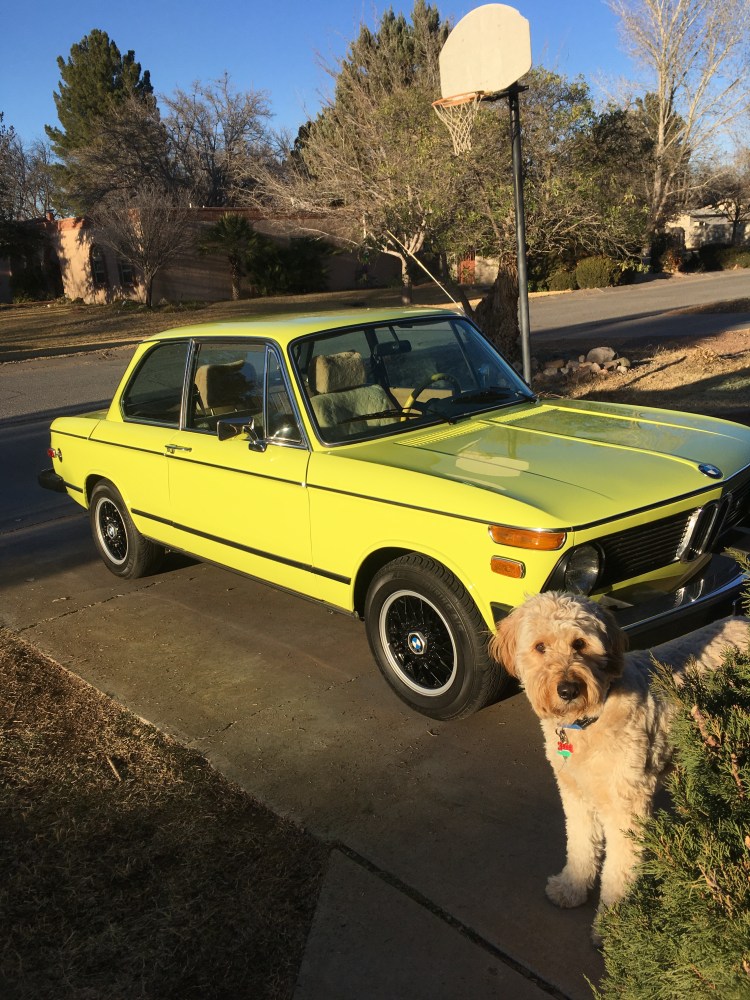
Max, the eight year old, gave us a particularly humorous insight when I gave him a ride in our classic 1975 BMW 2002.
The car had been sitting outside in the sun and the weather was warm, so in order to cool down the interior, I asked him to simply “roll down the window” on his door.
Chester, looking quizzical next to our classic 1975 BMW 2002
“How do you do that,” he asked. “I don’t see a button.”
Yes, in his eight years, he had never ridden in a vehicle with manually cranked windows like all of us Boomers grew up with in our tragically hard lives. Just muscle strength in our arms, no one-touch down switch on the door panel. How did we survive?
It took me a few seconds to show him how to crank the handle for the desired lowering of the window. Then he asked:
“How do you put it back up.”
Another teaching moment.
As I drove him back to our house with fragrant spring air flowing through the cabin, I rhythmically changed gears on the four-speed floor mounted shift. The exhaust made a wonderful burble that was musical to my ears. It was a delightful mechanical connection between a driver and the car.
“You know, Max, you’ll probably never drive a car that has a manual transmission,” I said ruefully.
Yes, I know the future is all electric. But there’s just something visceral about driving an older internal combustion powered vehicle with a manual transmission and going a little over the speed limit on a twisty road.
I’ll think I’ll hang on to the old girl as long as I can find fuel for her.
You have to feel sorry for alligators who have to live in New Mexico. They really couldn’t make it through our cold winters if it wasn’t for artificially heated water for them to swim in.
Take, for example, Wally, the Clovis Zoo’s long-time resident American Alligator. Last month, Wally’s heated pool became a little too chilly when the heating element for his pond inside his pen malfunctioned and a winter storm was on the way to the Clovis area.
American alligator in a warmer location.
The Clovis Fire Department was summoned to help rescue the chilly Wally. At first, they tried to lure him out of his pen by offering him whole defrosted chickens and dead rabbits — his usual mealtime snack. But as Zoo Director Lisa Fox noted, Wally was too cold and “had no interest in food.”
The next plan was to use brute strength to move the several hundred pound reptile. Fox gingerly placed a lasso around his head and then summoned the firemen to tug the critter to a warmer location in a nearby heated shed.
“This was our only alternative,” Fox said. “to get our hands on him and do it.”
While Wally is enjoying his warmer temporary headquarters, a new heating unit has been placed on order so he can eventually enjoy his old digs again.
And hopefully, his appetite for raw chicken and dead rabbits has returned.
A story out of northern New Mexico last week reported that a man had absconded with a $150 bottle of French Champagne that he had snatched from the back of a golf cart at an upscale resort near Santa Fe. The bottle of “Beau Joie curvee Champagne” was en route to a guest at the resort when it was lifted from the unattended golf cart.
Beau Joie curvee Champagne
Pollice said they had a security camera video of a man pulling up behind the cart in his Acura, jumping out of his vehicle and then snatching the bottle and driving away quickly.
Police also said the video showed the vehicle’s license plate, which they traced to a home near Santa Fe. When they went to the home, neither the vehicle nor the suspect was around. The Champagne also was not to be seen, leaving authorities to believe it had already been consumed.
A website touting the brand of Champagne claims it is “derived from the finest grapes of Epernay, France.” As you may be able to tell from the semi-fuzzy photo above, each bottle is wrapped in a “copper suit of armor inspired by the armor worn by knights” to keep the contents chiilled longer.
Each bottle offers, as the website breathlessly claims, “supreme quality with impeccable, cutting edge design.”
I don’t think I’ve ever had a drink of anything that expensive. The closest I’ve come was bottle of wine that my wife and I shared at a dinner in the Hermitage Hotel in Nashville a few years ago. Since it was a special occasion, I thought we could splurge on some nice wine. I found a bottle that I thought was about $25 — I know, what a big spender. But what I failed to notice was that the $25 was for a single glass. A full bottle was more than $90. When we got the final tab, I realized the error of my all too cursory reading of the menu. I gulped, paid the tab, and wished I had enjoyed the wine a bit more when I was sloshing it down.
I’m always on the look for good inexpensive red wines, and there are some out there. But I’m not enough of an oenophile to do that much research.
I do confess that I’ve had a few bottles of Trader Joe’s “Two Buck Chuck” (With inflation, it’s more like “Three buck fifty-nine Chuck” these days.) It’s similar to the perceived bargain of Buckhorn Beer, which when I was in college you could buy for ninety-nine cents a six pack and hope it didn’t make you go blind.
(In)famous Two Buck Chuck
The sign above at a Trader Joe’s claims Charles Shaw wine is “World Famous for Quality at an Incredible Price.”
I’ve had many conversations with people about Two Buck Chuck. The consistent comment they all have is, “It’s not that bad.”
I hope the guy in Santa Fe who swiped the $150 bottle of Champagne had many more positive things to say about the copper clad bottle of hooch that tempted him to risk jail time.
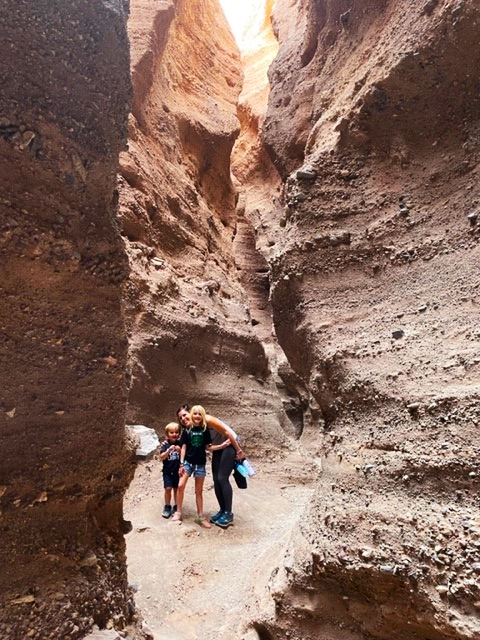
My wife and I first visited Slot Canyon north of Radium Springs more than two years ago. I talked about it in a Dec. 14, 2020 blog, saying I felt like I was on the set of an Indiana Jones movie when we trekked through the steep-walled canyon carved out by years of rushing flood waters.
We’ve been back several times, mostly for entertainment of visiting grandchildren. Our most recent visit was last week, with our daughter and grandchildren Hannah and Hayes.
Adventurers Hayes, Lindsay and Hannah in Slot Canyon
After we first visited Slot Canyon, we told others about it and also discovered that many other people had learned about the unique geological feature and visited it as well. It’s become quite popular around here as a place to hike.
A scene filmed there showed up on a recent advertisement for New Mexico State University. When we were visiting last week, a bride to be and her groom were having professional pictures taken of them in their wedding attire in the canyon. We also noticed that a large boulder had dropped into the middle part of the canyon, making it tricky to maneuver around. My hunch is that it was dislodged from above during a heavy rainfall last summer — however, it could have been pushed into the canyon by vandals.
I hope Slot Canyon’s popularity doesn’t become its downfall. We were disappointed to find a discarded half-eaten apple and a banana peel on floor of the canyon. There were several water bottles and other trash scattered along the route. There was unbagged dog poop along the trail. And on the unmarked green gate that is the beginning of the trail to the canyon, someone had written graffiti on one of the supporting posts.
The canyon is located on federal land, but there has been no visible attempt to protect or promote it. It’s such a small geological area and the canyon is so narrow that it really can’t accommodate huge numbers of visitors.
I’m just keeping my fingers crossed that most people realize what a treasure it is and do their part to protect it.
I’m sure you’re getting tired of this from me by now. Four posts this year about smuggling bologna into the United States from Mexico.
Well, it seems other edible items have been on the list of things you shouldn’t smuggle into New Mexico.
Illegal contraband?
Yep, chile.
When looking for articles about German submarines coming up the Rio Grande to blast El Paso (more on this important topic in a later post), I stumbled upon an article in a 1902 edition of the El Paso Herald reporting the arrest of a man for smuggling chile into the United States from Mexico.
There were few details about the incident, except to say he was trying to bring in 390 pounds of the stuff across the border from Mexico. That would have been pretty hard to “smuggle” in those days, I think.
So smuggling Mexican bologna into the United States, which I have been reporting in multiple posts, maybe doesn’t seem like such a big deal. The U.S. Customs and Border Patrol said in a recent newspaper article that smuggling bologna into the United States “wasn’t funny” and could harm American agriculture. My personal observation is that bringing chile in from Mexico (which happens all the time these days) probably poses a greater agricultural risk.
But I’m moving beyond that to a story in the same 1902 newspaper that appeared right above the tale of the smuggled chile.
The headline for that story was:
“Young Man Marries Girl He Wronged”
The story in the El Paso Herald said a man was arrested and jailed on a charge of “seduction” of a young woman. However, the man who had “wronged” the young woman agreed that if he could get out of jail, he would marry her, if she would have him. She agreed and the judge who jailed the man promptly performed the marriage ceremony after he was released.
According to the Herald article, the groom was so pleased about his fortuitous outcome that he purchased a wedding cake, tobacco and “other things” to share with his former cellmates at the jail.
There was no mention whether the bride attended the jailhouse celebration.














 aero-cordero.com