Las Cruces High School battled Albuquerque’s Volcano Vista High School last Saturday in the quest for New Mexico’s 5A high school basketball championship.
Unfortunately for us southern New Mexico residents, the Bulldawgs lost an overtime contest 66-55 in what was described as a thriller of a game between the state’s only two undefeated top basketball teams.
Atrisco Heritage celebrating after the game. Photo courtesy Albuquerque Journal.
What was interesting to me was a story in the Albuquerque Journal prior to the game that said one of Las Cruces’ early opponents tried to prepare for their game by using a long broomstick.
The Las Cruces team featured Senior player Isaiah Carr, who stretched the measuring tape to seven feet.
In the semi-final game, the Bulldawgs defeated another Albuquerque team, the Atrisco Heritage Academy, which used the unusual method to prepare how to defend the seven-foot Carr on the court.
As the Journal noted:
“Lacking a better option, Atrisco Heritage Coach Steve Heredia said the Jaguars used a broomstick in practice to try and simulate Carr’s height.”
It didn’t work for Atrisco Heritage, but Volcano Vista apparently figured out how to take him out of the game when it counted.
This reminds me of a New Mexico politician from the 1950s and early 1960s, Ingram B. Pickett, who served several terms as a State Corporation Commision member. Pickett billed himself as “Seven Foot Pickett,” even though he was a bit shy of that mark. He removed the door of his state government office on the premise that citizens could walk in any time to see him and to prove he was hiding nothing. Once there, they probably cowered at his 6 foot 10 3/4- inch height. His campaign slogan was “Big enough to serve you, Small enough to need you.”
In the early 1960s, he apparently became ill and told some news media outlets he would not run for a fourth term as Corporation Commissioner. However, an article I found in a November 1962 issue of the El Paso Times said he had recanted the story about his illness, was still planning to run for a fourth term in 1966 and was seen “dancing in public” at state oil and gas association convention in Santa Fe.
It’s interesting that another person whose name appears in various search sources was identified as Ingram B. Pickett. He also died in the early 1960s, but his claim to fame was that he was a movie actor. Despite my research, I could not link the two as being the same person. How interesting would that be — like Ronald Reagan becoming president. Our own “Seven Foot Pickett” politician whose career started as an actor.
Any readers who might have some information about this should send me a note.
And in the meantime, if you’ve picked your brackets for the NCAA basketball tournament, you might consider sending your winning team a seven-foot pole as a training device.
I’ve owned and driven BMWs for almost 50 years. I know — expensive to buy, expensive to repair and a bit obnoxious. But great to drive.
I gained a little more respect for the brand when I spotted this on the internet Monday.
It’s a story about two guys in the Ukraine who retrofitted their BMW 6 series convertible (a grand touring car) with a machine gun mounted in the trunk. It’s a similar concept to those Toyota pickups you see in the middle east where terrorists have mounted big machine guns in the bed of an otherwise docile vehicle.
In this case, the machine gun was apparently commandeered from Russians. It reportedly is the same caliber and type used on Russian tanks that are now roaming Ukraine and carrying out Putin’s attacks.
#Ukraine: A open top BMW 6 series with a NSV 12,7×10⁸ heavy machine gun mounted – is not something you see everyday. pic.twitter.com/wWGrg5ddEU
— 🇺🇦 Ukraine Weapons Tracker (@UAWeapons) March 14, 2022
A new take on BMWs
It made me feel good to say I own a couple of BMWs. They’re doing their part to stop the Russians in Ukraine.
Who says the federal government doesn’t have a sense of humor. Well me, for one.
This blaring headline showed up in the Albuquerque Journal last week:
“Officials: ‘Nothing funny” about bologna smuggling.”
The story quoted an official of the U.S. Customs and Border Patrol from El Paso as saying that smuggled balogna could bring in diseases from Mexico “which can be detrimental to our nation’s agricultural industry.”
Dangerous to American agriculture
“People will sometimes make light of these seizures but there is nothing funny about these failed smuggling attempts,” the agent said.
As my dwindling but somewhat dedicated pool of readers may recall, I made light of balogna smuggling in three recent posts. I mean really, how can you not chuckle at someone trying to smuggle the dregs of processed meat inside a spare tire, next to someone’s underwear in a suitcase, and stinking up the interior of a car by stashing it under the back seat?
Apparently, others have been making jokes about it too, since I doubt anyone from the U.S. Customs and Border Patrol has any idea that my blog exists and read my penetrating investigative journalistic report. Maybe I’ll start searching the web for other funny comments about Mexican bologna.
As you recall, I even gave Mexican bologna that I purchased legally in Las Cruces a taste test. I did not seem to have any vile reaction to it, other than concluding it wasn’t nearly as tasty as the gold standard “Oscar Mayer” American brand.
I guess my thought is that with much more seriously dangerous stuff being brought across the border, shouldn’t agents be focusing on that instead?
And now that gasoline prices have shot up dramatically, people in El Paso are zipping across the border to buy cheaper Mexican gasoline. Is there some inherent danger in Mexican gasoline that that our agents should be investigating? So what’s next, draining fuel tanks of every car that crosses into El Paso from Juarez?
Seriously, I do appreciate the efforts of our Customs and Border Patrol agents to keep our border secure from bad things.
New Mexico and Texas have suffered years of hostile legal wranglings about water rights involving the Pecos and Rio Grande rivers. Virtually all of the Pecos River water originates in New Mexico and a good splash of the Rio Grande comes from New Mexico watersheds. It’s our (New Mexico’s) water, damn it. Texas thinks it’s theirs.
I was involved in one of these of the legal procedures in the 1980s. I helped put together a public relations/media campaign by New Mexicans to try to stop a rude attempt by El Paso to drill wells Dona Ana County to pump water to our neighbor to the south. The attempt ended up in federal courts and I think it finally died there without any Texas wells being drilled in New Mexico.
While snooping around the Internet on a site of old newspaper stories about this subject, I discovered this incredible gem of a letter to the editor of the Santa Fe New Mexican in 1902. It was written by a resident of Taos, who was railing against a piece of proposed Congressional legislation called the “Stephens Bill”
Based on the letter, I am assuming the legislation was proposed by a group of businessmen from El Paso who were opposing construction of a dam on the Rio Grande near present day Truth or Consequences (at that time called Hot Springs). Instead, they apparently wanted to build one at El Paso. I’ve been searching historical sites for anything about “The “Stephens Bill” or a proposed dam and reservoir at El Paso, but I’ve come up blank so far. I’ll continue to dig into it.
The gist of the legislation, it appears, was to block the construction of the dam because the El Paso business leaders feared it would reduce the amount of water flowing down the Rio Grande to El Paso. Their concern appeared to be once the river’s flow was reduced, the Rio Grande would no longer be navigable for ships connecting El Paso to the Gulf of Mexico. I mean really — large ships moving along the waterway pictured below?
The Rio Grande in Las Cruces most of the year these days
What was hypocritical, however, was the assertion in the letter that the El Paso businessmen supported construction of just such a dam on the Rio Grande near their city. They contended that it would NOT reduce the flow of water in the river on its way to the Gulf of Mexico.
The letter went on to note that attempts to navigate boats down the Rio Grande had been unsuccessful, with one attempt ending in the death of an adventurer and another with the boat running aground on a sandbar somewhere southeast of El Paso.
The letter called the proposal a “boodling scheme, first last and all time,” and noted the “inconsistency and absurdity of the bill.”
Too bad. You probably won’t have a chance to see Putin’s Yacht sailing up the Rio Grande to El Paso.
So if you were holding out hopes that Putin’s yacht could be seized and sailed up the Rio Grande to El Paso as a tourist attraction, you’re probably going to be disappointed. Your best bet might be to spot a banged-up L.L. Bean canoe that someone had to portage over a few hundreds of miles of sandbars then finally left in desperation on a sticky mud flat near Fabens.
And in the meantime, enjoy Elephant Butte while it still has a little water in it.
My wife recently spotted the following puzzling first paragraph of a story in our local newspaper:
“A judge dismissed a motion Friday that would’ve held a man accused of shooting at a woman in jail.”
So was the man shooting at the woman while she was in jail? I don’t think so. I think what the writer intended to say was:
“A judge dismissed a motion Friday to hold a man in jail who had been accused of shooting a woman.”
First of all, the use of “would’ve” should not have made it past the copy editor’s desk. Oh wait — there are no longer any copy desks to catch such crude uses of the English language in a newspaper article.
Secondly, it was a curmudgeonly old copy editor at my first journalistic experience — cub reporter at the Albuquerque Journal — who many years ago came up with that language for my blog headline. His name was Millard Hunsley and he used that sentence to demonstrate why cub reporters like me needed to read over our stories for jumbled sentence structure before turning them over to the copy desk. And trust me, the marks a copy editor would make on what you thought was a perfectly crafted story were like daggers to your heart.
I think I got better at avoiding such gaffes, but I still struggled from time to time when I was a writer at United Press International — a now defunct news or “wire” service. At UPI, we had to write radio copy to be inserted into hourly “splits” where the national news feed would stop and we had the opportunity to insert state and local news. Usually, the “splits” came up all too quickly and we would have to write the story under the gun in real time. The only thing that occasionally saved us was the fact that what we typed out on the teletype was delayed by a few seconds before it appeared on the teletype that our subscribers got.
The teletypes were clunky mechanical devices that punched coded holes in yellow three-quarter-inch paper tape that was then fed through a device that read all the holes and printed the words out on paper a few seconds later. In the jargon of the wire service, we used to say we would “punch up” a story when we wrote it.
Teletype with tape reader on left
A print only teletype
So when writing in real time during a split, you would occasionally back yourself into a corner on sentence structure. The only thing that would save you was to halt the tape reader in mid-sentence, then manually type in a series of Xs to try to convince any reader that there had been some kind of mechanical or network malfunction that triggered the stoppage.
Then you could trash the error-ridden tape, and start a new sentence to replace the one you screwed up. This time, however, you would take a little more time to think things through for proper sentence structure and make sure you had finished writing the story before sending it through the tape reader.
I know, it’s all pretty esoteric and boring to most people. But the point is that we could sure use some good copy editors these days.
I even saw the improper use of the word “it’s” on one of the crawlers along the bottom of an ABC news feed the other day. The word should have been “its” but I suspect no one but a few of us old English loving curmudgeons would have noticed.
Think before you write — not just about content, but about proper use of the King’s English.
Police in Clovis arrested two men recently for attempting to sell a stolen set of aluminum bleachers at a metal recycling facility.
After receiving a report of missing bleachers at a city park and a tip from the metal recycling company, police concluded that the two men had swiped the bleachers in an attempt to raise some quick cash.
Available for the taking?
When the two suspects were confronted about the matter, they claimed that they had found the almost new bleachers next to a trash dumpster. They said they assumed that they were being thrown away and considered them to be available for the taking.
So using that logic, these guys may assume that when you park your car near a dumpster, they consider it to be abandoned and will sell it to Buster’s Barely Banged-Up Car Lot. Well, not until they get out of jail.
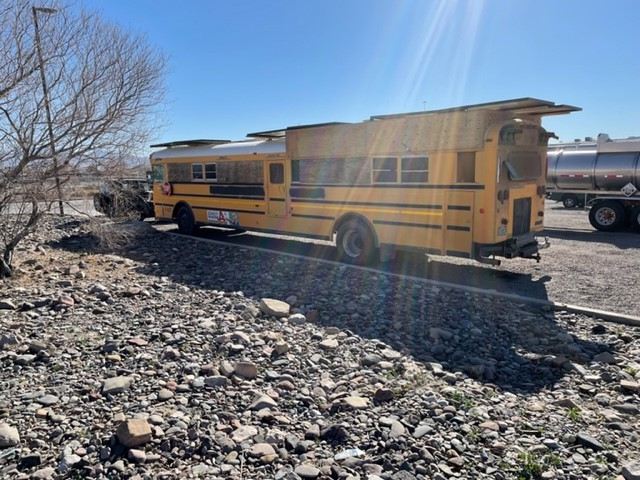
On my way to the Las Cruces city dump, I found this unusual recycled school bus parked along the route.
I hope it doesn’t transport school kids any more
It may be hard to see in this photo, but much of the bus has been “re-engineered” with sheets of plywood that blocked out some windows and were attached on top to support what looked like solar panels.
But perhaps the most interesting thing about the bus was the sign toward the front of the vehicle (hard to read in this photo) that says “Expect Success.” The sign was from the “Gilbert Public Schools” (Arizona, I think) proclaiming “120 years of quality education.”
I think if was in charge of that school district, I would made certain that someone removed that sign before selling it to an unknown buyer. It’s similar to the Houston , TX, plumber’s truck that ended up in the hands of militants in the Mideast a couple of years ago with a machine gun mounted in the bed. No one had bothered removing the company’s logo and phone number from the vehicle before it was shipped overseas and sold to the insurrectionists in Afghanistan.
I wonder if the Houston company is getting long distance calls to unclog someone’s toilet in Kabul.
We’ve finished watching the 2022 Olympics with less enthusiasm than we have watched the event in past years. There just wasn’t an “it” factor in the games, with lots of irritating distractions on so many levels.
Women’s curling
One thought that occurred to me as I watched what seemed to be an overload of TV coverage of curling was this: With women’s curling, where team members are constantly sweeping a floor, isn’t that reinforcing a negative stereotype that women are just constantly relegated to sweeping up — mostly the messes that men make? Maybe instead of brooms, women could be allowed use some kind of high powered air gun to help “curl” the stones on their way down the ice floor.
Another thought I had was that curling really doesn’t seem to have much in common with folks like me in the desert. Maybe we could invent a game where we “curl” tumbleweeds down a dry stretch of the Rio Grande.
The one event at the Olympics I always like to watch is the downhill alpine event. As a skier, it’s the one event I wish I had the courage to do. There is something about making sweeping turns at high speed on a ski slope that is invigorating. If only someone could guarantee that I would never fall and get injured, I’d do it in a heartbeat.
I was fortunate enough to be a ski racer on a very modest level in the old UNM Corporate Cup program. The Corporate Cup was a citizens ski race program which held several races each year at resorts around the state. It provided financial support to the UNM ski team, which regrettably was cancelled about three years ago.
I actually did fairly well in the races. I never fell and consistently won “gold” in my age class. The races were all giant slalom events — a few gates with enough room in between to get your speed up and your adrenalin rushing.
But I’m sure it was nothing like the rush of skiing in an Olympic or World Cup downhill where you reach speeds in excess of 90 miles an hour and have nothing but a thin spandex suit and a plastic helmet to protect you.
The circus has come to town in Las Cruces. It is the Do Portugal Circus, which I understand is based in Mexico and travels around to smaller markets in the United States. It will be here for about a week and one-half.
The large purple and white tent started setting up two weeks ago in the parking lot of our local mall — the most exciting thing to happen there in about 10 years.
The circus is in town, in purple and white
There was a really funny comment about this on our neighborhood social media link, which we do not contribute to but occasionally check out for really dumb comments. In this post, we were not disappointed. The person was convinced the erection of the enormous purple and white tent tent was actually going to be some kind of new fast food outlet. A “Biscuits and Butter” franchise, they speculated.
We had a couple of friends who tried to attend the circus with their three year old, but had to leave because it was so loud for him.
The circus website, which was pretty thin in information, said there would be fantastic aerial displays and other human performances, but no animal acts.
Which brings me to my topic.
When I was growing up in Ruidoso, we had a visiting circus stop by for a one-night performance. It was a big deal for a small town (maybe 1,500 hardy souls at that time) and everyone was planning to turn out as they set up the tents in what is the Gateway park on the southeast side of the city along Sudderth Drive.
The big draw for the circus — and I am not making this up — was the chance to view a “blood sweating hippopotamus.” I mean seriously, who could miss a chance to see something this weird.
The day before the one-day show, I came down with a bad cold or the flu. It was the middle of the winter, and at that time, temperatures got really cold during January and February. It was clearly not a good time to be out and about with a body temperature of more than 100 degrees. My parents, knowing that I would not want to miss the event of the year in Ruidoso, asked our family doctor if he thought it would be okay if I went to the circus — especially to see the blood seating hippo. Knowing the importance of this kind of thing to a kid and the odds that I would recover (and hopefully not infect too many others) he reluctantly said I could go.
I don’t remember much of the circus acts but I do remember staring at the poor hippopotamus in its red and gold trimmed cage. It was obviously bored and feeling the sting of the cold weather. Its cage smelled like wet straw and hippopotamus poop, although my cold or flu blunted the full olfactory experience.
I did not see it sweating blood, however. That was a major disappointment.
On researching the internet, I found that hippos do in fact look like they are sweating blood. It is kind of a pinkish secretion when they are exposed to very hot temperatures — which I can confirm were not around in mid-winter Ruidoso.
According to an obscure Japanese animal researcher named Professor Hashimoto, he and his colleagues collected samples of a hippo’s sweat and examined it to see what makes it so reddish colored. They found it is made up of two pigments – one red, called “hipposudoric acid”; and the other orange, called “norhipposudoric acid.” With my high fever, I probably had a better chance of sweating blood that day than did the poor hippo.
So there you have it. And if you really want a hippo for Christmas, don’t expect it to sweat blood, unless maybe you are in Florida or Australia.
A Santa Fe couple on vacation last month returned to their home to discover a man who had been living in their house while they were gone.
While staying in the home for an unknown number of days, the man helped himself to food in the refrigerator and some beer. He had been sleeping in one of the home’s bedrooms. Police said he had entered the home by breaking a window.
The uninvited visitor was discovered in a back room of the house by the returning couple. Although he did not appear threatening, he was in possession of an assault-style gun.
When confronted about his presence in the home, the man apologized for the break-in and said he was running away from someone in Texas who wanted to kill him.
After gathering up his belongings and heading out of the house, the contrite visitor left $200 to pay for the window he had broken.
Police reported last week that the man had been arrested in the vicinity of the home he had broken into.
Hang on to your seat. This is going to be hard driving piece of investigative journalism.
Your intrepid reporter on the trail of contraband bologna…
PSSSST!!! I know where to find Mexican bologna.
My interest was piqued late last year when I learned about the arrest of a man smuggling Mexican bologna into the US inside a spare tire in a vehicle headed to New Mexico. Then weeks later, another Mexican bologna smuggling case was reported where the captured meat underneath bags of corn chips was destroyed in a “USDA approved incinerator”. Then last week, a third case in which a whopping 188 pounds was “intermingled” with a woman’s luggage in the trunk of her car and discovered on its way to New Mexico.
Now let me be clear here. I am not intending to poke fun at our neighbors to the south, their culture or their dietary preferences. I just find it amusing that people have resorted to smuggling bologna into the United States. It would be just as amusing to me if it came from Canada or Iceland.
It was reported by one arrested smuggler that you can sell Mexican bologna in the United States for more than twice what you paid for it across the border. So I can understand the financial interest in taking a smuggling risk.
But I mean really — it’s still just bologna, the red-headed stepchild of processed meats. And why Mexican bologna instead of just plain old American bologna?
So after my latest post, my son challenged me to find out more about Mexican bologna. He said I should probe deeply into whether there might be a possible Oscar-Mayer bologna cartel in Mexico. And maybe, he suggested, there could be payoffs of customs agents with large slabs of bologna if they looked the other way when a processed-meat laden Oscar-Mayer Weinermobile trundled across the Bridge of Americas in Juarez. With conspiracy theories gone amuck these days, how could I resist testing my investigative journalism instincts.
But mostly, I wanted to see if I could actually buy the stuff in Las Cruces and then see if it tasted any different from what I remembered bologna tasting like the last time I ate it. That might have been about 23 years ago.
On Monday, I began checking out carnicerias (meat stores catering to Mexican palates) in our area. It turns out there are several. Interestingly about half of them were closed on Mondays. The two I went to said they did not sell Mexican bologna and said they did not know where you could find any around the area, unless you went to Juarez. I called a store in Dona Ana and asked about availability and was told they were aware of it, but said they never carried it.
I asked the person who answered the phone why Mexican bologna was so popular.
“I don’t know,” she said. “I’ve never tried it.”
On Tuesday, I went to one of the stores that was closed the day before. It was open.
The meat tube on the front of the store may have been a clue.
In fear that I might have been tailed by the meat police, I parked around the corner and quickly ducked inside. The walls were covered with photos and posters from Mexico. Poncho Villa was the subject of many of the photos. The names of the meats or dishes inside the display counter were mostly unknown to me.
I asked the young lady behind the counter if they had Mexican bologna. She stared at me blankly and I realized she did not understand English. She went to her supervisor at the cash register and asked her to interpret what I was seeking.
The supervisor acknowledged that they did have Mexican bologna.
“It is $14.95 per pound,” she said.
I gulped. I can still buy some steaks at that price. I asked if I could buy just a few slices. I was told a pound was the minimum.
In the interest of investigative journalism, I agreed.
There were furtive looks and hushed conversations between the supervisor and the counter woman. Then both shuffled behind a curtain in the back of the store. About three minutes later, the supervisor came back with sliced bologna wrapped in a clear plastic bag with no labels to indicate how much it weighed or what the ingredients might be.
As the woman took my debit card for payment, I asked her what made Mexican bologna so special. Her first response was: “It’s from Juarez.”
Okay, I understood that, but is it better than regular American bologna?
“I don’t know,” she confessed, looking rather embarrassed but obviously pleased that I was leaving without causing an international incident..
I left the store, looking behind me for flashing red lights and sirens wailing as I drove away.
Now let me be clear. I have no evidence that the bologna I bought from the store was brought into the United States illegally. I’m sure it was imported through proper channels or it wouldn’t have been so easy for me to buy. My intention for this important journalistic investigation was simply to see if I could find any and then sample some to see what the hypoe was about.
My son had suggested that I buy some all-American bologna for a taste comparison. I stopped by a nearby grocery store and picked up the American standard for bologna, Oscar Mayer, for considerably less than what I had paid for my find at the carniceria.
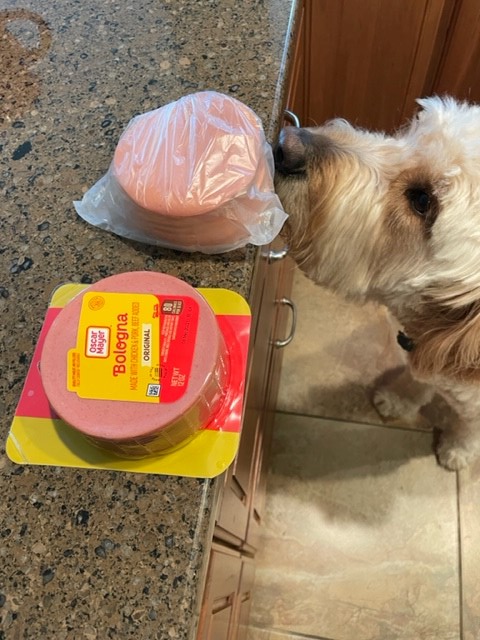
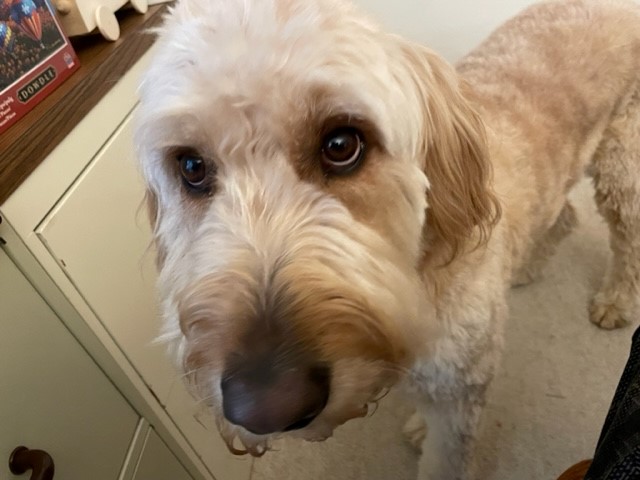
When I got home, I placed both on the counter. Our rambunctious goldendoodle, Chester, made an immediate evaluation of the merchandise. The Mexican bologna was his clear favorite in the sniff test.
Chester picks Mexican bologna
So now it was time for the taste test. My son had suggested I cook the Mexican bologna first, since there was no label regarding ingredients, recommendations for cooking, health warnings, etc.
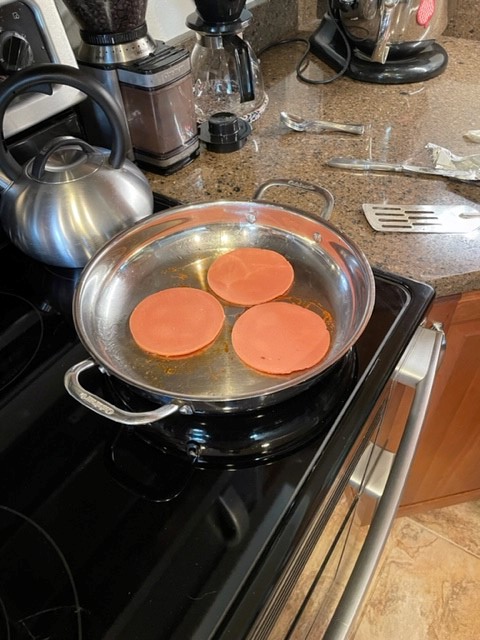
So my helpful investigative assistant (My wife Margo), fried each kind on our stove.
Oscar Mayer on left, Mexican “contraband” on right.
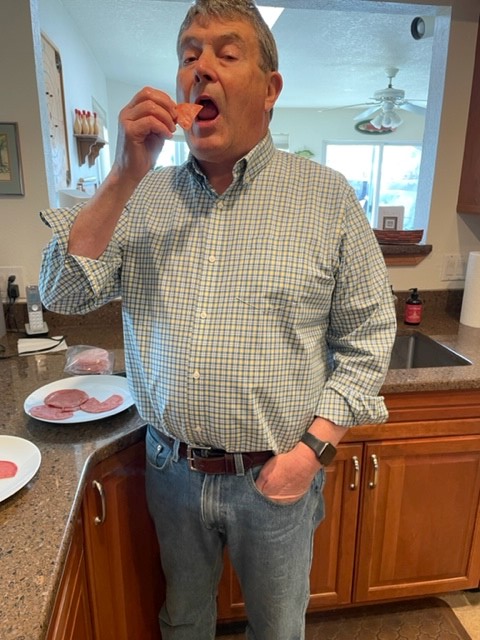
So first, the standard of the bologna world — Oscar Mayer. It tasted like, well, bologna has always tasted to me. Soft and mushy, salty and a hint of “you shouldn’t eat a lot of this.”
Then the Mexcan bologna. It was drier, thinner and had a slightly different taste that I can’t quite describe. Not bad, just different. And again, it had hints of “you shouldn’t eat a lot of this.”
Sacrificing my body for journalistic investigation
Next we conducted a taste test for Chester, our goldendoodle. Understanding that he’ll eat almost anything he sees humans put in their mouth, it was not entirely a clear cut case. He began drooling as soon as he sensed he was going to get something, and then in a blur he had eaten both samples in separate dishes — I’m sure going first for whatever was infinitesimally closest to his mouth.
I tried again with samples in each of my hands, hoping I would be left with fingers after he grabbed his preferred bologna. In the end, it was the Mexican bologna, which I think is not the best endorsement for human consumption.
Oh, and then I discovered this afterwards. I was actually charged $4.95 per pound for the Mexican bologna, not the $14.95 I was originally quoted. I’m not sure whether that was because of an error in communication by the clerk at the carniceria or perhaps they gave me a discount in hopes I would not turn them in.
So my investigation is complete, leaving me wondering what the buzz about Mexican bologna is about.
And it’s now lunch time. I’m going to have a bologna (baloney to me) sandwich.
Chester picked it wrong for the Super Bowl, going for Cincinnati over the Rams. He fears he has lost a lifetime supply of Milk Bones with his bet. And he apologizes for all of you who lost bets by following his pick.
A remorseful Chester
But ever the optimist, Chester says “woof.” (Meaning there’s always next year.)
Last year, we challenged our rambunctious goldendoodle, Chester, to pick the Super Bowl by selecting one of two differently colored squeaky balls tossed to him in our back yard. He correctly picked Tampa Bay, so with a 1-0 record of choosing the winner, here is a video of his pick this year between the Cincinnati Bengals and Los Angeles Rams:
On the verge of legendary
And there you have it. Call your bookie right away. Chester guarantees a Cincinnati win.










 aero-cordero.com