Maybe it got lost…

People who have lived in New Mexico a while are always a bit amused and annoyed when they see maps, postcards and other kitsch showing a saguaro cactus in the state.

Many years ago, at a tacky curio shop I ventured into during a gas stop, I found a kitchen magnet in the shape of Arizona with a saguaro cactus on it.  The magnet proudly proclaimed the state to be New Mexico. I sent it to a colleague at the Albuquerque Journal who wrote regular columns about how New Mexico is so often confused with our neighbor to the west — often with illustrations of those tall robust cactuses found in southern Arizona. He wrote a story about it, noting that the item was probably made in a factory in China where no one had every been to the American Southwest.

And of course the New Mexico Magazine has a monthly column entitled “One Of Our 50 Is Missing,” in which stories appear regularly about delusions of saguaros in the Land of Enchantment.

I found a reference to a 2000 article in the Audubon magazine of the National Audubon Society which breathlessly stated:

“Oaks are a kind of totem species in California like saguaros in New Mexico or maples in Vermont; they define the landscape both aesthetically and ecologically.”

As I’ve been told by botanists, it’s much too cold for saguaros to live in New Mexico. Yet, I’ve run across at least two that are surviving in the Las Cruces area. Both are growing next to southwest facing, heat-absorbing adobe walls that likely protect the species from our occasional below zero weather snaps.

I’ve attached a picture of one growing beside a home in our Mesilla Park neighborhood, looking quite healthy, but possibly missing its friends in Arizona. 

A lonely saguaro cactus growing in Mesilla Park near our home and looking a bit out of place.

Missing metal…

My first reaction to a story in last week’s Albuquerque Journal was, how do you manage to lose track of this much stuff?

The story involved the loss of $2 million in ball bearings from White Sands Missile Range. The missing ball bearings, which officials said weighed about 230,000 pounds or 115 tons, ended up in a scrap metal yard in Albuquerque. Investigators say that’s as much as a full grown whale would weigh.

The ball bearings were used in explosive research conducted at the southern New Mexico base, according to WSMR officials.

Authorities have opened an investigation into the missing ball bearings and two persons have been named as targets of the probe. Authorities said a person tipped them off about the possible theft and relocation of the ball bearings.

The story brings to mind another New Mexico incident involving  large amounts of missing metal in 1973. Construction work was underway on a section of I-25 south of Albuquerque when an informant said that short pieces of rebar that were supposed to be inserted every 30 inches into the highway roadbed were not being inserted as prescribed.

A University of New Mexico student working part time for the highway construction company said he was told by his foreman to skip inserting some of the rebar during the paving process. The student related a conversation in which he alleged his foreman told him “I want you to put in them rebars only when the inspectors are watching. The only way they’ll know there aren’t any bars in there is to tear up that slab. This is between you and me.”

Ultimately, an investigation using high-tech equipment from Sandia Labs showed that a section of highway did not contain the required amount of reinforcement bars. As a result of the finding, the primary contractor for the project paid a penalty of $20,322 and had to purchase a $60,000 surety bond to cover any long-term degradation of the roadway.

The investigation never concluded what happened to the missing rebar. And if you’ve driven to Albuquerque lately along that section of I-25, you’ll notice it has been the site of a major renovation of the busy highway.

I’m hoping there has been careful inspection of placement of rebar in the project. Maybe some ball bearings too.

Why New Mexico might be on this top ten list…

I ran across an interesting article in my BMW Car Club of America magazine,  Roundel, regarding car ownership and vehicle dependency rates by state. A car shopping website called Co-Pilot, lists the top ten states in terms of number of cars owned per person, along with other statistics. New Mexico ends up being ninth on the list, which made me start thinking about why we’re there.

Many of the other states in the top ten are rural western states, including Wyoming, Montana and South Dakota. That makes sense because we have long distances to drive and more than one vehicle is often a necessity. And if you think about trying to cut our carbon footprint in New Mexico by riding a bicycle, it doesn’t make much sense to pedal 60 miles to get three weeks of groceries. So the rural profile fits New Mexico.

Several states in the top 10 list are lower income states, many of them in the south. The lower income category also fits New Mexico.

The report shows that the average household in New Mexico owns .8 vehicles and that we drive that .8 of a vehicle an average of 19,157 miles each year. That’s the second highest number of miles per year of the top ten states, with Wyoming leading at 24,069 miles per vehicle per year. That shows we really flog our vehicles over the years.

Car crazy California is 31st on the list and not-surprisingly, New York is last on the list.

Our own household has three vehicles, our 2019 BMW X3, a 2012 GMC Sierra pickup and my “always need tinkering” classic 1975 BMW 2002. Do we need that many? Probably not, but I’d be sad to part with any of them.

And I also I think anyone who lives in New Mexico needs a pickup. I wouldn’t be surprised to see statistics showing New Mexico had one of the highest rates of pickup ownership per household in the nation. An old colleague of mine once wrote about the need of pickups in New Mexico and speculated that many of us might have been born or at least conceived in one. 

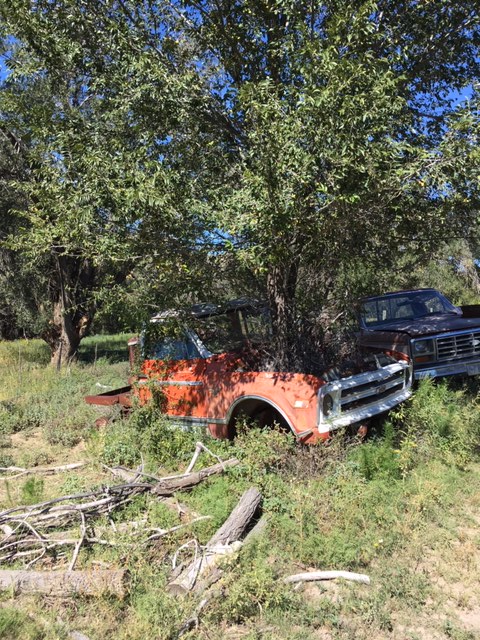
But I think if you look around many rural areas of our state, you’ll see another reason we have so many vehicles per household in New Mexico. Many folks just never get around to getting rid of that 1981 Buick or 1976 Ford F-150 and let it rust away in the driveway or behind the barn. We’re not willing to say we’ve abandoned these sources of fond memories and we convince ourselves that some day soon we will “fix it up and get it running again.”

The photo below, which I posted in an earlier blog, shows how much of a challenge that might be.

A 1969 Chevy pickup on a ranch on the Rio Penasco in eastern Otero County

Headline headaches…

I was skimming through the day’s top news stories on the internet last week when I came across this surprising headline from Reuters:

“New Mexican vigilante group’s sympathizers set fire to government offices, businesses.”

As you might expect, I was rather stunned to read this news about our state and wondered where the burning of government offices and businesses had occurred. And what was the vigilante group protesting? And who were its sympathizers? And why hadn’t I heard about this on any local/state news media?

As I read through the story, it quickly became apparent that this incident happened in the Republic of Mexico, but the headline clearly muddied the waters. A quick change in the wording would have made this story much less alarming for those of us in New Mexico. How about:

“Sympathizers of new vigilante group in Mexico set fire to government offices, businesses.”

Or:

“New vigilante group sympathizers set fire to government offices, businesses in Mexico.”

Most of my career in journalism with United Press International didn’t call for writing headlines. We left that for the print media editors to write at the copy desk before the story was inserted in a newspaper or other periodical or scrolled in a teaser line on the bottom of the TV screen. That didn’t stop us, however, from endlessly writing those headlines for our stories in our minds. I’ve spoken to many other journalists who, over the years, are always writing headlines in their minds for things that have happened to them or what they’ve observed, no matter how mundane.

I had a colleague who was involved in a near-fatal roll over accident who told me that while his car was tumbling end-over-end in a median on a rain-slick Texas highway, he was writing the headline of his death and accident in his mind. Luckily, no newspaper ever had to write it. It was just another traffic accident that probably never got reported.

I spotted another bad one just last week. It said that some former sports figure had “died after drowning.” Well, duh, isn’t the end result of drowning death? He died after he had already died?It should have said he “died from drowning”  or “died in a drowning accident.”  Again, where was the copy editor?

Some things just constantly lend themselves to bad headlines, however. The town of Loving, New Mexico, was a constant source of amusing headlines that you probably couldn’t write your way around. Some examples:

“Loving mayor slugs councilman in the face.”

“Loving police chief arrested for sexual misconduct.”

“Loving man ditches bride at altar.”

The guys at the sports desk always had a “rogue’s gallery” of bad headline writing, usually the best you could find.

One I remember in particular was a story about a Spanish tennis player who had played so badly in his first set that fans began to boo him. He made a miraculous recovery and won the match. The headline for the story read:

“Cheers replace jeers as Poncho pulls it out.”

Two years and oinking along…

Two years ago today, a surgeon stitched a pig heart valve into my heart to replace a  recalcitrant aortic valve that hiccupped along for more years than it should have lasted.

I’m still doing fine, maybe slowing down a bit, but that’s probably just age related. All of us Boomers feel like we’ll never get old. Many of us embrace science when it comes to things like climate change or vaccines, but I suspect that most of us Boomers refuse to accept the inevitable science of creeping geezerness.

At any rate, thanks to all of you who occasionally ask how I’m doing. I’m fortunate that the rest of me is in good shape for my age, other than a few aching joints in the mornings and after long rides in the car. And I’m especially fortunate to have a wonderful wife who tries to make sure I eat right, exercise frequently and don’t drink too much red wine (although I try to convince her that red wine is a beneficial medication.)

Here’s a photo of me holding the pillow they gave me two years ago after the surgery. It’s holding up well too, except perhaps for some random red wine stains. “:^)

Okay, maybe my hair is a bit grayer. I blame that on having my grandkids here for a good part of the summer.

As Steven Tyler of Aerosmith would say, “Walk this Way…”

While DNA has become an investigator’s best tool to capture criminals in recent years, an armed robbery case reported in Artesia earlier this summer proves that just careful observation can be just as effective.

When masked man walked into a bank branch in Artesia on July 15 and handed a teller a grammatically incorrect note (“Don’t trigger no alarms”),  and demanded everything she had in her cash drawer.

The teller complied, but as the bank manager watched the robber walking out of the building with almost $1900 in cash, something tweaked his memory.  The robber’s distinctly wobbly walk was eerily similar to that of a customer who had frequented the bank earlier.

Because the teller gave the robber “bait money” and because the manager had a pretty good idea of the suspect’s identity, the perp was soon captured. However, the police uncovered more evidence when they learned that the robber’s girlfriend had quit her job suddenly, paid off the balance of their hotel room bill in cash and then attempted to hide the remaining stash of money behind a box of ice cream cones in a local grocery store.

Police also were told that when the robber accompanied his girlfriend to announce she was quitting her job, he “was sweating and appeared to be in a hurry.”

What a good monsoon season can do…

A headline in Saturday’s Albuquerque Journal announced that “Rains ease New Mexico’s short-term drought.” That’s really great news. I recall last year’s monsoon season was almost non-existent. This year’s summer rainy season began in late June when more than two inches fell at our house during a two week period.

The rains have continued since, very spotty in typical New Mexico monsoon fashion, with arroyo busters two miles away and nothing but a few drops to mess up your car wash at home. But by the next day, we can get a third of an inch at our house while the Organ Mountains get nothing. 

The countryside, particularly around the Organ Mountains is as green as I remember it in years. And the Albuquerque Journal story says that while 53% of the state was considered in the category of “exceptional drought” three months ago, that number has dwindled to just 9% as of last week.

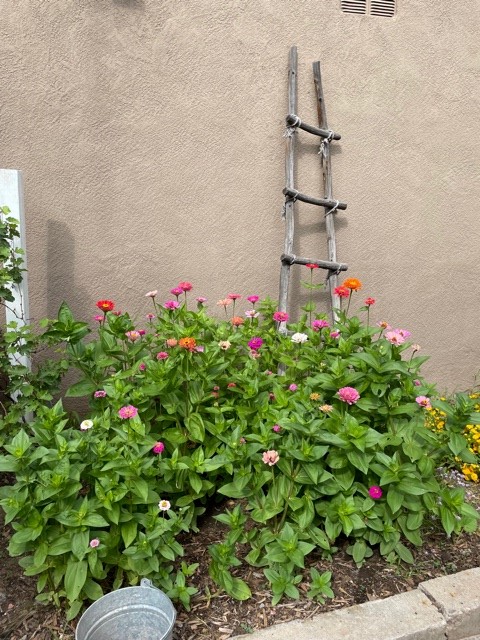
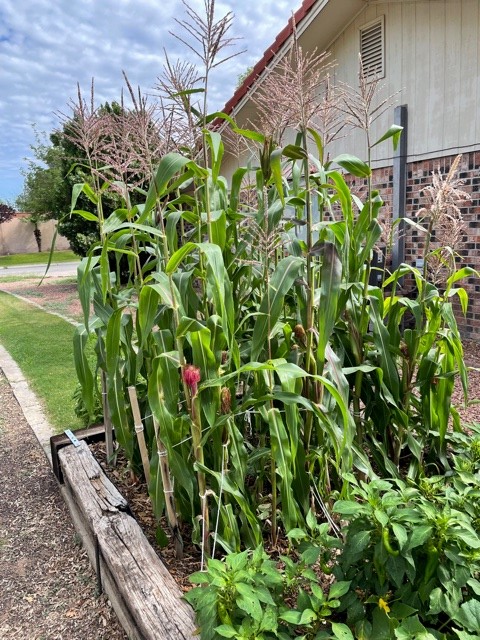
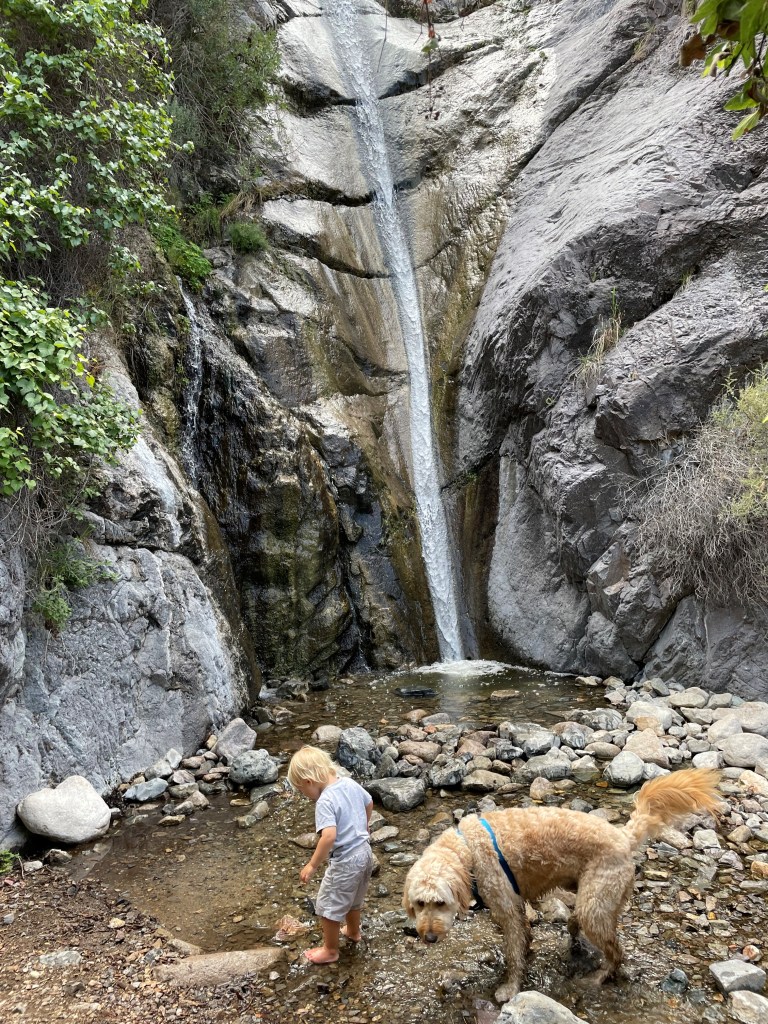
I’m attaching some photos of how our house has blossomed (literally) with the additional rainfall, along with some other pictures showing how beneficial the precipitation has been.

Bird of Paradise flower in our back yard
Zinnia flower garden with more than quadruple the number of blossoms we had last year
Taller plants and more ears of corn this year than last year in Margo’s raised garden
Some home grown chile in the garden, some of which have already been picked and eaten
Grandson Hayes looking at hollyhocks and sunflowers at the side of our house
Dripping Springs waterfall in the Organ Mountains with grandson Hayes and Chester enjoying the bounty of a wet monsoon season
Granddaughter Hannah with new friend dodging monsoon raindrops in the back yard

Hunting for its rider…

This week in Albuquerque, police spotted something unusual. It was a personal watercraft zipping around in loops in the Rio Grande somewhere in the North Valley.


No rider aboard

What was unusual, however, was that there was no rider on the watercraft as it sputtered around in its circle.

Police immediately began a search for the missing rider, thinking he or she may have been tossed off the watercraft during an extreme maneuver or when it hit a sandbar, log or some other object.

As of this writing, no one has been found — drowned or alive — who seems to have been connected to the watercraft.  And there were no details provided as to how police finally managed to corral the renegade machine.

Maybe the device just got tired of sitting in the driveway of its owner and managed to sneak up to the river through a series of irrigation canals. Or maybe La Llorona, the legendary ghost who haunts the river on its wanderings through New Mexico, was up for a thrill ride one night and forgot to shut off the machine when she finished her adventure.


Heading home after her ride…

Does the phrase “scarcer than hen’s teeth” not ring a bell???

My daughter and her children are visiting us now and we’ve become more aware of how focused she is to make sure that what the kids eat is healthy. I get that, and it’s a good thing. When I was young, we just ate what was put in front of us at the dinner table and my mother and my wife’s mother probably didn’t obsess about what went into whatever was in what we ate. A lot of it was probably not healthy food by today’s standards. Somehow, my wife and I survived.

But when I saw this label on a carton of eggs today, I was rather surprised.

Really? Vegetarian chickens? What about Vegan chickens?

Okay, I guess times have passed me by, but I didn’t know there was such a thing as “vegetarian fed hens.” I thought they all just ate chicken feed, which I assumed was made mostly from some kind of seed.

My wife, however, says that when she grew up on the Nebraska farm, chickens could be pretty mean and liked to peck at her. Maybe all along they’ve been craving some kind of meat.

And of course, we now know that birds evolved from the dinosaurs, and those guys, particularly Tyrannosaurus Rex and Velociraptors, chewed up other animals for snacks with some really fearsome teeth.

But honestly, do hens have teeth to rip off and eat the flesh of other animals? Maybe they have evolved since the last time I looked at one of those cute little yellow chicks at the feed store. Maybe they have incisors, molars and canines these days. I’ll have to look more closely the next time “chick days” happens at the local Tractor Supply Store — but I’ll keep my distance just in case.

Branson was the clear winner in my mind…

We watched Jeff Bezos blast off into space Tuesday morning aboard his Blue Origin space capsule. The flight was a success and according to some experts, he achieved true penetration into space, where Richard Branson’s Virgin Galactic flight a week earlier was a few miles shy of that threshold.

Bezos’ Blue Horizon Launch near Van Horn, Texas.

But comparing the two makes me think that Branson had the better product.

For beginners, I think Branson’s program and vision holds a lot more promise in terms of being able to launch a reliable reusable vehicle into space that can eventually carry a bigger payload. Bezos’ service rocket was impressive in its ability to land back on the launch pad where it blasted off, but the capsule landing left much to be desired. Having flown hot air balloons and knowing how much can change instantly with capricious surface winds, there was no guarantee where the capsule might have plunked down to earth. It could have drifted a few miles away from the open flat area where it landed and ended up on the side of a mountain or in a deep arroyo. It could have even tipped over on landing if a large boulder shared the same piece of ground.

Then there was the celebration afterwards. Branson’s landing right back where he started allowed a full-fledged celebration to take place, complete with large video screen set up next to the futuristic New Mexico SpacePort building east of Truth or Consequences. There were paved roads leading there. There were facilities for the media. There was room for large crowds. Bezos’ craft just landed in a big dirt patch of non-descript desert, and it took a while for anyone to get to him and his crew. When the crew did show up, it looks like many of the guests made a silly effort to look like real West Texas cowboys and cowgirls, complete with overly floppy straw western hats and jeans stuck inside garish boots.

The state of New Mexico did a much better job promoting itself during the Branson launch than did Texas. Again, the only nod to Texas were the fake cowgirls and cowboys.

Richard Branson’s Virgin Galactic spacecraft.

And then there’s the spacecraft. In the first place, Bezos rocket and capsule had an almost obscene look to it, with a bulbous protrustion on top of a more slender booster rocket. And it was scorched from previous flights and appeared to be worn and not as safe. It looked like it was lifting off from a oil rig in the middle of the desolate Permian Basin.

Branson’s futuristic lifter and sleek spacecraft were the clear winner. With its brilliant white amd blue finish tapering to a chrome-like tail section, it just plain looked cool.

But in my mind, the best thing about the spacecraft was the New Mexico Zia symbol painted on the tail. Well done, New Mexico. Well done, Virgin Galactic.

They just don’t make ’em like they used to…

In the interest of lighter weight and fuel efficiency, certain body panels in new cars and trucks are made with composite (read that plastic) materials. For example, my current SUV has a hood, tailgate, front fenders and front doors made from composite materials. Oddly, the rear doors are made from steel. The discrepancy in materials between front and rear doors may have something to do with achieving a 50-50 weight balance in the vehicle — at least that’s the best that I can guess.

And as you might suspect, these composite materials may be good a saving weight, but they lack a little in durability.

Take, for example, a lawsuit filed by a Pecos, NM, man in 2012 against his neighbor.  The suit alleged that his neighbor’s dog, in a fit of unexplained rage,  had ripped off a rear quarter panel and part of a bumper on his Volvo. There were identifying tooth marks and canine blood found on the body panels that had been mangled.

The cost to repair the wounded Volvo was $2,000.

Volvos used to have a reputation as super-safe vehicles, some models even carrying a $1 million insurance policy if anyone was killed in a crash involving the Swedish car. Now maybe the owners need to carry additional insurance to protect their vehicles from the aftermath of a dog bite.

Yep, stars are expected over the New Mexico Spaceport…

New Mexico is in a state of self-congratulation after Sir Richard Branson’s historic launch of his Virgin Galactic spacecraft above the central New Mexico desert last Sunday. 

Virgin Galactic soars into space above New Mexico

Now that we’ve all taken a deep breath to take in the accomplishment amid lots of hoopla, remember there is more to come.

In 2013 two pop culture stars signed up to go into space aboard Branson’s spacecraft even before it had flown its first flight — Justin Bieber and Lady Gaga. And at the time Lady Gaga indicated she wanted to buy a ticket to space, she announced she would sing a song during the flight.

Which gives us all kinds of opportunities to imagine what she might sing. My pick would be something by David Bowie, but I’m attaching a link to what someone said were the top rock and roll songs about space so you can peruse them and make your choice about what Lady Gaga should sing.

16 Songs About Space That Are Cosmically Great (popularmechanics.com)

Of course, if you’d like to make up your own tune and submit it to Lady Gaga for consideration, go right ahead. Just let me know so we can all sing along if she picks yours. 

Looking for relievers where you wouldn’t expect to find them…

In 2013, a man entered a Mexican restaurant in Deming and announced it was a stick-up. He then grabbed the cash register but as he headed for the door, the hostess spotted a potential weapon to stop his escape — an empanada. She hurled the split fingered dough ball  at the fleeing robber and tagged him squarely in the back of his head. There were no radar units available at the restaurant, so we don’t know how fast her pitch was.

He responded by dropping the cash register and holding an arm over his head to prevent injury from further flying pastries and fast pitches.

Unfortunately that same year, Dona Ana County Sheriff’s Deputies did not have access to an empanada to stop an intoxicated man who had tried to break into his mother’s mobile home. Despite being spritzed with pepper spray, the man attempted to run away but managed to snatch a pine cone from a nearby tree and served up a wobbly conifer knuckle ball at the deputy. It hit the officer smartly in his ear. He was ultimately subdued and arrested for, among other things, assault on a police officer.

What this tells me is there are some pretty promising recruits for relief pitchers in New Mexico. Except that one of them is still probably in jail.


Not the empanada hurler from Deming…

Sometimes, we might know more about our neighbor than they do…

I’ve just finished reading a book by my friend, author-historical researcher Jack Wilson of Las Cruces about some interesting footnotes in Arizona history. It’s entitled Arizona Across 400 Years, Stories from a Colorful Past.

Last year Wilson released a book about some previously unknown or little reported incidents in New Mexico history in a book entitled New Mexico Episodes, Stories from a Colorful Past. Well written and laced with a sense of humor, the book’s topics included a great short summary of the Lincoln County War, a tale about a faithful dog and the robbery of a stagecoach headed to Silver City in which a bottle of whisky became a key negotiating point.

Wilson’s newest book includes an update on attempts to pinpoint the exact route of early Spanish explorer Francisco Vásquez de Coronado in his foray into Arizona in the 16th century.  He concludes that after 480 years, there is still much uncertainty about the exact path of exploration, but that details are still slowly “coming to light.”

If you’ve ever been in Yuma in the summer, you know how hot it can get. Early settlers in the western Arizona outpost had to have a bit of a sense of humor to deal with the oppressive heat and Wilson discovered a tale that confirms that attitude. It seems that two soldiers went to Hell after dying in Yuma and shortly afterwards delivered a message to the living that they needed blankets to keep warm down below in their new confines.

A story I found particularly fascinating was the exploration for oil in southeastern Arizona in the early 20th century. I had never known about any such activity in the Grand Canyon state, so it was a enlightening to read all the details Wilson uncovered in his research. Although tiny traces of oil were found, there were many unsuccessful wells drilled near Bowie in southeastern Arizona. If you’ve ever driven from Las Cruces to Tucson, you’ve blown right by it just after crossing the New Mexico-Arizona state line. Most of the wells drilled were dry holes or struck water.

Early wildcatters who were trying to raise funds for their ill-fated operations often stretched the truth, claiming their exploration equipment was high tech and not like the “doodlebug contraptions” that other explorers were using to find oil in the region.

Wilson, in perhaps his best line in the book, notes that “unwarranted optimism flowed more freely than oil…” in the hunt for petroleum in the Bowie area.

The 107 page paperback released last month by Sunstone Press of Santa Fe contains 14 short chapters focusing on separate historical events in Arizona — many not previously reported. The book includes many historical photos, maps, diagrams and prolific references which help the reader better understand the material.  Wilson also includes a list of suggested readings for those wanting more details about the subjects in the book.

Wilson is a Harvard graduate and a retired archaeologist and historical researcher, who began his career with the Museum of New Mexico. After 10 years with that agency and two years spent excavating a War of 1812 period British fort for Parks Canada, he began a 28-year career as a contract archaeologist and historical researcher for utilities, mining and engineering companies, government agencies and Native American tribes or communities, in both Arizona and New Mexico.   He has written several previous books: Merchants, Guns & Money: The Story of Lincoln County and its Wars; Islands in the Desert, A History of the Uplands of Southeastern Arizona; When the Texans Came: Missing Records from the Civil War in the Southwest 1861-1862; Peoples of the Middle Gila, A Documentary History of the Pimas and Maricopas, 1500-1945; and New Mexico Episodes, Stories from a Colorful Past.  In addition, he has authored articles in several professional journals. He and his wife Cheryl live, with their pampered cat Seth, in Las Cruces, New Mexico.

The book is available online through Barnes and Noble, Amazon.com., Ebay.com., Thriftbooks and other online booksellers.  Local booksellers may stock it as well.

It’s a fun and enlightening read. I strongly recommend it, particularly if you have friends in Arizona so you can show them up with historical tidbits about their state they didn’t know about.