Albuquerque transit — bringing dangerous moving objects to you…

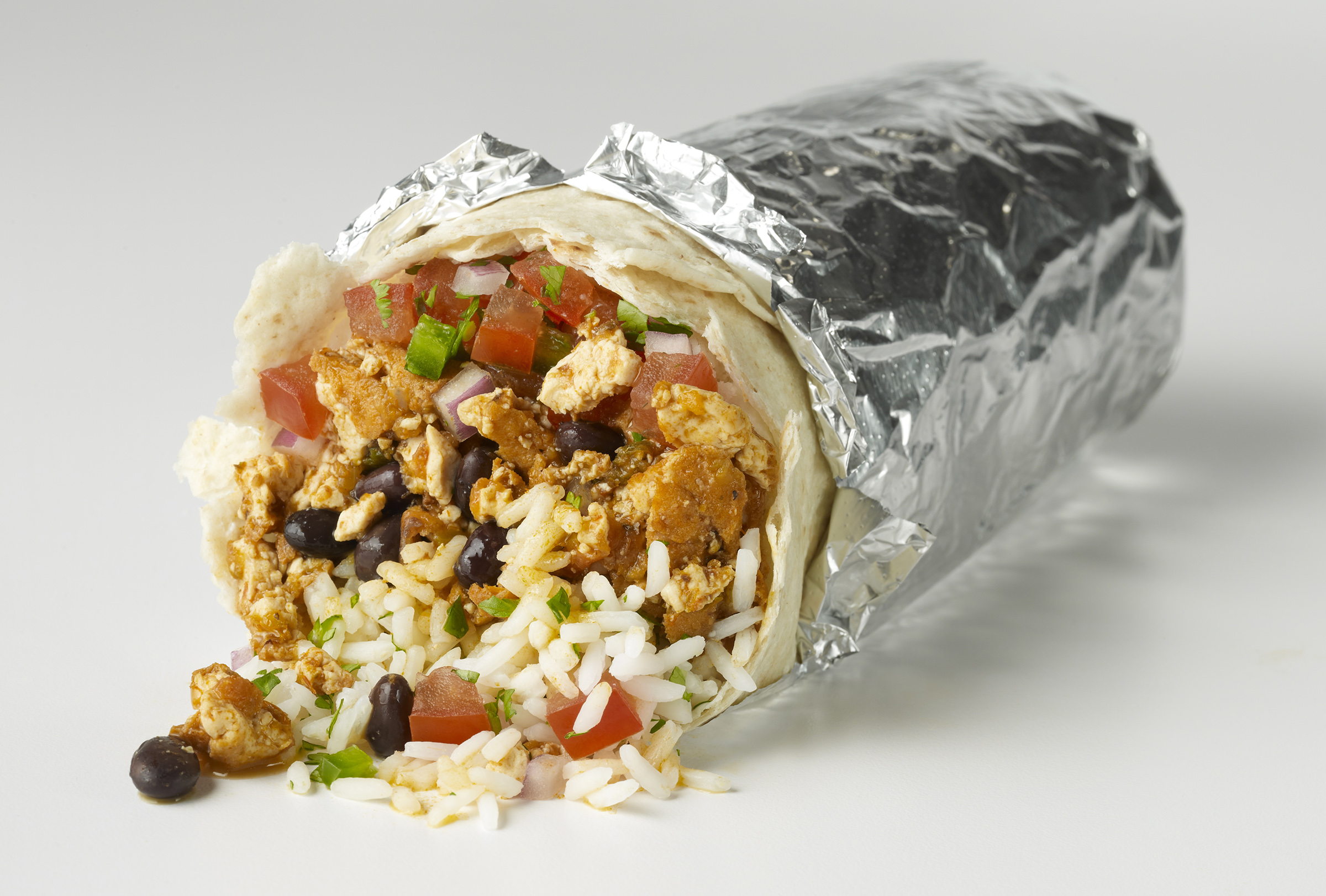
You might remember an earlier post I wrote about an Albuquerque RIDE (municipal transit system) bus which was involved in a collision when its driver, noshing on a breakfast burrito, failed to notice the stopped car in front of him and rear-ended the vehicle.

And you may remember all of the drama which has surrounded the city’s attempt to implement a faster public transportation system along Central Avenue. The system, called “Albuquerque Rapid Transit” was a poor substitution for a light rail system that previous administrations touted as the wave of the future but that few others supported. ART ended up being a plan to use electric buses to zoom people along Central on a route which seemed to dodge more likely users of a pseudo light rail system.  The proposed route also reduced the number of driving lanes in the busy street and many trees — particularly in the trendy Nob Hill area — had to be removed. 


Albuquerque Rapid Transit logo

The project got off to a rocky start when the electric buses showed up late. Then testing, which seemed to go on interminably, concluded that the buses’ electric range was not as long as has been touted. Then city officials found other manufacturing flaws with the buses.

The city finally rejected the initial order of buses and ordered a new batch from a more reputable supplier.

New ART bus.

Then things got worse. The loading platforms in the middle of the street turned out to not be the correct height, resulting in the fancy new buses accidentally smashing into fixtures on the loading platform. Drivers were confused by the flow of traffic and frequently collided with ART buses or were in turn crunched by the them. 

And now the latest danger from the ART system? Falling light fixtures.

It seems that when the high-tech lighting fixtures were installed, some were not installed properly or were manufactured improperly. They have been raining down as high as 25 feet to the street below. Fortunately, no drivers or pedestrians have been injured, but the city has now filed a lawsuit of at least $2.5 million to have the deviant lighting fixtures corrected or replaced.

Perhaps ART might need to be renamed the “Aggressively Recalcitrant Transportation” system. 

Law enforcement on the cheap…

This story showed up on our neighborhood “Nextdoor Digest” last week, which triggered some long ago memories of growing up in Ruidoso.

This sighting happened in metropolitan Rodeo, NM, about as far in the southwestern corner of our state as you can get. It seems that the Hidalgo County Sheriff’s Department — apparently short on staff, budget and ideas — decided to park a mothballed police cruiser with an inflatable dummy in the driver’s seat in a conspicuous location in Rodeo in hopes of deterring crime. 

Inflatable dummy, complete with uniform, waiting to terrorize law breakers in mothballed Hidalgo County police cruiser.

You’ll note that the cruiser in the photograph appears to be an early 90s vintage Chevrolet Impala, the last big sedan GM ever offered as a police car. Most were mothballed by the year 2010. Any crook today worth his salt would probably spot that clue right away and conclude that the aging car was no threat. Other police cruiser accoutrements, such as the obligatory spotlight, have been stripped away and the light bar looks like something from the early Anasazi era. 

This reminded me of a time Ruidoso when police purchased a fleet (well, actually just two) 1961 Chevy sedans with the infamous “409” hot rod V8. All of us gear-head guys in town were excited about the presence of this hot engine in our community. After a few years, the police department updated its two-car fleet with something less exciting, but managed to keep one of the units. They parked it in a conspicuous spot right on Sudderth Drive near where the local bad boys with hot cars would do smoky doughnuts in an empty parking lot and head back up the street to try to spot girls visiting from Texas. I don’t think the Ruidoso cops every fooled anyone with the toothless warrior.

As for me, my ride at the time was a hand-painted blue 1942 WWII jeep which did not attract many members of the opposite sex. With an asthmatic four-cylinder engine, a doughnut or burnout was not an option.  It was, however a convertible — only because the original canvas top rotted away years before I became its owner.

It’s not the first time for titillations in the air…

I’m sure you’ve all read about this incident in Albuquerque during the past week — a drone with an offending sex toy dangling below buzzes around a candidate’s rally.

If you haven’t here’s the synopsis:

The controversial sheriff of Bernalillo County, Manuel Gonzales, was holding a campaign rally for his run for mayor of Albuquerque when an unexpected object in the air whizzed up to the stage where he was orating. The object began hovering nearby as members of the crowd came to an astonishing conclusion about what it was. 

It was a drone carrying a larger than life-size dildo swinging beneath it. Members of the candidate’s team were able to snatch the object from the sky by the dangling protuberance and remove the distraction. The owner of the drone, now dubbed the “dong copter,” tried to retrieve his device and punch the candidate, only to be met by police who arrested him for  violations of resisting arrest, evading and obstructing police. The drone has been kept as evidence.


Candidate Manual Gonzales tries to ignore “dong copter” over his right shoulder while staff member snatches the drone by the offending dangling appendage.

But it’s not the first time sex objects have been seen floating around the sky. I offer tales of two much earlier incidents.

The first involved a good friend of mine who, during a mass ascension of the Albuquerque International Balloon Fiesta, discovered a surprise attached to his crown line (the rope connected to the top of the balloon for use during inflation and deflation.) It seems some prankster friends had attached an anatomically correct and naked inflatable woman about halfway up the crown line that the pilot had not noticed until he launched. The announcer on the field was proudly introducing the pilot when he spotted the hitchhiker on the crown line. At first thinking it was benign, he was about to point out the object to the crowd below, complete with gawking kids and innocent bystanders. When the announcer realized what it was, he quickly switched his focus and announced the next balloon to launch — which thankfully did not have any obscene objects attached to it. 

The next incident involved a plan during the 1990s to fly an unusual balloon at the Albuquerque International Balloon Fiesta. The balloon was named “I SAVE LIVES” and was in the shape of a giant condom. The Balloon Fiesta organizers debated about whether to allow a giant flying condom to appear at the family oriented event and ultimately decided it was not appropriate.

A representative of the organization which managed the balloon was also managing my commercial balloon program at the time and gave me a full accounting of the difficulties the balloon had experienced gaining acceptance at various rallies around the United States. She gave me a pin, which I still have on my balloon pin board, of the offending balloon.

I SAVE LIVES” hot air balloon pin on my pin collection board.

When I was researching this article, I could not find any information about what happened to this American hot air balloon. However, I found images of similar shaped and themed condom balloons used at various balloon and event rallies around in Europe, where I know they have a much more lenient approach to displays of this type. 

The big splash…

For more years than I care to remember, I’ve been able to take out my frustrations about not having a gold medal trout stream in my back yard by traveling up to the Rio Penasco, an unexpected spring-fed trout fishery on the eastern slopes of the Sacramento Mountains just two hours away.

The water here is all privately owned and our local fly fishing club, the Mesilla Valley Fly Fishers, Inc., has been able to negotiate leases with private land owners for rights to fly fish on this unique section of water.

Both my children and my wife learned how to fly fish on this water and it’s been a special place for me and many others. The most remarkable thing about it is that it is a fishery that is really unexpected in this part of the world.

Last Thursday, as I have done several times before, I helped re-stock the leased waters with some really beautiful, healthy and fat Rainbow trout, about 12-14 inches in length. Since the water is all under catch and release rules, I hope the 20 or so trout I tossed into some nice deep pools will flourish for many seasons and hopefully help increase the natural population. And I hope I will re-acquaint myself with a few of them. 

Instead of gently releasing them into their new waters, those who regularly stock fish say the best technique is to toss them in with a splash to “wake them up” from their numbing ride in a tank on the back of a stocking truck. So I do that with a great deal of gusto, but make sure all that I toss in the water start swimming right away for cover — which they always do.

While not as rewarding as re-stocking native Gila trout on my all-time favorite stream, Whitewater Creek in the Gila National Forest, it always makes me happy to put fish into a river where they can flourish and give us humans a rewarding experience without harvesting them.

Here are some photos of my day’s activities.

Loading up Rainbow trout in bucket for stocking
Ready for the splash in the Rio Penasco

I missed the anniversary…

June 5, 2020 — my first blog post on my website. I was thinking that it was sometime in the middle of June, so I decided to look it up this morning.

So since that date, I’ve posted 146 blogs. I hope a few of them were entertaining to you and I really hope none were offensive. And thanks for reading them.

What occurred to me was that the date, June 5, is one I always remember. On June 5, 1967, the infamous raid on the Rio Arriba Courthouse in Tierra Amarilla occurred. I was in college at the time, but already working as a journalist.

The raid occurred when a group of armed gunmen took over the town of Tierra Amarilla during a legal proceeding involving the murder of a county jailer, Eulogio Salazar. The death was linked to a movement led by Reies Lopez Tijerina to reclaim Spanish Land Grants in northern New Mexico, but the murder was never solved.  A colleague and good friend, Larry Calloway, was a reporter for United Press International at the time, and was calling in a story from a phone booth outside the courthouse when he was approached at gunpoint and held captive briefly.

Because I later wrote so many stories about the incident and the various legal maneuverings involved, that date has stuck in my memory.

So now, I’ll also remember it was the date when I started my blog.

Again, thanks for reading and, as always, I appreciate any comments or observations you have.

Not “in the zone,” but “in the cone”…

Our rambunctious and always happy goldendoodle, Chester, got into something that gave him an allergic reaction on his left hind leg a week or so ago. And of course, he started licking it and ripping out his fur to stop the itch.

As all parents know, kids’ maladies always get worse right at the start of a three-day holiday weekend. So by the time Tuesday rolled around, we thought part of Chester was going to look like a hairless Chihuahua.

Luckily, we were able to get him into the vet on Wednesday and yep, you guessed it, the “cone of shame” (plus medications) were prescribed.

So here’s what he looks like now.


Bewildered Chester

And here’s what he looked like in his leisure days before “coning:”


Chester, in happier, more robust hair times…

So here’s the deal, Chester. We’ve put up with more than a year of COVID-19 crud. You can at least deal with the “cone of shame” for four more days. 

“Buttload,” version 2.0…

You may remember an earlier post about my discovery that “buttload” was a legitimate measurement term. Well, another story has popped up about the use of someone’s posterior region for potentially holding a measurement of something.

A few years ago, police in Demining spotted a man near the local Wal-Mart repeatedly clinching his buttocks. Never mind that he might have had issues trying to hold something back — police immediately suspected his twitches were signs of him of concealing illegal drugs in a “body cavity.”

So convinced of his guilt that police rushed him to a hospital in Silver City — about 50 miles away — where doctors performed numerous probes, searches, enemas and X-rays to find suspected hidden objects.

The results?

No drugs were found but the suspect was left with some pain — the worst of which was his $6,000 bill from the hospital for their services.

Truly a pain in the … well you know what.

Let’s call it what it is…

My late brother once told me about a controversy at the then new baseball stadium for the Los Angeles Angels when the concessionaire decided that it would be “California appropriate” to serve quiche to fans. I’m not sure you remember it, but there used to be a Chevrolet advertising campaign with an all-American spin and a song that went like this:

“Baseball, hot dogs, apple pie and Chevrolet. They all go together in the good old USA.”

While the song likely resonated with baseball fans, it clearly didn’t appeal to the interest of the Angels concessionaire who felt international cuisine was more in line with tastes of the southern California fan base. I’ve only been to one Angels baseball game, and I don’t remember seeing if quiche was still on the menu.  Ridiculously expensive hot dogs, yes.

Apparently a desire to keep things “all American” showed up in a public hearing several years ago in Albuquerque. The focus of the hearing was the planned construction of a traffic roundabout — something itself very foreign at that time in many western states.

When the hearing moderator said that traffic would flow smoothly as drivers waited in a queue to enter the roundabout, one attendee stood up to declare that: “This is America!” We don’t say ‘queues’ in America. We say ‘lines.’ We stand in line, we wait in line. We do not queue!”

I’m thinking that the location of the roundabout would have been a great place to open up a quiche takeout stand.

Image result for traffic roundabout

So I’m a bit of a steam train nerd…

Almost anyone in southern New Mexico who has driven from Alamogordo to Cloudcroft has marveled at the old Mexican Canyon railroad trestle just below the summit of the Sacramento Mountains. 

Built in the early 1900s, the trestle was the crowning achievement of a steep mountain railroad called the Alamogordo and Sacramento Mountain Railway. Work on the railroad started in the late 1890s and by the 1920s and 1930s, it connected a large network of logging railroads in the Sacramento Mountains. The rail lines were constructed primarily to harvest the timber needed for residential and commercial construction in El Paso and surrounding communities and for railroad ties throughout New Mexico. 

The railroad, which was later dubbed the “Cloud Climbing Railroad,” was also used to carry passengers from the desert lowlands to the cool mountain air of Cloudcroft. The railway continued to operate until 1947, when it was abandoned. 

Having grown up just a few miles north of Cloudcroft in the village of Ruidoso, we had visited the area many times. However, until this last week, I was only aware of two other  trestles along the abandoned railway route.

Remnants of unnamed trestle on Bridal Veil Falls trail in Sacramento Mountains
Solado Canyon trestle on Bridal Veil Falls trail in Sacramento Mountains

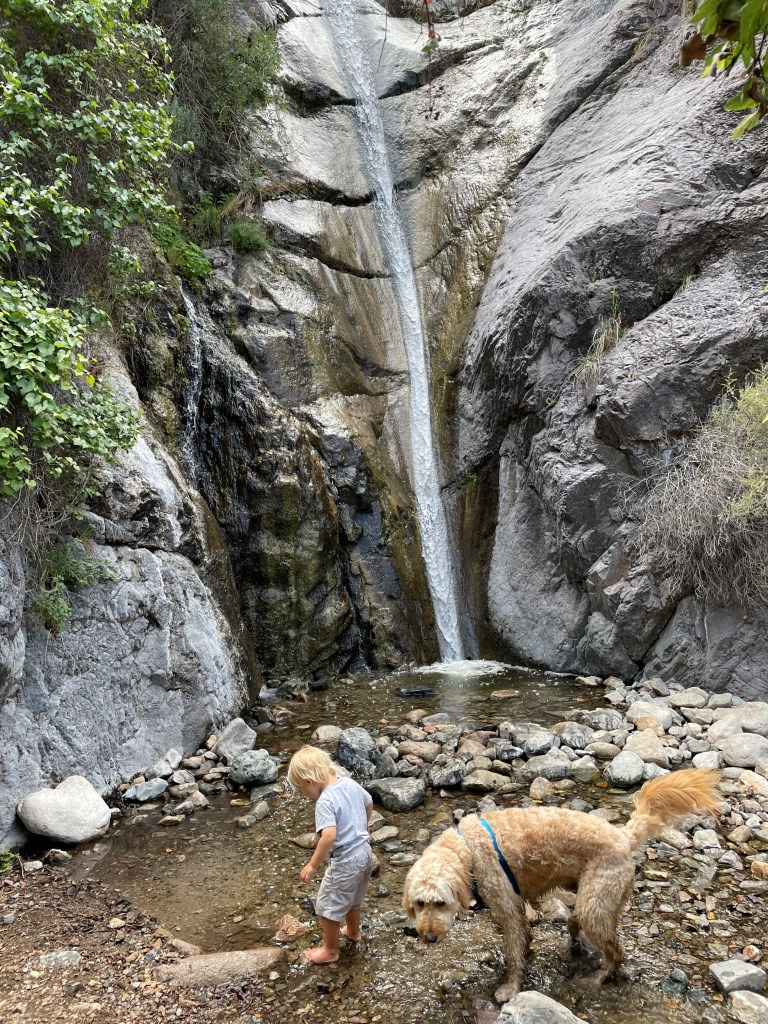
At any rate, it was quite a surprise to find out about the remains of two trestles I had never known about, both just north of the town of High Rolls. My wife, dog Chester and I hiked part of the way along the old railroad bed leading to Bridal Veil Falls when we discovered the trestle. There was a nice flow of spring water beneath the remnants of the trestle, which Chester enjoyed as a place to wade, drink and flop in the cool water.

For many years while I was a journalist in Santa Fe, I reported on progress of the effort to resurrect a section of the old Denver and Rio Grande Western narrow gauge railway between Chama and Antonito, CO. After many years of negotiations, involving two state governments, the dilapidated railway was purchased by the states of Colorado and New Mexico. It has now become a popular tourist attraction known as the Cumbres and Toltec Scenic Railway

It’s unfortunate that the old “Cloud Climbing Railroad” between Alamogordo and Cloudcroft could not have been preserved for future generations. I believe it was an even more spectacular railroad than the Cumbres and Toltec route or the Denver and Rio Grande line between Durango and Silverton, CO.

I found a link to a document about the railroad that was prepared by the U.S. Forest Service in 1984:

Logging-Railroads-of-the-Lincoln-National-Forest[7918].pdf

There’s also a book about the railroad that was written many years ago by Dorothy Jensen Neal that is still available:

http://twp.utep.edu/cloud.php

At any rate, I hope you’ll take time to take a look at these old trestles and walk along the very easy railroad bed trails. I don’t think I’m as much of a railroad nerd as Sheldon Cooper from “The Big Bang Theory” TV show, but it’s fun to learn about these historic railways in our neighborhood. 

Proof that patience is a virtue…

Our daily morning walks around the Mesilla Park neighborhood frequently yield pleasant surprises and discoveries. Earlier this spring, we noticed a century plant starting to sprout up in the yard of an historic old adobe home adjacent to an irrigation ditch that we frequent.

Many weeks after spotting it, it has now grown to be more than 20 feet tall, in full spectacular bloom.


Century plant in full bloom in our neighborhood

Through a friendship between our goofy Goldendoodle, Chester, and a neighbor’s dog, Duck, we’ve gotten to know the person who lives in the house where the century plant is blooming. He said he had lived in the house for more than 20 years and this is the first time the plant has ever bloomed. Because it is protected by a network of trees, it hasn’t toppled over when our often ferocious spring winds create havoc on trees and other plants in the neighborhood. Our neighbor says he thinks its the tallest variety of the plant he’s ever seen. 

We won’t tell you exactly where it is because of the neighbor’s fear that someone might show up and try to hack it down. That’s a sad commentary about how some people regard things of beauty.

At any rate, with all the troubling things in our world right now,  I hope that a tall spectacular plant that shows up only once in every 20 years will be seen as a very positive sign. 

Give the bear a break…

On occasions when I’ve had maybe one more glass of wine that I should have, I have been known to break into embarrassing (for my wife) songs. There are usually three of them that fall into rotation:

“Deck us all with Boston Charlie…” from the comic strip Pogo, which I have written about in an earlier blog.

The other is my high school fight song: “Hail mighty Warriors, brave and bold, onward to victory Blue and Gold…”

And the third is this: “Smokey the Bear, Smokey the bear, growlin’ and a prowlin’ and a sniffin’ the air. He can find a fire, before it starts to flame. That’s why they call him Smokey and that’s how he got his name.” It was written and performed by Gene Autry and was mildly controversial because Smokey’s actual name was “Smokey Bear,” not “Smokey THE Bear.” Anyway, it was an ode to the abandoned bear cub found clinging to a burned pine tree in the Capitan Mountains of the Lincoln National Forest in 1950 who was made famous as an icon for encouraging Americans to prevent forest fires.

And speaking of Smokey, years ago my sister Wendy was photographed cuddling a small female bear cub named “Smokina” who was possibly to become Smokey’s paramour. She too, like Smokey, was found abandoned in a forest fire in the Lincoln National Forest in the late 1950s. I never heard any more about Smokina — apparently she did not have an agent as effective as Smokey’s. Despite the best plans for bear romance, Smokey never had offspring because his private parts were apparently scorched during the 1947 fire, making him sterile and unable to produce any offspring.  That’s probably more than you really wanted to know. 

Smokey is buried in Capitan at the Smokey Bear Historical Park after living many years in the National Zoo in Washington. I’ve attached a photo of his burial plaque and a link to the park if you’re interested. We visited the park a couple of years ago with good friends, and it’s worth the trip.

Smokey’s burial plaque at the Smokey Bear Historical Park in Capitan

EMNRD Forestry Division (state.nm.us)

So why all this blathering about Smokey? Well last week, I read an article in the Albuquerque Journal that said that 28 abandoned campfires had been found in the Santa Fe National Forest, one of them still with flames lapping at logs. My wife and I once ran across a similar still burning campfire in Colorado — and dutifully extinguished it. It was scary and a completely irresponsible act by whoever left it.

But for Pete — or Smokey’s sake, please douse your campfire during this extremely dry windy spring season in New Mexico. As Smokey was quoted: “If it’s too hot to touch, it’s too hot to leave.”


With no particular place to go…

One of the reasons why hot air ballooning is such an adventure is that you almost never know exactly where your flight will end. You may have a general idea of an area where you might land, but subtle variations in wind direction, changes in winds at different altitudes during your flight, landing site restrictions and other factors completely outside of your control make predicting a precise landing spot virtually impossible. 

Just after launch at the Albuquerque International Balloon Fiesta, with me wondering where I’ll eventually land.

I’ve landed in many interesting places over the years. I’ve touched down several times on residential streets in the middle of a surprised neighborhood. A couple of times I ended up way out in the middle of nowhere in the deserts west of Albuquerque and Las Cruces. Other landing sites included crowded parking lots, gated and fenced in plots of land, city parks, river levee roads with locked gates, and a pasture where I was greeted by a friendly herd of cattle apparently thinking my wicker basket was a giant bale of hay for them. I even landed in a narrow mobile home lot with a giant electrical substation looming in front of me — my scariest landing by far.  (Maybe more on that in a later blog.)

But as we say in ballooning, it’s all a matter of simple math: If the number of landings equal the number of takeoffs, you’ve had a good flight. So far, all of mine have been good flights. 

Me over the Mesilla Valley with the Organ Mountains in the background.

On only two occasions have I managed to land back almost where I launched. Both were at the Albuquerque International Balloon Fiesta when mostly predictable “Albuquerque Box” winds allowed me to land within a few spaces of my original launch site. It was a challenge for me to work the wind currents to “get back home,” but it was especially boring for the crew who just waited around the launch field during my entire flight for me to come back.

So it’s not surprising that newcomers to ballooning don’t understand how little control you have over where you go in a hot air balloon. I try to explain my general flight plan, but most don’t seem to understand that I can’t just point the aircraft in a specific direction and end up there.

That was made especially evident to me one year when I flew one of the Wells Fargo balloons at Balloon Fiesta. I had been assigned the duty of flying a couple of passengers who had won a bid for a balloon flight for a charity event (something we did quite frequently). The passengers arrived and as usual, it was one of those mornings where the winds were slow and we were in a “hurry up and wait” mode. I told my passengers that because of the launch delays, I thought they had time to go to vendor’s row to look around before coming back to the launch site to begin their hot air balloon adventure.

Well, things changed quickly and I was suddenly confronted by a launch director who advised me that I needed to get into the air quickly to avoid slowing down the launch process for many other balloons nearby. My passengers were nowhere in sight, so I grabbed a couple of extra crew members who had not been able to fly at Fiesta before and put them in the basket. We launched on time and had a great 45 minute flight — but landed somewhere far away from the field. 

When I came back to the field after packing up the balloon, we returned to our launch site to find my two original passengers standing around looking bewildered. I apologized profusely for not being able to give them a ride when one of them responded:

“Oh, we saw you launch and fly away. We just thought you’d eventually fly back here and land to take us on our ride, so we just waited around.”

So now, when I’m flying new-to-ballooning passengers, I try to make clear that the unpredictable landing site is part of the thrill of the experience. And maybe we’ll find another herd of welcoming cows to really make it a really fun day. 

I think I know who invented this…

In case you missed it, last Friday, May 7, was “No Pants Day.” It was the last in the rush of truly significant events — Star Wars Day (May the Fourth be with you), Cinco de Mayo (when maybe a ship carrying a load of mayonnaise was sunk), and then on Friday, “No Pants Day.”

I fully participated as you can see from the photo below. (I tried to emulate a no-pants event once before wearing a long trench coat with no socks and my pants rolled up so they couldn’t be seen — I was asked to leave the office. Maybe more to be revealed in a later post.)


Me, in my hot dog boxers, cowboy boots and Chester looking on quizzically.

I first learned about this from a couple of cartoons in Friday’s Albuquerque Journal, where artists had made reference to the event. I looked it up online, and found initially that the main reason for “No Pants Day” was just random silliness. A closer investigation, initiated by my wife, said it was actually part of an effort to encourage people to donate gently used clothing to help the more unfortunate and homeless. I’m all for that, especially considering that after COVID-19, my size 34 pants are no longer useful and my waist prefers a size 35. I’m sending a batch of these pants to various collection points.

But the main point of this blog is to credit my best next door neighbor ever, who will remain nameless but who lives just west of me, with likely initiating this significant event. He can occasionally be spotted picking up the newspaper, hauling out his trash gondola and occasionally just scoping out the early morning neighborhood activities without pants — even in 28 degree weather. Luckily, almost no one ever sees him in this mode except for me. Yes, he does wear some kind of undergarment, so he is not on any deviant list. He has become my role model for freedom of expression and I am honored to have him as a friend and neighbor. And no, he really doesn’t do this much — it’s just mostly a joke between us. 

So if you have spare pants, please donate them to your local homeless shelter, Salvation Army, Good Will or other favorite charity — or maybe to my neighbor. 


Well, at least they got the country right…

New Mexico is frequently confused with our neighbor to the south. In fact, the New Mexico Magazine has a regular column entitled “One Of Our 50 Is Missing” in which readers offer their stories of being told they can’t ship items to a foreign country or that they’ll have to prove they have the proper vaccinations before traveling here.

I’ve often wondered about the impact of our state’s name on our progress — or lack of it — compared to other surrounding states. But that’s a matter for another blog which I’ve already written and will share with you some day.

And New Mexico often gets confused with other locations because of town names like Cuba or Des Moines.

And then there’s Carlsbad. In 2012, a Serbian tennis player was scheduled to play in a tournament in Carlsbad, California. Her travel agent unwittingly booked her a flight to Carlsbad, New Mexico.

The tennis player arrived, rather bewildered by the fact that she hadn’t been able to see the Pacific Ocean when her plane was on approach to the airport. Still not comprehending what had happened, she went to the outside of the airport terminal where she was expecting to be picked up by a pre-arranged VIP ride service — apparently two states to the west. When her ride didn’t show up, she made a rather huffy phone call to her driver.

“I am the only person here,” she said. “How can you not see me?”

At that point, it probably dawned on her that her ride probably wasn’t going to get wherever she was. And she probably realized she wasn’t going to make it in time for the tournament.