We watched Jeff Bezos blast off into space Tuesday morning aboard his Blue Origin space capsule. The flight was a success and according to some experts, he achieved true penetration into space, where Richard Branson’s Virgin Galactic flight a week earlier was a few miles shy of that threshold.
Bezos’ Blue Horizon Launch near Van Horn, Texas.
But comparing the two makes me think that Branson had the better product.
For beginners, I think Branson’s program and vision holds a lot more promise in terms of being able to launch a reliable reusable vehicle into space that can eventually carry a bigger payload. Bezos’ service rocket was impressive in its ability to land back on the launch pad where it blasted off, but the capsule landing left much to be desired. Having flown hot air balloons and knowing how much can change instantly with capricious surface winds, there was no guarantee where the capsule might have plunked down to earth. It could have drifted a few miles away from the open flat area where it landed and ended up on the side of a mountain or in a deep arroyo. It could have even tipped over on landing if a large boulder shared the same piece of ground.
Then there was the celebration afterwards. Branson’s landing right back where he started allowed a full-fledged celebration to take place, complete with large video screen set up next to the futuristic New Mexico SpacePort building east of Truth or Consequences. There were paved roads leading there. There were facilities for the media. There was room for large crowds. Bezos’ craft just landed in a big dirt patch of non-descript desert, and it took a while for anyone to get to him and his crew. When the crew did show up, it looks like many of the guests made a silly effort to look like real West Texas cowboys and cowgirls, complete with overly floppy straw western hats and jeans stuck inside garish boots.
The state of New Mexico did a much better job promoting itself during the Branson launch than did Texas. Again, the only nod to Texas were the fake cowgirls and cowboys.
Richard Branson’s Virgin Galactic spacecraft.
And then there’s the spacecraft. In the first place, Bezos rocket and capsule had an almost obscene look to it, with a bulbous protrustion on top of a more slender booster rocket. And it was scorched from previous flights and appeared to be worn and not as safe. It looked like it was lifting off from a oil rig in the middle of the desolate Permian Basin.
Branson’s futuristic lifter and sleek spacecraft were the clear winner. With its brilliant white amd blue finish tapering to a chrome-like tail section, it just plain looked cool.
But in my mind, the best thing about the spacecraft was the New Mexico Zia symbol painted on the tail. Well done, New Mexico. Well done, Virgin Galactic.
In the interest of lighter weight and fuel efficiency, certain body panels in new cars and trucks are made with composite (read that plastic) materials. For example, my current SUV has a hood, tailgate, front fenders and front doors made from composite materials. Oddly, the rear doors are made from steel. The discrepancy in materials between front and rear doors may have something to do with achieving a 50-50 weight balance in the vehicle — at least that’s the best that I can guess.
And as you might suspect, these composite materials may be good a saving weight, but they lack a little in durability.
Take, for example, a lawsuit filed by a Pecos, NM, man in 2012 against his neighbor. The suit alleged that his neighbor’s dog, in a fit of unexplained rage, had ripped off a rear quarter panel and part of a bumper on his Volvo. There were identifying tooth marks and canine blood found on the body panels that had been mangled.
The cost to repair the wounded Volvo was $2,000.
Volvos used to have a reputation as super-safe vehicles, some models even carrying a $1 million insurance policy if anyone was killed in a crash involving the Swedish car. Now maybe the owners need to carry additional insurance to protect their vehicles from the aftermath of a dog bite.
New Mexico is in a state of self-congratulation after Sir Richard Branson’s historic launch of his Virgin Galactic spacecraft above the central New Mexico desert last Sunday.
Virgin Galactic soars into space above New Mexico
Now that we’ve all taken a deep breath to take in the accomplishment amid lots of hoopla, remember there is more to come.
In 2013 two pop culture stars signed up to go into space aboard Branson’s spacecraft even before it had flown its first flight — Justin Bieber and Lady Gaga. And at the time Lady Gaga indicated she wanted to buy a ticket to space, she announced she would sing a song during the flight.
Which gives us all kinds of opportunities to imagine what she might sing. My pick would be something by David Bowie, but I’m attaching a link to what someone said were the top rock and roll songs about space so you can peruse them and make your choice about what Lady Gaga should sing.
Of course, if you’d like to make up your own tune and submit it to Lady Gaga for consideration, go right ahead. Just let me know so we can all sing along if she picks yours.
In 2013, a man entered a Mexican restaurant in Deming and announced it was a stick-up. He then grabbed the cash register but as he headed for the door, the hostess spotted a potential weapon to stop his escape — an empanada. She hurled the split fingered dough ball at the fleeing robber and tagged him squarely in the back of his head. There were no radar units available at the restaurant, so we don’t know how fast her pitch was.
He responded by dropping the cash register and holding an arm over his head to prevent injury from further flying pastries and fast pitches.
Unfortunately that same year, Dona Ana County Sheriff’s Deputies did not have access to an empanada to stop an intoxicated man who had tried to break into his mother’s mobile home. Despite being spritzed with pepper spray, the man attempted to run away but managed to snatch a pine cone from a nearby tree and served up a wobbly conifer knuckle ball at the deputy. It hit the officer smartly in his ear. He was ultimately subdued and arrested for, among other things, assault on a police officer.
What this tells me is there are some pretty promising recruits for relief pitchers in New Mexico. Except that one of them is still probably in jail.
I’ve just finished reading a book by my friend, author-historical researcher Jack Wilson of Las Cruces about some interesting footnotes in Arizona history. It’s entitled Arizona Across 400 Years, Stories from a Colorful Past.
Last year Wilson released a book about some previously unknown or little reported incidents in New Mexico history in a book entitled New Mexico Episodes, Stories from a Colorful Past.Well written and laced with a sense of humor, the book’s topics included a great short summary of the Lincoln County War, a tale about a faithful dog and the robbery of a stagecoach headed to Silver City in which a bottle of whisky became a key negotiating point.
Wilson’s newest book includes an update on attempts to pinpoint the exact route of early Spanish explorer Francisco Vásquez de Coronado in his foray into Arizona in the 16th century. He concludes that after 480 years, there is still much uncertainty about the exact path of exploration, but that details are still slowly “coming to light.”
If you’ve ever been in Yuma in the summer, you know how hot it can get. Early settlers in the western Arizona outpost had to have a bit of a sense of humor to deal with the oppressive heat and Wilson discovered a tale that confirms that attitude. It seems that two soldiers went to Hell after dying in Yuma and shortly afterwards delivered a message to the living that they needed blankets to keep warm down below in their new confines.
A story I found particularly fascinating was the exploration for oil in southeastern Arizona in the early 20th century. I had never known about any such activity in the Grand Canyon state, so it was a enlightening to read all the details Wilson uncovered in his research. Although tiny traces of oil were found, there were many unsuccessful wells drilled near Bowie in southeastern Arizona. If you’ve ever driven from Las Cruces to Tucson, you’ve blown right by it just after crossing the New Mexico-Arizona state line. Most of the wells drilled were dry holes or struck water.
Early wildcatters who were trying to raise funds for their ill-fated operations often stretched the truth, claiming their exploration equipment was high tech and not like the “doodlebug contraptions” that other explorers were using to find oil in the region.
Wilson, in perhaps his best line in the book, notes that “unwarranted optimism flowed more freely than oil…” in the hunt for petroleum in the Bowie area.
The 107 page paperback released last month by Sunstone Press of Santa Fe contains 14 short chapters focusing on separate historical events in Arizona — many not previously reported. The book includes many historical photos, maps, diagrams and prolific references which help the reader better understand the material. Wilson also includes a list of suggested readings for those wanting more details about the subjects in the book.
Wilson is a Harvard graduate and a retired archaeologist and historical researcher, who began his career with the Museum of New Mexico. After 10 years with that agency and two years spent excavating a War of 1812 period British fort for Parks Canada, he began a 28-year career as a contract archaeologist and historical researcher for utilities, mining and engineering companies, government agencies and Native American tribes or communities, in both Arizona and New Mexico. He has written several previous books: Merchants, Guns & Money: The Story of Lincoln County and its Wars; Islands in the Desert, A History of the Uplands of Southeastern Arizona; When the Texans Came: Missing Records from the Civil War in the Southwest 1861-1862; Peoples of the Middle Gila, A Documentary History of the Pimas and Maricopas, 1500-1945; and New Mexico Episodes, Stories from a Colorful Past. In addition, he has authored articles in several professional journals. He and his wife Cheryl live, with their pampered cat Seth, in Las Cruces, New Mexico.
The book is available online through Barnes and Noble, Amazon.com., Ebay.com., Thriftbooks and other online booksellers. Local booksellers may stock it as well.
It’s a fun and enlightening read. I strongly recommend it, particularly if you have friends in Arizona so you can show them up with historical tidbits about their state they didn’t know about.
You might remember a post I did a few weeks back focusing on a humorous approach on the Navajo Nation to encourage safe social distancing during the COVID-19 pandemic. Around the reservation, posters showing a drawing two sheep end to end separating two people. The message was to keep your distance, which was “two sheep apart.”
My wife got a recent link from the Omaha World Herald about efforts to encourage more people in rural areas of the state to get their COVID-19 vaccine. The effort included the outdoor advertising board shown below:
I don’t intend to be political here, but I think it was a pretty clever message. I do hope people will do what they can and are comfortable with to continue to stop spread of the disease. I don’t think we’re completely done with it yet.
I had been hoping for several comments on my post last week about whether our state’s name — New Mexico — has been a hindrance to its development and success compared to other states.
I was disappointed that I received only one response, from a very dear friend who agreed with me that the name New Mexico might have been a factor in limiting progress of “The Land of Enchantment.”
“I too have wondered if the name New Mexico has hindered our progress and development compared to neighboring states,” he said. He mentioned an incident at a Mountain West basketball tournament several years ago when fans of the University of Utah held up a sign which said “Old or new, it’s still Mexico.”
There was also a controversial t-shirt sold by Abercrombie and Fitch in the early 2000s which said “New Mexico — cleaner than the Old Mexico.” Not exactly a ringing endorsement. Another company is still offering them for sale, and if you’re interested, you can find them on the internet.
At any rate, I was hoping for more comments from my readers, but it appears I have been “silenced as a lamb” (Okay, I’ve earned the right to use a few bad puns). However, you still have time to comment and I hope you do. You can either e-mail me directly or post it on the website.
There were a couple of interesting things about the post, however. The first was that the original post only stayed up for a few hours. I had to recreate it and post it again on Sunday. Was it censorship from a Mexican anti-defamation group? And then I noticed on my website host page that the post had been viewed more than just about any other post I’ve written. The website lists what country the viewers are from and if you guessed they were from Mexico, you’d be wrong. Nope — there were 41 views from Canada. Go figure.
By now, most of you have probably read about the tragic balloon accident in Albuquerque last weekend that claimed five lives.
Many friends, who know I am a hot air balloon pilot, have asked me whether I knew the pilot and wondered what might have happened. I was familiar with the pilot, probably met him a time or two, but could not say we were friends. Yet, in the ballooning community, we are all close friends.
As far as I could tell, he was an experienced pilot. Somehow, despite his experience, a set of powerlines snuck up on him, or he experienced some kind of burner or mechanical failure which made it impossible for him to avoid the lines. We’ll know more as the NTSB investigation proceeds. It’s too early to speculate now.
In our balloon pilot training and in our frequent safety seminars, we are constantly reminded about the dangers of powerlines. In one seminar I attended, they were aptly branded as “Rattlesnakes in the sky.”
They’ve been my biggest fear in hot air ballooning. Luckily, I only had one incident early in my flying career where a powerline snuck up on me during a landing. It was a single strand of lines whose supporting poles were hidden by trees on both ends. I was also looking directly in the direction of the early morning sun, when spotting thin lines is much more difficult. When I spotted the line, my training kicked in and I made an immediate but safe and ugly landing before striking the line. Had I hit the line, it probably would have just snagged the top of the balloon envelope and resulted in some minor rips but no injuries. Nothing like what happened in Albuquerque on Saturday.
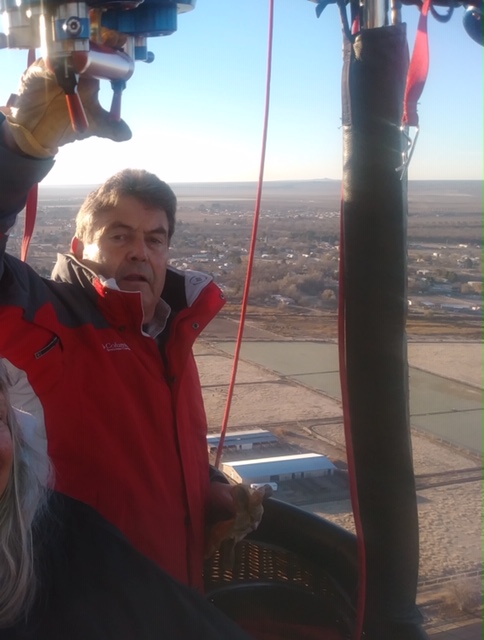
Not much chance of hitting a powerline at this altitude, but I’m always on the watch.
So should we back away from hot air ballooning because of an tragic accident like this?
I have a friend whose son was killed in a rock climbing accident. I have another friend whose son was partially paralyzed in a snowboarding accident. My long time best friend almost drowned in a river while he was enjoying the gentle art of fly fishing.
Many individual and group outdoor pursuits are considered to be “risk exercise” activities. Scientists say when you end a successful day of skiing, rock climbing or hot air ballooning, you may be physically exhausted but the noodles in your brain let you know that you “cheated death or injury” and sends you a rush of a adrenalin. It’s why a celebratory beer or party always seems in order after such a day.
So no, we can’t stop being hot air balloon adventurers, skiers, rock climbers or even fly fishermen who wade into rushing waters to catch an elusive trout.
We have to calculate risks versus rewards, like we do all through life. We can’t stop doing things that bring us and others enjoyment.
Please pray for the families of those killed in the accident in Albuquerque and keep a proper perspective about what makes our lives fulfilling.
(With apologies to Daivid Letterman. And bear with me, this post might be a bit longand philosophical… )
Many years ago, my father, who prided himself for his knowledge of New Mexico history, told me that when the territory was being considered for statehood, there was consideration given to calling it “Lincoln” instead of New Mexico. After all, the notorious town of Lincoln, located in Lincoln County, seems to have had some considerable significance in the history of the territory. And another of America’s great presidents, George Washington, had a state named after him — so why not Albuquerque, Lincoln, or Las Cruces, Lincoln, or Lincoln, Lincoln.
I’ve done some research and I can’t seem to find any evidence of consideration of the name Lincoln. I do think at one time I remember reading that the name “Montezuma” was considered for the state’s name. I could not find any information on that either. A good friend and a well-respected New Mexico historian who has published several books about the history of our state, also said he was not aware of the name “Lincoln” being considered. He said that perhaps had heard about the consideration of Montezuma as the state’s moniker.
I looked in a book we’ve relied on for years to accompany us along our New Mexico journeys for some additional clues. It’s called New Mexico Place Names, a 1965 publication compiled by T.M. Pearce using materials collected by the 1936 and 1940 New Mexico Writer’s Project. (I note that it was revised in 1969 and re-released by the University of New Mexico Press — its original publisher — and renamed The Place Names of New Mexico by Robert Julyan.) The original version makes no mention of whether the name “Lincoln” was ever considered and notes that the name “New Mexico” — at the time “Nuevo Mexico” — was first used by Spanish explorer Don Francisco de Ibarra in 1562.
The historic town of Lincoln and Lincoln County were indeed named after President Lincoln. The New Mexico Place Names even notes that a rock structure near the present day town of Lincoln resembles the profile of President Lincoln. (Having grown up in Lincoln County and explored most of it, I can’t recall seeing that rock structure, but I’ll be sure to look for it the next time I’m in the vicinity.)
Old Lincoln County Coutrhouse, Lincoln, NM
I’m not sure where my father picked up the notion that “Lincoln” was considered for a state name, but it has always left me wondering about whether the state’s name has had an influence on its development over the years.
So here’s my point and a question to you. How different would New Mexico’s fortunes have been if it had been named something else?
I need to be careful here because I do not intend to be disparaging in any way to the Republic of Mexico and its wonderful residents and culture. However, I think it is safe to say that most Americans tend to have a more pejorative view of Mexico than, say, Canada. In fact, much of the upper Midwest was called “New Canada” following the 1803 Louisiana Purchase. Maybe North Dakota or Minnesota could have ended up being called the state of “New Canada.”
If you look at the map below, part of what is now New Mexico was part of the Louisiana Purchase — so who knows, we might have ended up as “New Canada.”
So here is New Mexico, perhaps seen in the prejudicial mind’s eye of many who think of us as just an extension of a country with less ambition, progress and future like the bordering nation to our south.
Consider Arizona, with many of the attributes of New Mexico had when it became a territory. It had similar geography, a sparse population, an arid climate, rugged terrain, not much water, a large native population, lack of cultural amenities and lots of bad guys roaming around. Yet Arizona, compared to New Mexico, has been more of a success story in terms of its progress.
I know that New Mexico offers much more than Arizona in terms of natural resources, scenic beauty, artistic offerings and climate. And the influence of the Mexican/Hispanic and Native American cultures have blessed this state with a uniqueness that Arizona does not seem to embrace to the extent we do.
And of course, we’re always being confused with our neighbor to the south. Readers of the New Mexico Magazine always turn to the “One of our 50 is Missing” section for humorous instances of ignorant confusion about our existence. (I’ve been subjected to these kinds of insults myself over the years. As I mentioned in an earlier blog, I once found a kitchen magnet with the outline of the state of New Mexico decorated with a saguaro cactus and the words “Arizona” overlaid on it.)
But New Mexico always seems to end up at or near the bottom of the “worst” lists. Why? I’m sure many will blame political influences, cultural reasons, actions of the early explorers in colonizing the region, secular and non-secular influences, bad karma, etc. But is it that, or is part of it just the name we’ve been given? I ask that you focus JUST on our name and not look for blame elsewhere.
I’m always sad that we can’t do better for our children and education, that we can’t make an improvement in our poverty rate and lament that our economy is not as good as surrounding states. Yet somehow, I guess I’m glad New Mexico is always a little off the radar screen so we can enjoy the things that others don’t see in us. I’m always proud to say I’m from New Mexico, despite its warts, but I don’t want it to be discovered any more than it already has been. Maybe a lot of other people feel that way too, and in a way, we’re all partially responsible for our situation.
I’d sincerely appreciate your thoughts on this question about how our state’s name may or may not have influenced others about the stature of our state. Again — just focus on our state’s name. And again, I hope I haven’t offended anyone.
And by the way, I’ve always wondered if my life might have been different if I had been Patrick Wolf instead of Patrick Lamb.
I do feel sorry for Espanola. It’s the butt of endless jokes (and even has its own “Epanola Jokes” cult following.)I think it sits in a spectacular location along the Rio Grande with vistas of the Jemez and Sangre de Cristo Mountains on either side. It has a wonderful cultural blend with Native, Hispanic and Anglo populations.
But every time I drive through I find something humorously rooted in bad taste. I once told my son that “Espanola never disappoints” when it comes to the unexpected examples of bad taste. My son commented that perhaps “Espanola Never Disappoints” should be the city’s motto — it could work both ways, you know.
At any rate, I’m attaching a photo of a billboard for a dental office that I spotted on a drive through the city a few years ago.
You might remember an earlier post I wrote about an Albuquerque RIDE (municipal transit system) bus which was involved in a collision when its driver, noshing on a breakfast burrito, failed to notice the stopped car in front of him and rear-ended the vehicle.
And you may remember all of the drama which has surrounded the city’s attempt to implement a faster public transportation system along Central Avenue. The system, called “Albuquerque Rapid Transit” was a poor substitution for a light rail system that previous administrations touted as the wave of the future but that few others supported. ART ended up being a plan to use electric buses to zoom people along Central on a route which seemed to dodge more likely users of a pseudo light rail system. The proposed route also reduced the number of driving lanes in the busy street and many trees — particularly in the trendy Nob Hill area — had to be removed.
Albuquerque Rapid Transit logo
The project got off to a rocky start when the electric buses showed up late. Then testing, which seemed to go on interminably, concluded that the buses’ electric range was not as long as has been touted. Then city officials found other manufacturing flaws with the buses.
The city finally rejected the initial order of buses and ordered a new batch from a more reputable supplier.
New ART bus.
Then things got worse. The loading platforms in the middle of the street turned out to not be the correct height, resulting in the fancy new buses accidentally smashing into fixtures on the loading platform. Drivers were confused by the flow of traffic and frequently collided with ART buses or were in turn crunched by the them.
And now the latest danger from the ART system? Falling light fixtures.
It seems that when the high-tech lighting fixtures were installed, some were not installed properly or were manufactured improperly. They have been raining down as high as 25 feet to the street below. Fortunately, no drivers or pedestrians have been injured, but the city has now filed a lawsuit of at least $2.5 million to have the deviant lighting fixtures corrected or replaced.
Perhaps ART might need to be renamed the “Aggressively Recalcitrant Transportation” system.
This story showed up on our neighborhood “Nextdoor Digest” last week, which triggered some long ago memories of growing up in Ruidoso.
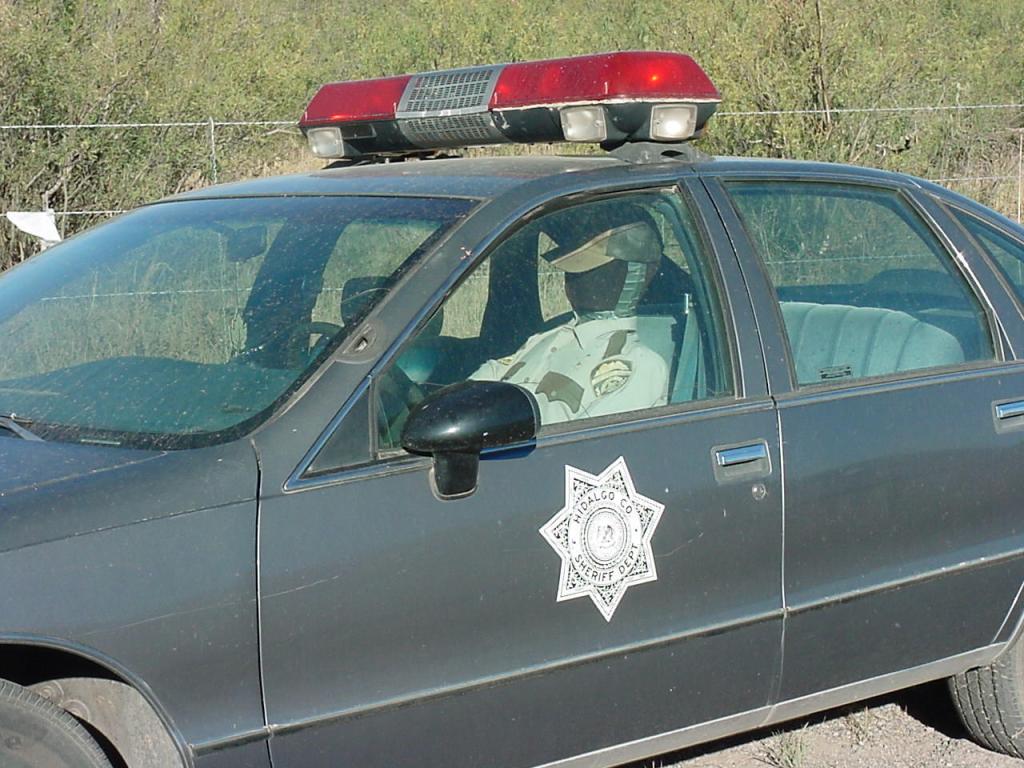
This sighting happened in metropolitan Rodeo, NM, about as far in the southwestern corner of our state as you can get. It seems that the Hidalgo County Sheriff’s Department — apparently short on staff, budget and ideas — decided to park a mothballed police cruiser with an inflatable dummy in the driver’s seat in a conspicuous location in Rodeo in hopes of deterring crime.
Inflatable dummy, complete with uniform, waiting to terrorize law breakers in mothballed Hidalgo County police cruiser.
You’ll note that the cruiser in the photograph appears to be an early 90s vintage Chevrolet Impala, the last big sedan GM ever offered as a police car. Most were mothballed by the year 2010. Any crook today worth his salt would probably spot that clue right away and conclude that the aging car was no threat. Other police cruiser accoutrements, such as the obligatory spotlight, have been stripped away and the light bar looks like something from the early Anasazi era.
This reminded me of a time Ruidoso when police purchased a fleet (well, actually just two) 1961 Chevy sedans with the infamous “409” hot rod V8. All of us gear-head guys in town were excited about the presence of this hot engine in our community. After a few years, the police department updated its two-car fleet with something less exciting, but managed to keep one of the units. They parked it in a conspicuous spot right on Sudderth Drive near where the local bad boys with hot cars would do smoky doughnuts in an empty parking lot and head back up the street to try to spot girls visiting from Texas. I don’t think the Ruidoso cops every fooled anyone with the toothless warrior.
As for me, my ride at the time was a hand-painted blue 1942 WWII jeep which did not attract many members of the opposite sex. With an asthmatic four-cylinder engine, a doughnut or burnout was not an option. It was, however a convertible — only because the original canvas top rotted away years before I became its owner.
I’m sure you’ve all read about this incident in Albuquerque during the past week — a drone with an offending sex toy dangling below buzzes around a candidate’s rally.
If you haven’t here’s the synopsis:
The controversial sheriff of Bernalillo County, Manuel Gonzales, was holding a campaign rally for his run for mayor of Albuquerque when an unexpected object in the air whizzed up to the stage where he was orating. The object began hovering nearby as members of the crowd came to an astonishing conclusion about what it was.
It was a drone carrying a larger than life-size dildo swinging beneath it. Members of the candidate’s team were able to snatch the object from the sky by the dangling protuberance and remove the distraction. The owner of the drone, now dubbed the “dong copter,” tried to retrieve his device and punch the candidate, only to be met by police who arrested him for violations of resisting arrest, evading and obstructing police. The drone has been kept as evidence.
Candidate Manual Gonzales tries to ignore “dong copter” over his right shoulder while staff member snatches the drone by the offending dangling appendage.
But it’s not the first time sex objects have been seen floating around the sky. I offer tales of two much earlier incidents.
The first involved a good friend of mine who, during a mass ascension of the Albuquerque International Balloon Fiesta, discovered a surprise attached to his crown line (the rope connected to the top of the balloon for use during inflation and deflation.) It seems some prankster friends had attached an anatomically correct and naked inflatable woman about halfway up the crown line that the pilot had not noticed until he launched. The announcer on the field was proudly introducing the pilot when he spotted the hitchhiker on the crown line. At first thinking it was benign, he was about to point out the object to the crowd below, complete with gawking kids and innocent bystanders. When the announcer realized what it was, he quickly switched his focus and announced the next balloon to launch — which thankfully did not have any obscene objects attached to it.
The next incident involved a plan during the 1990s to fly an unusual balloon at the Albuquerque International Balloon Fiesta. The balloon was named “I SAVE LIVES” and was in the shape of a giant condom. The Balloon Fiesta organizers debated about whether to allow a giant flying condom to appear at the family oriented event and ultimately decided it was not appropriate.
A representative of the organization which managed the balloon was also managing my commercial balloon program at the time and gave me a full accounting of the difficulties the balloon had experienced gaining acceptance at various rallies around the United States. She gave me a pin, which I still have on my balloon pin board, of the offending balloon.
“I SAVE LIVES” hot air balloon pin on my pin collection board.
When I was researching this article, I could not find any information about what happened to this American hot air balloon. However, I found images of similar shaped and themed condom balloons used at various balloon and event rallies around in Europe, where I know they have a much more lenient approach to displays of this type.
For more years than I care to remember, I’ve been able to take out my frustrations about not having a gold medal trout stream in my back yard by traveling up to the Rio Penasco, an unexpected spring-fed trout fishery on the eastern slopes of the Sacramento Mountains just two hours away.
The water here is all privately owned and our local fly fishing club, the Mesilla Valley Fly Fishers, Inc., has been able to negotiate leases with private land owners for rights to fly fish on this unique section of water.
Both my children and my wife learned how to fly fish on this water and it’s been a special place for me and many others. The most remarkable thing about it is that it is a fishery that is really unexpected in this part of the world.
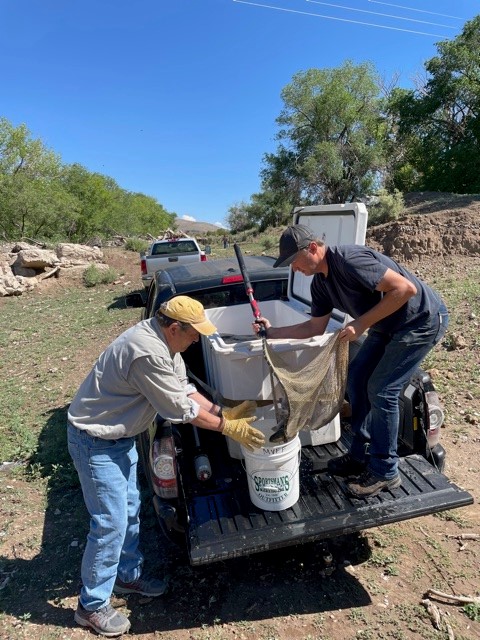
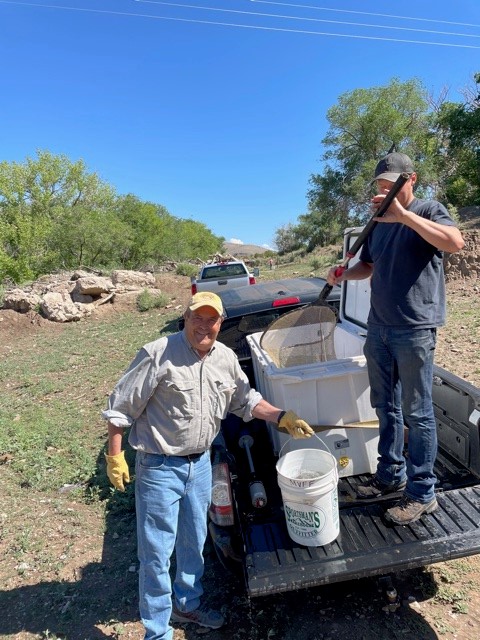
Last Thursday, as I have done several times before, I helped re-stock the leased waters with some really beautiful, healthy and fat Rainbow trout, about 12-14 inches in length. Since the water is all under catch and release rules, I hope the 20 or so trout I tossed into some nice deep pools will flourish for many seasons and hopefully help increase the natural population. And I hope I will re-acquaint myself with a few of them.
Instead of gently releasing them into their new waters, those who regularly stock fish say the best technique is to toss them in with a splash to “wake them up” from their numbing ride in a tank on the back of a stocking truck. So I do that with a great deal of gusto, but make sure all that I toss in the water start swimming right away for cover — which they always do.
While not as rewarding as re-stocking native Gila trout on my all-time favorite stream, Whitewater Creek in the Gila National Forest, it always makes me happy to put fish into a river where they can flourish and give us humans a rewarding experience without harvesting them.











 aero-cordero.com