June 5, 2020 — my first blog post on my website. I was thinking that it was sometime in the middle of June, so I decided to look it up this morning.
So since that date, I’ve posted 146 blogs. I hope a few of them were entertaining to you and I really hope none were offensive. And thanks for reading them.
What occurred to me was that the date, June 5, is one I always remember. On June 5, 1967, the infamous raid on the Rio Arriba Courthouse in Tierra Amarilla occurred. I was in college at the time, but already working as a journalist.
The raid occurred when a group of armed gunmen took over the town of Tierra Amarilla during a legal proceeding involving the murder of a county jailer, Eulogio Salazar. The death was linked to a movement led by Reies Lopez Tijerina to reclaim Spanish Land Grants in northern New Mexico, but the murder was never solved. A colleague and good friend, Larry Calloway, was a reporter for United Press International at the time, and was calling in a story from a phone booth outside the courthouse when he was approached at gunpoint and held captive briefly.
Because I later wrote so many stories about the incident and the various legal maneuverings involved, that date has stuck in my memory.
So now, I’ll also remember it was the date when I started my blog.
Again, thanks for reading and, as always, I appreciate any comments or observations you have.
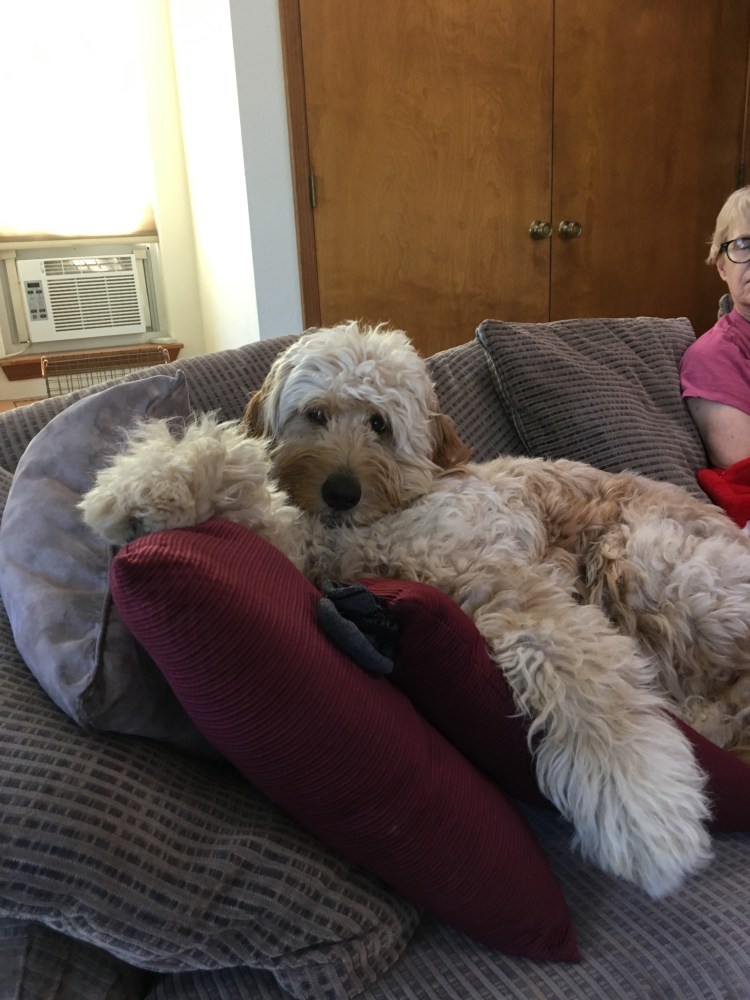
Our rambunctious and always happy goldendoodle, Chester, got into something that gave him an allergic reaction on his left hind leg a week or so ago. And of course, he started licking it and ripping out his fur to stop the itch.
As all parents know, kids’ maladies always get worse right at the start of a three-day holiday weekend. So by the time Tuesday rolled around, we thought part of Chester was going to look like a hairless Chihuahua.
Luckily, we were able to get him into the vet on Wednesday and yep, you guessed it, the “cone of shame” (plus medications) were prescribed.
So here’s what he looks like now.
Bewildered Chester
And here’s what he looked like in his leisure days before “coning:”
Chester, in happier, more robust hair times…
So here’s the deal, Chester. We’ve put up with more than a year of COVID-19 crud. You can at least deal with the “cone of shame” for four more days.
You may remember an earlier post about my discovery that “buttload” was a legitimate measurement term. Well, another story has popped up about the use of someone’s posterior region for potentially holding a measurement of something.
A few years ago, police in Demining spotted a man near the local Wal-Mart repeatedly clinching his buttocks. Never mind that he might have had issues trying to hold something back — police immediately suspected his twitches were signs of him of concealing illegal drugs in a “body cavity.”
So convinced of his guilt that police rushed him to a hospital in Silver City — about 50 miles away — where doctors performed numerous probes, searches, enemas and X-rays to find suspected hidden objects.
The results?
No drugs were found but the suspect was left with some pain — the worst of which was his $6,000 bill from the hospital for their services.
My late brother once told me about a controversy at the then new baseball stadium for the Los Angeles Angels when the concessionaire decided that it would be “California appropriate” to serve quiche to fans. I’m not sure you remember it, but there used to be a Chevrolet advertising campaign with an all-American spin and a song that went like this:
“Baseball, hot dogs, apple pie and Chevrolet. They all go together in the good old USA.”
While the song likely resonated with baseball fans, it clearly didn’t appeal to the interest of the Angels concessionaire who felt international cuisine was more in line with tastes of the southern California fan base. I’ve only been to one Angels baseball game, and I don’t remember seeing if quiche was still on the menu. Ridiculously expensive hot dogs, yes.
Apparently a desire to keep things “all American” showed up in a public hearing several years ago in Albuquerque. The focus of the hearing was the planned construction of a traffic roundabout — something itself very foreign at that time in many western states.
When the hearing moderator said that traffic would flow smoothly as drivers waited in a queue to enter the roundabout, one attendee stood up to declare that: “This is America!” We don’t say ‘queues’ in America. We say ‘lines.’ We stand in line, we wait in line. We do not queue!”
I’m thinking that the location of the roundabout would have been a great place to open up a quiche takeout stand.
Almost anyone in southern New Mexico who has driven from Alamogordo to Cloudcroft has marveled at the old Mexican Canyon railroad trestle just below the summit of the Sacramento Mountains.
Built in the early 1900s, the trestle was the crowning achievement of a steep mountain railroad called the Alamogordo and Sacramento Mountain Railway. Work on the railroad started in the late 1890s and by the 1920s and 1930s, it connected a large network of logging railroads in the Sacramento Mountains. The rail lines were constructed primarily to harvest the timber needed for residential and commercial construction in El Paso and surrounding communities and for railroad ties throughout New Mexico.
The railroad, which was later dubbed the “Cloud Climbing Railroad,” was also used to carry passengers from the desert lowlands to the cool mountain air of Cloudcroft. The railway continued to operate until 1947, when it was abandoned.
Having grown up just a few miles north of Cloudcroft in the village of Ruidoso, we had visited the area many times. However, until this last week, I was only aware of two other trestles along the abandoned railway route.
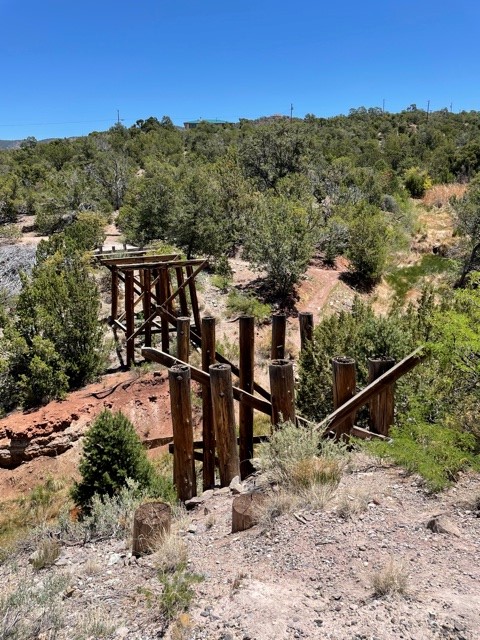
Remnants of unnamed trestle on Bridal Veil Falls trail in Sacramento Mountains
Solado Canyon trestle on Bridal Veil Falls trail in Sacramento Mountains
At any rate, it was quite a surprise to find out about the remains of two trestles I had never known about, both just north of the town of High Rolls. My wife, dog Chester and I hiked part of the way along the old railroad bed leading to Bridal Veil Falls when we discovered the trestle. There was a nice flow of spring water beneath the remnants of the trestle, which Chester enjoyed as a place to wade, drink and flop in the cool water.
For many years while I was a journalist in Santa Fe, I reported on progress of the effort to resurrect a section of the old Denver and Rio Grande Western narrow gauge railway between Chama and Antonito, CO. After many years of negotiations, involving two state governments, the dilapidated railway was purchased by the states of Colorado and New Mexico. It has now become a popular tourist attraction known as the Cumbres and Toltec Scenic Railway
It’s unfortunate that the old “Cloud Climbing Railroad” between Alamogordo and Cloudcroft could not have been preserved for future generations. I believe it was an even more spectacular railroad than the Cumbres and Toltec route or the Denver and Rio Grande line between Durango and Silverton, CO.
I found a link to a document about the railroad that was prepared by the U.S. Forest Service in 1984:
At any rate, I hope you’ll take time to take a look at these old trestles and walk along the very easy railroad bed trails. I don’t think I’m as much of a railroad nerd as Sheldon Cooper from “The Big Bang Theory” TV show, but it’s fun to learn about these historic railways in our neighborhood.
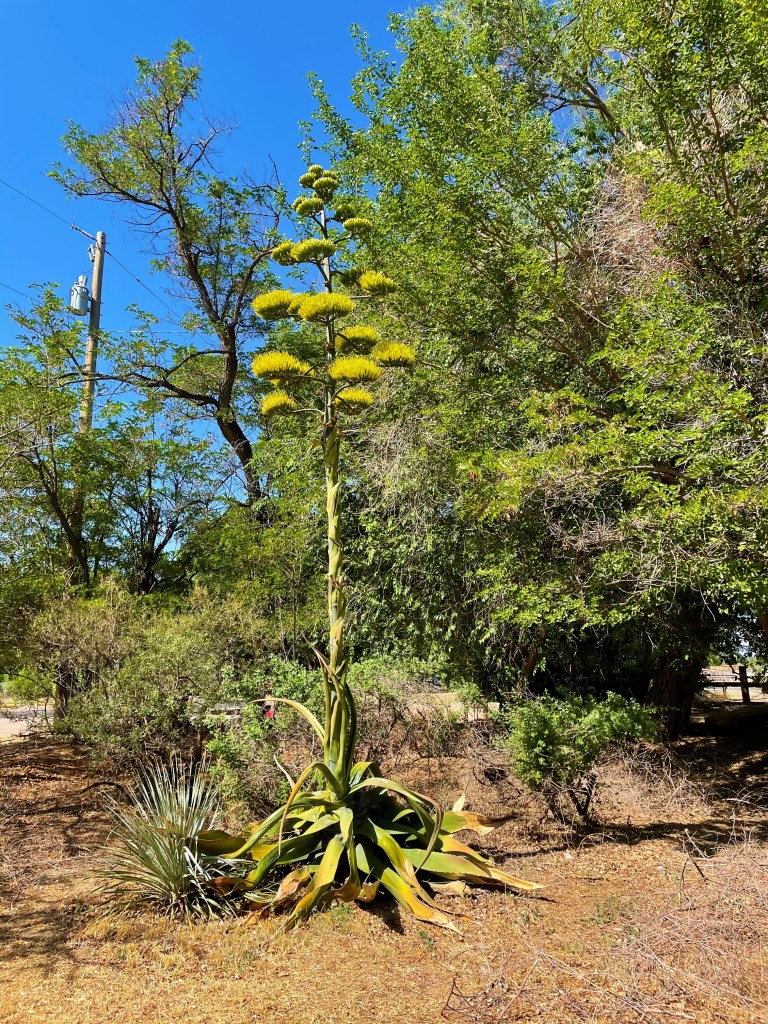
Our daily morning walks around the Mesilla Park neighborhood frequently yield pleasant surprises and discoveries. Earlier this spring, we noticed a century plant starting to sprout up in the yard of an historic old adobe home adjacent to an irrigation ditch that we frequent.
Many weeks after spotting it, it has now grown to be more than 20 feet tall, in full spectacular bloom.
Century plant in full bloom in our neighborhood
Through a friendship between our goofy Goldendoodle, Chester, and a neighbor’s dog, Duck, we’ve gotten to know the person who lives in the house where the century plant is blooming. He said he had lived in the house for more than 20 years and this is the first time the plant has ever bloomed. Because it is protected by a network of trees, it hasn’t toppled over when our often ferocious spring winds create havoc on trees and other plants in the neighborhood. Our neighbor says he thinks its the tallest variety of the plant he’s ever seen.
We won’t tell you exactly where it is because of the neighbor’s fear that someone might show up and try to hack it down. That’s a sad commentary about how some people regard things of beauty.
At any rate, with all the troubling things in our world right now, I hope that a tall spectacular plant that shows up only once in every 20 years will be seen as a very positive sign.
On occasions when I’ve had maybe one more glass of wine that I should have, I have been known to break into embarrassing (for my wife) songs. There are usually three of them that fall into rotation:
“Deck us all with Boston Charlie…” from the comic strip Pogo, which I have written about in an earlier blog.
The other is my high school fight song: “Hail mighty Warriors, brave and bold, onward to victory Blue and Gold…”
And the third is this: “Smokey the Bear, Smokey the bear, growlin’ and a prowlin’ and a sniffin’ the air. He can find a fire, before it starts to flame. That’s why they call him Smokey and that’s how he got his name.” It was written and performed by Gene Autry and was mildly controversial because Smokey’s actual name was “Smokey Bear,” not “Smokey THE Bear.” Anyway, it was an ode to the abandoned bear cub found clinging to a burned pine tree in the Capitan Mountains of the Lincoln National Forest in 1950 who was made famous as an icon for encouraging Americans to prevent forest fires.
And speaking of Smokey, years ago my sister Wendy was photographed cuddling a small female bear cub named “Smokina” who was possibly to become Smokey’s paramour. She too, like Smokey, was found abandoned in a forest fire in the Lincoln National Forest in the late 1950s. I never heard any more about Smokina — apparently she did not have an agent as effective as Smokey’s. Despite the best plans for bear romance, Smokey never had offspring because his private parts were apparently scorched during the 1947 fire, making him sterile and unable to produce any offspring. That’s probably more than you really wanted to know.
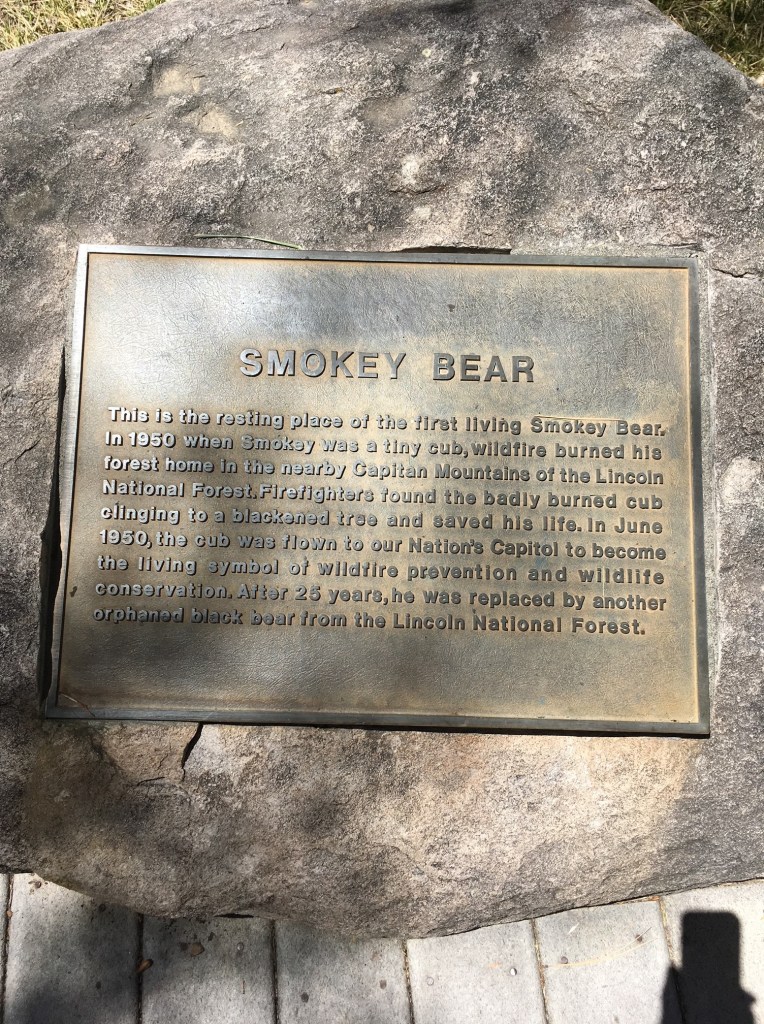
Smokey is buried in Capitan at the Smokey Bear Historical Park after living many years in the National Zoo in Washington. I’ve attached a photo of his burial plaque and a link to the park if you’re interested. We visited the park a couple of years ago with good friends, and it’s worth the trip.
Smokey’s burial plaque at the Smokey Bear Historical Park in Capitan
So why all this blathering about Smokey? Well last week, I read an article in the Albuquerque Journal that said that 28 abandoned campfires had been found in the Santa Fe National Forest, one of them still with flames lapping at logs. My wife and I once ran across a similar still burning campfire in Colorado — and dutifully extinguished it. It was scary and a completely irresponsible act by whoever left it.
But for Pete — or Smokey’s sake, please douse your campfire during this extremely dry windy spring season in New Mexico. As Smokey was quoted: “If it’s too hot to touch, it’s too hot to leave.”
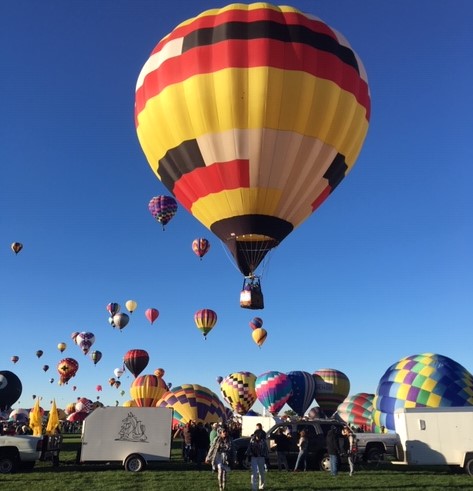
One of the reasons why hot air ballooning is such an adventure is that you almost never know exactly where your flight will end. You may have a general idea of an area where you might land, but subtle variations in wind direction, changes in winds at different altitudes during your flight, landing site restrictions and other factors completely outside of your control make predicting a precise landing spot virtually impossible.
Just after launch at the Albuquerque International Balloon Fiesta, with me wondering where I’ll eventually land.
I’ve landed in many interesting places over the years. I’ve touched down several times on residential streets in the middle of a surprised neighborhood. A couple of times I ended up way out in the middle of nowhere in the deserts west of Albuquerque and Las Cruces. Other landing sites included crowded parking lots, gated and fenced in plots of land, city parks, river levee roads with locked gates, and a pasture where I was greeted by a friendly herd of cattle apparently thinking my wicker basket was a giant bale of hay for them. I even landed in a narrow mobile home lot with a giant electrical substation looming in front of me — my scariest landing by far. (Maybe more on that in a later blog.)
But as we say in ballooning, it’s all a matter of simple math: If the number of landings equal the number of takeoffs, you’ve had a good flight. So far, all of mine have been good flights.
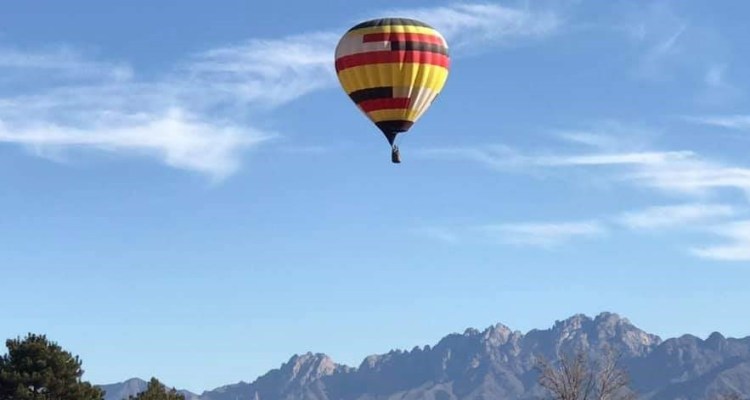
Me over the Mesilla Valley with the Organ Mountains in the background.
On only two occasions have I managed to land back almost where I launched. Both were at the Albuquerque International Balloon Fiesta when mostly predictable “Albuquerque Box” winds allowed me to land within a few spaces of my original launch site. It was a challenge for me to work the wind currents to “get back home,” but it was especially boring for the crew who just waited around the launch field during my entire flight for me to come back.
So it’s not surprising that newcomers to ballooning don’t understand how little control you have over where you go in a hot air balloon. I try to explain my general flight plan, but most don’t seem to understand that I can’t just point the aircraft in a specific direction and end up there.
That was made especially evident to me one year when I flew one of the Wells Fargo balloons at Balloon Fiesta. I had been assigned the duty of flying a couple of passengers who had won a bid for a balloon flight for a charity event (something we did quite frequently). The passengers arrived and as usual, it was one of those mornings where the winds were slow and we were in a “hurry up and wait” mode. I told my passengers that because of the launch delays, I thought they had time to go to vendor’s row to look around before coming back to the launch site to begin their hot air balloon adventure.
Well, things changed quickly and I was suddenly confronted by a launch director who advised me that I needed to get into the air quickly to avoid slowing down the launch process for many other balloons nearby. My passengers were nowhere in sight, so I grabbed a couple of extra crew members who had not been able to fly at Fiesta before and put them in the basket. We launched on time and had a great 45 minute flight — but landed somewhere far away from the field.
When I came back to the field after packing up the balloon, we returned to our launch site to find my two original passengers standing around looking bewildered. I apologized profusely for not being able to give them a ride when one of them responded:
“Oh, we saw you launch and fly away. We just thought you’d eventually fly back here and land to take us on our ride, so we just waited around.”
So now, when I’m flying new-to-ballooning passengers, I try to make clear that the unpredictable landing site is part of the thrill of the experience. And maybe we’ll find another herd of welcoming cows to really make it a really fun day.
In case you missed it, last Friday, May 7, was “No Pants Day.” It was the last in the rush of truly significant events — Star Wars Day (May the Fourth be with you), Cinco de Mayo (when maybe a ship carrying a load of mayonnaise was sunk), and then on Friday, “No Pants Day.”
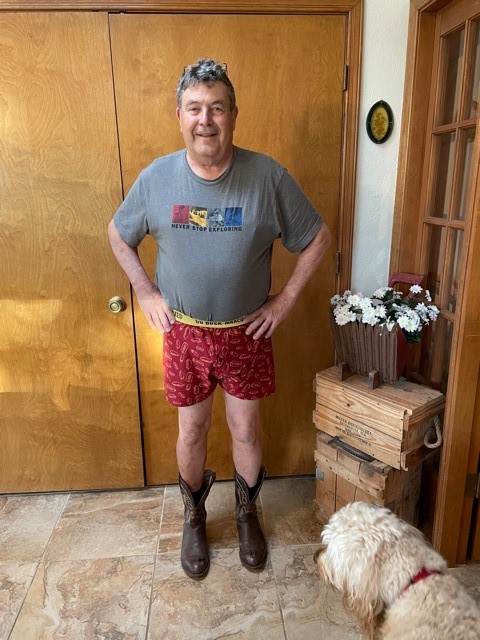
I fully participated as you can see from the photo below. (I tried to emulate a no-pants event once before wearing a long trench coat with no socks and my pants rolled up so they couldn’t be seen — I was asked to leave the office. Maybe more to be revealed in a later post.)
Me, in my hot dog boxers, cowboy boots and Chester looking on quizzically.
I first learned about this from a couple of cartoons in Friday’s Albuquerque Journal, where artists had made reference to the event. I looked it up online, and found initially that the main reason for “No Pants Day” was just random silliness. A closer investigation, initiated by my wife, said it was actually part of an effort to encourage people to donate gently used clothing to help the more unfortunate and homeless. I’m all for that, especially considering that after COVID-19, my size 34 pants are no longer useful and my waist prefers a size 35. I’m sending a batch of these pants to various collection points.
But the main point of this blog is to credit my best next door neighbor ever, who will remain nameless but who lives just west of me, with likely initiating this significant event. He can occasionally be spotted picking up the newspaper, hauling out his trash gondola and occasionally just scoping out the early morning neighborhood activities without pants — even in 28 degree weather. Luckily, almost no one ever sees him in this mode except for me. Yes, he does wear some kind of undergarment, so he is not on any deviant list. He has become my role model for freedom of expression and I am honored to have him as a friend and neighbor. And no, he really doesn’t do this much — it’s just mostly a joke between us.
So if you have spare pants, please donate them to your local homeless shelter, Salvation Army, Good Will or other favorite charity — or maybe to my neighbor.
New Mexico is frequently confused with our neighbor to the south. In fact, the New Mexico Magazine has a regular column entitled “One Of Our 50 Is Missing” in which readers offer their stories of being told they can’t ship items to a foreign country or that they’ll have to prove they have the proper vaccinations before traveling here.
I’ve often wondered about the impact of our state’s name on our progress — or lack of it — compared to other surrounding states. But that’s a matter for another blog which I’ve already written and will share with you some day.
And New Mexico often gets confused with other locations because of town names like Cuba or Des Moines.
And then there’s Carlsbad. In 2012, a Serbian tennis player was scheduled to play in a tournament in Carlsbad, California. Her travel agent unwittingly booked her a flight to Carlsbad, New Mexico.
The tennis player arrived, rather bewildered by the fact that she hadn’t been able to see the Pacific Ocean when her plane was on approach to the airport. Still not comprehending what had happened, she went to the outside of the airport terminal where she was expecting to be picked up by a pre-arranged VIP ride service — apparently two states to the west. When her ride didn’t show up, she made a rather huffy phone call to her driver.
“I am the only person here,” she said. “How can you not see me?”
At that point, it probably dawned on her that her ride probably wasn’t going to get wherever she was. And she probably realized she wasn’t going to make it in time for the tournament.
During the 2016 Presidential Campaign, a high level Democrat in New Mexico was chastised for bashing a piñata bearing the image of Republican candidate Donald Trump. I’m not going to dip into the political issues involved in this story except to say that piñatas are essential parts of our New Mexico heritage, often used to express things that are of current topical interest.
We should appreciate the clever examples of this tradition that show up on hanging from the ceilings or on the shelves of various arts and crafts stores, grocery stores, convenience stores and yes, even Wal Mart stores. I’ve seen dangling images of “Frozen” characters, Batman, monster trucks, “Despicable Me” guys and yes, maybe even Nancy Pelosi portrayed as an evil character worthy of bashing.
Generic piñata
So when a mother went shopping for a piñata in Clovis at the local Wal-Mart store in 2010, she found more than she wanted in the paper stuffed inside the candy pouch of the traditional looking piñata. The newspaper pages used to construct the piñata were replete with “girly” photos of half-naked women, showing their eye candy to anyone who might have ripped open the mangled object in search of more “candy.”
The woman immediately complained to the store manager, who promptly removed all of the offending works of cultural art, leaving future piñata purchasers with empty shelves or without offensive hanging objects. Okay, you can insert your own offensive comment here. “:^)
Odors, scents, smells — good and bad — often make lasting memories in our brains. We associate a particular moment, time of year, place, person or experience with them.
I can still remember the smell of Aqua Net hairspray that girls in my high school spritzed on themselves to pump up their bubble hairdo that was so common in the late 1960s. Toxic as it probably was for the environment, it gave me pleasant memories of that time of first infatuation with the opposite sex, young and the faint hope that you might one day actually be of interest to one of them. It was young love in a single sniff.
Similarly, an odor that always reminds me of the Albuquerque Balloon Fiesta and my good times there for almost 35 years is Cocoa Puffs cereal. Immediately south of the Fiesta launch field is the General Mills cereal factory, which each fall produces a batch of Cocoa Puffs for waiting kids around the nation. The unmistakable sticky sweet odor drifts up from the factory’s ventilators into the atmosphere and into your nostrils as you pass over and downwind of the plant. All you need is some milk.
For my wife, who grew up on a farm in the middle of Nebraska, it’s the smell of freshly cut alfalfa from late spring until early fall that reminds her of home.
Similarly in Las Cruces, smells of late fall remind me of red enchiladas. North of our home, there is a factory that begins processing red chile for various uses just when the air starts turning colder. With a predictable down-valley drainage wind, the smell of processed red chile envelopes our neighborhood. The first day or two that you smell the processed chile is appealing and pleasant, but by mid December it’s kind of annoying — like you’re working in a Mexican food restaurant 24 hours a day.
At a similar chile processing plant in Santa Teresa in southern Dona Ana County, things got a little more than just being annoying about 10 years ago. It seems that the facility was processing an exceptionally hot batch of habanero chiles when some of the powdered mix seeped into the main floor of the facility instead of going out through the ventilators. So intense was the blast of habanero chile powder that a local HAZMAT crew was called in. One woman was taken to the hospital, and other workers complained of irritated eyes, sore throats and bloody noses.
Every New Mexican has encountered an exceptionally hot enchilada at one time or other and managed to suffer through eating it — with a good dose of sopapillas and honey to numb the taste buds afterwards. But in this case, the workers didn’t even have the pleasure of having their appetites satiated.
On a trip a few years ago to visit my sister in Cochiti Lake, I passed by a street sign that literally made me stop and take a second look. The name of the street was “Sparkling Moolah Road,” just south of metropolitan Pena Blanca.
After some research, I discovered that the street was named after a race horse that won about a dozen quarter horse races in the late 1970s and early 1980s. I’m assuming that the horse was bred and raised at a horse farm at the end of that road. A map proving that I did not make this up is below.
Sparking Moolah Road, just south of Pena Blanca
There was another amusing story regarding street names in Las Cruces a couple of years ago. Some local historians had suggested that the bland name “Motel Boulevard” be changed to “Pat Garrett Boulevard” in honor of the famous Dona Ana County lawman best known for killing Billy the Kid. Garrett, who was twice sheriff of Dona Ana County, was also the father of Elizabeth Garrett who penned the lyrics to “Oh Fair New Mexico,” our official state song.
Well, the “inclusive police” stepped in and decided there were many more legendary people in Las Cruces who should have a street honoring all of them. It was suggested by a city council member that the street name be “Legends Boulevard.” I mean honestly, “Motel Boulevard” was a better choice than “Legends Boulevard” in terms of attracting attention to our city. The idea, thankfully, was eventually dropped. But I honestly hope someone steps up and pushes the “Pat Garrett Boulevard” proposal again.
Which brings me to my final point. While driving to Albuquerque last week, I noticed a very cleverly named street on my car’s navigation screen while driving just south of Truth of Consequences.
The street was named “Yippie Calle.”
Okay, think about it for a second, then say it out loud.
My wife used to remark that our children’s dental bills probably paid for one of the propellers on our orthodontist’s fancy twin-engine airplane.
A recent confirmation of discovery of the fossil of a “Godzilla Shark” that swam in a shallow sea covering what is now New Mexico 300 million years ago puts those dental bills in more perspective.
Illustration ofDracopristis hoffman, swimming in a shallow sea that was located in New Mexico
A fossil of this giant shark predecessor was discovered in the Manzano Mountains of central New Mexico in 2013. It took several years of research to confirm that it was a new species. Weighing in at about 200 pounds, the apex predator also had jagged spines on its back and — get this — 12 rows of teeth. My kids’ single row of teeth was expensive enough.
What was interesting to me is that the shallow sea where the Godzilla shark was swimming was then located at the equator, apparently long before even dinosaurs showed up. Tectonic plate movement and continental drift has since moved the bed of that sea thousands of miles north to form the bedrock of many parts of New Mexico.
So if you’re thinking of dipping your toe into Elephant Butte or maybe even the Rio Grande, just hope that the genetic wizards from Jurassic Park haven’t slipped one of these into the water.




 aero-cordero.com